- Category:
- Military operations
- Front:
- Eastern Front
- Date:
- 8 April 1944
- Author:
- Łukasz
- Battle:
- Crimean offensive (1944)
- Tags:
- Red Army, Wehrmacht, Romania, Adolf Hitler
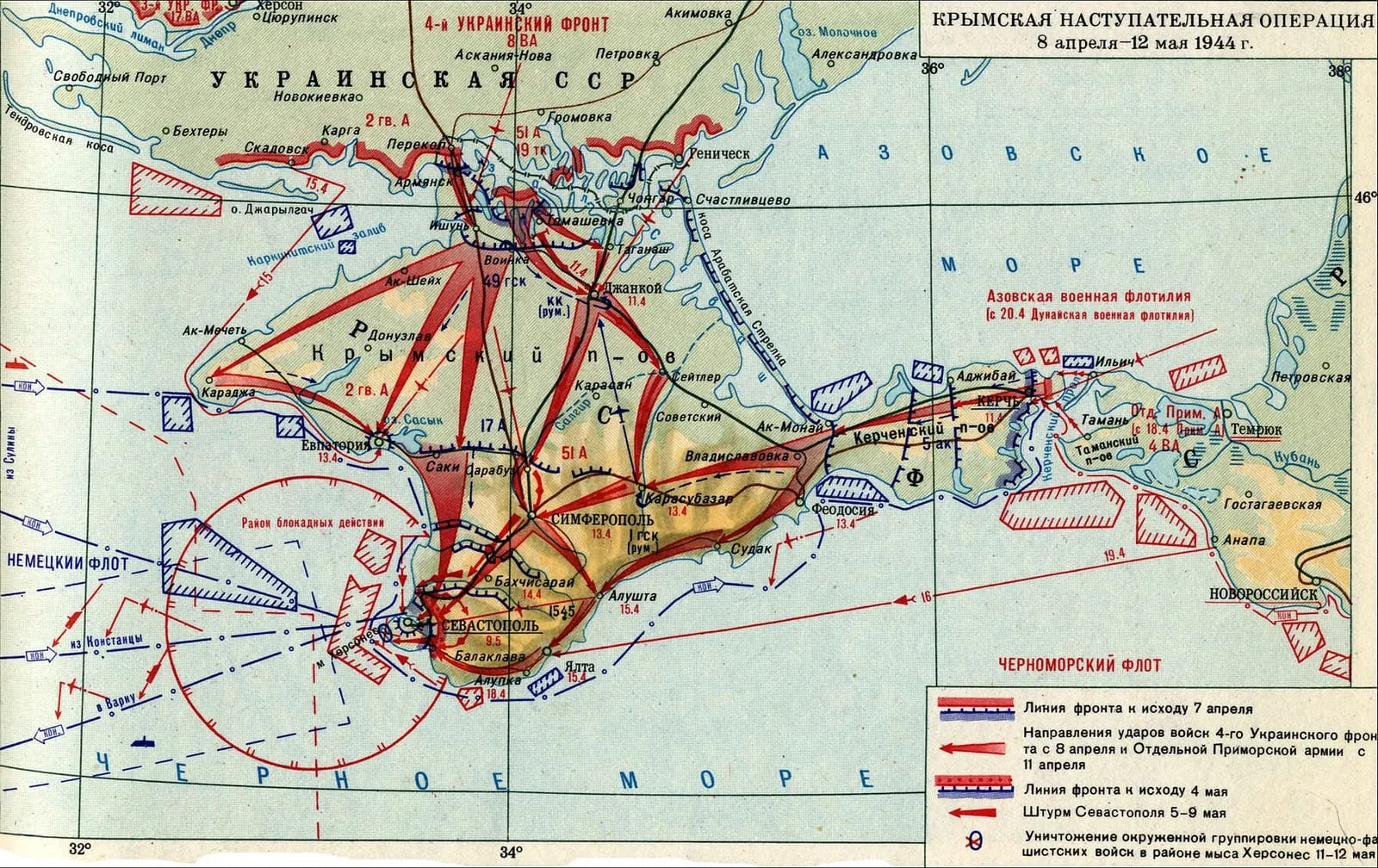
At eight in the morning on 8 April 1944 Soviet artillery and aircraft began a two-and-a-half-hour bombardment of the northern edge of the Crimean Peninsula. Then the troops of General of the Army Fyodor Tolbukhin’s 4th Ukrainian Front went into the attack – on the Perekop Isthmus and from a bridgehead on the southern side of the Sivash, a shallow salt lagoon. So began the operation that within five weeks took from the Germans the whole of Crimea, which they had conquered with such difficulty in 1941–1942.
The report recorded under this date says that the Red Army attacked to recover all of Crimea and that the Germans withdrew west to Sevastopol. The first part is accurate. The second needs qualifying: on 8 April nobody was yet retreating – for the first three days the German and Romanian defence held firm, and the withdrawal towards Sevastopol began only after the front on the Sivash was broken on 10–11 April, lasting until 16 April. Sevastopol itself, moreover, lies in the south-west of the peninsula, not to the west of the battle lines.
Crimea cut off
Crimea had been in German hands since the autumn of 1941, when Erich von Manstein’s 11th Army broke through the fortifications at Perekop and Ishun and forced its way into the peninsula. In the winter of 1941–1942 the Red Army tried to retake it with landings at Kerch and Feodosia, but in May 1942 Manstein smashed its forces on the Kerch Peninsula and on 1 July, after a long siege, took Sevastopol.
Two years later the situation was reversed. After the evacuation of the Kuban bridgehead, which Hitler gave up after the defeats of summer 1943, the German 17th Army of Colonel General Erwin Jaenecke crossed the Kerch Strait into Crimea in October 1943. A few weeks later, at the beginning of November, Soviet troops reached the lower Dnieper and Perekop and cut the peninsula off from the mainland. On 1 November infantry of the Soviet 51st Army waded through the icy water of the Sivash and seized a bridgehead on its southern shore. At the same time, in the Kerch–Eltigen landing operation, other units landed on the Kerch Peninsula; the landing at Eltigen, south of Kerch, was wiped out in December, but the bridgehead north-east of the city held until spring.
From then on the 17th Army could be supplied only by sea – across the Black Sea from Romanian ports and from Odessa – and by air. Meanwhile great battles were being fought on the mainland for the Dnieper bend and Right-Bank Ukraine, and for five months Crimea became a secondary sector of the front.
Why Hitler held on to Crimea
Militarily, a peninsula cut off from the mainland was a trap. The commander of Army Group A, Field Marshal Ewald von Kleist, had prepared a plan to evacuate the 17th Army as early as the autumn of 1943, and its withdrawal was also advocated by Manstein, by the Chief of the Army General Staff, General Kurt Zeitzler, and by Jaenecke himself. The strongest pressure came from the Romanian dictator, Marshal Ion Antonescu, whose divisions made up a large part of the Crimean garrison and who did not want to lose them in a hopeless defence when the Red Army already stood on the Dniester and the Prut.
Adolf Hitler refused. His arguments were political and economic, not operational: the loss of Crimea would, in his view, shake Turkey, which might cease to be neutral, and give Soviet aircraft and the Soviet fleet bases from which they could easily strike the Romanian oilfields and ports. He was confirmed in this by the head of the Kriegsmarine, Grand Admiral Karl Dönitz, for whom Crimea covered the Balkans “like a shield”. The order therefore read like all of Hitler’s orders of this period: hold the positions you occupy.
At the end of March 1944 Hitler dismissed Kleist and Manstein, blaming them for the retreat in Ukraine. Army Group A, renamed Army Group South Ukraine at the beginning of April, was taken over by Colonel General Ferdinand Schörner, a commander Hitler trusted and an advocate of rigid defence. After visiting the 17th Army, Schörner reported on 7 April that in his opinion the defence of Crimea was assured “for a long time”. The next day the Soviet offensive began.
The opposing forces
At the beginning of April the 17th Army numbered – by various calculations – some 195,000 to 200,000 men, 3,600 guns and mortars, about 200 tanks and assault guns and just under 150 aircraft. It had five German and six or seven Romanian divisions (some of them badly depleted), two assault-gun brigades and support units; volunteers from the Eastern units also fought in its ranks. In the north, on the Perekop Isthmus and facing the Sivash bridgehead, stood five German and Romanian divisions (including XLIX Mountain Corps); on the Kerch Peninsula there were four, with the German V Army Corps as the core; and the rest – mainly Romanian mountain and cavalry units – were deployed along the coast and in the mountains, where Soviet partisans were active. At Perekop the Germans had built three lines of defence, around the Sivash bridgehead two or three, and at Kerch four.
The Soviet side had been preparing since February; the date of the attack was postponed twice – to March and then to April – because of the fighting on the lower Dnieper and storms on the Sea of Azov, which hampered the supply of the Kerch bridgehead. Sappers built causeways and bridges across the Sivash, strengthened by March so that T-34 tanks and heavy artillery could cross them. The Germans knew about these crossings but failed to destroy them.
The operation was entrusted to the 4th Ukrainian Front and to General of the Army Andrei Yeremenko’s Separate Coastal Army on the Kerch Peninsula – together some 470,000 men, nearly 6,000 guns and mortars, 559 tanks and self-propelled guns and about 1,250 aircraft of the 4th and 8th Air Armies. They were to be supported by the Black Sea Fleet, the Azov Flotilla and the partisans in the Crimean Mountains. The actions of both groupings were coordinated by Marshal Aleksandr Vasilevsky as the Stavka representative; Marshal Kliment Voroshilov played the same role with the Coastal Army.
The breakthrough on the Sivash
The Soviet plan was for the main blow to come not from Perekop, where the Germans most expected it, but from the Sivash bridgehead, into the rear of the isthmus defenders. At Perekop the attack of the 2nd Guards Army was meant to pin down the defence, and it did indeed go hardest: despite a five-day bombardment of the fortifications, it took the Guardsmen two days to break the first line, and at the second line, at Ishun, the attack stalled. On the morning of 10 April a rifle battalion landed in the German rear, which helped push the defenders back to the next position, but the Ishun line was not broken until the morning of 12 April.
General Yakov Kreizer’s 51st Army fared better. On 8 April its divisions took only the first trenches, but the next day, after a fresh artillery bombardment, 63rd Rifle Corps drove seven kilometres into the positions of the German 111th Infantry Division and Romanian units. By the evening of 10 April the defence on this axis had been broken. On 11 April General Ivan Vasilyev’s 19th Tank Corps was sent into the gap and that same day took the railway junction of Dzhankoy in the middle of northern Crimea, emerging in the rear of the German defence at Perekop. Holding the isthmuses no longer made any sense.
That same night of 10–11 April the Separate Coastal Army went over to the attack in the east; on the morning of 11 April it took the ruined city of Kerch, and over the following days it broke through the positions at the narrowest point of the Kerch Peninsula, at Ak-Monai.
The retreat to Sevastopol
Only when encirclement threatened did Hitler agree to what his commanders had been demanding for months – and only in part. On 11 and 12 April he allowed the troops to be withdrawn from the Kerch Peninsula and from the north, but only to Sevastopol, which he declared a fortress to be held. The evacuation by sea was to cover only rear services, the wounded, prisoners and some of the Romanians; its first wave, from 15 April, took several tens of thousands of people to Constanța in Romania.
The retreat was disorderly, and the Soviet units were fast thanks to the tanks of 19th Corps. On 13 April the Red Army entered Simferopol, the capital of Crimea, as well as Yevpatoria on the west coast and Feodosia in the east. That same day units of the Coastal Army met the spearheads of the 4th Ukrainian Front near Karasubazar (today Bilohirsk). Romanian and German columns fell back through the mountains and along the southern coast, where they were attacked by partisans who had been hiding in the Crimean Mountains for years. On 15 and 16 April Soviet troops arrived before Sevastopol. Within a week almost the whole peninsula had changed hands; the Germans and Romanians now held only the perimeter of the fortress, whose defences, destroyed in the fighting of 1942, they had not managed to rebuild fully.
According to Soviet intelligence, some 72,000 German and Romanian soldiers were shut up in Sevastopol – little more than a third of the 17th Army’s strength a week earlier. The rest had been killed, captured or shipped out by sea. In those days the Romanians lost a large part of their mountain troops and cavalry, and Antonescu pressed all the harder for the evacuation of all his soldiers.
Crimea after two and a half years of occupation
The Soviet troops were entering a peninsula profoundly changed by German occupation. Almost all of Crimea’s Jews – some 44,000 people, including several thousand Krymchaks – had been murdered by mid-1942 (PL) by Einsatzgruppe D with the participation of the Wehrmacht, Romanian soldiers and local collaborators; by April 1944 at most a few hundred of them had survived. The Germans answered partisan activity by burning villages and executing hostages, and many inhabitants were deported to forced labour in the Reich. The towns over which the front had passed twice – Sevastopol, Kerch, Feodosia, Yevpatoria – were largely destroyed.
A separate fate awaited the Crimean Tatars, the indigenous people of the peninsula. Some of them – about 20,000 by historians’ estimates – served in self-defence units and auxiliary battalions formed by the Germans; at the same time several tens of thousands of Tatars fought in the Red Army, and others belonged to the partisans. The Soviet authorities nevertheless treated the entire nation as guilty of collaboration.
Place in the war
The first week of the offensive decided the fate of Crimea. The assaults on Sevastopol on 19 and 23 April were repulsed, but after two weeks of preparation the decisive attack began on 5 May; on 7 May Soviet troops took Sapun Ridge and on 9 May the city itself. Hitler, who at a conference on 29 April had rejected Jaenecke’s request to evacuate the fortress and relieved him of command (he was replaced by General Karl Allmendinger), allowed the evacuation of the remaining troops only on the night of 8–9 May, when the defence was already collapsing. The last defenders, crowded onto the Chersonese peninsula, surrendered on 12 May; during the evacuation on 10 May Soviet aircraft sank, among others, the transports Totila and Teja, with thousands of soldiers lost aboard. German and Romanian losses in the whole operation are estimated – depending on the source – at about 60,000–100,000 killed, missing and captured; Soviet losses, according to official figures, exceeded 80,000 killed and wounded, including about 18,000 dead.
In Soviet historiography the liberation of Crimea and Odessa was counted among the “ten Stalinist blows” of 1944. The Black Sea Fleet regained its main base, and Soviet aviation gained airfields from which it could reach over Romania. Romania, which had lost tens of thousands of soldiers in Crimea, sought a way out of the war all the more urgently. For the peninsula’s inhabitants the end of the fighting did not bring peace: under a decision of the State Defence Committee of 11 May 1944, on 18–20 May the NKVD deported the entire Tatar population – more than 190,000 people according to NKVD documents – to Uzbekistan and other parts of the USSR, followed in June by the Greeks, Bulgarians and Armenians. In the first years of exile, by various estimates, anywhere from over ten to more than 40 per cent of the deportees died. A year after it was retaken in April and May 1944, Crimea hosted the conference at which Stalin, Roosevelt and Churchill settled the post-war order of Europe – in the Livadia Palace near Yalta.
Sources
Meanwhile
(03)Elsewhere, within a week.
- 5 April 1944 · Central and Eastern EuropeThe first raids on Ploiești from ItalyOn 5 April 1944 the US Fifteenth Air Force, flying from Italy, bombed the Ploiești rail junction, also hitting refineries. The war on Romanian oil had begun.
- 4 April 1944 · MilitaryDe Gaulle becomes commander-in-chiefOn 4 April 1944 a CFLN decree abolished Giraud's post of commander-in-chief. De Gaulle became head of the armed forces, and Giraud went into retirement.
- 3 April 1944 · Central and Eastern EuropeThe raids on Budapest and BucharestOn 3 April 1944 bombers of the US Fifteenth Air Force struck Budapest for the first time, and Bucharest a day later. Several thousand civilians died.
Related events
(04)The same battle, people or subject.
- 9 May 1944 · Eastern FrontThe liberation of SevastopolOn 9 May 1944 the 4th Ukrainian Front took Sevastopol, two days after storming Sapun Ridge. The remnants of the German 17th Army fell back to the Chersonese.
- 16 April 1944 · Eastern FrontThe liberation of Yalta and KerchThe Coastal Army retook Kerch on 11 April 1944, Feodosia on 13 April and Yalta on 16 April. In Crimea the Germans and Romanians now held only Sevastopol.
- 12 May 1944 · Eastern FrontThe end of the fighting in the CrimeaOn 12 May 1944 the last 17th Army units on the Chersonese surrendered. The Crimea was in Soviet hands; many Axis troops were evacuated, thousands drowned.
- 8 March 1944 · Eastern FrontThe offensive in Right-Bank UkraineIn early March 1944 three Ukrainian Fronts of the Red Army struck west of the Dnieper. In the spring mud the Germans fell back towards the Bug and the Dniester.