Equipment
The Douglas SBD Dauntless
The US Navy's dive bomber: slow but accurate, in a few minutes at Midway it wrecked three Japanese carriers, and a fourth that evening.
- Role:
- dive bomber
- State:
- United States
- Maker:
- Douglas
- First flight:
- 1 May 1940
- Built:
- 5,936 (including the army's A-24)
- Author:
- Natalia
- Updated:
- 1 November 2026
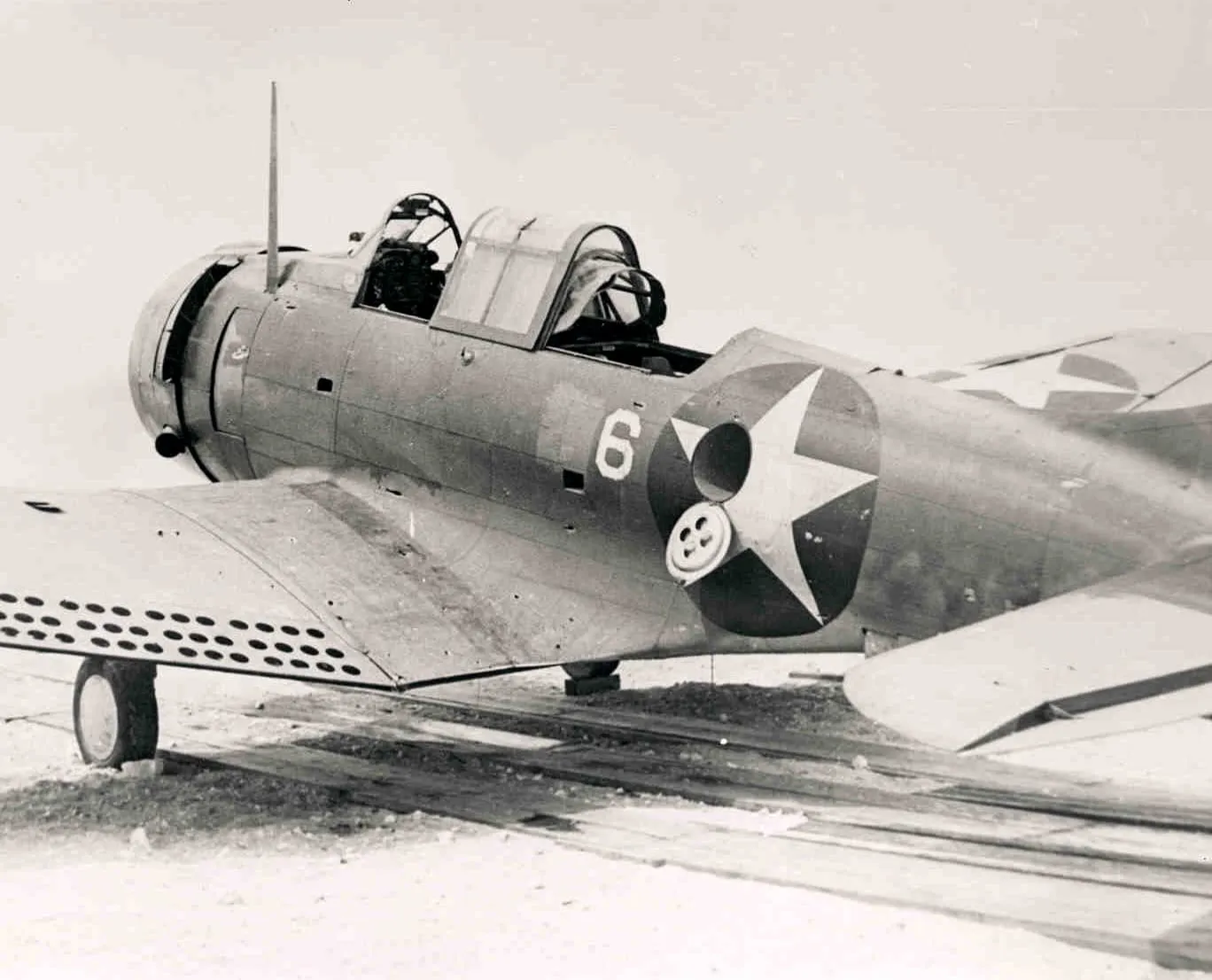
The Douglas SBD Dauntless was the dive bomber of the US Navy and Marine Corps, and at the same time the aircraft that changed the course of the Pacific war within a few minutes. On the morning of 4 June 1942 three squadrons of these machines fell on Admiral Nagumo’s carriers off Midway and set three of them ablaze, and a fourth in the afternoon. It was neither fast nor modern, and when war with Japan broke out the navy was already thinking about its successor. It proved, though, to be reliable, accurate and easy to fly, and it fought from the first day of the Pacific war to the last.
From Northrop to Douglas
The aircraft was designed in the mid-1930s by a team at Northrop’s plant in El Segundo, which included a young engineer, Ed Heinemann. The original BT-1 was a two-seat monoplane dive bomber, but it had awkward handling qualities. When Douglas took over Northrop in 1937, the team reworked the design, and the navy ordered the new version under the designation SBD, for Scout Bomber Douglas. The first production SBD-1 took to the air on 1 May 1940; at the end of the year the Marine Corps began receiving them, and the navy at the beginning of 1941.
The most important feature of the design was the split flaps on the trailing edges of the wings, perforated like a sieve. Extended before a dive, they slowed the aircraft without making the tail shake, and let the pilot drop on the target almost vertically at a speed at which he could aim calmly. The Dauntless carried a 1,000-pound bomb, about 450 kilograms, under its fuselage. Its crews joked that SBD stood for “Slow But Deadly”.
The first months of the war
On 7 December 1941 dive bombers from the Enterprise, sent ahead to Ford Island, flew straight into the Japanese attack on Pearl Harbor, and some of them were shot down. Three days later Dauntlesses from the same carrier sank the Japanese submarine I-70 north of Hawaii. In February 1942 they struck the atolls of the Marshall Islands, and on 10 March, flying over the mountains of New Guinea, they sank transports during the Japanese landing at Lae and Salamaua.
The first Japanese carrier went to the bottom in May. On 7 May, during the Battle of the Coral Sea, Dauntlesses and torpedo aircraft from the Lexington and the Yorktown sank the light carrier Shōhō with a dozen or more bombs and torpedoes. The next day dive bombers from both carriers hit the great Shōkaku three times, putting her out of the fighting for many weeks.
Midway
It was at Midway that the Dauntless made its deepest mark. On the morning of 4 June Marine dive bombers from the atoll, mostly flying new SBD-2s, attacked the Japanese carriers without fighter cover; their commander, Major Lofton Henderson, was killed, and fewer than half of his dozen-plus Dauntlesses made it back to the atoll, most of them badly shot up. A few hours later, at about 10.20, while the Japanese covering fighters were fighting low against the American torpedo aircraft, three squadrons of Dauntlesses appeared over Nagumo’s force almost at the same moment: two from the Enterprise under Lieutenant Commander Wade McClusky and one from the Yorktown. Within minutes the Kaga, the Akagi and the Sōryū were in flames, because the bombs exploded in hangars full of fuelled aircraft, bombs and torpedoes.
In the afternoon Rear Admiral Raymond Spruance sent 24 dive bombers from the Enterprise, including the surviving machines from the Yorktown, from which, after the Japanese counter-attack, Rear Admiral Frank Jack Fletcher had had to move his staff to a cruiser. At about 17.00 they hit the Hiryū with four bombs. In a single day Japan lost all four carriers that had attacked Pearl Harbor half a year earlier. Two days later Dauntlesses also sank the heavy cruiser Mikuma.
Guadalcanal and the last years
On 20 August 1942 twelve Dauntlesses of squadron VMSB-232 landed at Henderson Field, the airfield named after the major killed at Midway. In the months that followed, Marine and navy bombers were the main air weapon of the Guadalcanal campaign against the Japanese ships that brought troops to the island by night. By day the convoys had to stay out of their reach. In August Dauntlesses and torpedo aircraft from the Saratoga in the Battle of the Eastern Solomons sank the light carrier Ryūjō; in October a night bombardment destroyed most of the bombers on the airfield; and in November, during the Naval Battle of Guadalcanal, Dauntlesses helped finish off the battleship Hiei and spent the whole day smashing the transport convoy.
From 1943 the navy replaced the SBD with the larger and faster Helldiver, which long had teething troubles, so many pilots preferred the old Dauntless. It fought in a great carrier battle for the last time in June 1944 in the Philippine Sea. Marine squadrons flew it until the end of the war, among other places over the Solomon Islands and, in 1945, over Luzon, where they supported the American infantry. New Zealanders and the Free French used it as well, while the army, which bought the land-based A-24 version, judged it too slow and poorly armed. The last Dauntless left the factory on 21 July 1944; together with the army version, 5,936 were built.
Sources
Battles
(04)- 4–8 May 1942Battle of the Coral SeaOn 4–8 May 1942 carriers fought carriers for the first time in the Coral Sea. The Americans lost Lexington, but Japan called off the landing at Port Moresby.
- 3–7 June 1942Battle of MidwayOn 3–7 June 1942 off Midway Atoll American aircraft sank Nagumo's four carriers. Japan abandoned the operation; the United States lost Yorktown.
- 7 August 1942 – 9 February 1943Guadalcanal campaignFrom 7 August 1942 to 9 February 1943 the Americans held the airfield seized on Guadalcanal until, after six months of fighting, Japan evacuated the island.
- 12–15 November 1942Naval Battle of GuadalcanalFrom 12 to 15 November 1942, in two night actions and a series of air strikes, the Americans sank two Japanese battleships and most of a Guadalcanal convoy.
In the chronicle
(16)1942
- 1 February 1942The Marshalls–Gilberts raids
- 8 March 1942The Japanese at Lae and Salamaua
- 3 May 1942The Japanese on Tulagi
- 7 May 1942The sinking of Shōhō
- 8 May 1942The carrier clash in the Coral Sea
- 4 June 1942The sinking of Nagumo's carriers
- 21 August 1942The Battle of the Tenaru
- 24 August 1942The Battle of the Eastern Solomons
- 15 September 1942The sinking of USS Wasp
- 11 October 1942The Battle of Cape Esperance
- 13 October 1942The bombardment of Henderson Field
- 23 October 1942The battle for Henderson Field
- 26 October 1942The Battle of the Santa Cruz Islands
- 14 November 1942The battleship duel off Guadalcanal