- Category:
- Politics
- Date:
- 18 February 1943
- Author:
- Natalia
- Tags:
- Joseph Goebbels, propaganda, Third Reich, Holocaust
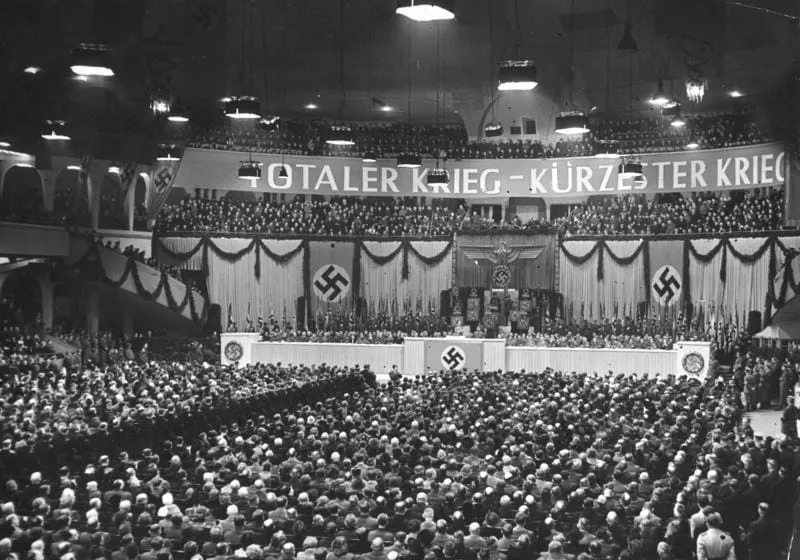
On 18 February 1943 the Reich Minister of Propaganda, Joseph Goebbels, spoke for almost two hours in Berlin’s Sportpalast, the largest assembly hall in the capital. Above the rostrum hung a banner bearing the slogan “Totaler Krieg – kürzester Krieg” (“Total war – shortest war”). Towards the end Goebbels put ten questions to the audience, and each was answered with a roar of “Yes!”. The most famous of them was: “Do you want total war?” – to which he added whether they wanted it, if necessary, more total and more radical than anything that could even be imagined today. The speech was broadcast on the radio and extracts were shown in the newsreels. It became one of the best-known examples of Nazi propaganda and, at the same time, the first public admission by the leaders of the Third Reich that the war had taken a very bad turn for Germany.
After Stalingrad
Two weeks earlier, on 2 February 1943, the last units of the Sixth Army had surrendered at Stalingrad. More than 90,000 German and allied soldiers were taken prisoner, among them Field Marshal Friedrich Paulus. German radio announced the defeat on 3 February to the strains of a funeral march and proclaimed three days of national mourning. The bad news did not stop there. The Red Army pressed on westwards: on 14 February it retook Rostov-on-Don, and on 16 February Kharkiv. In North Africa the Axis had already lost Libya, together with Tripoli, and was holding out in Tunisia. In January, at the Casablanca Conference, Roosevelt and Churchill had announced that they would demand Germany’s unconditional surrender.
The SS Security Service’s reports on public morale spoke of dejection, doubt and criticism of the leadership, as well as fear of the Soviet Union, which seemed to have inexhaustible reserves of men and equipment. As recently as September 1942 Hitler had assured the same Sportpalast that Stalingrad would be taken. Now he himself avoided public appearances, and the burden of addressing the Germans fell to Goebbels.
A bid for power
For months Goebbels had been demanding a radical mobilisation of the economy and society: the closure of non-essential businesses, compulsory labour for women from well-to-do homes, and curbs on the social life of the elite. On 17 January 1943 he published an article entitled “Total War” in the weekly Das Reich. Hitler shared some of these aims but feared that overly harsh restrictions on consumption would breed discontent. He remembered the November Revolution of 1918 and believed in the legend of the “stab in the back” supposedly dealt to the fighting army by a rebellious home front.
In January 1943 Hitler entrusted the preparation of the mobilisation to the so-called Committee of Three: the head of the Reich Chancellery, Hans Lammers; the head of the Party Chancellery, Martin Bormann; and Field Marshal Wilhelm Keitel. Goebbels was passed over. Among the committee’s results were the decree of 27 January on compulsory registration for labour and an order closing businesses not needed for the war. Goebbels regarded these measures as half-hearted.
The Sportpalast speech was thus meant to do more than raise morale. Goebbels wanted to show Hitler that the nation expected radical steps and was ready for them, and at the same time to present himself as the man capable of carrying out such a mobilisation. He hoped to be put in charge of “total war” and thereby become the second man in the state. That place was formally held by Reich Marshal Hermann Göring, Hitler’s designated successor and head of the war economy. Göring’s prestige, however, was already badly dented: the Luftwaffe had managed neither to supply the encircled army at Stalingrad nor to defend German cities against air raids. His lavish lifestyle was a good illustration of the “less than total war” against which Goebbels was campaigning.
A stage-managed evening
Formally, the meeting was a rally of the Berlin branch of the NSDAP, which Goebbels had led as Gauleiter of the capital since 1926. The audience – around 14,000 people, according to various accounts – had been carefully selected from among the party’s most loyal members. They included soldiers wounded on the Eastern Front, workers from Berlin’s armaments plants, officials, artists and scientists, with ministers, party dignitaries and generals in the front rows. Groups of claqueurs knew when to applaud and which slogans to chant. According to some accounts, recorded applause was also played through the hall’s loudspeakers. Goebbels wrote the text himself and rehearsed it carefully. The Armaments Minister, Albert Speer, who was in the hall, recalled years later that Goebbels had called this audience the best-trained one to be found in Germany.
Goebbels began by praising a nation that “knows the truth” and is able to bear it. He did not explain who was responsible for the defeat on the Volga; that subject he put off “until later”. He merely claimed that the Bolshevik enemy had proved stronger than anyone could have supposed, because it had concealed its potential for years. He painted a picture of a new “storm from the steppe” sweeping over Europe – the propaganda figure of Asiatic hordes – and presented the war as the defence of the whole continent. He repeated three theses: if the Wehrmacht did not halt the danger from the east, the Reich and, soon after, all of Europe would fall prey to Bolshevism; only Germany and its allies could save Europe; and action had to be swift and thorough, or it would be too late.
He then justified the restrictions already adopted: the closure of places of entertainment, luxury shops and fashion salons, compulsory labour for women, and the transfer of people from commerce and administration to the armaments industry. He presented them as a fair sharing of the burdens of war that would also affect the “better classes”. Many of these announcements were aimed less at the listeners in the hall than at Goebbels’s rivals in the party and the state, who were holding back his plans.
Ten questions
The climax was the ten questions. Goebbels declared that those gathered in the hall represented “a cross-section of the whole German nation, at the front and at home”, and asked whether this was so. When the hall answered with an ovation, he added: “But there are no Jews here.” The questions were framed as replies to supposed claims by “the English” that the Germans were tired of the war, unwilling to work and had lost faith in the Führer. Goebbels asked whether his listeners believed, together with Hitler, in “final, total victory”; whether they were ready, at the Führer’s command, to work ten, twelve and if necessary fourteen and sixteen hours a day; whether they wanted total war; whether they trusted the Führer more than ever; and whether they agreed that women should, wherever possible, take the place at work of men called up to the front. He also asked whether they approved of “the most radical measures” against “shirkers and profiteers”, and whether anyone who “offended against the war” should lose his head. The last question concerned “equal rights and equal duties” for all in wartime.
The hall answered every question with shouts of “Ja!”, and the recording captures chanted slogans and long ovations. Goebbels ended with the cry “Now, people, rise up, and storm, break loose!”. It was an adaptation of a line by Theodor Körner, a poet of the Napoleonic Wars who in 1813 had called for a rising against Napoleon. Goebbels had already used these words in the 1932 election campaign. After the speech the audience sang the first verse of “Deutschland, Deutschland über alles”.
A threat against the Jews
Goebbels devoted an important part of the speech to the Jews. He repeated the basic thesis of Nazi propaganda that behind both Bolshevism and Western “plutocratic” capitalism stood a single enemy, “international Jewry”, which sought to plunge Europe into chaos and dominate it. To the Allied protests against the persecution of the Jews, voiced among other things in the declaration of 17 December 1942, he replied that Germany had no intention of yielding and would, if necessary, apply “the most radical measures” in good time. The hall greeted this with uproar.
The sound recording shows that Goebbels began to speak of the “total and most radical” Ausrottung – extermination – of Jewry, broke off mid-word and finished it as Ausschaltung, “elimination”. In the text published in the press the sentence was toned down. Historians regard this slip as one of the few moments in a public address by a Nazi leader when what was really happening at the time broke through. The systematic extermination of the Jews had been under way for more than a year, and several million people had already been murdered in the gas chambers of the death camps, in mass shootings in the occupied Soviet territories and in the ghettos. Nine days after the speech, on 27 February 1943, the so-called Factory Action began in Berlin: the Gestapo and the SS seized thousands of the capital’s last Jews, who until then had been employed as forced labour in industry, at their workplaces, and deported most of them to Auschwitz.
The German Jews still living in the Reich read the speech as a threat. The Dresden philologist Victor Klemperer, who survived the war thanks to his marriage to an “Aryan” woman, noted in his diary that the text published in the newspapers had heightened his sense of danger.
The outcome
According to Goebbels’s diary, Hitler called the speech a “psychological and propaganda masterpiece”. He did not, however, grant Goebbels’s most important demand: he did not hand him control of the mobilisation. After the speech Goebbels and Speer tried to circumvent the Committee of Three by reviving the Ministerial Council for the Defence of the Reich under Göring’s chairmanship, in which they themselves would have the decisive voice. At the turn of February and March they visited Göring at Obersalzberg about the matter, but the plan came to nothing because Göring did not want to fall foul of Hitler or Bormann.
The practical effects of “total war” in 1943 thus proved more modest than the words. Some restaurants, bars, places of entertainment and luxury shops were closed. Many of these closures turned out to be short-lived or merely for show. According to Speer’s memoirs, Horcher, the exclusive Berlin restaurant that was Göring’s favourite, was not closed but turned into a Luftwaffe officers’ club. Compulsory labour for women applied mainly to those who had to earn a living anyway. The Reich’s civilian economy was never curtailed to the same extent as Britain’s, and the growth in armaments output in 1943–1944 owed most to Speer’s reorganisation of industry and to the labour of millions of forced workers from the occupied countries. At the same time, in occupied France, the Laval government introduced compulsory labour service, which was to supply the Reich with hundreds of thousands more young Frenchmen.
How ordinary Germans received the speech is unclear. SD reports recorded both approval and scepticism, as well as questions about why radical measures were only being introduced now. Abroad, the speech was read as an admission that Germany was in crisis, but also as a sign that the Germans would fight to the end.
The same day in Munich
A few hours before Goebbels spoke, on the morning of 18 February 1943, the siblings Hans and Sophie Scholl distributed the sixth leaflet of the clandestine White Rose group in the main building of the Ludwig Maximilian University in Munich, calling on students to rise against the dictatorship after the defeat at Stalingrad. A university porter caught them and handed them over to the Gestapo. Their leaflet, too, ended with a quotation from the poetry of the wars of liberation against Napoleon. On the same day some Germans heard a call for total war, while others paid the price for trying to oppose it.
Place in the war
The Sportpalast speech marked a turning point in Nazi propaganda. Until then it had promised swift victories; from February 1943 onwards it spoke more and more of defending Europe against Bolshevism, of sacrifice and of a life-and-death struggle. Goebbels counted on fear of the Red Army and of unconditional surrender to bind the Germans to the regime more tightly than promises of victory. To some extent he was right: despite ever heavier defeats and air raids, German society did not rebel until the end of the war, although an equal cause was the increasingly harsh repression of any sign of doubt.
Goebbels’s own position was strengthened only after the attempt on Hitler’s life of 20 July 1944. At the end of July 1944 Hitler appointed him Reich Plenipotentiary for Total War. Goebbels then closed the theatres and most publishing houses, lengthened the working week and raised the age limit for women subject to compulsory labour, and in the autumn the Volkssturm was formed. None of this could change the course of the war. On 1 May 1945, the day after Hitler’s suicide, Goebbels and his wife Magda poisoned their six children in the Berlin bunker and took their own lives.
The hall itself, damaged in air raids, survived the war and served Berlin for almost three more decades; it was demolished in 1973. The question “Do you want total war?” has remained in German memory as a symbol of crowd manipulation and of the blindness that led the country to catastrophe. The recording of the speech is today one of the most frequently analysed sources for the history of Third Reich propaganda.
Sources
Meanwhile
(04)Elsewhere, within a week.
- 16 February 1943 · Eastern FrontThe liberation of KharkivOn 16 February 1943 Voronezh Front troops entered Kharkiv, abandoned by an SS corps against Hitler's orders. A month later the Germans retook the city.
- 14 February 1943 · Eastern FrontThe liberation of RostovOn 14 February 1943 troops of the Southern Front liberated Rostov-on-Don. The Germans had got the First Panzer Army through the city and fell back to the Mius.
- 13 February 1943 · MediterraneanThe Battle of Sidi Bou ZidOn 14 February 1943 Arnim's panzer divisions routed the Americans at Sidi Bou Zid, and Rommel took abandoned Gafsa. US II Corps fell back to the Western Dorsal.
- 25 February 1943 · PacificThe Featherston camp massacreOn 25 February 1943 guards at the Featherston POW camp in New Zealand opened fire on striking Japanese prisoners. 48 prisoners and one soldier died.
Related events
(04)The same battle, people or subject.
- 28 January 1943 · SocietyCompulsory labour in the ReichSauckel's decree of 27 January 1943 required German men aged 16–65 and women aged 17–45 to register for work in the defence of the Reich.
- 2 February 1943 · Eastern FrontThe end of the Battle of StalingradOn 2 February 1943 General Strecker's northern pocket surrendered and the Battle of Stalingrad ended. A day later the Reich announced the Sixth Army's defeat.
- 31 January 1943 · Eastern FrontPaulus surrendersOn 31 January 1943 men of the 64th Army captured Field Marshal Paulus and his staff in a Stalingrad department store basement. The southern pocket fell.
- 22 February 1943 · Crimes and repressionThe execution of Hans and Sophie SchollOn 22 February 1943 Freisler’s People’s Court sentenced Hans and Sophie Scholl and Christoph Probst of the White Rose to death. They were guillotined that day.