Germany
Wilhelm Keitel
Head of the Wehrmacht Office (1935–1938), Chief of the High Command of the Wehrmacht (1938–1945), Field Marshal (1940)
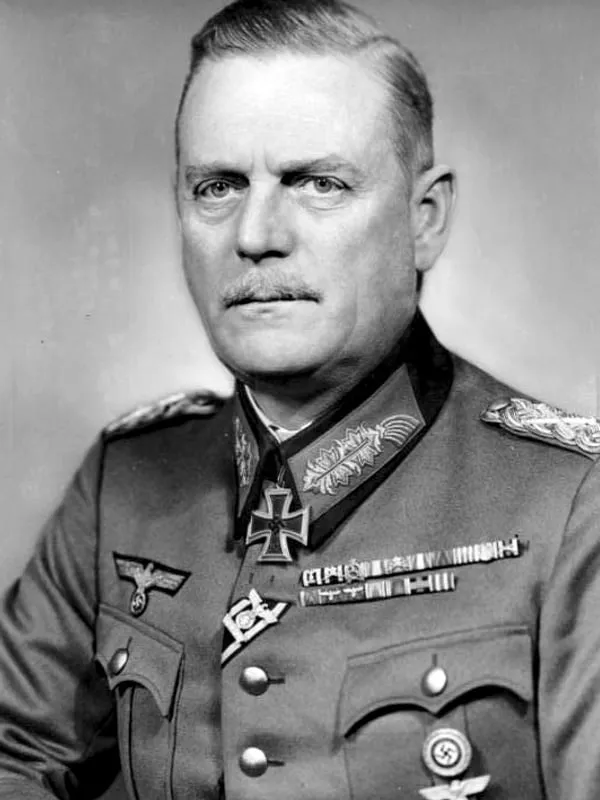
- Born:
- 22 September 1882, Helmscherode (Duchy of Brunswick)
- Died:
- 16 October 1946, Nuremberg
- Author:
- Łukasz
- Photo:
- autor nieznany, CC BY-SA 3.0 DE, Wikimedia Commons

Throughout the war Wilhelm Keitel stood closer to Adolf Hitler than any other German general. As chief of the High Command of the Wehrmacht (OKW) from February 1938 to May 1945 he commanded no army and planned no campaign, but Hitler’s orders to the armed forces passed across his desk and went out over his signature: from the Case White directive, which prepared the invasion of Poland, to the orders that absolved soldiers of responsibility for killing civilians and that called for Soviet political commissars to be shot and for hundreds of hostages to be executed for every German killed. Behind his back his fellow officers called him “Lakeitel”, from the word Lakai (lackey). He has gone down in history as the type of officer who placed obedience above conscience and law. In May 1945 in Berlin he signed the unconditional surrender of the Wehrmacht, and a year and a half later, sentenced by the International Military Tribunal, he died on the gallows at Nuremberg.
The landowner’s son
He was born on 22 September 1882 at Helmscherode near Bad Gandersheim in the Duchy of Brunswick, the eldest son of the landowner Carl Keitel and Apollonia, née Vissering. His mother died in 1889 after giving birth to a younger son, Bodewin, who also became a general. Wilhelm was first taught at home and then at a classical grammar school (Gymnasium) in Göttingen. He dreamed of farming the family estate, but his father had no intention of handing it over yet. So in 1901, like many sons of landowners, he joined the Prussian army. He did not go into the cavalry, which was expensive and dominated by the nobility. He became an officer cadet in the Lower Saxon 46th Field Artillery Regiment at Wolfenbüttel, was commissioned as a second lieutenant in 1903, and from 1908 was the regiment’s adjutant.
In 1909 he married Lisa Fontaine, the daughter of a wealthy owner of an estate and of the Wülfel brewery near Hanover. They had six children, one of whom died in childhood. His biographers stress the ambition of his wife, who preferred being an officer’s wife to being a landowner’s. When Keitel’s father died in 1934, the general applied for retirement in order to take over the estate, but at the urging of his wife and his superiors he stayed in the army.
The Great War and the Reichswehr
At the start of the First World War he fought on the Western Front; in Flanders a shell splinter badly wounded his right forearm. After returning to his regiment as a captain and battery commander, he moved in 1915 to staff work without the usual course at the war academy. In 1916 he was the first staff officer (Ia) of the 19th Reserve Division, and towards the end of the war he served on the staff of the Marine Corps in Flanders. In 1914 he had met Major Werner von Blomberg, with whom his fate would be intertwined for a quarter of a century.
After the war he remained in the 100,000-strong Reichswehr, on which the Treaty of Versailles had imposed strict limits. According to some biographers, in 1919 he helped organise volunteer units on the border with Poland. He taught tactics at the cavalry school in Hanover, served on an artillery staff and became a major in 1923. In 1925–1927 he worked in the organisation section (T 2) of the Truppenamt, the camouflaged general staff whose existence was forbidden by the Treaty of Versailles. After two years commanding an artillery battalion at Minden, he returned to the ministry and in 1929–1933 headed the T 2 section. He drew up secret plans to expand the army from 10 to 30 divisions in the event of a “national emergency”, and at least once travelled to the USSR to inspect the schools and training grounds where Germans were trained under the secret cooperation between the two states. He was a hard-working, conscientious staff officer who drove himself beyond his strength. At the end of 1932 he fell seriously ill, and when Hitler became chancellor in January 1933 he was convalescing in a sanatorium in the Czechoslovak Tatras.
A career in the Third Reich
In July 1933 he saw Hitler for the first time and was captivated. In the autumn he returned to line service as artillery commander and deputy commander of the 3rd Division; in 1934 he became a Generalmajor and was given the task of forming the 22nd Infantry Division in Bremen. On 1 October 1935, with the backing of the army high command, he took over the Wehrmacht Office (Wehrmachtamt) in Blomberg’s war ministry – in effect its staff for all three branches of the armed forces. He tried to create a joint command of the army, navy and air force, but met resistance from the army generals and from Hermann Göring. In 1936 he was a Generalleutnant, and in 1937 a General der Artillerie.
The turning point was the Blomberg–Fritsch affair. In January 1938 the Berlin police passed Keitel documents showing that Blomberg’s newly married wife had a police record as a prostitute. Keitel advised that they be handed to Göring, who took them to Hitler. Blomberg had to go, and his intended successor at the head of the army, General Werner von Fritsch, was removed on a fabricated charge. According to accounts of those days, Blomberg, asked by Hitler about a successor, suggested the Führer himself, and of Keitel – whose son Karl-Heinz was engaged to Blomberg’s daughter – he said that he was merely the man who “ran his office”. Hitler is said to have replied that this was exactly the kind of man he was looking for.
On 4 February 1938 Hitler abolished the war ministry and himself assumed supreme command of the Wehrmacht. His staff became the Oberkommando der Wehrmacht, with Keitel as its chief, holding the rank of a Reich minister. It was he, it is generally accepted, who suggested General Walther von Brauchitsch to Hitler as commander-in-chief of the army, while his brother Bodewin took over the Army Personnel Office. The OKW, however, had no authority over the commands of the individual services. The operations department under Alfred Jodl prepared plans and directives for Hitler, while Keitel dealt with administration, armaments, the war economy, prisoners of war and the occupied territories and, above all, with transmitting the Führer’s will.
On the road to war
From his first weeks in the new post Keitel took part in all of Hitler’s moves. On 12 February 1938, together with Generals Walter von Reichenau and Hugo Sperrle, he sat at the Berghof while Hitler broke the Austrian chancellor Kurt Schuschnigg. The generals’ presence was meant as a reminder of the threat of force. A month later the Wehrmacht marched into Austria in the Anschluss. In 1938 the Case Green directives for a war with Czechoslovakia went out through the OKW, and on the night of 14–15 March 1939 Keitel was in the Reich Chancellery while Hitler and Göring forced President Emil Hácha to consent to the occupation of Bohemia and Moravia.
On 3 April 1939 Keitel issued the directive in which Hitler demanded readiness to attack Poland from 1 September. That same month Hitler gave him the Golden Party Badge, although he was formally admitted to the NSDAP only in 1944, at his own request and with a backdated membership. He was present at the conferences of 23 May and 22 August at which Hitler announced the war with Poland to his generals. On 25 August it was Keitel whom Hitler ordered to halt immediately the attack that had already been set in motion. According to one account, Keitel then refused to decorate the participants in the failed raid on the Jablunkov Pass, since the war had not yet begun. On 30 August he became a member of the six-man Ministerial Council for the Defence of the Reich, which served as a war cabinet.
September 1939
The Polish campaign, which Germany launched on 1 September, was directed by the army high command – Brauchitsch and his chief of staff Franz Halder – not by the OKW. Keitel accompanied Hitler in the special train from which the Führer made his trips to the front. For history, what he knew about the crimes matters more than his part in the operations. On 12 September 1939, in Hitler’s train in Upper Silesia, the head of military intelligence, Admiral Wilhelm Canaris, warned him that mass shootings were being planned in Poland which would be laid at the Wehrmacht’s door, and that their victims were to be above all the intelligentsia, the nobility and the clergy. According to a note by Canaris’s aide Erwin Lahousen, presented at Nuremberg after the war, Keitel replied that the Führer had already decided the matter. If the Wehrmacht wanted nothing to do with it, it would have to accept that the SS and the Gestapo would appear alongside it, and that in the military districts civilian administrators would appear alongside the military commanders, and theirs would be the task of “ethnic extermination”.
And so it came about. Security Police task forces operating under Operation Tannenberg, together with the ethnic German self-defence units, murdered Polish activists, teachers, priests and Jews in September and the months that followed, and the Intelligenzaktion claimed tens of thousands of victims. Keitel did not protest, and he brushed aside the protests of some military commanders. On 17 October 1939 he recorded Hitler’s guidelines for occupied Poland: it was to be a “hard ethnic struggle” free of legal restraints, and the German authorities were to prevent the Polish intelligentsia from becoming a leadership class.
The peak of his career
In the campaign in the West in 1940 Keitel was again at Hitler’s side. On 17 June, when the French request for an armistice reached headquarters, he reportedly called him “the greatest warlord of all time”. After Stalingrad the Germans turned this phrase into the mocking abbreviation “Gröfaz”. On 21 June in the forest of Compiègne, in the same railway carriage in which Germany had signed the armistice in November 1918, Keitel read the preamble to the German terms to the French delegation, and on 22 June he and General Charles Huntziger signed the armistice. On 19 July 1940 Hitler promoted him to field marshal together with eleven other generals. He also rewarded him generously: in 1942 Keitel received 250,000 Reichsmarks, and in 1944 a forest estate in Lower Saxony.
According to his own memoirs, in the summer of 1940 he warned against war with the USSR and offered his resignation, which Hitler refused. Once the decision was taken, he prepared its execution without hesitation. He told General Georg Thomas, who was responsible for the war economy, that Hitler did not want to hear about difficulties with fuel and raw materials.
His signature on the crimes
Keitel was not the author of most of the criminal orders, but he gave them force with his signature, and some he issued on his own initiative. Before Operation Barbarossa he signed, on 13 May 1941, the decree on military jurisdiction, which removed cases involving civilians in the East from the courts martial and exempted soldiers from prosecution for crimes against the population. On 6 June the OKW issued the Commissar Order, requiring captured Soviet political officers to be shot. In September 1941, when Canaris protested against new regulations on the treatment of Soviet prisoners of war, Keitel wrote on his memorandum that such objections reflected soldierly notions of chivalrous warfare, whereas what was at stake here was the destruction of a world view. Millions of Soviet prisoners died in German camps of hunger, disease and cold.
On 12 September 1941 Keitel instructed the troops in the East to take “ruthless and energetic action”, above all against the Jews, “the main carriers of Bolshevism”. On 16 September he issued an order prescribing the execution of 50–100 “communists” for the death of one German soldier in the occupied territories. In October 1941, on the basis of this order, Wehrmacht units shot thousands of civilians in Serbia, at Kragujevac and Kraljevo. On 7 December 1941 he signed the Nacht und Nebel (Night and Fog) decree, under which inhabitants of the western countries suspected of resistance were secretly deported to Germany, and their families were never told of their fate. In October 1942 he circulated the Commando Order, which required captured soldiers of special forces to be killed, even those in uniform. Under his authority the Wehrmacht became an accomplice in the policy of extermination, and in 1942 Keitel himself reminded his subordinates that the “evacuation” of the Jews must be carried out thoroughly.
The years of defeat
In the autumn of 1942, when the offensive into the Caucasus stalled, Keitel, fearing for his own position, tried to shift the blame onto Jodl and have him dismissed. In 1943 he joined Hans Lammers and Martin Bormann in the “Committee of Three”, which was supposed to coordinate the war economy but soon lost importance. Without objection he passed on Hitler’s orders forbidding retreat, including during the Battle of Stalingrad. Field Marshal Ewald von Kleist called him “Hitler’s stupid helper”, and according to Gerd von Rundstedt, Hitler said of him that he had the brains of a cinema usher but was as loyal as a dog.
On 20 July 1944 Keitel was in the hut at the Wolf’s Lair when the conspirators’ bomb went off. He led the lightly wounded Hitler out of the wreckage and directed the hunt for the plotters by telephone. He then sat on the army’s “Court of Honour”, which expelled suspected officers from the army so that they could be tried by the People’s Court. Among those it handed over was Field Marshal Erwin von Witzleben.
In the last weeks of the war the OKW took over operational command on the shrinking fronts. Keitel called for counter-attacks to relieve Berlin, although the forces for them no longer existed. After Hitler’s suicide he stayed with Grand Admiral Karl Dönitz at Flensburg. On 7 May 1945 Jodl signed the surrender at Reims. At Soviet insistence the act was repeated at Karlshorst in Berlin, where late in the evening of 8 May Keitel, together with Admiral Hans-Georg von Friedeburg and General Hans-Jürgen Stumpff, signed the instrument of the unconditional surrender of the Wehrmacht in the presence of Marshal Georgy Zhukov. On 13 May he was arrested at Flensburg.
The war took two of his sons. The youngest, Hans-Georg, was killed near Smolensk in July 1941, and Ernst-Wilhelm went missing on the Eastern Front.
Nuremberg
After several months in a prisoner-of-war camp at Mondorf-les-Bains, Keitel was taken to Nuremberg, where he stood before the International Military Tribunal (PL) among the major war criminals. The prosecution rested largely on his signatures on dozens of orders. He admitted that many of them were unlawful, but argued in his defence that as a soldier he had been bound by his oath and by the leader principle. The tribunal rejected this defence. On 1 October 1946 it found him guilty on all four counts of the indictment: conspiracy against peace, crimes against peace, war crimes and crimes against humanity. In its judgment it stated that superior orders could not be considered in mitigation where crimes so shocking and extensive had been committed consciously, ruthlessly and without military justification. It sentenced him to death by hanging. The Allied Control Council rejected Keitel’s request to be shot, as befitted a soldier.
On 16 October 1946 Keitel was the second, after Joachim von Ribbentrop, to mount the gallows in the gymnasium of the Nuremberg prison. According to accounts, he said that he called on Almighty God to have mercy on the German people; that more than two million German soldiers had gone to their deaths for the fatherland before him; and that he was following his sons – all for Germany. The hangman, Master Sergeant John C. Woods, carried out the sentence in such a way that Keitel did not die at once but took more than ten minutes – by some accounts over twenty – to die. His body was cremated in Munich and the ashes scattered in a stream flowing into the Isar. In his cell he wrote memoirs, published in 1961 (in English as The Memoirs of Field-Marshal Keitel), which historians regard as an unreliable attempt at self-justification.
Significance
Keitel was neither a commander nor a strategist. He was a functionary of war who made his career by questioning nothing and who for seven years turned Hitler’s will into orders for millions of soldiers. His case, together with Jodl’s, became the model at Nuremberg for the principle that superior orders do not absolve anyone of responsibility for a crime. Long before the trial, the responsibility of the Wehrmacht as an institution was also focused in his person: from its tacit acceptance of the murders in Poland in September 1939 to the army’s part in the war of extermination in the East. The myth of the “clean Wehrmacht”, which arose in Germany after the war, rested on distinguishing the fighting soldiers from the crimes of the SS. The orders signed by Keitel are among the strongest proof that no such line existed.
Sources
Mentioned in battles
(04)Often appears with
People who appear in the same events.
On the timeline
(77)The 40 most important of 77 events. All tagged “Wilhelm Keitel” (6) →