- Category:
- Military operations
- Front:
- Eastern Front
- Date:
- 22 June 1944
- Author:
- Łukasz
- Battle:
- Operation Bagration
- Tags:
- Red Army, Wehrmacht, Soviet Union, Joseph Stalin
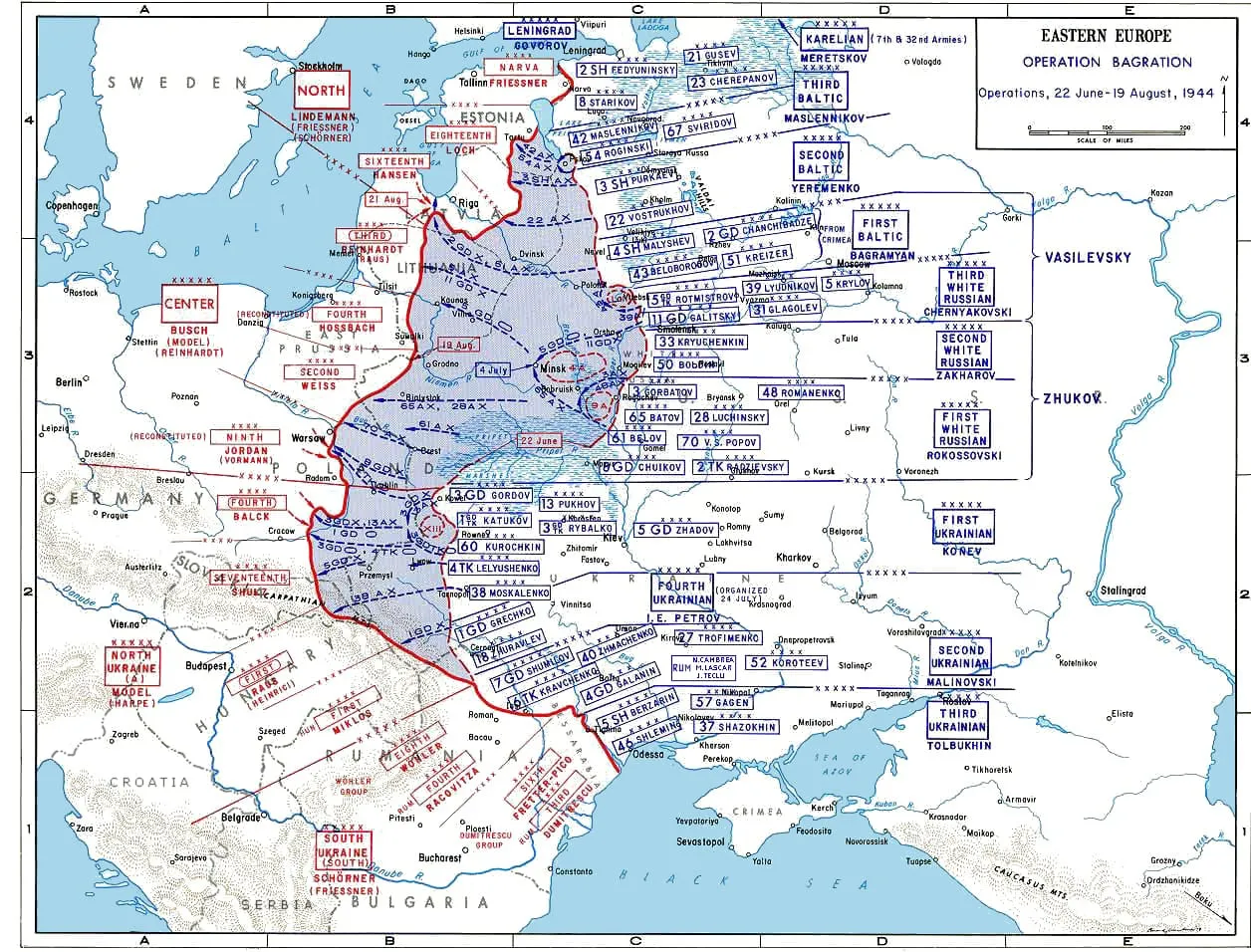
On 22 June 1944, exactly three years after Germany attacked the USSR, the Red Army opened an offensive in Belarus codenamed Bagration. Its target was Field Marshal Ernst Busch’s German Army Group Centre, which since the autumn of 1943 had been holding a salient pushed far to the east around Vitebsk, Orsha, Mogilev and Bobruisk – known on both sides as the “Belarusian balcony”. Four Soviet fronts were preparing to attack, with, according to the most frequently cited estimates, a total of about 1.7 million men, more than 24,000 guns and mortars, about 4,000 tanks and self-propelled guns and more than 6,000 aircraft (figures given in some accounts and in Steven Zaloga’s studies). On the German side the whole army group had about 800,000–850,000 men, fewer than half of them in front-line units, with only a few hundred tanks and assault guns.
On the first day the attack did not yet get under way along the whole front. On 22 June, on the northern flank, the 1st Baltic Front and the 3rd Belorussian Front carried out a powerful reconnaissance in force at Vitebsk, which in several places turned into a breach of the first defensive line; the 2nd Belorussian Front prepared its attack at Mogilev with an artillery bombardment. The main blows came on 23 June, and Konstantin Rokossovsky’s 1st Belorussian Front moved against Bobruisk on 24 June. For this reason some historians (among them David Glantz and Karl-Heinz Frieser) regard 23 June as the true start of the offensive, while Soviet historiography kept to the symbolic date of 22 June. A few days earlier, on the night of 19/20 June, Belarusian partisans had launched mass attacks on the railway lines behind the German front.
The dates given in war chronologies need two clarifications here. The entry for 19 June, that the Red Army was preparing Operation Bagration, is accurate, except that the preparations had been going on since May, and 19 June stands out above all as the start of the partisan operation. Under 22 June a “general attack” intended to clear Belarus and destroy Army Group Centre is mentioned – but 22 June was only the beginning, and the general offensive of all the fronts developed on 23–24 June. The judgement that this was perhaps the Wehrmacht’s greatest defeat is common in the literature (it is made, among others, by Frieser in the German history of the war published by the Military History Research Office, MGFA), but it refers to the results of the whole operation, not of its first day.
Why Belarus
In the spring of 1944 the Eastern Front looked quite different from a year earlier. In the south, after the offensive in Right-Bank Ukraine, the Red Army had reached the Carpathians and Romania, and as early as January its units had crossed Poland’s pre-war border in Volhynia. In the centre, by contrast, the front had barely moved since the autumn of 1943: after the liberation of Gomel and the winter fighting at Vitebsk and Orsha, Army Group Centre still held a great salient reaching far to the east, with the Dnieper and the Pripet Marshes (Polesie) on its flanks. This “balcony” was at once a threat to the Soviet fronts in Ukraine and the shortest route to Minsk, Warsaw and East Prussia.
The plan for the summer campaign had been taking shape in the Soviet General Staff since April; its principal author was the Deputy Chief of Staff, General Aleksei Antonov. An attack from western Ukraine towards Lublin and the Baltic, in Romania or in the Baltic states was considered; the Stavka, however, concluded that the surest course was to smash the German army group that was weakest relative to the length of its sector – the one in Belarus – and only afterwards to strike at Lwów and further west. The plan was discussed at a conference with Joseph Stalin on 22–23 May (some accounts give 20 May). According to Rokossovsky’s memoirs, a dispute arose there: the commander of the 1st Belorussian Front insisted on two equal blows against Bobruisk – from Rogachev and from the Berezina in the Parichi area – instead of one, and Stalin twice sent him away to “think it over again” before finally giving way. Some historians, including David Glantz, treat this colourful scene with caution – in Georgy Zhukov’s account the two-pronged concept had been agreed earlier – but the plan with two pincers at Bobruisk was indeed adopted. Stalin approved the directives on 30–31 May and named the operation after Pyotr Bagration, the Georgian prince and Russian general mortally wounded at Borodino in 1812.
The operational concept envisaged encircling and destroying the German groupings on the flanks of the “balcony” – at Vitebsk and at Bobruisk – and then a converging drive on Minsk to trap the forces defending the centre, east of the Berezina. The fronts’ objectives were set at a relatively shallow depth, which distinguished this directive from the over-ambitious plans of 1942–1943. The work of the two pairs of fronts was coordinated by representatives of the Stavka: Marshal Aleksandr Vasilevsky for the 1st Baltic and 3rd Belorussian Fronts, and Marshal Zhukov for the 2nd and 1st Belorussian Fronts.
Maskirovka and the timing with Normandy
The success of the operation depended on surprise, and surprise was hard to achieve: moving several armies, tank corps and thousands of aircraft to Belarus required hundreds of trains. The Soviet command therefore employed wide-ranging maskirovka – deception and disinformation. Troop movements took place at night under radio silence; on sectors from which units were withdrawn the previous volume of signals traffic was kept up; and concentrations were simulated behind the 3rd Ukrainian Front in Moldavia and in the north, in the Baltic states. Above all, however, the Stavka left four tank armies in western Ukraine, facing Lwów, and made no secret of their presence – confirming the Germans in their belief that the main blow would fall there.
The German Army High Command (OKH) and its intelligence branch – Colonel Reinhard Gehlen’s Foreign Armies East (PL) – expected a summer offensive from the Kovel and Lwów area towards the Vistula or the Baltic that would cut off Army Groups Centre and North. In May LVI Panzer Corps was taken from Army Group Centre and handed over to Field Marshal Walter Model’s Army Group North Ukraine; according to Karl-Heinz Frieser, the army group thereby gave up most of its tanks, while holding a front more than a thousand kilometres long. In June the staffs of Busch’s armies identified many Soviet concentrations, and on 19 June the army group pointed to a marked shift of enemy air power to its sector – but OKH regarded an attack in Belarus as a secondary effort. The Germans did not detect the Soviet strategic reserves, including the 5th Guards Tank Army.
The offensive also had an inter-Allied dimension. At the Tehran Conference Stalin had promised that when the Allies landed in France the Red Army would attack at the same time, so that the Germans could not move troops to the West. On 6 June, the day of the Normandy landings, he wrote to Winston Churchill that the Soviet summer offensive would begin in mid-June on one of the important sectors of the front. The original date – 15–20 June – was put back by a few days because the rail transports could not keep up; according to Zhukov and Vasilevsky, Stalin instructed Lazar Kaganovich to speed up the movements.
The “rail war” on the night of 19/20 June
A special role in the preparations was played by the Soviet partisans, who were exceptionally numerous in Belarus – according to Soviet figures some 140,000 partisans were operating behind Army Group Centre in 1944. As early as 1943 they had carried out large-scale operations against the railways, known as the “Rail War” and “Concert”. In June 1944 the Central Staff of the Partisan Movement ordered them resumed just before the offensive. On the night of 19/20 June the partisans laid, according to the figure cited by Western historians on the basis of German reports, about 10,500 explosive charges on Belarus’s railway lines; the Germans defused many of them, but traffic on the key lines supplying the front, which converged on Minsk, was seriously disrupted for many days. The attacks went on until 23 June. They hampered the delivery of ammunition and fuel and the movement of reserves in the first, decisive days of the battle; the partisans also marked targets for aircraft and later blocked the escape routes of encircled units.
It is this night that gives the date of 19 June its significance: by then the Soviet preparations were no secret to the soldiers on either side of the front, but the sabotage on the railways was the first direct move of Bagration.
Two armies before the battle
From north to south, four fronts were to strike Army Group Centre. Army General Ivan Bagramyan’s 1st Baltic Front was to attack north of Vitebsk, and Colonel General Ivan Chernyakhovsky’s 3rd Belorussian Front – he was the youngest front commander in the Red Army – south of Vitebsk and along the Moscow–Minsk highway towards Orsha. Colonel General Georgy Zakharov’s 2nd Belorussian Front – Zakharov had replaced the dismissed Ivan Petrov at the beginning of June – was to pin down the German forces at Mogilev, while Rokossovsky’s 1st Belorussian Front, the strongest of them, was to strike at Bobruisk. It also included, for the time being in the second line, General Zygmunt Berling’s Polish First Army, which went into action only in July.
Army Group Centre consisted of four armies: General Georg-Hans Reinhardt’s Third Panzer Army at Vitebsk, General Kurt von Tippelskirch’s Fourth Army at Orsha and Mogilev, General Hans Jordan’s Ninth Army at Bobruisk, and the Second Army in Polesie, away from the main axis of attack. There was a shortage of armoured reserves, and at the start of the offensive Luftflotte 6 had few serviceable fighters. The defence was further stiffened by Adolf Hitler’s order of 8 March 1944 on “fortified places” (feste Plätze): Vitebsk, Orsha, Mogilev and Bobruisk were to be held to the end, even if surrounded, by divisions assigned to the task. The army commanders – Jordan in particular – warned that in the event of a breakthrough this would tie troops to places that were easy to encircle. Busch, known for his obedience to Hitler, did not support requests to shorten the front.
22 June
On the morning of 22 June, after night raids by long-range aircraft on the German rear, reconnaissance battalions reinforced with tanks and artillery moved forward on the northern flank. In the 1st Baltic Front’s sector, where the 6th Guards Army and the 43rd Army attacked IX Corps of the Third Panzer Army north-west of Vitebsk, the reconnaissance in force tore such large gaps that Bagramyan committed part of his main forces that same day. In the 3rd Belorussian Front’s sector the attack south of Vitebsk also broke through the first position, whereas at Orsha, on the road to Minsk, the 11th Guards Army ran into heavily fortified defences and made slow progress. The German command judged these actions to be local and refused to let the Third Panzer Army withdraw from Vitebsk.
On 23 June, after a massive artillery preparation, the main forces of three fronts attacked, and on 24 June the 1st Belorussian Front followed at Bobruisk, after a bombardment by some 7,000 guns, mortars and rocket launchers (a figure given by Zaloga among others). Within a few days the German defences on both flanks of the “balcony” had been broken.
Place in the war
What began on 22 June turned within two weeks into a catastrophe for Army Group Centre. Vitebsk, taken by the Wehrmacht in July 1941, was encircled on 25 June, and General Friedrich Gollwitzer’s LIII Corps, trapped there, surrendered on 27 June. Orsha fell the same day, Mogilev on 28 June and Bobruisk on 29 June, where a large part of the Ninth Army was caught in a pocket. On 28 June Hitler dismissed Busch and gave the command to Model, who also kept command of Army Group North Ukraine. On 3 July Soviet troops entered Minsk, lost three years earlier after the battle of the Białystok–Minsk pocket; east of the city the main forces of the Fourth Army – some 100,000 men – were trapped in a pocket from which only a small fraction broke out. On 17 July a column of about 57,000 German prisoners was marched through Moscow.
The offensive rolled on westward: on 13 July the Red Army took Wilno (Vilnius), where Home Army units had earlier joined the fight against the Germans in Operation Ostra Brama – after which the NKVD disarmed and arrested their soldiers. In July Grodno, Białystok and Brześć (Brest) fell, and in the neighbouring Lublin–Brest offensive Soviet troops and the Polish First Army took Chełm and Lublin, where the Polish Committee of National Liberation established itself. At the end of July the Soviet spearheads seized bridgeheads on the Vistula and approached Warsaw, where the uprising broke out on 1 August. In the north the 1st Baltic Front reached the Gulf of Riga at the end of July, briefly cutting off Army Group North. At the same time, on 13 July, the Lwów–Sandomierz offensive began, for which Bagration had drawn German reserves away from the south.
Losses on both sides were enormous. Frieser estimates Army Group Centre’s losses from 22 June to the end of August at about 400,000 men (killed, missing and wounded); other authors give from 300,000 to more than 450,000; by the beginning of July the Germans had lost some 25 divisions. Soviet losses, according to Grigori Krivosheev’s figures, amounted to about 178,000 killed and missing and about 590,000 wounded and sick. For Belarus, which during the occupation had lost – according to the most frequently cited estimates – about a quarter of its population, the offensive meant the end of German rule, but also further destruction and the return of Soviet power with its repressions.
Many historians regard the defeat of Army Group Centre as the greatest disaster in the history of the German army – greater than Stalingrad in terms of the number of divisions lost. It coincided with the fighting in Normandy and Italy: in the summer of 1944 the Germans for the first time had to defend themselves simultaneously on three land fronts, without reserves capable of patching any of them. Within two months the Eastern Front moved 500–600 km west, from its old line at Vitebsk to the Vistula and the borders of East Prussia.
Sources
Meanwhile
(04)Elsewhere, within a week.
- 23 June 1944 · PoliticsThe declaration of the National Committee of the Estonian RepublicThe manifesto “To the Estonian people”, dated 23 June 1944, proclaimed Estonia's continuity as a state. Issued in Stockholm in July, in Estonia in August.
- 19 June 1944 · PacificThe Battle of the Philippine SeaOn 19–20 June 1944 the US Task Force 58 shattered Ozawa's carrier air groups west of the Marianas. Japan lost three carriers and several hundred aircraft.
- 19 June 1944 · Western FrontThe Channel stormThe storm of 19–22 June 1944 wrecked the American Mulberry A artificial harbour off Omaha and almost halted the unloading of supplies in Normandy for days.
- 25 June 1944 · ScandinaviaThe Battle of Tali-IhantalaOn 25 June 1944 the Red Army struck the Finnish VKT line from Viipuri. By 9 July the Finns, with German help, had halted the attack at Tali and Ihantala.
Related events
(04)The same battle, people or subject.
- 3 July 1944 · Eastern FrontThe liberation of MinskOn 3 July 1944 Soviet troops entered ruined Minsk. East of the city some 100,000 soldiers of the German Fourth Army were trapped in a pocket.
- 13 January 1945 · Eastern FrontThe East Prussian offensive beginsOn 13 January 1945 the 3rd Belorussian Front attacked East Prussia; next day the 2nd Belorussian Front struck from the Narew. The East Prussian offensive began.
- 17 August 1944 · Eastern FrontThe Red Army at the border of East PrussiaOn 17 August 1944 divisions of the Soviet 5th Army reached the Šešupė on the East Prussian border, standing on the Reich's frontier for the first time.
- 9 May 1944 · Eastern FrontThe liberation of SevastopolOn 9 May 1944 the 4th Ukrainian Front took Sevastopol, two days after storming Sapun Ridge. The remnants of the German 17th Army fell back to the Chersonese.