Italy
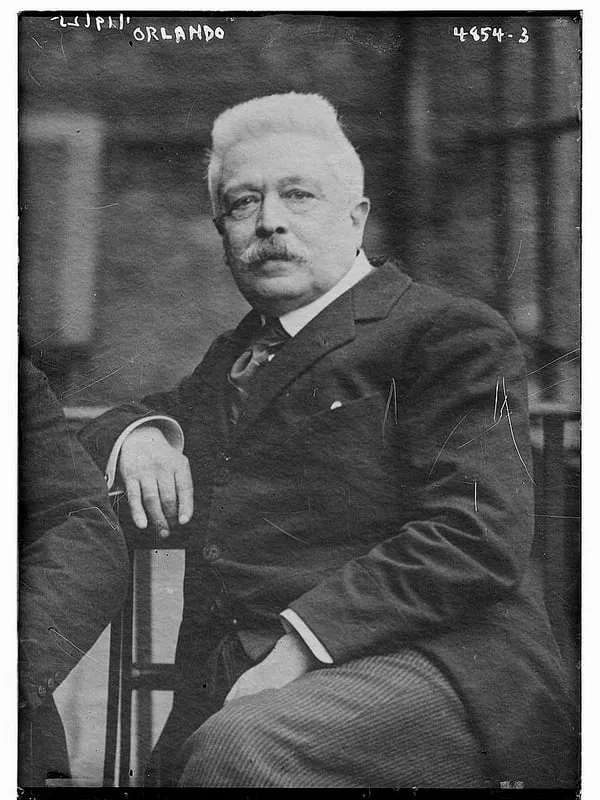
Vittorio Emanuele Orlando
Professor of public law, Minister of Justice (1907–1909, 1914–1916) and of the Interior (1916–1919), Prime Minister of Italy (1917–1919), President of the Chamber of Deputies (1919–1920, 1944–1945)
- Born:
- 19 May 1860, Palermo (Italy)
- Died:
- 1 December 1952, Rome
- Author:
- Natalia
- Photo:
- Bain News Service, domena publiczna, Wikimedia Commons

Vittorio Emanuele Orlando, a distinguished jurist from Palermo, took over the Italian government at the worst moment of the country’s war, at the end of October 1917, as the army was retreating in disorder from Caporetto. With the watchword “Resistere!” (Hold fast!) he rallied the country behind the defence of the Piave, and a year later, as the “Prime Minister of Victory”, he sat in Paris among the Big Four alongside Woodrow Wilson, Georges Clemenceau and David Lloyd George. There he lost the dispute over Fiume and the Adriatic coast. The disappointment, which the nationalists called the “mutilated victory”, brought down his government and became one of the roots of Fascism. Like many liberals, Orlando at first saw Benito Mussolini as a cure for the crisis of the state, and by the time he understood what the dictatorship was, it was too late. He outlived it, and after the war, as one of the last liberal politicians of Italy, he protested against the peace that the victors dictated to Italy in 1947.
The professor from Palermo
He was born on 19 May 1860 in Palermo, a few days after Garibaldi’s Expedition of the Thousand landed in Sicily. His father, Camillo, was a lawyer. Vittorio studied law at the University of Palermo and made a very rapid academic career. Before he had even graduated he won a competition for an essay on electoral reform, and while still in his twenties he taught constitutional law in Palermo, Modena and Messina. His textbooks on the principles of constitutional law (1889) and administrative law (1890 and 1891) are regarded as the founding act of the modern Italian science of public law. He took the German school as his model and sought to make public law a strictly scientific discipline, separate from politics. In 1891 he founded the journal Archivio di diritto pubblico, around which he gathered his pupils. From 1903 to 1931 he lectured at the University of Rome.
He was elected to parliament in 1897 for the Sicilian constituency of Partinico, which he represented until 1925. He aligned himself with the liberal Giovanni Giolitti, in whose governments he was Minister of Education in 1903–1905 and Minister of Justice in 1907–1909. In November 1914 he took over the Ministry of Justice for a second time, now in the cabinet of Antonio Salandra, which in May 1915 brought Italy into the war on the side of the Entente. In return for entering the war, Italy was promised, in the secret Treaty of London, the Trentino, South Tyrol, Trieste, Istria and most of Dalmatia. Orlando, previously a supporter of neutrality, came out in favour of the war once Italy had entered it and drafted the laws granting the government emergency powers.
Interior minister and Prime Minister after Caporetto
In June 1916 he became Minister of the Interior in the cabinet of Paolo Boselli, and with it responsible for public order on the “home front”. He tried to respect constitutional freedoms, including those of the socialists and Catholics who opposed the war, which drew upon him the anger of the Chief of Staff, General Luigi Cadorna. The general accused the government of sapping the army’s morale by tolerating subversive propaganda.
On 24 October 1917 the Germans and Austrians broke through the front at Caporetto, and the Italian army fell back more than a hundred kilometres, losing hundreds of thousands of men, most of them as prisoners. Boselli’s government fell, and on 29 October Orlando became Prime Minister, keeping the Interior Ministry for himself. Sidney Sonnino, the uncompromising guardian of the Treaty of London, remained Foreign Minister. At the conference at Rapallo the Allies – Lloyd George and the French Prime Minister Paul Painlevé – made the dispatch of their divisions to Italy conditional on Cadorna’s removal. On 8 November he was replaced by General Armando Diaz, with whom the Prime Minister worked far better.
The army came to a halt on the Piave and on the Monte Grappa massif. Orlando did much to prevent the defeat from shattering the home front. On 22 December 1917 he ended a speech in parliament with the words “Resistere! resistere! resistere!”, which passed into legend. His government attended to propaganda among the troops, to the care of their families and to promises of land for peasants fighting at the front. In June 1918 the Italians beat off the last great Austro-Hungarian offensive on the Piave, and the Prime Minister, like Marshal Ferdinand Foch, pressed Diaz to go over to the attack. He wanted Italy to enter the peace conference as a victor, not as a country whose victory had been won for it by others. The offensive began on 24 October 1918, the anniversary of Caporetto, and ended at Vittorio Veneto with the disintegration of the Austro-Hungarian army. On 3 November the armistice was signed at Villa Giusti near Padua. The war cost Italy some 650,000 dead.
Paris and Fiume
Orlando came to the Paris Peace Conference as head of government of one of the five Great Powers. He became one of the conference’s four vice-presidents, but the opening session itself, on 18 January 1919, coincided with a crisis in his government in Rome, which ended that day with a reshuffle of the cabinet after the resignations of Leonida Bissolati and Francesco Saverio Nitti. Bissolati left because he opposed the annexation of lands inhabited by Slavs. From 24 March Orlando sat on the Council of Four, but he did not speak English, and his talks with Wilson and Lloyd George were conducted mostly in French or through Sonnino.
Italy demanded everything that the Treaty of London had promised, and in addition the port city of Fiume, where Italians made up the majority of the inhabitants of the town centre but which the treaty had not assigned to Italy. The two Italian statesmen differed: Orlando was prepared to give up most of Dalmatia in return for Fiume, while Sonnino insisted on Dalmatia. As a result Italy demanded both and obtained neither. The obstacle was Wilson, who did not feel bound by a secret treaty, invoked the principle of nationality and defended the interests of the emerging Kingdom of Serbs, Croats and Slovenes. On 23 April 1919 the President published a message to the Italian people in which, over the Prime Minister’s head, he called on Italians to show moderation. Orlando regarded this as an attack on his authority, and the next day the Italian delegation left Paris. In Rome he was greeted by crowds, and parliament gave the government a vote of confidence. In Paris, however, the talks went on without the Italians, and when it looked as though the treaty would be handed to Germany without them, Orlando and Sonnino returned on 7 May, having obtained no concessions.
The failure weighed on the Prime Minister. On 19 June 1919 the Chamber of Deputies rejected the government’s request for a secret session on the conference, which amounted to a loss of confidence. Orlando resigned, and on 23 June Nitti took over the government. Orlando thus did not sign the Treaty of Versailles. Italy received the Trentino, South Tyrol, Trieste and Istria, but the nationalists, egged on by the poet Gabriele D’Annunzio, spoke of a “mutilated victory”. In September 1919 D’Annunzio, at the head of a band of volunteers, seized Fiume. The charge that the liberal politicians had squandered the fruits of victory became one of the strongest arguments of the emerging Fascist movement.
A liberal confronting Fascism
In 1919–1920 Orlando was President of the Chamber of Deputies. When in October 1922 the Fascists staged the March on Rome and King Victor Emmanuel III entrusted the government to Mussolini, Orlando, like most liberals, accepted the new government as a necessary response to chaos and hoped that Fascism could be absorbed into the parliamentary system. In 1923 he sat on the committee that examined the Acerbo bill, which gave two-thirds of the seats to the list winning at least a quarter of the votes, and in 1924 he stood as a candidate on the government’s “big list” (listone) in Sicily.
The turning point was the kidnapping and murder of the socialist deputy Giacomo Matteotti in June 1924. According to the Treccani Biographical Dictionary, Orlando went over to the opposition in November 1924; other sources link his break with Mussolini’s speech of 3 January 1925, which opened the way to dictatorship. In the summer of 1925 he lost the municipal elections in Palermo to the Fascist list, and in August he gave up his seat in parliament. In 1931 he left the university, avoiding the oath of loyalty to the regime that was required of professors. His stance, however, was not entirely consistent: on 3 October 1935, the day Italy invaded Ethiopia, he wrote Mussolini a letter placing himself at the disposal of the fatherland, and the dictator published it in the press for propaganda purposes.
The Second World War and the republic
When in July 1943, after the Allied landings in Sicily, the King was preparing to remove Mussolini, Orlando was among the pre-Fascist politicians whom the monarch consulted in secret. He is credited with drafting the proclamation of Marshal Pietro Badoglio of 25 July 1943, which announced the fall of Fascism and gave the assurance that “the war goes on”. After the liberation of Rome, in 1944–1945, he again presided over the Chamber of Deputies.
In 1946 he was elected to the Constituent Assembly and presided over its first sittings. When in 1947 the assembly debated the ratification of the peace treaty, which deprived Italy of its colonies, Istria and Zadar and limited its armed forces, Orlando made a fiery speech against it and accused the Prime Minister, Alcide De Gasperi, of a “lust for servility” towards the victors. The old Prime Minister, who in 1919 had fought in Paris for the Adriatic coast, saw Italy in 1947 lose even what it had gained then. In 1948 he was put forward as a candidate in the election of the President of the Republic, which was won by Luigi Einaudi. As a former head of government, Orlando became a senator by right. He spoke in parliament to the end. He died in Rome on 1 December 1952, aged 92.
Assessment
Italians remember Orlando above all as the “Prime Minister of Victory”. Historians stress that after Caporetto he gave the country the leadership it had previously lacked: he chose Diaz wisely and backed him, kept parliament united and refused to be pushed down the road of police rule that Cadorna demanded. His oratory was an important weapon in the winter of 1917–1918. He also remained one of Italy’s most important theorists of public law.
He is judged less favourably as a diplomat. His failure in Paris was attributed to indecision and to his being torn between loyalty to the Treaty of London and the demand for Fiume. His defenders reply that no Italian prime minister could have overcome Wilson’s opposition. For the story of the road to the Second World War, what followed matters more. The myth of the “mutilated victory”, born around his defeat in Paris, fed Italian nationalism, and for twenty years Mussolini promised Italians what they had not received in 1919. Orlando, who in 1922–1924, together with other liberals, helped the Fascists consolidate their power, withdrew from public life once the dictatorship had dropped its mask. He returned to politics only after its fall and after the defeat into which it had dragged Italy.
Sources
Mentioned in battles
(01)Often appears with
People who appear in the same events.