Poland
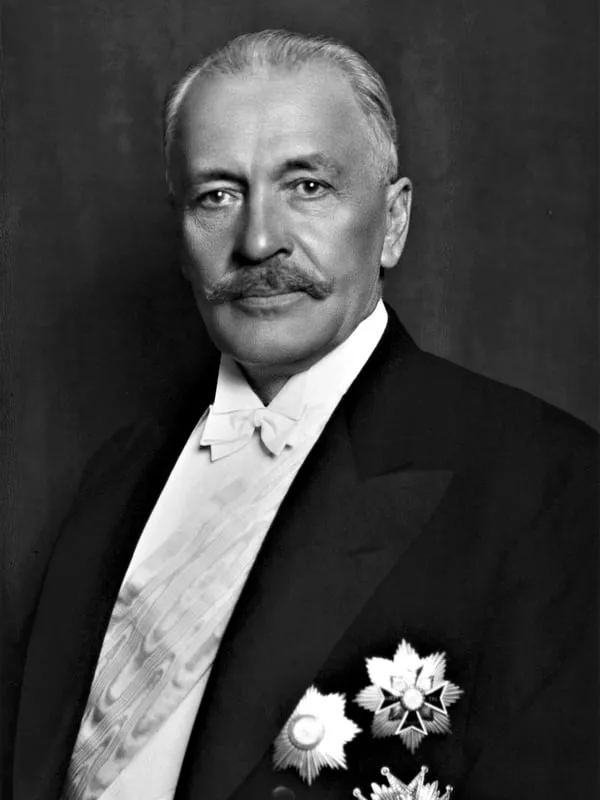
Ignacy Mościcki
President of the Republic of Poland (1926–1939), professor at the Lwów and Warsaw Polytechnics
- Born:
- 1 December 1867, Mierzanów (Russian Empire)
- Died:
- 2 October 1946, Versoix (Switzerland)
- Author:
- Łukasz
- Photo:
- autor nieznany, domena publiczna, Wikimedia Commons

Ignacy Mościcki was a scientist who, by an accident of history, became head of state. A chemist and inventor of European reputation, a socialist and conspirator in his youth, he was made President of the Republic in 1926 at the wish of Józef Piłsudski and held the office longer than anyone before him, until September 1939. During Piłsudski’s lifetime his role was mainly ceremonial; after the Marshal’s death he became one of the two pillars of the ruling camp, alongside Marshal Edward Rydz-Śmigły. It was he who signed the acts with which Poland entered the war, and it was he who, interned in Romania, passed his office to a successor in exile, thanks to which the Polish state retained lawful authorities recognised by the Allies.
Youth and conspiracy
He was born on 1 December 1867 in Mierzanów (PL) near Ciechanów, in the Kingdom of Poland, into a noble family with a tradition of insurrection: his grandfather had fought in the November Uprising, his father and uncles in the January Uprising. He attended gymnasia in Płock and Zamość and, to escape Russification, took his school-leaving examinations at a modern school (realschule) in Warsaw. In 1891 he graduated in chemistry from the polytechnic in Riga. There he joined the National League and the Union of Polish Youth “Zet”, but he soon moved over to the pro-independence socialist movement. In 1892, by then married to his cousin Michalina Czyżewska, he took part in Warsaw in preparations by members of the Second Proletariat (PL) for a bomb attack on the Governor-General of Warsaw, Iosif Gurko. The plot was uncovered. Mościcki, warned of his impending arrest, fled with his wife through Germany to London.
In London he lived in poverty for several years, working as a labourer, while studying and taking part in the Union of Polish Socialists Abroad (PL), the émigré base of the Polish Socialist Party. In 1896 he met Piłsudski there. The acquaintance, kept up over the following decades, shaped the whole of his later life.
The inventor
In 1897 Mościcki moved to Switzerland and became assistant to the physicist Józef Wierusz-Kowalski at the University of Fribourg. He worked on fixing nitrogen from the air in an electric arc – that is, producing nitric acid without Chilean saltpetre – and along the way designed and patented high-voltage capacitors that were used throughout Europe. His method was used to build a nitric acid plant at Chippis in Switzerland, which opened in 1910. Fribourg was also a place where Piłsudski stayed on his travels around Europe.
In 1912 Mościcki accepted a professorship at the Lwów Polytechnic. In Lwów (Lviv) he worked on the processing of crude oil and natural gas, accumulated dozens of patents and during the war founded the “Metan” research institute, from which the Chemical Research Institute in Warsaw grew in 1922. After part of Upper Silesia was awarded to Poland, he took over in 1922 as director of the nitrogen compounds plant at Chorzów, taken over from the Germans. Despite the departure of the German staff and the lack of documentation, he soon had it running and greatly increased its output of fertilisers. In 1925 he was elected rector of the Lwów Polytechnic but moved instead to the Warsaw Polytechnic. Later, as president, he initiated the building of the State Nitrogen Compounds Works near Tarnów (PL), which went into operation in 1929–1930. The factory district was named Mościce.
President by Piłsudski’s choice
After the May Coup of 1926 the National Assembly elected Piłsudski president on 31 May, but he declined, believing that the March Constitution gave the head of state too little power. Prime Minister Kazimierz Bartel then proposed Mościcki, and the Marshal accepted the proposal with satisfaction. On 1 June 1926, in the second ballot, Mościcki defeated the candidate of the right, Adolf Bniński, and became the third President of the Republic, after Gabriel Narutowicz and Stanisław Wojciechowski. He took up residence in the Royal Castle.
Until 1935 real power lay with Piłsudski. The president, formally strengthened by the August Amendment, signed the Marshal’s decisions on dissolving parliament and on dismissing and appointing governments, while himself dealing mainly with the economy and industry. Piłsudski treated him with ostentatious respect, but the opposition saw him as a puppet. Mościcki also lent his name to the darkest episodes of those years: the crackdown on the Centrolew (the centre-left opposition alliance), the arrest of its leaders before the 1930 election and their imprisonment in the Brest fortress. On 8 May 1933, with part of the opposition boycotting the vote, he was elected to a second term. As head of state he ratified the treaties that shaped Poland’s position between Germany and the USSR, among them the Polish–German declaration of non-aggression of 1934. The president’s private life caused a scandal in 1933: a year after the death of his first wife he married his secretary, Maria Nagórna, the wife of his aide-de-camp, whose previous marriage had been annulled by the church authorities.
Duumvirate with Rydz-Śmigły
In April 1935 the April Constitution came into force, making the president the supreme organ of the state, “responsible before God and history”. A month later Piłsudski died. Some of his associates, led by Walery Sławek, expected Mościcki to step down and make way for Sławek, whom the Marshal had reportedly seen as his successor. The president refused. He reached an informal understanding with the new Inspector General of the Armed Forces, Rydz-Śmigły, and together they pushed Sławek out of power. In 1936 the two of them settled the composition of Prime Minister Felicjan Sławoj Składkowski’s government, which included both the president’s men – with Deputy Prime Minister Eugeniusz Kwiatkowski, creator of the Central Industrial Region – and the general’s. On 10 November 1936 Mościcki presented Rydz with the baton of a Marshal of Poland.
Thus arose the duumvirate of the “Castle” and the Inspector General, in which the president was responsible chiefly for the economy and Rydz-Śmigły for the army and, together with Foreign Minister Józef Beck, for foreign policy. The president seldom opposed it. In the spring of 1939 Beck reported to him on the German demands concerning Gdańsk and the motorway, and the ruling camp rejected them unanimously. That summer Mościcki, like Rydz, refused to agree to a government of national unity including the opposition. At the end of August he responded positively to Franklin Delano Roosevelt’s appeal for a peaceful settlement of the dispute, agreeing to negotiation or conciliation, and on 29 August, at Rydz’s request, he decided to proclaim general mobilisation, which was postponed by a day under pressure from the British and French ambassadors.
September 1939
The German attack found the president at Spała. On the morning of 1 September Polish Radio broadcast his address: “Citizens of the Republic! Last night our age-old enemy began offensive operations against the Polish State, which I declare before God and History.” That day he appointed Rydz-Śmigły Commander-in-Chief and, in accordance with Article 24 of the constitution, designated him as his successor should the office fall vacant in time of war. On 3 September he signed the decree establishing the Czech and Slovak Legion. As the Germans advanced, the president moved his seat several times: from the vicinity of Warsaw he went on 8 September to Ołyka in Volhynia, and around 14 September to Załucze on the Czeremosz, on the Romanian border.
After the Red Army invaded on 17 September, the authorities decided to cross into Romania, hoping to travel on to France. Mościcki crossed the border bridge at Kuty at 9.45 p.m. Romania, under German pressure, interned him together with the government and the Commander-in-Chief. The president was placed under guard at Bicaz in the Eastern Carpathians. Knowing that he could not govern from there, Mościcki decided to hand over his office. First, in a sealed envelope sent to the embassy in Paris, he named as his successor the ambassador in Rome, General Bolesław Wieniawa-Długoszowski. When the French government and the opposition grouped around General Władysław Sikorski objected to the appointment, Wieniawa withdrew, and the president named Władysław Raczkiewicz instead. On the evening of 29 September Mościcki resigned, and on 30 September Raczkiewicz was sworn in in Paris and appointed Sikorski’s government. This act, carried out in accordance with the constitution, ensured the continuity of the Polish state, whose existence Germany and the Soviet Union did not recognise.
Switzerland
The former president wished to go to Switzerland, of which he had been a citizen from 1908 to 1920. The Germans objected, but after American intervention the Romanian government allowed him to leave in December 1939. He travelled through Italy to Fribourg, where for a time he lectured at the university, and then moved to Geneva and worked in a chemical laboratory. The new authorities in exile, who blamed the Sanacja regime for the defeat, kept him out of politics. He wrote his memoirs and gave financial support to Polish soldiers and prisoners of war. After 1943 his health deteriorated sharply. He died on 2 October 1946 at Versoix near Geneva and was buried in the local cemetery. In 1993 his remains were brought back to Poland and laid in the crypt of St John’s Archcathedral in Warsaw.
Assessment
Mościcki was one of the most eminent Polish chemical technologists of his time, and his contribution to building the chemical industry of reborn Poland is beyond dispute. As a politician he raises far more doubts. For nine years he lent his name to Piłsudski’s authoritarian rule, including the repression of the opposition, and after 1935, in the duumvirate with Rydz-Śmigły, he shared responsibility for a system that before the war rejected an understanding with the opposition and failed to prepare the state for war with two more powerful neighbours. In exile and in communist Poland he was seen as the symbol of the Sanacja regime and its defeat, and the night crossing of the bridge at Kuty long remained one of the most bitter images of September. Historians also stress, however, that his last decision – handing over the office to Raczkiewicz in accordance with the constitution – had lasting significance: thanks to it, Poland had a president and government recognised by its allies throughout the war, and the state that Germany and the USSR declared non-existent remained a belligerent until the very end.
Sources
Mentioned in battles
(03)Often appears with
People who appear in the same events.
On the timeline
(18)1927
1934
1939
March
April
August
September
- 01
- Key eventGermany invades PolandAt dawn on 1 September 1939 the Wehrmacht attacked Poland from the north, west and south without declaring war. The Slovak army struck alongside the Germans.
- Roosevelt’s appeal to spare civiliansOn 1 September 1939 Roosevelt urged the belligerents not to bomb civilians. Hitler gave his pledge on the very day the Luftwaffe destroyed Wieluń.
- 28
- The German–Soviet Boundary and Friendship TreatyOn 28 September 1939 Ribbentrop and Molotov signed the Boundary and Friendship Treaty, moving the partition line to the Bug and giving Lithuania to the USSR.
- The Soviet–Estonian Mutual Assistance PactOn 28 September 1939, under threat of war, Estonia signed a mutual assistance pact in Moscow, giving the USSR bases and the right to station 25,000 troops.