Hungary
Albert Apponyi
Hungarian Minister of Religion and Education (1906–1910, 1917–1918), head of the Hungarian peace delegation (1920), delegate to the League of Nations
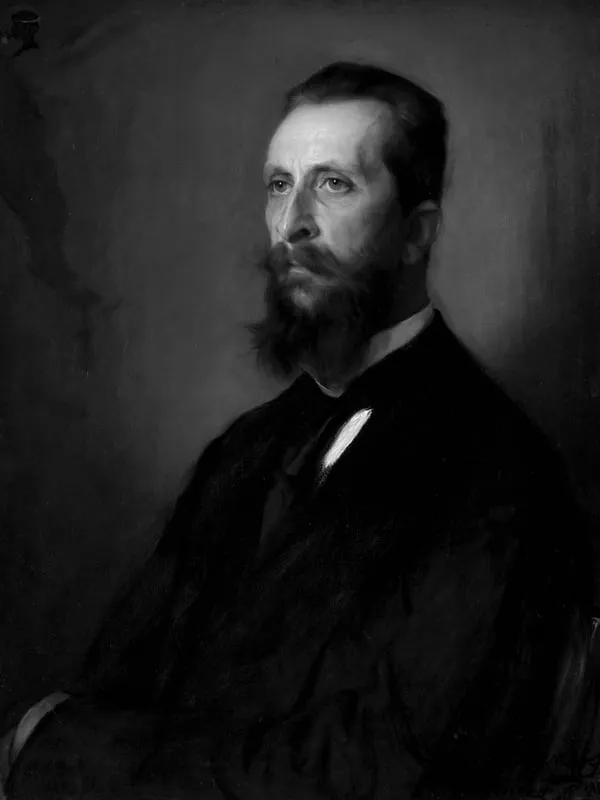
- Born:
- 29 May 1846, Vienna (Austrian Empire)
- Died:
- 7 February 1933, Geneva (Switzerland)
- Author:
- Natalia
- Photo:
- Philip de László, domena publiczna, Wikimedia Commons

Count Albert Apponyi sat in the Hungarian parliament for more than sixty years and was regarded as his country’s greatest orator. To Hungarians he was a symbol of national dignity: it was he who, in Paris in January 1920, defended the integrity of the historic kingdom before the victors in three languages, and who then spent a decade in Geneva reminding the world of the injustice of the Treaty of Trianon. To Slovaks, Romanians and Serbs he was above all the author of the school laws of 1907, which became a byword for Magyarisation. Both faces belong to the same man. Apponyi was a liberal on freedom of speech and the franchise, and at the same time a convinced nationalist for whom Hungary was the state of a single political nation. His life shows where Hungarian revisionism came from – the revisionism that, after his death, led the country into alliance with Hitler.
Aristocrat and parliamentarian
He was born on 29 May 1846 in Vienna, where his father, Count György Apponyi, was then the Hungarian Court Chancellor. He came from one of the oldest families of the Hungarian aristocracy. He was educated at the Jesuit college at Kalksburg near Vienna and studied law in Pest and Vienna. He then spent several years travelling through Germany, France and England, where he encountered the French Catholic liberals and the ideas of the conservative sociologist Frédéric Le Play. He spoke fluent German, French, English and Italian and was interested in music, philosophy and literature.
He first entered parliament in 1872 and, with one short break, sat in it until his death. He quickly made his name as an orator. He began as a conservative, then led the moderate opposition, which demanded wider rights for Hungary within the Dual Monarchy, above all Hungarian as the language of command in the army. From 1901 to 1903 he was Speaker of the House of Representatives. Later he moved to the Party of Independence, which wanted to loosen the ties with Austria, and in 1905 he helped lead the campaign in which the opposition defeated the Liberals, who had governed for decades. In 1897 he married Countess Clotilde Mensdorff-Pouilly, who later became an activist in the women’s movement. The family lived at the manor house in Éberhárd, today’s Malinovo near Bratislava, where in 1910 Apponyi hosted the former President of the United States, Theodore Roosevelt.
He was also one of the most active Hungarian figures in the peace movement and in the Inter-Parliamentary Union, in which he was involved from 1895. He made repeated lecture tours of the United States and was nominated several times for the Nobel Peace Prize.
Lex Apponyi
From April 1906 to January 1910 Apponyi was Minister of Religion and Education in the government of the opposition coalition. His reforms extended free elementary education, but he is best known for the school laws of 1907, named Lex Apponyi after him. They required all elementary schools, including the minorities’ denominational schools, to teach Hungarian to such a level that after four years a child could use it in speech and writing. Teachers at denominational schools whose salaries were subsidised by the state came under close supervision and could be dismissed for an attitude deemed hostile to the state. Schools that failed to meet the requirements were closed. According to some studies, several hundred Romanian villages were left without a school.
The government argued that every citizen ought to know the language of the state. The minorities saw the laws as an attempt at denationalisation, and abroad they drew protests from, among others, the Norwegian writer Bjørnstjerne Bjørnson. Even Apponyi’s opponent István Tisza believed that compulsory Hungarian lessons would make no one a Hungarian, but would rather make enemies of the Hungarian cause. A dozen or so years later, in Paris, these laws became one of the most effective arguments against Apponyi.
War and revolutions
In 1914, after the death of Ferenc Kossuth, Apponyi became leader of the Party of Independence. He greeted the outbreak of war with enthusiasm; according to accounts later cited by his opponents, he welcomed it in parliament with the cry “At last!”. In 1915, amid the victories in Serbia and Poland, he sketched out plans for the monarchy’s territorial gains. Over time, however, he pressed ever harder for an extension of the franchise, which in Hungary covered only a small proportion of men. When in 1917 King Charles IV induced Tisza to resign, Apponyi again served as Minister of Education from June 1917 to May 1918.
After the Aster Revolution he withdrew from public life. When Béla Kun’s communists seized power in March 1919, he fled Budapest by carriage and made his way across Transdanubia to his estate at Éberhárd, which already lay in territory occupied by the Czechoslovaks. He returned to the capital in November 1919. He took part in the talks held under the auspices of the British diplomat George Clerk, which were meant to produce a government that the Entente would recognise, and for a moment he was mentioned as a candidate for prime minister, but part of the Christian-National camp opposed it.
Paris, 1920
At the beginning of December 1919 the government of Károly Huszár entrusted him with leading the delegation to the peace conference. Apponyi arrived in Paris in January 1920, received the peace terms on 15 January, and on 16 January addressed the Supreme Council, on which sat Georges Clemenceau, David Lloyd George and Francesco Saverio Nitti. He spoke in French and English and finished in Italian. He called for plebiscites in the disputed territories and promised that Hungary would abide by their results. He asked whether the country was to commit suicide in order to escape a natural death.
The speech was admired but changed nothing. The borders had already been settled, and Apponyi’s appointment as head of the delegation had been welcomed in Prague: the Czechoslovak diplomat Štefan Osuský wrote that this was precisely the man who embodied the contempt for the Slovaks in the old kingdom. The words in the speech about handing power to nations “at a lower level of culture” merely confirmed the neighbours’ charges. When it became clear that the terms would remain unchanged, Apponyi resigned as head of the delegation and did not sign the treaty, which was signed at Trianon on 4 June 1920 by two less well-known officials. At home his speech was hailed as an act of national heroism.
Legitimist and advocate of revision
In the 1920s Apponyi sat as deputy for Jászberény, formally as an independent; on the question of the form of the state he was a legitimist who regarded Charles IV as the rightful king. When Charles twice tried to regain the throne in 1921, Apponyi had not known of his intentions in advance, but when parliament, under pressure from the Great Powers and the Little Entente, stripped the Habsburgs of their rights to the crown in November 1921, he protested and walked out of the chamber with the legitimists. In domestic politics he demanded the secret ballot and criticised the restrictions on political freedom under the governments of István Bethlen.
His main field of activity, however, became foreign policy. In the autumn of 1923 he made a triumphant lecture tour of the United States and Canada, speaking about the situation of Central Europe and the injustice done to Hungary. In the same year he represented Hungary for the first time before the Council of the League of Nations, and from 1924 he led the Hungarian delegation to the Assembly in Geneva. He demanded that complaints by national minorities be examined as a matter of course and with the involvement of the court in The Hague, and that the victors, as promised in the peace treaties, disarm themselves. From 1927 to 1930 he conducted a dispute before the League with Romania over compensation for the Hungarian landowners of Transylvania who had been expropriated in the Romanian land reform; his opponent in it was Nicolae Titulescu. In September 1929, arguing in Geneva that the Treaty of Trianon could not endure, he warned that nothing in politics is eternal.
Death in Geneva
He died on 7 February 1933 in Geneva, where he had come for the resumption of the disarmament conference. A week earlier Adolf Hitler had become Chancellor of Germany, and in the autumn of that year Germany left both the conference and the League, burying the cause for which Apponyi had campaigned for a decade. His coffin lay in state in the parliament building in Budapest, and on 14 February 1933 Apponyi was buried in the Matthias Church in Buda Castle. The funeral was attended by the Regent, Miklós Horthy, and the prime minister, Gyula Gömbös, while Benito Mussolini sent an enormous wreath. When the First Vienna Award of 1938 gave southern Slovakia to Hungary, Éberhárd was once again within Hungary’s borders, and during the war the remains of Apponyi and his wife were moved to the family chapel on the former estate. Hungarian sources date this to September 1943. The grave is still there today, now in Slovakia.
Significance
Apponyi belonged to the generation that built the modern Hungary of the Dual Monarchy, and he could not accept that their multinational kingdom had ceased to exist. He defended it by means that in his day counted as civilised: oratory, law, appeals to Wilson’s principles and to the League of Nations. Yet the same attitude made the revision of Trianon the overriding aim of the entire state, and revision was impossible without Great Powers willing to overturn the Versailles order. A few years after his death those powers, Italy and Germany, gave Hungary back part of its lost lands, including his own Éberhárd, and Hungary paid for it by taking part in Hitler’s war. Apponyi did not live to see this, and it is impossible to say how he would have judged that price. His speech of 16 January 1920 remains one of the most important texts of national memory in Hungary, while in the neighbouring countries his name is still associated above all with the school laws of 1907.
Sources
Often appears with
People who appear in the same events.