United Kingdom
George V
Prince of Wales (1901–1910), King of the United Kingdom and the Dominions, Emperor of India (1910–1936)
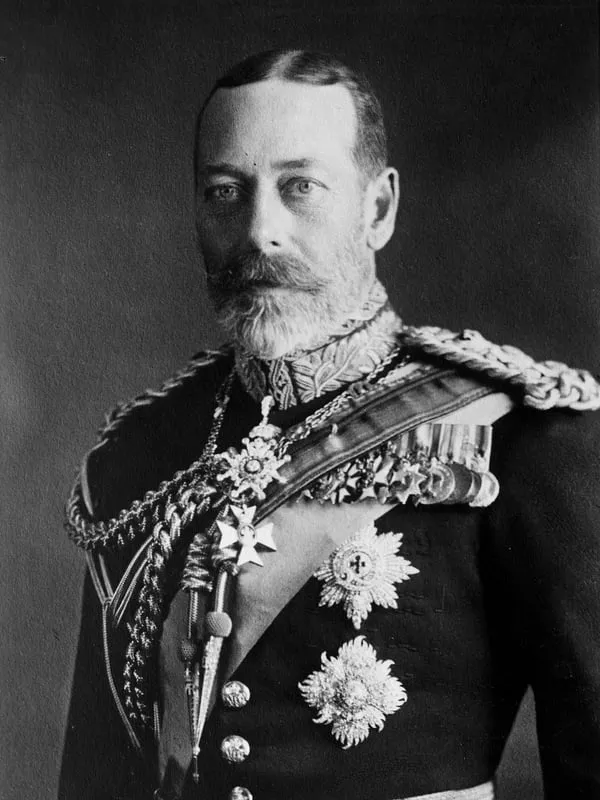
- Born:
- 3 June 1865, London (United Kingdom)
- Died:
- 20 January 1936, Sandringham (Norfolk, United Kingdom)
- Author:
- Łukasz
- Photo:
- Bassano Ltd, domena publiczna, Wikimedia Commons

George V reigned over Britain and the largest empire in history for a quarter of a century, from 1910 to 1936. He had no outstanding talents and did not want any: he was a sailor, a shot and a stamp collector, a man of duty and habit, whom a biographer ironically described as someone who for years “did nothing at all but kill animals and stick in stamps”. Even so, he steered the British monarchy through an age in which the thrones of his cousins in Russia and Germany fell, through the First World War, the war in Ireland, the first Labour governments and the Great Depression. He renamed the dynasty Windsor, turned the Crown into a symbol of the unity of the independent dominions and was the first monarch to speak to his subjects by radio. From the point of view of the road to the next war he also matters as one of the few people at the summit of power who had no illusions about Hitler from the start, and as the father of two kings: Edward VIII, about whom he had grave misgivings, and George VI, who led the country into war in 1939.
Younger son and sailor
George Frederick Ernest Albert was born on 3 June 1865 at Marlborough House in London, the second son of the heir to the throne, the future Edward VII, and the Danish princess Alexandra. His grandmother was Queen Victoria. No one expected him to become king, since the throne was to pass to his elder brother, Prince Albert Victor. At the age of twelve the two brothers were sent to the training ship Britannia, and in 1879–1882 they sailed round the world in the corvette Bacchante, visiting the colonies, South America, Egypt and Japan, among other places; in Japan they were received by the Emperor Mutsuhito. His elder brother then went to university, while George stayed in the Royal Navy. He commanded a torpedo boat and a gunboat, and in 1891–1892 the cruiser Melampus. The navy shaped him for life: punctuality, order and plain, soldierly manners stayed with him to the end.
In January 1892 Prince Albert Victor died of pneumonia during an influenza epidemic. George became second in line to the throne and had to give up his naval career. He was created Duke of York, and in July 1893 he married his late brother’s fiancée, Princess Mary of Teck. The marriage, entered into for reasons of state, turned out to be a very happy one. The couple had five sons and a daughter and lived modestly at York Cottage on the Sandringham estate. George was a stern father, and his relations with his sons, especially the eldest, Edward, were cool. In 1894 he travelled to St Petersburg for the funeral of Tsar Alexander III and the wedding of his first cousin, Tsar Nicholas II, whom he strikingly resembled. The German Emperor Wilhelm II was also his first cousin.
Prince of Wales
After Queen Victoria’s death in January 1901 his father became king, and in November that year George was created Prince of Wales. Before that he and his wife had made a grand tour of the Empire: he opened the first session of the parliament of the newly formed Australian federation and visited New Zealand, South Africa and Canada. On his return he warned in a celebrated speech that “the old country must wake up” if it wished to keep its position in colonial trade. Unlike Queen Victoria, his father allowed him to see state papers. In 1905–1906 George toured India, where he was offended by racial discrimination and became convinced that Indians should have a greater share in governing their country.
The first years of the reign
On 6 May 1910 Edward VII died and George became king. He was immediately caught up in a constitutional crisis. Herbert Asquith’s Liberal government wanted to curb the power of the Conservative House of Lords, which had thrown out Lloyd George’s budget, and demanded from the king a promise that, if necessary, he would create as many new peers as were needed to pass the reform. George reluctantly agreed, and the threat alone was enough: in 1911 the Lords passed the bill that took away their veto. On 22 June 1911 the king was crowned in Westminster Abbey. Among the guests from Japan were Admiral Heihachirō Tōgō and General Maresuke Nogi. In December that year George became the only Emperor of India to attend in person the durbar in Delhi, where he received the homage of the Indian princes and announced that the capital would move from Calcutta to Delhi.
Until 1914 the most serious problem was Ireland. The government wanted to give it home rule, the Ulster Protestants threatened armed resistance and the country stood on the brink of civil war. In July 1914 the king called a conference of the leaders of all sides at Buckingham Palace. It produced no agreement, and a few weeks later the outbreak of the world war pushed the question aside.
War and the House of Windsor
On 4 August 1914 the king wrote in his diary that the war with Germany was “a terrible catastrophe but it is not our fault”. For four years he visited the troops in France, hospitals and factories. In October 1915, during a review of troops in France, his horse threw him and fell on him, and he felt the effects of his injuries for the rest of his life. The war put the royal family in an awkward position: George was a grandson of Prince Albert of Saxe-Coburg and Gotha, his wife came from the German house of Teck, and the enemy, personified by Wilhelm II, was his cousin. When the writer H.G. Wells called the court “alien”, the king replied that he might be uninspiring, but he was certainly not an alien. On 17 July 1917 he changed the name of the royal house by proclamation to Windsor, and his relatives renounced their German titles. German cousins who had fought against Britain lost their British titles.
In the spring of 1917, after the February Revolution, the British government offered asylum to the deposed Nicholas II and his family. It was the king who, fearing the growth of revolutionary feeling at home and the reaction of public opinion, persuaded the government to withdraw the invitation. The imperial family stayed in Russia and in July 1918 was murdered by the Bolsheviks. George V called it a “foul murder” in his diary. He later helped the surviving Romanovs, and in 1919, on his personal instructions, a British officer escorted the last Emperor of Austria, Charles I, to Switzerland.
Between the wars
After the Armistice and the Treaty of Versailles the Empire reached its greatest extent, but it began to change from within. In June 1921, opening the Parliament of Northern Ireland, George V made a speech appealing for reconciliation, prepared with the involvement of David Lloyd George. A few weeks later a truce was agreed in the Anglo-Irish War, and in December a treaty created the Irish Free State. In 1921 the king received in London the Japanese crown prince Hirohito, who was greatly impressed by the relaxed atmosphere of the British court.
George V feared socialism, but he knew how to adapt to it. In January 1924 he appointed the Labour leader Ramsay MacDonald prime minister and treated him with a kindness that dispelled Labour’s misgivings. That government recognised the Soviet Union, although the king could never forgive the Bolsheviks for murdering his cousin. During the General Strike of 1926 he warned the Conservative government of Stanley Baldwin against provoking the strikers and is said to have remarked: “Try living on their wages before you judge them.” The Balfour Declaration of 1926 and the Statute of Westminster of 1931 recognised the dominions as equal to Britain, and the only formal bond between them became the person of the monarch. When in August 1931 the Labour government broke up under the weight of the slump, the king persuaded MacDonald to head an all-party National Government with the Conservatives and Liberals, and cut his own Civil List. On 25 December 1932 he gave the first ever royal Christmas broadcast on the radio.
From 1928 he was seriously ill. A lung infection and septicaemia nearly killed him, and for months afterwards many of his duties were taken over by his son Edward.
Facing Hitler
George V was disturbed by Hitler’s rise to power. In 1934 he told the German ambassador Leopold von Hoesch bluntly that Germany had become a danger to the world and that if it went on rearming at this pace there would be war within ten years. He warned the British ambassador in Berlin not to trust the Nazis. At the same time, like most Britons of his generation, who remembered the slaughter on the Western Front, he dreaded a new war and supported the policy of a government that was trying to avoid one. In May 1935 he celebrated his Silver Jubilee, which turned into a great demonstration of attachment to the monarch. The king was genuinely surprised that people loved him.
He worried about the future. His eldest son, a forty-year-old bachelor, had affairs with married women, and in 1934 became close to the American Wallis Simpson. In 1935 George V predicted that after his death Edward would “ruin himself in twelve months”, and prayed that nothing would come between the throne and his second son, Albert, and Albert’s daughter Elizabeth.
Death
In January 1936 the king took to his bed at Sandringham and died on 20 January shortly before midnight. Half a century later the diary of his physician, Lord Bertrand Dawson, revealed that Dawson had hastened his death with an injection of morphine and cocaine, partly so that the news could appear in the morning edition of The Times. The funeral in St George’s Chapel, Windsor, on 28 January brought together kings, princes, the President of France and ministers from almost the whole of Europe. The king’s prophecy came true sooner than he had expected: before the year was out Edward VIII had abdicated, and Albert had come to the throne as George VI.
Significance
George V created the model of the modern British monarchy: above politics, founded on a sense of duty, family virtues and closeness to its subjects, including working people and their representatives. Thanks to this the Crown survived an age in which almost all the dynasties of Europe fell, and became the bond holding together an Empire in transformation. On the eve of the Second World War this model proved important: after the abdication crisis his second son deliberately took his father’s name to evoke his reign, and during the war the royal family played the part of a symbol of national resistance. George V did not live to see the war he had warned against, but he left behind an institution that came through it.
Sources
Often appears with
People who appear in the same events.