United States
Edward R. Murrow
Head of the CBS European bureau (1937–1946), war correspondent in London (1939–1945), CBS radio and television journalist (1947–1961), Director of the USIA (1961–1964)
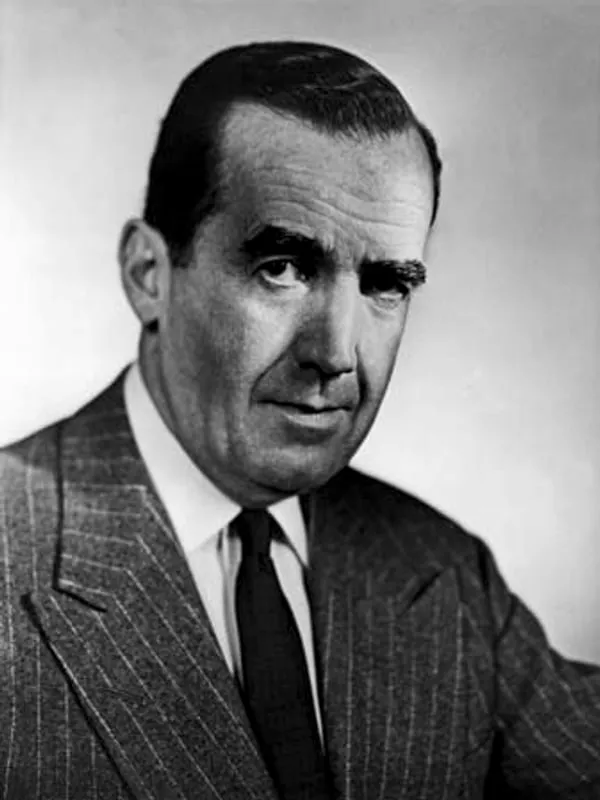
- Born:
- 25 April 1908, Polecat Creek near Greensboro, North Carolina (United States)
- Died:
- 27 April 1965, Pawling, New York (United States)
- Author:
- Natalia
- Photo:
- US Information Agency, domena publiczna, Wikimedia Commons

Edward Roscoe Murrow, born Egbert Roscoe Murrow, was the most famous American radio journalist of the Second World War and one of the founders of modern broadcast journalism. As head of the CBS network’s European bureau he organised, in 1938, the first great broadcasts linking several capitals at once, and during the Blitz his reports from London, which opened with the words “This is London”, brought the war into American homes and helped persuade a still-neutral America that Britain was also fighting its cause. He flew over Germany in bombers, was one of the first reporters to describe the Buchenwald camp, and after the war, by then on television, he stood up to Senator Joseph McCarthy. In the history of the Second World War he is above all a witness: the man whose voice shaped how Americans imagined the war in Europe.
From a Carolina cabin to university
He was born on 25 April 1908 in Polecat Creek near Greensboro, North Carolina, the youngest son of poor farmers, Roscoe and Ethel Murrow. His parents were Quakers; the family lived in a log cabin without electricity. When Egbert was six, the Murrows moved to the other end of the country, to Skagit County in Washington State, close to the Canadian border. The boy worked in logging camps, and at high school he was student body president and the best speaker on the debating team.
In 1926 he began studying at Washington State College in Pullman, where he chose speech. His teacher, Ida Lou Anderson, taught him to speak calmly and sparingly – it was from her that the famous pause in “This… is London” would later come. While a student he changed his name from Egbert to Edward and became involved in student politics. In 1929, after a speech in which he urged students to take an interest in world affairs, he was elected president of the National Student Federation of America.
After graduating he moved to New York. From 1932 to 1935 he was assistant director of the Institute of International Education, an organisation dealing with academic exchanges, and at the same time secretary of a committee that helped scholars expelled from German universities after Hitler came to power. This work gave him a knowledge of Europe, contacts and an early understanding of what Nazism was. In 1934 he married Janet Huntington Brewster; their only son, Casey, was born in London in November 1945.
CBS and the birth of radio reporting
In 1935 Murrow joined the CBS network as director of talks and education. At the time the network had no reporters of its own; his job was to invite politicians and scholars into the studio. In 1937 he went to London as head of the CBS European bureau, still not as a journalist but as an organiser of broadcasts. He then hired William L. Shirer to do similar work on the Continent. This was the beginning of the team of correspondents later known as the “Murrow Boys” – among them Eric Sevareid, Charles Collingwood, Howard K. Smith, Larry LeSueur, Cecil Brown, Bill Downs and Richard C. Hottelet, as well as one woman, Mary Marvin Breckinridge.
The breakthrough came in March 1938. When Germany carried out the Anschluss of Austria, Murrow was in Warsaw, and Shirer could not broadcast from Vienna because Austrian radio had fallen into Nazi hands. Murrow sent Shirer to London and himself chartered an aeroplane and flew to Vienna. At the request of the head office in New York, on 13 March 1938 the two organised a special broadcast in which correspondents in London, Paris, Berlin, Rome and Vienna spoke in turn, live, over short wave. It was technically very difficult, yet it worked; from this broadcast grew the daily “World News Roundup”, and Murrow spoke to America as a reporter for the first time. In September 1938 he and Shirer covered the Sudeten crisis and the Munich Agreement, and listeners in the United States waited for their links from Europe as if for news from the front.
“This is London”
When war broke out Murrow stayed in London. His broadcasts began with the words “This is London”, with a marked stress on the first word and a short pause – a formula suggested by his old teacher in place of the earlier “Hello, America. This is London calling”. In August 1940 he helped create “London After Dark”, broadcast live from the streets of the city at night, and when in September the Luftwaffe began the Blitz he spoke into the microphone from rooftops, streets and shelters, during raids, to the sound of sirens and anti-aircraft guns. He described ordinary Londoners, the queues outside the shelters, wrecked houses, firemen. He signed off with “Good night, and good luck” – the farewell Londoners exchanged in the evenings, not knowing whether they would see each other in the morning.
These reports had political weight. In the United States the isolationists were locked in a dispute with President Franklin Delano Roosevelt, who wanted to help Britain. Murrow did not campaign openly, but his picture of a calm London that was fighting back – reinforced by other correspondents and by British propaganda – reached millions of listeners. Murrow was also close to the British elite: he was friends with politicians, and in 1943 Winston Churchill even offered him the joint direction of BBC programmes, which Murrow declined. An affair with the Prime Minister’s daughter-in-law, Pamela Churchill, ended after the birth of Murrow’s son.
At the end of 1941 Murrow came to America on leave. On 2 December CBS gave a grand banquet in his honour at the Waldorf-Astoria hotel; the poet Archibald MacLeish said on that occasion that Murrow had “burned the city of London in our houses”. Five days later, on the evening of 7 December 1941, Murrow was invited to dinner at the White House. Despite the attack on Pearl Harbor, Eleanor Roosevelt did not cancel the invitation, and after midnight the President received Murrow for a conversation and told him about the fleet’s losses; according to his biographers, Murrow regarded this knowledge as confidential and did not use it in his reports.
Over Berlin and in Buchenwald
After the United States entered the war Murrow returned to London and built up the CBS bureau into a team that the journalist Harrison Salisbury called the finest ever assembled in Europe. Against the wishes of his superiors he flew with bomber crews – according to his biographers he took part in about 25 combat missions.
The most famous of them took place on the night of 2–3 December 1943, during the air Battle of Berlin. He flew in the Lancaster “D-Dog”, piloted by Wing Commander William “Jock” Abercromby. Over the city the aircraft was caught in a cone of searchlights, and only the pilot’s violent manoeuvres allowed it to break free. Of the five journalists who flew with RAF crews that night, three did not come back. The next day Murrow broadcast the report known as “Orchestrated Hell”: “Berlin was a kind of orchestrated hell, a terrible symphony of light and flame.” He spoke of the airmen’s calm, of his own fear and of how men were dying in the sky while others were roasted alive in their cellars, and he called the raid a “calculated, remorseless campaign of destruction”. The report became a classic of war journalism.
In April 1945 Murrow accompanied units of the US Third Army in Thuringia. On 12 April, the day after the liberation of the Buchenwald concentration camp, he went in with another reporter, Bill Shadel. He saw emaciated prisoners, children with tattooed numbers, piles of bodies by the crematorium. He broadcast his report on 15 April, while America was still absorbed by the death of President Roosevelt. He spoke without raising his voice, and ended with words that were remembered for generations: “I pray you to believe what I have said about Buchenwald.” He had reported what he had seen and heard, he said, but only part of it; for most of it he had no words. And he added that if he had offended his listeners with this rather mild account of Buchenwald, he was not in the least sorry. It was one of the first reports through which American public opinion saw the truth about the German camps.
After the war: from radio to television
In December 1945 Murrow reluctantly accepted an offer from the head of CBS, William S. Paley, and became the network’s vice-president in charge of news. He broadcast his last report from London in March 1946. The role of manager did not suit him; its most painful episode was the break with Shirer in 1947, after Shirer lost his programme at CBS. Later in 1947 Murrow returned to the microphone with an evening news programme. With the producer Fred W. Friendly he made a series of records of historic recordings, “I Can Hear It Now”, and in 1950 the two began broadcasting the radio magazine “Hear It Now”.
On 18 November 1951 the magazine moved to television as “See It Now”. Murrow, who had at first distrusted television, became its first great journalist. In 1953 a second programme followed, “Person to Person”, in which he visited the homes of well-known people – lighter in tone and very popular.
Murrow against McCarthy
From 1950 to 1954 American political life was shaken by the campaign of Senator Joseph McCarthy, who accused officials, soldiers and artists of communist sympathies. In October 1953 “See It Now” presented the case of Milo Radulovich, an Air Force reserve lieutenant whom the service wanted to discharge because of the alleged political sympathies of his father and sister; after the programme the decision was reversed. On 9 March 1954 Murrow and Friendly broadcast a half-hour “Report on Senator Joseph R. McCarthy”, built mainly from the senator’s own statements, which exposed his contradictions and methods. Murrow closed it by saying that “we must not confuse dissent with disloyalty”, and of the senator himself he said: “He didn’t create this situation of fear; he merely exploited it – and rather successfully.” McCarthy replied on 6 April on the same programme, accusing Murrow of communist sympathies, but came off badly. The programme did not bring the senator down on its own, but it contributed to a change of mood; in December 1954 the Senate censured McCarthy. The story became the subject of George Clooney’s 2005 film “Good Night, and Good Luck”.
Murrow’s relations with the CBS management deteriorated. “See It Now” was losing sponsors and airtime, and in July 1958 it was taken off the air. On 15 October 1958, in Chicago, Murrow gave a speech to the Radio and Television News Directors Association in which he accused television of escaping into entertainment and commerce. He warned that television could teach and inspire, but only if people were determined to use it to those ends – otherwise it would be merely “wires and lights in a box”. Murrow’s last great television work was the documentary “Harvest of Shame” of November 1960, about the poverty of migrant farm workers in the United States.
In government service and the last years
In January 1961 President John F. Kennedy appointed Murrow director of the United States Information Agency (USIA), the government agency responsible for information and propaganda aimed abroad, of which the Voice of America was a part. Murrow left CBS, with which he had been associated for a quarter of a century. At the agency, which had been weakened by the purges of the McCarthy era, he reinstated some of the people then accused of disloyalty, and he insisted that the USIA be involved in making decisions, not merely in announcing them – “if we are to be in on the landings, we must be in on the take-offs”. The role of government spokesman also brought him setbacks: shortly after taking office he asked the BBC not to show “Harvest of Shame”, which became public and made him look ridiculous as the censor of his own work.
Murrow was a chain smoker – by some accounts he smoked sixty-odd cigarettes a day, and a cigarette was with him even in front of the camera. In 1963 he was diagnosed with lung cancer and had a lung removed. At the request of President Lyndon Johnson he stayed on at the USIA for a few months after Kennedy’s assassination, but at the beginning of 1964 he resigned because of his illness. That same year he received the Presidential Medal of Freedom, and in March 1965 Queen Elizabeth II made him an honorary Knight Commander of the Order of the British Empire. He died on 27 April 1965 at his farm in Pawling, New York, two days after his 57th birthday. Eric Sevareid said of him: “He was a shooting star; we will live in his afterglow a very long time.”
Significance
Murrow was neither a commander nor a politician, yet few people did so much to shape how their contemporaries saw the Second World War. In 1938–1941 his voice from Europe taught Americans that events in Vienna, Munich or London concerned them too, and made it easier for Roosevelt to win public opinion over to helping Britain. In 1943–1945 his reports from a bomber over Berlin and from Buchenwald showed the war without embellishment – with the courage of the airmen, the deaths of civilians and a crime for which he had no words. After the war the principles he held to – eyewitness testimony, meticulousness, independence from those in power and from advertisers – made him a model for radio and television journalists. The most important awards in American broadcast journalism bear his name today.
Sources
Mentioned in battles
(01)Often appears with
People who appear in the same events.