Germany
Ernst Udet
Fighter ace (62 victories, 1916–1918), head of the Technical Office of the Reich Air Ministry (1936–1939), Director-General of Air Armament (Generalluftzeugmeister, 1939–1941), Colonel General
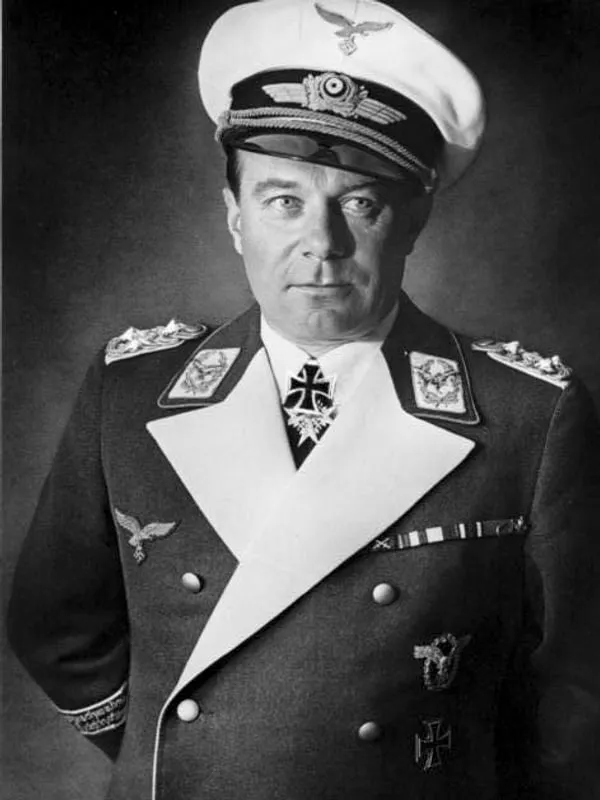
- Born:
- 26 April 1896, Frankfurt am Main (German Empire)
- Died:
- 17 November 1941, Berlin
- Author:
- Natalia
- Photo:
- Conrad, CC BY-SA 3.0 DE, Wikimedia Commons

Ernst Udet was the most successful German fighter pilot of the First World War after Manfred von Richthofen, and the most successful of those who survived it. In the 1920s and 1930s, as a stunt pilot, traveller and star of aviation films, he was one of the most popular people in Germany. His former commander Hermann Göring drew him into the building of the Luftwaffe and entrusted him with its technical development, and later with the armament and supply of the whole air force. Udet pushed through the Ju 87 dive bomber, which became the symbol of the Blitzkrieg, but he failed in a post that demanded technical knowledge and organisational talent. When the Luftwaffe began to lose the production race, Göring made him a scapegoat. In November 1941 Udet shot himself, and the regime concealed the truth about his death.
The young airman
Ernst Udet was born on 26 April 1896 in Frankfurt am Main, the son of an engineer, Adolf Udet, a descendant of a Huguenot family, and Paula, née Krüger. The family soon moved to Munich, where his father ran a workshop making heating boilers. From childhood the boy was passionate about flying: with his friends he built model aircraft and founded a model-making club, tried to fly a glider, and spent hours at Gustav Otto’s aircraft works. In 1913 he left secondary school with difficulty, with only the intermediate certificate.
In August 1914 he volunteered for the army but, at 160 centimetres tall, was rejected. Thanks to owning a motorcycle he reached the Western Front as a volunteer motorcycle dispatch rider, and when the army stopped using civilian dispatch riders he paid for private flying lessons at Otto’s flying school. In April 1915 he obtained a civilian pilot’s licence and was accepted into the military air service. At first he flew two-seat reconnaissance and artillery-spotting aircraft over Alsace; he was awarded the Iron Cross for saving a damaged machine and placed under arrest for crashing another. He was then transferred to a fighter unit at Habsheim. In his first combat he could not bring himself to fire and was nearly killed himself, but on 18 March 1916 he shot down a French Farman bomber. According to his later account, in 1917 he fought a duel with the French ace Georges Guynemer, who, seeing that Udet’s machine guns had jammed, waved to him and flew away. The story, known only from Udet’s memoirs, long sustained the myth of chivalrous war in the air.
Richthofen’s ace
After most of his comrades in Jasta 15 had been killed, Udet moved to Jasta 37, whose command he took over on 7 November 1917 as a Leutnant der Reserve. His successes caught the attention of Manfred von Richthofen, who in March 1918 brought him into his elite Jagdgeschwader 1, known as the “Flying Circus”, and gave him command of Jasta 11. On 9 April 1918 Udet was awarded the Pour le Mérite. After Richthofen’s death in April, he took over Jasta 4 in May. He hoped for command of the whole wing, but in July it went to Hermann Göring. His red-and-white Fokker D.VII bore the inscription “Du doch nicht!!” (“Certainly not you!”), and on the fuselage the name of his fiancée, Lo Zink. On 29 June 1918 he became one of the first airmen to save himself by parachute from an aircraft that had been shot down. In August 1918 alone he claimed 20 victories, and in September, wounded in the thigh, he ended the war as an Oberleutnant der Reserve with 62 confirmed victories.
Star of air shows and the screen
After the war Udet married Lo Zink, but the marriage broke up in 1923. He made his living from air shows and passenger flights, and in 1922, with money from an American investor, William Pohl, he founded in Munich a company building light sports aircraft, Udet Flugzeugbau, which, despite the prohibitions of the Treaty of Versailles, also built machines useful to the Reichswehr. In 1925 he left the firm, whose most popular product, the U 12 “Flamingo” biplane, later served in flying schools. Udet devoted himself to aerobatics: he picked up a handkerchief from the ground with his wingtip, flew under bridges and looped just above the grass. His displays drew tens of thousands of spectators in Germany and abroad. He flew in Arnold Fanck’s mountain films alongside Leni Riefenstahl, among them Die weiße Hölle vom Piz Palü (The White Hell of Pitz Palu, 1929) and S.O.S. Eisberg (1933), shot in Greenland; he filmed wild animals from the air in East Africa, drew caricatures and published books. In 1931 he performed in the United States at the National Air Races in Cleveland, where the displays of the Polish pilot Bolesław Orliński were also enthusiastically received. He led an extravagant life full of love affairs and alcohol, was friends with the actor Heinz Rühmann and the writer Carl Zuckmayer, and despite his high income was constantly in debt. In America he was captivated by the Curtiss Hawk II biplane, which was capable of dive-bombing, but he could not afford one.
In the service of the new air force
Udet regarded himself as an unpolitical man, but after Adolf Hitler’s seizure of power he let himself be won over by the Nazis, who needed his fame. On 1 May 1933 he joined the NSDAP. Göring, by then Minister of Aviation, found him the money to buy two Hawks, which arrived in Germany by sea in the autumn of 1933 and were used in dive-bombing trials. One of them, in which Udet showed off during the Berlin Olympics of 1936, survived the war and is now on display at the Polish Aviation Museum in Kraków. In 1934 Udet became a lieutenant colonel in the Air Ministry, in 1935 a colonel in the new Luftwaffe, and in February 1936 Inspector of Fighters and Dive Bombers. In June 1936 he blocked Wolfram von Richthofen’s decision to halt work on the Junkers Ju 87, and that same month, after the death of Walther Wever, he took over the Technical Office of the Reich Air Ministry. He is credited with the idea of the sirens that gave diving Stukas their terrifying sound.
In 1937 he became a Generalmajor, and in 1938 a Generalleutnant. He played host to foreign aviators, among them Charles Lindbergh, and on 5 June 1938, flying a Heinkel He 100 fighter, he set a speed record over a 100-kilometre closed circuit of more than 634 km/h. As head of technical development he demanded that medium and heavy bombers, too, should be capable of dive attacks, which delayed and complicated work on the Junkers Ju 88 and the Heinkel He 177. On 1 February 1939 Göring appointed him Director-General of Air Armament (Generalluftzeugmeister). From then on he was responsible for the development, testing, procurement, production and supply of the entire air force, at the head of an office of some 4,000 people. Formally he was subordinate to the State Secretary, Erhard Milch, with whom he waged a constant war over responsibilities. His biographer in the Neue Deutsche Biographie judges that, lacking technical training and organisational ability, Udet was “barely” equal to the task.
The war
The first campaigns brought Udet recognition. The dive bombers with which he was associated had caused problems before the war, as shown by the Neuhammer disaster in August 1939, but in the September Campaign – in which Ju 87s bombed Wieluń on the very first day – and in France they became the symbol of the German Blitzkrieg. In April 1940 Udet was made General der Flieger, on 4 July he received the Knight’s Cross of the Iron Cross, and on 19 July he was promoted to Colonel General. The Battle of Britain, however, exposed the shortcomings of the German air force: it had no heavy bombers or long-range fighters, and the new aircraft types were not ready. The Messerschmitt Me 210 heavy fighter, ordered before its first flight, proved dangerous to fly; the He 177 struggled with unreliable engines; and aircraft production stagnated throughout 1941. Göring, who according to many historians had himself for years concealed the air force’s problems from Hitler, blamed Udet ever more harshly. When in May 1941 Rudolf Hess flew to Britain, it was Udet whom Hitler asked whether such a flight to Scotland could succeed at all.
After the attack on the Soviet Union the Luftwaffe had to fight on several fronts, and its losses exceeded deliveries. In the summer of 1941 Göring gave Milch wide powers to expand the aircraft industry, and in the autumn he removed Udet’s closest associates. Udet, who had for years abused cognac, tobacco and the stimulant Pervitin, exhausted and ill, was losing the last of his influence. On 17 November 1941 in Berlin he shot himself during a telephone conversation with his partner, Inge Bleyle. On the headboard of his bed he left a reproach addressed to Göring, rendered in various accounts as “Iron one, you have deserted me” or “Iron one, you lied to me”. Propaganda announced that he had been killed while testing a new weapon. On 21 November, after a state funeral, he was buried in Berlin’s Invalids’ Cemetery next to Richthofen, with Göring walking behind the coffin. On their way to the funeral ceremonies General Helmuth Wilberg and the fighter ace Werner Mölders were killed in air crashes; Mölders was succeeded as head of the fighter arm by Adolf Galland. Udet’s successor was Milch.
Memory
Udet’s name was given to the Luftwaffe’s Jagdgeschwader 3 and to the airfield of the testing ground near Tarnowskie Góry, named Udetfeld, today Katowice Airport at Pyrzowice. After the war his fate became the subject of Carl Zuckmayer’s play The Devil’s General (Des Teufels General), written in exile in the United States and first staged in Zurich in 1946. Its title character, General Harras, an airman who sold himself to the Nazis for the sake of flying, was modelled on Udet, and in the 1955 film he was played by Curd Jürgens. The play fixed the image of Udet as a tragic idealist whose death was a gesture of defiance against the regime. Historians do not share it. The author of the entry in the Neue Deutsche Biographie stresses that the regime used Udet’s popularity to build up the Luftwaffe and for propaganda, and that Udet “willingly allowed this and supported it”, while his suicide was certainly not an act of resistance.
Udet remains an ambiguous figure. He was an outstanding pilot, a sociable and well-liked man who was friends with people of very different views. At the same time he helped to build an air force that in 1939–1941 destroyed Polish, Dutch, British and Soviet cities, and as its chief of armament he bears a considerable share of responsibility for the mistakes that led the Luftwaffe into a long war without the right equipment. His career illustrates the workings of the Third Reich, in which the most important posts were decided by personal loyalty and fame rather than competence.
Sources
Often appears with
People who appear in the same events.