Germany
Adolf Galland
Commander of Jagdgeschwader 26 (1940–1941), General of Fighters (General der Jagdflieger, 1941–1945), commander of Jagdverband 44 (1945)
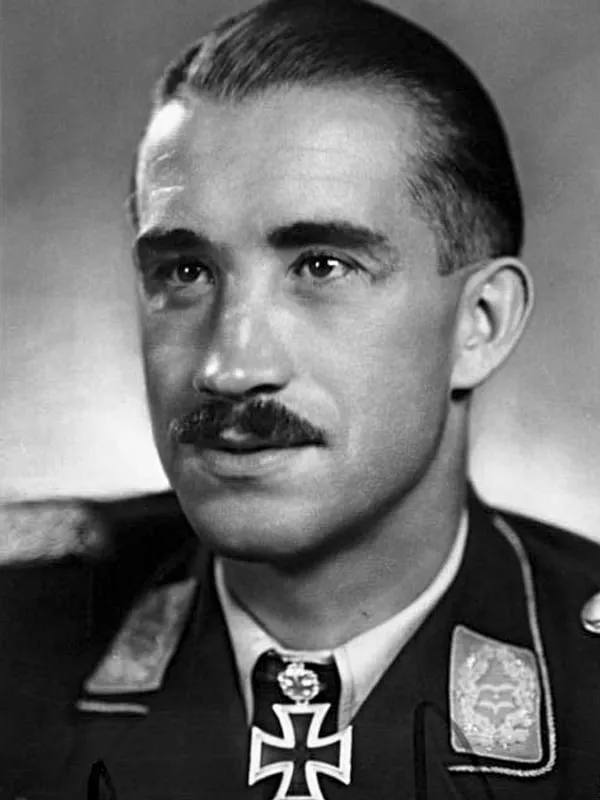
- Born:
- 19 March 1912, Westerholt (Westphalia, German Empire)
- Died:
- 9 February 1996, Oberwinter (Remagen, Germany)
- Author:
- Łukasz
- Photo:
- Heinrich Hoffmann, CC BY-SA 3.0 DE, Wikimedia Commons

Adolf Galland was one of the most famous fighter pilots of the Second World War and the best-known German airman to fight the Western Allies. He began as a ground-attack pilot in Spain and Poland and did not become a fighter pilot until the spring of 1940. In the Battle of Britain he commanded one of the Luftwaffe’s finest fighter wings, and at the age of 29 he was placed at the head of the entire German fighter arm. As a general he defended his pilots against Hermann Göring, which in the end cost him his post, and he finished the war flying combat missions in the Me 262 jet. He claimed 104 victories. After the war, thanks to his memoirs and his friendships with former opponents in the RAF, he became a symbol of “chivalrous” air warfare, although his image also had darker sides.
Glider pilot and airline pilot
Adolf Josef Ferdinand Galland was born on 19 March 1912 in Westerholt in Westphalia, today a district of the town of Herten. He was the second of four sons of the steward of the estates of the Counts von Westerholt, a descendant of Huguenots who had come to Westphalia from France. Two of his younger brothers, Wilhelm-Ferdinand and Paul, also became fighter pilots, and both were killed in action, Paul in 1942 and Wilhelm-Ferdinand in 1943.
He caught the flying bug as a teenager at the Borkenberge gliding field, home to a gliding club from Gelsenkirchen. The Treaty of Versailles forbade Germany a military air force, so for many young people gliding became the way into flying. In 1932 Galland passed his school-leaving examinations in Buer and, as one of a handful of successful candidates out of several thousand, was admitted to the state school for airline pilots in Brunswick. In 1933 he secretly underwent fighter training in Italy and then flew as a Lufthansa pilot. At the time the school and the airline served as cover for the military air force being quietly rebuilt. In 1934 he completed military training in Dresden and was commissioned as a Leutnant, and in 1935 he joined the first fighter wing of the Luftwaffe, which by then existed openly. In October that year he crashed during aerobatic training and injured an eye. His superior concealed the doctors’ finding that he was unfit to fly, and Galland is said to have later learned the eye-test charts by heart.
Spain and Poland
In 1937 Galland volunteered for the Condor Legion, which was fighting on the side of General Francisco Franco in the Spanish Civil War. From the summer of 1937 he commanded the 3rd Squadron of fighter group J/88, which flew obsolete Heinkel He 51 biplanes as a ground-attack unit, striking Republican troops on the ground while the other squadrons were re-equipping with Messerschmitt Bf 109s. He flew some 300 combat sorties in Spain. In May 1938 he was replaced by Werner Mölders, with whom he was later bound by both friendship and rivalry. Galland took no part in the bombing of Guernica, but after the war he presented it as a failed attack on a nearby bridge, which does not agree with the findings of historians.
After his return he worked at the Air Ministry on the principles of air support for ground forces and trained ground-attack units. In September 1939, during the invasion of Poland, he flew as a captain with the ground-attack group of Lehrgeschwader 2 (2nd Training Wing) in Henschel Hs 123 biplanes, which supported the German 10th Army by attacking Polish troops, columns and positions, among other occasions during the Battle of the Bzura. He flew 87 sorties and received the Iron Cross 2nd Class. He had no wish, however, to go on flying ground-attack aircraft and, pleading rheumatism that the open cockpit supposedly aggravated, secured a transfer to the fighter arm.
The Battle of Britain
In February 1940 he became adjutant of Jagdgeschwader 27, and learned fighter tactics from Mölders. On 12 May 1940, the third day of the offensive in the West, he shot down his first three aircraft, British Hurricanes, over Belgium. He fought over France and Dunkirk, where he met Spitfires for the first time, and on 6 June he took command of III Group of Jagdgeschwader 26 “Schlageter” (JG 26). In the summer the group was based in the Pas-de-Calais, and from July it fought over the English Channel in the first phase of the Battle of Britain. Galland, promoted to major, was awarded the Knight’s Cross of the Iron Cross at the turn of July and August for 17 victories. He quickly realised that the British had an efficient system for directing fighters from the ground and that their pilots were not as inexperienced as had been assumed. On 15 August he claimed three victories.
On 18 August, “the Hardest Day” of the battle, Galland did not fly. Together with Mölders he was at Göring’s country estate, Carinhall, where the Reichsmarschall presented both with the gold Pilot and Observer Badge with diamonds while at the same time reproaching them for the bomber losses and the fighters’ lack of zeal. The following day Göring ordered the fighters to stay close to the bombers. Galland considered the order a mistake, since it robbed the Messerschmitts of their chief advantages: height, speed and surprise. On 22 August he took command of the whole of JG 26. He replaced some group and squadron commanders with younger and more effective men, flew the most difficult missions himself and worked out a flexible method of escort in which the fighters constantly varied their height and distance from the bombers. JG 26 earned a reputation as one of the best wings at protecting bombers.
The anecdotes that made him famous date from this period. When Göring asked at a briefing what his pilots needed, Mölders asked for more powerful engines, while Galland replied that he would like a set of Spitfires for his wing, which sent the Reichsmarschall into a fury. According to Galland’s memoirs, Göring also once asked him what he would think of an order to shoot enemy pilots hanging from their parachutes; Galland replied that he would regard it as murder and would not carry out such an order. In September 1940 he became the third member of the Wehrmacht to receive the Oak Leaves to the Knight’s Cross, and he reported personally to Hitler that the British were a tough opponent and that the morale of the German fighter pilots was flagging. On 5 December 1940 he claimed his 57th victory and for a time became the most successful German pilot of the war.
The Channel Front
In 1941, when most of the Luftwaffe was transferred to the East, JG 26 remained in France and fought the RAF’s ever larger raids over the occupied coast. On 10 May Göring ordered Galland to intercept the Messerschmitt in which Rudolf Hess had flown to Scotland, but it was already too late. On 21 June 1941 Galland was shot down twice in one day. In the morning he made a belly landing near Calais; according to some Polish accounts, his aircraft had been damaged by Bolesław Drobiński of No. 303 Squadron. In the afternoon he bailed out of a burning Messerschmitt. That same day he became the first member of the Wehrmacht to receive the Swords to the Knight’s Cross. In August his wing shot down the legless British ace Douglas Bader; Galland received him at his headquarters and arranged for the RAF to be allowed to drop a spare artificial leg for the prisoner. By November 1941 he had claimed 96 victories.
General of Fighters
When Mölders was killed in an air crash on 22 November 1941, Göring appointed Galland to succeed him as General of Fighters (General der Jagdflieger). Galland did not want a staff job, and the new post meant he was banned from combat flying. In February 1942 he planned the air cover for the passage of the battleships Scharnhorst and Gneisenau through the English Channel, which was a great success; earlier, in January, he had become the second man after Mölders to receive the Diamonds to the Knight’s Cross. At the end of 1942 he was made a Generalmajor at the age of 30, the youngest general in the Wehrmacht.
From then on his main task was the defence of Germany against the daylight raids of American bombers. Galland called for more fighters, better pilot training and the husbanding of forces, while Göring and Hitler continued to put their faith in bombers and the offensive. In May 1943 Galland flew the Messerschmitt Me 262 jet and wrote that it flew “as if an angel were pushing”. From then on he pressed for it to be produced as a fighter, but for a long time Hitler wanted to see it as a fast bomber. In the summer of 1943 Galland directed the fighters in Sicily without success, and at that time he passed on to the pilots the threats of Göring, who accused the fighter arm of cowardice. In 1944, when the Luftwaffe was losing hundreds of pilots a month, he built up a reserve for the “Big Blow”, a massed attack by several hundred fighters on a single American raid. Hitler, however, threw these forces into support of the Ardennes offensive, and in Operation Bodenplatte on 1 January 1945 the Luftwaffe lost hundreds of aircraft and many experienced commanders.
In January 1945 Göring dismissed Galland from his post. Several leading fighter commanders, among them Günther Lützow and Johannes Steinhoff, then presented Göring with their demands, an episode that became known as the “Fighter Pilots’ Revolt”. Göring suspected that Galland was behind it, and Heinrich Himmler wanted him put on trial. Hitler put a stop to the affair. Galland was given permission to form Jagdverband 44, a unit of Me 262 jets, into which he brought many decorated aces. He flew combat missions with it over Bavaria, and on 26 April 1945, after shooting down two American B-26 bombers, he was hit by a P-47 fighter and wounded in the knee. It was his last combat flight. At the beginning of May he surrendered to the Americans.
After the war
Until 1947 Galland was a prisoner in Britain, where he was interrogated many times. In 1948 he went to Argentina, and until 1955 he served as an air force adviser to President Juan Perón, who employed many German aviation specialists, among them the designer Kurt Tank. In 1953 he published his memoirs, Die Ersten und die Letzten (The First and the Last), which were translated into more than a dozen languages. For decades the book shaped the image of German fighter pilots as professionals who fought fairly and independently of Nazism.
After returning to West Germany Galland was considered as commander of the new air force of the Bundeswehr, but the Americans objected, accusing him among other things of contacts with neo-Nazi circles, including Hans-Ulrich Rudel; the post went to Josef Kammhuber. Galland became a consultant to the aviation industry in Bonn and chairman of the association of former fighter pilots. He was an adviser on the 1969 film Battle of Britain, in which one of the characters was modelled on him, and he became friends with former opponents, Bader and Robert Stanford Tuck, who became godfather to his son. He died on 9 February 1996 in Oberwinter near Remagen.
Significance
Galland was an outstanding pilot and a commander who showed courage towards his superiors: in the Battle of Britain and in the defence of the Reich he saw more clearly than Göring that the Luftwaffe was losing a war of attrition against an opponent with more aircraft, a better command system and ever better trained pilots. His disputes with Göring over bomber escort in 1940 and over the defence of Germany in 1943–1944 illustrate the weaknesses of the Luftwaffe’s leadership well. Historians also point to his mistakes as a general, among them the neglect of training pilots to fly in bad weather, which he himself admitted after the war. For Poles he is also one of the airmen who attacked Polish troops in September 1939 and then spent two years fighting Polish fighter squadrons over the Channel. His legend as a “knight of the skies” was created largely after the war and largely by his own hand.
Sources
Mentioned in battles
(01)Often appears with
People who appear in the same events.