Germany
Eva Braun
Companion of Adolf Hitler (from c. 1932), his wife (29–30 April 1945)
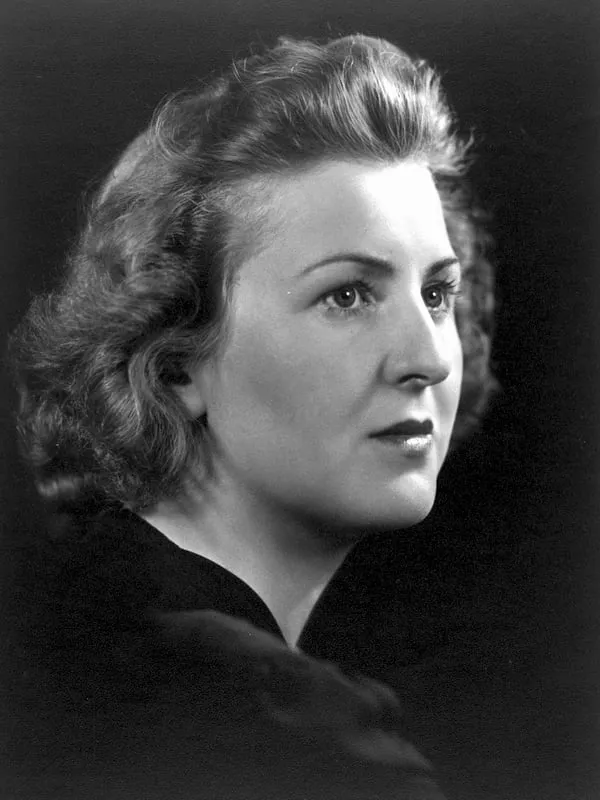
- Born:
- 6 February 1912, Munich (Kingdom of Bavaria, German Empire)
- Died:
- 30 April 1945, Berlin
- Author:
- Łukasz
- Photo:
- Studio of Heinrich Hoffmann, domena publiczna, Wikimedia Commons

For more than twelve years Eva Braun was the companion of Adolf Hitler, yet almost no one in Germany knew she existed. She met him as a seventeen-year-old employee of a Munich photographer’s shop, from the mid-1930s she lived at his Alpine residence, the Berghof, and in April 1945 she came of her own free will to besieged Berlin. During the night of 28–29 April Hitler married her, and on 30 April they both took their own lives in the bunker beneath the Reich Chancellery. She held no public office and had no influence on political or military decisions. Her life is nonetheless important for understanding the dictator’s entourage: it reveals the private world that Hitler carefully kept apart from his image as a leader “married to Germany”, and the closed circle of people who led comfortable, carefree lives around a criminal regime.
Youth in Munich
Eva Anna Paula Braun was born in Munich on 6 February 1912, the second of three daughters of Friedrich (Fritz) Braun, a vocational school teacher, and Franziska, née Kronberger, a seamstress. Her elder sister Ilse was born in 1909, her younger sister Margarete, known as Gretl, in 1915. The family belonged to the modest Catholic middle class. After the First World War her parents briefly divorced, but they soon remarried.
Eva went to school in Munich and then to a convent school in Simbach am Inn, where she learned housekeeping and typing. She was regarded as a lively, sporty and not especially diligent girl who liked dancing, swimming, skiing, fashion and the cinema. Politics did not interest her. In 1929, at the age of seventeen, she took a job at the photographic studio on Schellingstraße of Heinrich Hoffmann, the NSDAP’s official photographer, who held the exclusive rights to pictures of Hitler. She worked as a shop assistant and laboratory helper.
Meeting Hitler
According to her later accounts, repeated by her sisters, Hitler appeared at the studio in the autumn of 1929. Hoffmann introduced him as “Herr Wolf”, and only later did Eva learn who the visitor, twenty-three years her senior, really was. From then on Hitler called at the shop, paid her compliments and invited her to the cinema and on drives. A closer relationship probably began after the death of his niece Geli Raubal, who shot herself in his Munich flat in September 1931. By the turn of 1931–1932 Eva was his mistress, although her parents did not know for a long time, and her father, when he found out, opposed the relationship.
Hitler, busy with the election campaigns that brought him to power in January 1933, seldom had time for her. During the night of 31 October – 1 November 1932 Eva shot herself in the neck with her father’s pistol; the bullet missed the artery. She was treated by Hoffmann’s brother-in-law, a doctor. Hitler visited her in the clinic. Some biographers regard the act as a desperate cry for attention; others point out that for Hitler, a year after Raubal’s death and in the middle of a campaign, it was an alarming signal. From then on he paid her more attention, but he did not make the relationship public.
The surviving fragments of her diary from February–May 1935, which historians regard as authentic, show the loneliness and humiliation of a woman whom Hitler left without word for weeks at a time. During the night of 28–29 May 1935 Eva swallowed a large dose of sleeping pills. Her sister Ilse found her. After this second suicide attempt Hitler regularised her situation: in the summer of 1935 he rented a flat for her and Gretl, and in 1936 he bought them a villa in the Munich district of Bogenhausen.
Mistress of the Berghof
From 1936 Eva Braun spent most of her time at the Berghof, Hitler’s rebuilt residence on the Obersalzberg above Berchtesgaden. She had rooms there connected to Hitler’s apartment and informally acted as hostess to a narrow circle: adjutants, secretaries, doctors, Hoffmann, Martin Bormann and Albert Speer with their wives. To the outside world she did not exist. When official guests, diplomats or party dignitaries arrived, she had to stay in her rooms, and in published photographs and newsreels she never appeared as Hitler’s partner. Hitler explained to those around him that as leader he had to remain “married to Germany” and could not allow himself a wife, because he would lose the adoration of women. Formally she was employed by Hoffmann as a secretary, and her income came, among other sources, from the rights to photographs.
Life at the Berghof passed in long meals, walks to the teahouse, bathing in the Königssee, skiing and late-night film screenings. Eva had two Scottish terriers, Negus and Stasi, took care over her clothes and looks, and above all took photographs and made films. Her amateur colour films of 1937–1944, showing Hitler among guests, children and dogs, became after the war one of the most frequently used visual sources for the story of his private life – and at the same time evidence of how carefully this circle cultivated an idyllic picture, cut off from the war and the crimes. In his will of May 1938 Hitler left her a life annuity.
Eva did not belong to the NSDAP and held no posts. Witnesses from Hitler’s entourage – secretaries, adjutants, Speer in his memoirs – described her as an apolitical woman, absorbed in herself and her relationship. This picture has largely become fixed in the literature. In a biography published in 2010, however, the German historian Heike B. Görtemaker argued that Eva was not a naive girl on the sidelines but a conscious and loyal part of the innermost circle, which accepted Hitler’s policies, enjoyed the privileges of the regime and asked no questions about the fate of its victims. There is no evidence that she influenced any decision of state.
The war years
After the outbreak of war Hitler spent most of his time at his field headquarters, longest of all at the Wolf’s Lair in East Prussia, where Eva did not visit him. They met when he stayed on the Obersalzberg and in Munich. The Braun family enjoyed his protection: Eva was able to travel, to Italy among other places, and her standing in the Führer’s entourage grew over the years.
On 3 June 1944 Gretl Braun married SS-Gruppenführer Hermann Fegelein, Heinrich Himmler’s liaison officer at Hitler’s headquarters, in Salzburg. The witnesses were Hitler, Himmler and Bormann. The marriage strengthened Fegelein’s position and gave Eva a pretext to appear at Hitler’s side as the sister-in-law of a senior officer. After the 20 July 1944 plot she wrote Hitler a letter assuring him that since their first meeting she had sworn to follow him anywhere, even unto death.
In the bunker
In January 1945 Hitler moved permanently to Berlin. Eva arrived at the Reich Chancellery at the beginning of March, against his wishes, and refused to return to Bavaria. At first she lived in the ruined rooms of the old Chancellery, and when the air raids and Soviet shelling intensified she moved in mid-April into the Führerbunker under the Chancellery garden, where she took a room next to Hitler’s quarters. On 20 April she gave a modest party for his last birthday, with dancing to the one surviving gramophone record, as those present recalled.
On 22 April, after Hitler’s breakdown at the military conference, the dictator offered to fly Eva and the secretaries to the south. According to the secretary Traudl Junge, Eva was the first to refuse. In letters written in those days to Gretl and to her friend Herta Schneider she said farewell, asked for her private correspondence to be destroyed and assured them that she would stay with Hitler to the end.
In the last days of April her family’s drama played out in the bunker. On 27 April Fegelein, who had left the bunker without permission, was picked up in civilian clothes at his Berlin flat and brought back. When news arrived on the evening of 28 April of Himmler’s offer of surrender to the Western Allies, Hitler judged Fegelein an accomplice to the betrayal and had him shot; the sentence was carried out in the Chancellery garden. Accounts of Eva’s conduct conflict: according to some witnesses she tried to intercede for her brother-in-law, reminding Hitler that Gretl was heavily pregnant; according to others she held that the decision was Hitler’s alone. Gretl gave birth to a daughter on 5 May 1945 and named her Eva.
Marriage and death
Shortly after midnight on the night of 28–29 April 1945, in the map room of the bunker, Hitler and Eva Braun were married in a civil ceremony. It was conducted by the official Walter Wagner, and the witnesses were Joseph Goebbels and Martin Bormann. Eva began to sign the certificate with her maiden name, then struck out the “B” and signed “Eva Hitler, née Braun”. In his private testament, dictated the same night, Hitler explained that he had decided to take as his wife the woman who, after many years of faithful friendship, had come of her own free will to the almost besieged city to share his fate, and that at her own wish she would go to her death with him as his wife.
On 30 April, after lunch, the couple took leave of their entourage and shut themselves in Hitler’s study. At around 3.30 p.m. they were found dead: Hitler had shot himself; Eva had taken cyanide and bore no wounds. She was 33 and had been Hitler’s wife for less than forty hours. On Hitler’s orders the bodies were carried out into the Chancellery garden, doused with petrol and burned, and the remains were buried in a shell crater – the last act of Hitler’s suicide.
Remains and legends
At the beginning of May 1945 soldiers of SMERSH, the Soviet military counter-intelligence, dug the charred remains of two people and two dogs out of a crater in the Chancellery garden. According to Soviet documents, the woman’s body was identified chiefly from her teeth and a dental bridge, recognised by Käthe Heusermann, the assistant of Hitler’s dentist; the Soviet autopsy found cyanide poisoning. For years Moscow concealed these findings, which encouraged legends that Hitler and his wife had escaped. The remains were secretly buried near Rathenow, moved in February 1946 to the grounds of a Soviet military unit in Magdeburg, and in April 1970, on the orders of the KGB leadership, dug up and burned, and the ashes thrown into a river in the Elbe basin.
After the war Eva Braun’s life became the subject of sensational publications. In 1948 a supposed “diary of Eva Braun” appeared, brought out through the actor and director Luis Trenker; the Braun family and Leni Riefenstahl, who was maligned in the text, went to court, which ruled it a forgery. There is also a Polish connection: local tradition in Pobierowo on the West Pomeranian coast gives her name to a wooden villa by the Baltic in which she is said to have stayed in the 1940s – the so-called Eva Braun House in Pobierowo – although there are no reliable documents confirming her stay. Both her sisters survived the war.
Significance
Eva Braun was not a political figure and played no part in the course of the war. Her life is nevertheless part of the history of the Third Reich for two reasons. First, it shows how the Hitler cult worked: the leader who was supposed to belong to the nation alone concealed his relationship with a young woman for years, and his entourage guarded the secret so effectively that most Germans heard her name only after his death. Second, the Berghof that Eva captured on colour film was a place where decisions were taken to attack neighbouring countries and where men responsible for the Holocaust were guests; the idyll of her films existed alongside the camps, the ghettos and the front. Historians differ on how much she knew and what she thought, but they agree that she remained loyal to Hitler and his cause to the end. Her death at his side on 30 April 1945 was one of the last acts in the bunker, after which the fall of Berlin and Germany’s unconditional surrender were only a matter of days.
Sources
Mentioned in battles
(01)Often appears with
People who appear in the same events.