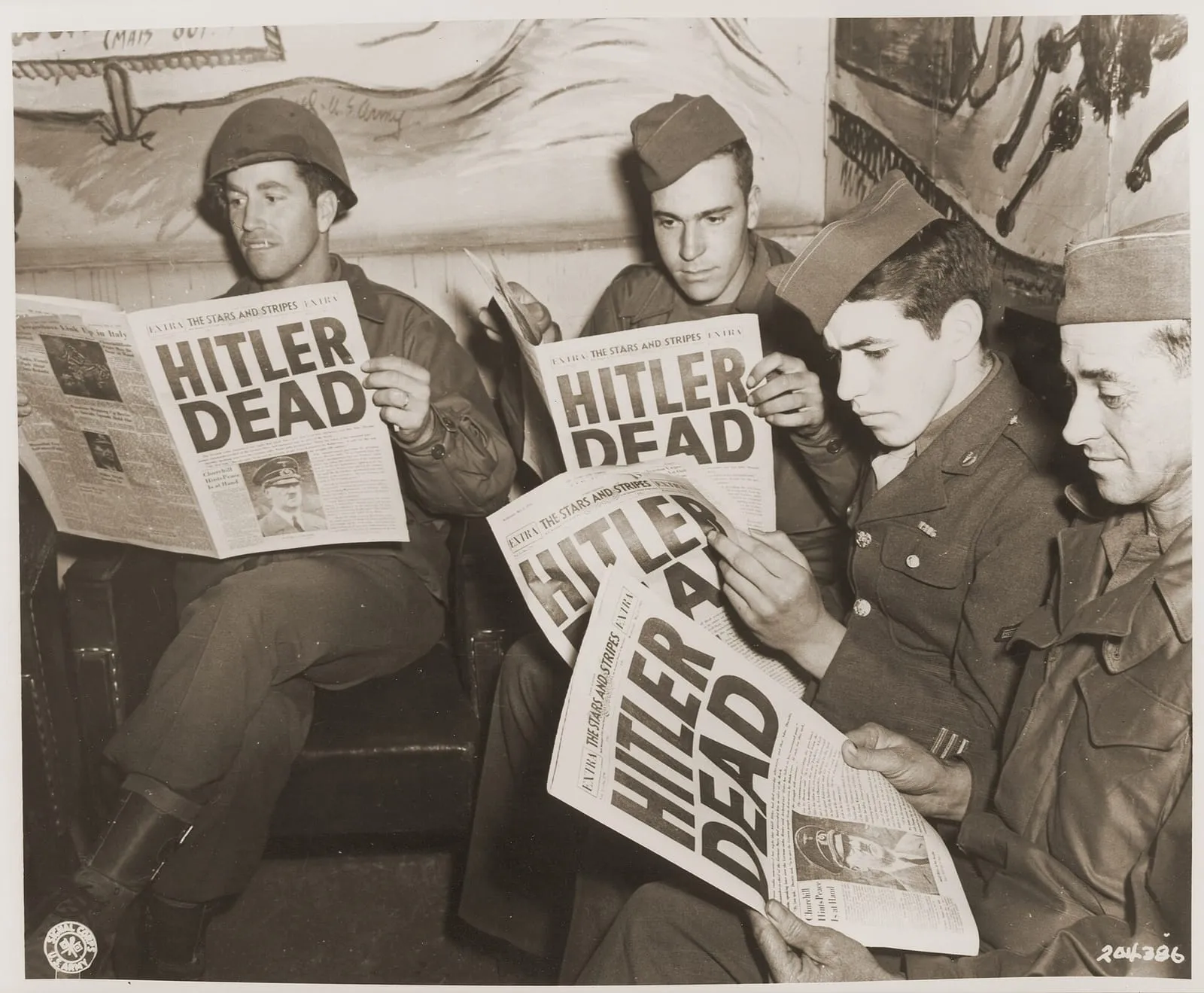
On 30 April 1945, at about 3.30 p.m., in the underground bunker beneath the garden of the Reich Chancellery in Berlin, Adolf Hitler shot himself in his study. Beside him, on the same sofa, sat Eva Braun, dead from cyanide. Less than two days earlier, shortly after midnight on the night of 28–29 April, the two had married, and a few hours later Hitler signed his political testament: he named Grand Admiral Karl Dönitz as his successor as head of state and Joseph Goebbels as Reich Chancellor. Both bodies were carried out into the garden, doused with petrol and burned. Soviet soldiers were then a few hundred metres from the bunker.
The death of the dictator who had unleashed the Second World War and was responsible for the Holocaust did not immediately end the fighting. It did, however, remove the one obstacle that had so far blocked Germany’s surrender. Its circumstances – obscured for years by Dönitz’s propaganda, Soviet disinformation and legends of an escape – are now well established thanks to the testimony of witnesses from the bunker, British and West German investigations and documents from the Soviet archives.
The bunker beneath the Reich Chancellery
Hitler returned to Berlin on 16 January 1945, after the failure of the Ardennes offensive. As air raids destroyed much of the New Reich Chancellery (PL), he spent more and more time in the Führerbunker, a shelter built beneath the chancellery garden, several metres underground under a thick reinforced-concrete roof. From there he directed a war whose outcome had been settled for months: in the west the Americans and British had crossed the Rhine, in the east the Red Army stood on the Oder.
On 16 April the Berlin offensive began. On 20 April Hitler celebrated his last birthday in the bunker, after which most of the dignitaries left the capital. On 22 April, when he learned that the attack by Steiner’s group had not even begun, he suffered a breakdown: in front of his generals he admitted openly for the first time that the war was lost and announced that he would stay in Berlin and take his own life. His only remaining hope lay in relief by Walther Wenck’s Twelfth Army and Theodor Busse’s Ninth Army.
The following days brought further blows. On 23 April Hermann Göring sent a telegram from Bavaria asking whether he should take over power in accordance with the succession decree of 1941; Hitler regarded this as treason and stripped him of his offices, and Bormann ordered the SS to arrest him on the Obersalzberg. On 25 April Soviet troops closed the ring around Berlin. On 26 April General Robert von Greim got through to the bunker by air, wounded on the way by anti-aircraft fire; he was accompanied by the pilot Hanna Reitsch. Hitler promoted him to field marshal and made him commander of the Luftwaffe in place of Göring.
On the evening of 28 April a Reuters report reached the bunker: Heinrich Himmler, through the Swedish Count Folke Bernadotte, had offered the Western Allies a surrender. For Hitler this was the worst betrayal of all – “loyal Heinrich” was the head of the SS. He ordered Greim and Reitsch to fly out of Berlin, secure air support and arrest Himmler; during the night they took off from a makeshift airstrip on the East–West Axis in the Tiergarten. That same night Hermann Fegelein, Himmler’s liaison officer and Eva Braun’s brother-in-law, who had earlier been detained in civilian clothes in his Berlin flat, was shot in the chancellery garden; the circumstances of his death are known only from inconsistent accounts. Soviet units were already fighting around Potsdamer Platz, about a kilometre from the bunker.
The wedding on the night of 28–29 April
The news of Himmler’s betrayal prompted Hitler’s final decisions. Shortly after midnight on the night of 28–29 April, in the small map room of the bunker, he married Eva Braun, his companion since the early 1930s, whose relationship with him had for years been kept hidden from the public. The civil ceremony was conducted by Walter Wagner, an official of the Berlin party and municipal administration, fetched from a Volkssturm unit fighting nearby. The witnesses were Goebbels and Martin Bormann. In accordance with the Nuremberg Laws, the bride and groom both declared that they were “of pure Aryan descent” and had no hereditary diseases. According to the surviving certificate, Eva began to sign with her maiden name, then crossed out the letter “B” and signed “Eva Hitler née Braun”.
The ceremony was followed by a modest reception attended by Goebbels and his wife Magda, Bormann, Generals Hans Krebs and Wilhelm Burgdorf, the secretaries and the cook Constanze Manziarly. According to the recollections of those present, Hitler talked about the old days and about everything being over. The marriage lasted less than forty hours.
The testament
That same night Hitler dictated two documents to his secretary Traudl Junge: a personal will and a political testament. Some accounts say he dictated them before the wedding, others immediately after the reception; all agree that he signed them at about 4 a.m. on 29 April. The statement sometimes encountered that Hitler dictated his testament just before his death is therefore inaccurate: it happened more than thirty hours before his suicide.
In his personal will Hitler explained that he had decided to marry the woman who had come “of her own free will” to the besieged city to share his fate. He left his property to the party or, should it cease to exist, to the state; his art collection was to go to a gallery in his home town of Linz. He appointed Bormann as his executor. He directed that his body and that of his wife be burned immediately “in the place where I have performed the greater part of my daily work”. The signature was witnessed by Bormann, Goebbels and Colonel Nicolaus von Below, Hitler’s Luftwaffe adjutant.
The political testament consisted of two parts. In the first, Hitler repeated that neither he nor anyone else in Germany had wanted war in 1939, and laid the responsibility for it on “international Jewry and its helpers”. He declared that he would not leave Berlin and was choosing death so as not to fall into the hands of enemies who needed a “spectacle”. He enjoined the leaders of the nation to “scrupulous observance of the laws of race” and to “merciless opposition to the universal poisoner of all peoples, international Jewry”. The closing sentences of his most important political document were thus the same as his whole career had been from the start: the antisemitism that had led to the Holocaust.
The second part dealt with power after his death. Hitler expelled Göring and Himmler from the party and stripped them of all their offices, calling both traitors. He annulled the 1941 decree that had made Göring his successor. He appointed Dönitz Reich President, Supreme Commander of the Wehrmacht, Minister of War and Commander-in-Chief of the Kriegsmarine; Goebbels Reich Chancellor; and Bormann “Party Minister”. Arthur Seyss-Inquart was to become Foreign Minister, Field Marshal Ferdinand Schörner Commander-in-Chief of the Army, and the Gauleiter of besieged Breslau (Wrocław), Karl Hanke, head of the SS and police. The office of president, which Hitler had abolished in 1934 by merging it with that of chancellor, was thus revived only to be handed on. The political testament was signed as witnesses by Goebbels, Bormann, Burgdorf and Krebs. Goebbels appended his own “appendix”: he declared that for the first time in his life he was refusing to obey an order of the Führer and would not leave Berlin, but would die there with his family.
Three copies of the testaments were carried out of the encircled city by couriers: the deputy press chief Heinz Lorenz, Bormann’s adjutant Wilhelm Zander and Hitler’s army adjutant Major Willy Johannmeyer. None of them reached Dönitz; the documents were later found by the Allies – Lorenz, detained by the British, had his copy sewn into his clothing. Historians point out that the provisions on the succession were largely declaratory: Hanke was besieged in Breslau, Bormann had no chance of reaching Schleswig-Holstein, and Goebbels was announcing that he would die in Berlin.
The last day
On the afternoon of 29 April news reached the bunker that Italian partisans had shot Benito Mussolini and his companion Claretta Petacci, and that their bodies had been put on public display in Milan (the death of Mussolini). Historians suppose that this strengthened Hitler’s resolve that his corpse should not become a “spectacle” – as he had in fact already written in his testament. That same day the surrender of the German forces in Italy was signed at Caserta, something not yet known in the bunker.
Hitler had cyanide ampoules, obtained through the SS doctor Ludwig Stumpfegger. After Himmler’s betrayal, however, he began to doubt whether poison supplied by the SS would work. He ordered his doctor, Werner Haase, to test a capsule on his dog Blondi; the dog died instantly.
Late in the evening of 29 April Hitler sent a signal to the Wehrmacht High Command with a series of questions: where were Wenck’s spearheads, when would they attack, where was the Ninth Army? At about 1 a.m. on 30 April Field Marshal Wilhelm Keitel replied that Wenck was stuck south of Potsdam and that the Ninth Army was encircled. There would be no relief. At about 2.30 a.m. Hitler said goodbye in the bunker corridor to a group of about twenty people, mostly women from the staff, shaking each of them by the hand.
Before noon on 30 April General Helmuth Weidling, commander of the defence of Berlin, reported that the defenders would run out of ammunition that night at the latest and that the fighting would last a day at most. Soviet units were already a few hundred metres from the bunker, and the assault on the nearby Reichstag building had been going on since the morning. Weidling asked for permission to attempt a breakout from the city; at about 1 p.m. he received it, on condition that there was no question of surrender.
The suicide
After lunch, which Hitler ate with his secretaries and his cook, he and Eva Braun said goodbye to their closest entourage: Goebbels, Bormann, the secretaries and officers. Between 2.30 and 3 p.m. they went into Hitler’s study. His adjutant, SS-Sturmbannführer Otto Günsche, guarded the door. At about 3.30 p.m. Hitler’s valet Heinz Linge and Bormann went in. According to their accounts and that of Günsche, Hitler was sitting on the sofa with his head slumped, with a gunshot wound to his right temple; beside him lay his 7.65 mm Walther pistol. Eva Braun had no wounds – she had poisoned herself with cyanide. Linge remembered the smell of bitter almonds characteristic of hydrogen cyanide.
The often repeated statement that both took their lives by “a combination of poison and a gunshot” needs to be made more precise: Eva Braun took poison and Hitler shot himself. Whether he also bit into a cyanide capsule before firing remains disputed: Soviet reports of 1945 and some later writers claimed so, but the testimony of witnesses from the bunker and the findings of a West German court in 1956 speak of death from a shot to the right temple.
Günsche informed those gathered in the conference room – Goebbels, Krebs, Burgdorf and the Hitler Youth leader Artur Axmann – of Hitler’s death. In accordance with Hitler’s instructions, the bodies were wrapped in blankets, carried up the emergency exit stairs into the chancellery garden, laid in a shell crater, doused with petrol and set alight. Bormann, Goebbels, Günsche, Linge, the chauffeur Erich Kempka and several SS men stood in the bunker doorway with their arms raised in the Nazi salute. The garden was under Soviet artillery fire. The SS men kept pouring on petrol for about two and a half hours; at about 6.30 p.m. the charred remains were covered with earth in the shallow crater.
The succession and the end of the bunker
On the evening of 30 April Bormann informed Dönitz by radio, at Plön in Schleswig-Holstein, that the Führer had appointed him his successor in place of Göring. He did not say that Hitler was dead, and he also passed over the demand to fight on and the names of the other members of the new government. Only on the afternoon of 1 May did a signal from Goebbels inform Dönitz of the time of Hitler’s death, without mentioning suicide.
Meanwhile the new chancellor tried to pursue his own policy. Shortly before 4 a.m. on 1 May General Krebs, a former military attaché in Moscow, crossed the front line to the headquarters of General Vasily Chuikov, commander of the 8th Guards Army. He was the first to inform the Soviet side of Hitler’s death, and he proposed a truce and negotiations. The news was passed to Georgy Zhukov, who informed Joseph Stalin. Stalin demanded unconditional surrender, which Krebs had no authority to accept. Goebbels rejected the demand.
On the evening of 1 May Joseph and Magda Goebbels killed their six children, aged between 4 and 12: according to the later testimony of the SS dentist Helmut Kunz, they were first given morphine and then cyanide, probably with the involvement of Stumpfegger as well. The couple then took their own lives in the chancellery garden. Goebbels had been Reich Chancellor for little more than a day. During the night of 1–2 May the people in the bunker tried to break out of the city in small groups. Krebs and Burgdorf shot themselves in the bunker. Bormann died during the escape; his remains were found in Berlin in 1972, and his identity was confirmed by DNA analysis in 1998. Günsche, Linge and Kempka, as well as Hitler’s secretaries, fell into Russian hands or made their way west; their testimony later became the principal source of knowledge about the last days in the bunker.
On the evening of 30 April, a few hours after Hitler’s death, soldiers of the Soviet 3rd Shock Army planted red flags on the roof of the Reichstag. The flag of the 150th Rifle Division was recognised as the official Victory Banner; Soviet historiography credited its raising to Sergeants Mikhail Yegorov and Meliton Kantaria. Fighting continued inside the building until 2 May. Yevgeny Khaldei’s famous photograph of the flag over the Reichstag was taken only on 2 May and was staged. That same day Weidling signed the surrender of the Berlin garrison.
On the evening of 1 May the Hamburg radio station interrupted its programme to announce that Hitler had “fallen at his command post in the Reich Chancellery, fighting to his last breath against Bolshevism”, supposedly “this afternoon”, that is, on 1 May. In a radio address Dönitz called his death heroic. It was a legend: Dönitz did not know the circumstances of Hitler’s death, and the image of a leader fallen in battle was meant to sustain the morale of the soldiers fighting in the east. Dönitz formed a government headed by Lutz Schwerin von Krosigk, which from 3 May sat in Flensburg, and instead of fighting to the end he sought to drag out the surrender in the west so that as many soldiers and refugees as possible could escape from the Red Army.
Remains, investigations and legends
Stalin wanted to be certain that Hitler was dead and ordered the military counter-intelligence service Smersh to find his body. In early May Soviet soldiers dug charred remains out of the crater in the chancellery garden, including the bodies of dogs and fragments of jaws. According to Soviet documents, by 11 May Käthe Heusermann, the assistant to Hitler’s dentist, and the dental technician Fritz Echtmann had identified the teeth and dental bridges of Hitler and Eva Braun; both later spent years in Soviet prisons. The post-mortem carried out by Soviet doctors pointed to cyanide poisoning, but its description, published in 1968, raises doubts, since it is not even certain whether it was Hitler’s body that was examined or only fragments of remains.
The Kremlin kept these findings secret and for years played a propaganda game. At the beginning of June 1945 the Soviet side announced that Hitler had poisoned himself with cyanide; a few days later, that the body had not been identified and the Führer had probably escaped. In conversations with Western politicians Stalin suggested that Hitler was hiding in Spain or Argentina. This uncertainty, fuelled by the press, gave rise to legends of Hitler escaping by submarine to South America, which circulate to this day, although there is no credible evidence for them.
In the autumn of 1945 British intelligence commissioned the historian Hugh Trevor-Roper to investigate the matter. On the basis of interrogations of witnesses in the hands of the Western Allies, he reconstructed the course of the last days in the bunker and confirmed the suicide; his book The Last Days of Hitler (1947) long remained the standard account. Between 1952 and 1956 a court in Berchtesgaden heard 42 witnesses and on 25 February 1956 declared Hitler dead, finding that on 30 April 1945 he had taken his own life with a shot to the right temple. Witnesses who returned from Soviet captivity, including Günsche and Linge, confirmed this version.
The remains that Smersh had taken from Berlin were moved several times and finally buried on the grounds of a Soviet military facility in Magdeburg. In 1970, when the facility was due to be handed over to the GDR, the head of the KGB, Yuri Andropov, ordered them to be dug up and destroyed so that no neo-Nazi shrine could arise. The ashes were thrown into a river. In Moscow fragments of the jaws and a fragment of skull with a bullet hole were preserved. A DNA test in 2009 indicated that the skull belonged to a woman, which revived speculation; in 2018, however, a team led by the French pathologist Philippe Charlier, which had gained access to the teeth in the Russian archives, announced that they matched X-rays of Hitler taken in 1944 and could not be a forgery. That Hitler died in the bunker on 30 April 1945 is today not in doubt among historians.
Significance
Hitler’s suicide was not an act of courage or sacrifice, but an escape from responsibility. The man who since 1939 had sent millions of soldiers and civilians to their deaths, ordered the extermination of the Jews and to the very end forbidden retreats and surrenders took his own life when enemy soldiers were a few hundred metres from his bunker, and in his testament blamed the war and the defeat on the Jews and on the “treachery” of his own generals. To the last day he demanded of others a fight which in Berlin cost the lives of tens of thousands of soldiers on both sides and of civilians.
His death opened the way to ending the war in Europe. As long as he lived, no German commander dared to attempt a general surrender; now Dönitz, despite his declarations about fighting Bolshevism, brought about within a week the surrender of the German forces in north-western Germany and then the unconditional surrender of the entire Wehrmacht, signed on 7 May at Reims and on 8 May in Berlin. The Dönitz government was arrested by the British on 23 May 1945.
The chief culprit was missing from the dock at Nuremberg – besides Hitler, Goebbels had taken his own life, and on 23 May, in British captivity, so had Himmler. Göring, Dönitz, Keitel and others were tried, and before the court they readily hid behind the orders of the dead Führer. The absence of a body and Soviet disinformation gave rise to legends that live on to this day, but the documents from the bunker, the testimony of witnesses and the examination of the remains leave no doubt: ten days after his 56th birthday and in the thirteenth year of his rule, Adolf Hitler ended his life in the ruins of the capital he had meant to rebuild as “Germania”, capital of the world.
Sources
Meanwhile
(04)Elsewhere, within a week.
- 29 April 1945 · MediterraneanThe surrender at CasertaOn 29 April 1945 at Caserta, envoys of Vietinghoff and Wolff signed the surrender of the German forces in Italy. The guns fell silent at 2 p.m. on 2 May.
- 29 April 1945 · Western FrontThe liberation of DachauOn 29 April 1945 soldiers of the US Seventh Army entered Dachau, the first concentration camp of the Third Reich, and freed more than 30,000 prisoners.
- 1 May 1945 · BalkansTito in TriesteOn 1 May 1945 the Yugoslav 4th Army and IX Corps entered Trieste, followed on 2 May by New Zealanders. Forty days of Yugoslav rule brought arrests and killings.
- 1 May 1945 · PacificThe landing on TarakanOn 1 May 1945 the Australian 26th Brigade, with US and Dutch units, landed on Tarakan off Borneo. The fight for the oil island lasted until June.
Related events
(04)The same battle, people or subject.
- 20 April 1945 · Eastern FrontHitler's last birthdayOn 20 April 1945 Hitler turned 56 in the bunker beneath the Reich Chancellery. The leaders offered their wishes, and that evening most of them left Berlin.
- 2 May 1945 · Eastern FrontThe breakout from the bunkerOn the night of 1–2 May 1945 the occupants of Hitler's bunker tried to break out of Berlin. Krebs and Burgdorf shot themselves; Bormann died while fleeing.
- 23 April 1945 · PoliticsGöring's telegramOn 23 April 1945 Göring asked Hitler if he should take over power in the Reich. Hitler called it treason and stripped him of office; Greim took the Luftwaffe.
- 22 April 1945 · Eastern FrontHitler's breakdownOn 22 April 1945, on learning that Steiner's attack had not begun, Hitler admitted the war was lost and declared that he would stay in Berlin to the end.