The Battle of Berlin
- Dates:
- 16 April – 2 May 1945
- Front:
- Eastern Front
- Location:
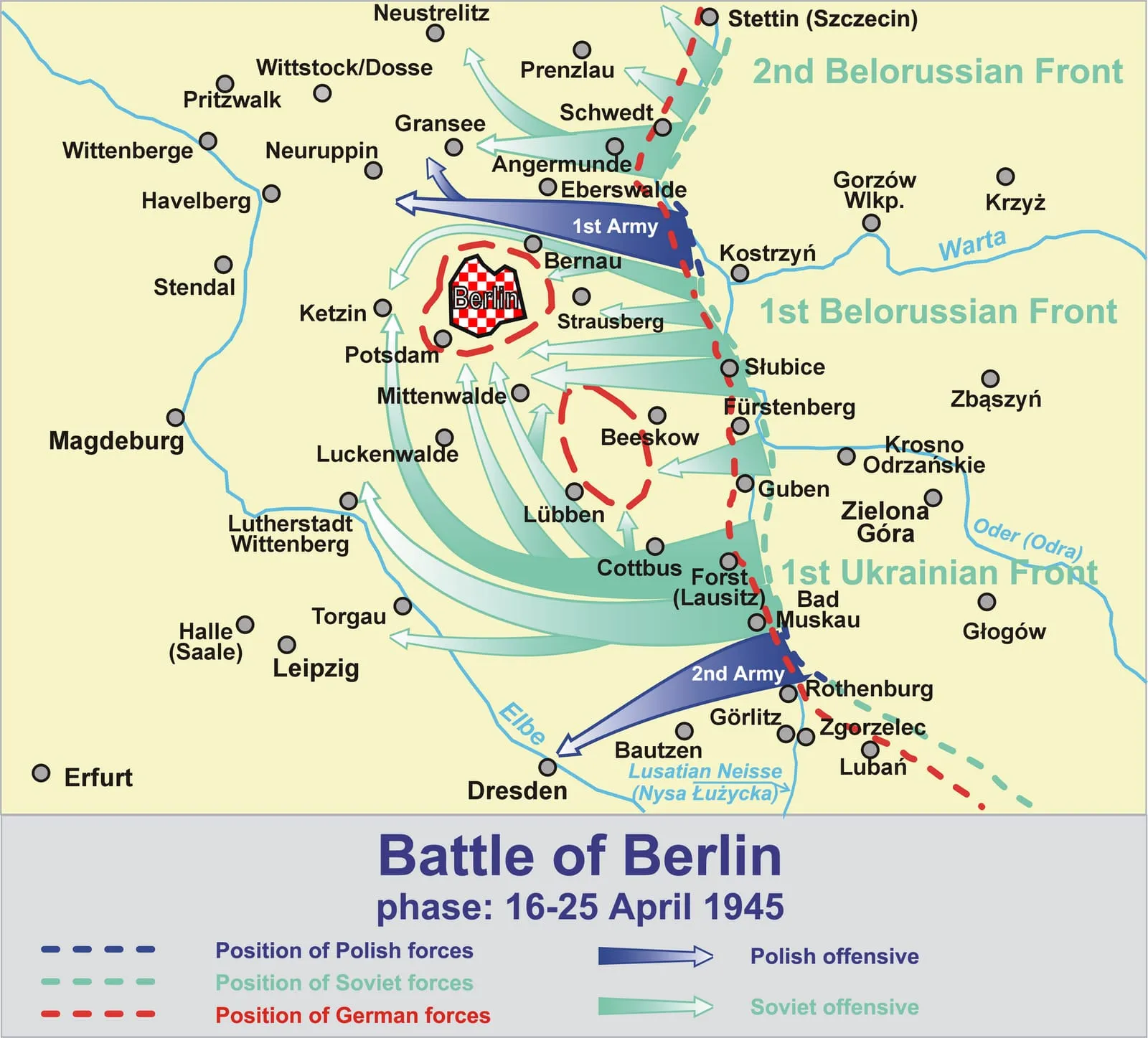
- Eastern Germany between the Oder, the Lusatian Neisse and the Elbe: the Küstrin bridgehead and the Seelow Heights, the lower Oder between Szczecin (Stettin) and Schwedt, the Lusatian Neisse from Guben to Rothenburg, Lusatia with Bautzen, the forests around Halbe south-east of the capital, Potsdam and Ketzin to the west, and Berlin itself – from the suburbs to the government quarter with the Reich Chancellery, the Reichstag building and the TiergartenOn the battle map →
- Sides:
- Soviet Union and Poland (Polish 1st and 2nd Armies)Georgy Zhukov, Ivan Konev, Konstantin Rokossovsky, Vasily Chuikov, Stanisław Popławski, Karol ŚwierczewskiNazi GermanyGotthard Heinrici, Helmuth Weidling, Theodor Busse, Walther Wenck
- Result:
- Soviet and Polish victory. Berlin was encircled on 25 April, the 9th Army was destroyed in the Halbe pocket, and on the morning of 2 May General Helmuth Weidling signed the surrender of the capital's garrison. Adolf Hitler committed suicide on 30 April. According to Grigori Krivosheev, between 16 April and 8 May the three Soviet fronts lost 78,291 killed and missing and 274,184 wounded and sick; German losses are estimated at 92,000–100,000 killed, and civilian deaths ran into the tens of thousands.
- Author:
- Łukasz
Name and dates
The Berlin offensive – in Soviet and Russian historiography the “Berlin Strategic Offensive Operation” – was the Red Army’s last great offensive in Europe. Between 16 April and 2 May 1945 three Soviet fronts – Marshal Georgy Zhukov’s 1st Belorussian Front, Marshal Ivan Konev’s 1st Ukrainian Front and Marshal Konstantin Rokossovsky’s 2nd Belorussian Front – together with two armies of the Polish Army, broke through the German defences on the Oder and the Lusatian Neisse, encircled Berlin and took it in street fighting. In everyday usage the whole operation is often called the “Battle of Berlin”, although the fighting in the city itself lasted from 21 April to 2 May, while the operation as a whole covered an area stretching from the Baltic to Lusatia.
Its starting date is set by the night attack from the Küstrin bridgehead and the crossing of the Neisse on the morning of 16 April. The operation is taken to have ended on 2 May 1945, when General Helmuth Weidling, commander of the defence of Berlin, surrendered to the Soviet forces and the fighting in the city died away in the course of the day. North and west of the capital, Soviet and Polish units fought on for several more days – as far as the Elbe and the Baltic – until the unconditional surrender of the Third Reich on 8 May, but historians count those actions among the operation’s aftermath.
It was the largest battle of the final phase of the war in Europe. It ended with the suicide of Adolf Hitler in the bunker beneath the Reich Chancellery and the capture of the capital from which, for twelve years, Germany and most of conquered Europe had been ruled.
Background
At the turn of January and February 1945 the Vistula–Oder offensive brought Zhukov’s troops to the Oder. On 31 January a detachment of the 5th Shock Army crossed the frozen river near Kienitz and seized a bridgehead some 70 kilometres from Berlin. The Stavka nevertheless halted the advance on the capital, because strong German forces still stood in Pomerania, threatening the front’s flank. February and March were therefore taken up by the East Pomeranian offensive, which ended with the capture of Kołobrzeg, Gdynia and Gdańsk (Danzig), and by the fighting in Silesia, where the siege of Breslau (Wrocław) had been under way since mid-February. In East Prussia Königsberg fell on 9 April, and on 13 April, in the south, the Red Army took Vienna.
Meanwhile, on the Oder, heavy fighting for the bridgeheads went on for two months. On 20 March Hitler relieved Heinrich Himmler of command of Army Group Vistula and handed it to General Gotthard Heinrici, a recognised master of defensive warfare. His first concern was the fortress of Küstrin (Kostrzyn), which barred the road from the bridgehead to Berlin; it fell on 30 March. From then on Zhukov’s troops held a continuous bridgehead several dozen kilometres wide on the west bank of the Oder, opening the way to the capital across the Seelow Heights.
In the west the Allies had crossed the Rhine and were advancing rapidly into Germany. At the end of March Dwight Eisenhower decided that the main objective of his armies was not Berlin but the axis towards Leipzig and Dresden, and informed Stalin accordingly. The boundaries of the future occupation zones had been fixed earlier, and the Yalta Conference had confirmed that Berlin lay deep inside the Soviet zone. Joseph Stalin, however, did not trust Eisenhower’s assurances and feared that the British and Americans, against whom the Germans in the west were now offering only weak resistance, might get there first. For him, taking the capital of the Reich was a matter of prestige.
Berlin itself had been a target of RAF raids since 1940 – the heaviest in the winter of 1943–1944 – and from 1944 of the American Eighth Air Force as well; the raid of 3 February 1945 alone killed almost 2,900 people according to German figures. Hitler had been in Berlin since mid-January, and from February spent most of his time in the shelter beneath the Reich Chancellery garden. The city was declared a fortress and divided into eight defence sectors plus a central sector “Z” around the government quarter, but its preparations were poor. Civilians and forced labourers were made to build the fortifications.
On 12 April news of President Franklin D. Roosevelt’s death reached Berlin. Joseph Goebbels and Hitler briefly took it for a “miracle” that – like the death of the Empress Elizabeth in the Seven Years’ War – would break up the enemy coalition. Nothing of the sort happened; four days later the offensive began.
The plan and the rivalry of the marshals
On 1 April 1945 Stalin summoned Zhukov and Konev to the Kremlin. According to the memoirs of Konev and of the head of the General Staff’s Operations Directorate, General Sergei Shtemenko, a telegram was read out to them – probably exaggerated or invented – about an alleged Anglo-American plan to take Berlin ahead of the Red Army. Stalin asked: “So who is going to take Berlin – we or the Allies?” Both marshals assured him that they would, and within two days presented plans, which were approved on 2–3 April.
The main blow was entrusted to the 1st Belorussian Front. Zhukov was to attack due west from the Küstrin bridgehead, across the Seelow Heights, take Berlin and reach the Elbe by the twelfth to fifteenth day of the operation at the latest. Konev’s 1st Ukrainian Front was to force the Lusatian Neisse, destroy the German forces south of Berlin and advance on Dresden and Leipzig. The question of who would enter the capital was settled by a single gesture: Stalin broke off the boundary line between the two fronts at the small town of Lübben, some 60 kilometres south-east of Berlin, and did not extend it any further west. Konev understood this as tacit permission to swing towards the capital if things went well – and he made use of it. The rivalry between the two marshals, which Stalin deliberately fostered, shaped the course of the entire operation and raised its cost.
Rokossovsky’s 2nd Belorussian Front, which had only just finished the fighting in Pomerania and had to regroup over a distance of several hundred kilometres, was to join in a few days later: it was to force the lower Oder between Szczecin (Stettin) and Schwedt, destroy the German 3rd Panzer Army and cover Zhukov’s northern flank.
On the main axis Zhukov planned a night attack. The assault was to begin two hours before dawn after a half-hour artillery bombardment, and the battlefield was to be lit up – and the defenders blinded – by anti-aircraft searchlights, 143 of them according to Soviet accounts, placed about 200 metres apart. The two tank armies, the 1st and 2nd Guards, were to enter the gap only once the infantry had broken through the defences, and then to encircle Berlin from the north and south.
Forces
According to Soviet figures cited in Polish and English-language literature, the three fronts had a combined strength of about 2.5 million soldiers, 41,600 guns and mortars, about 6,250 tanks and self-propelled guns and 7,500 aircraft. Two armies of the Polish Army fought within them: the 1st Army of Major General Stanisław Popławski, 78,556 strong according to these figures, in the 1st Belorussian Front, and the 2nd Army of Major General Karol Świerczewski, with some 85,000–90,000 men, in the 1st Ukrainian Front. In all, according to Polish studies, some 155,000–180,000 Polish soldiers took part in the operation.
The 1st Belorussian Front alone concentrated almost a million men. The key tasks fell to the 8th Guards Army of General Vasily Chuikov – the defender of Stalingrad – and to General Nikolai Berzarin’s 5th Shock Army, the 3rd Shock Army and the 47th Army, as well as General Mikhail Katukov’s 1st Guards Tank Army. The striking force of the 1st Ukrainian Front consisted of the 3rd Guards Tank Army (commanded by General Pavel Rybalko) and the 4th Guards Tank Army (General Dmitry Lelyushenko).
On the German side the Berlin axis was covered by Heinrici’s Army Group Vistula: in the north General Hasso von Manteuffel’s 3rd Panzer Army on the lower Oder, and on the main axis General Theodor Busse’s 9th Army, which by various estimates numbered about 110,000 men, several hundred tanks and about 2,600 guns (including anti-aircraft guns). On the Lusatian Neisse the line was held by the 4th Panzer Army of Field Marshal Ferdinand Schörner’s Army Group Centre. The strength of the whole German grouping is uncertain; many divisions had only part of their establishment, and their replacements were poorly trained recruits, Luftwaffe and navy personnel transferred to the infantry, the Volkssturm and boys from the Hitler Youth. Fuel, ammunition and aircraft were all in short supply.
Heinrici foresaw where the main blow would fall. On the Seelow Heights – the steep edge of a plateau rising several dozen metres above the marshy Oder valley (the Oderbruch) – he prepared several defensive belts, and on the night before the expected attack he ordered the infantry pulled back from the first line to the second, so that the Soviet bombardment would fall on empty ground. In Berlin itself the defence was organised chaotically; according to estimates cited by historians, the city was defended by anything from about 60,000 to over 100,000 men: soldiers of the Wehrmacht and the Waffen-SS, members of the Volkssturm, the Hitler Youth and the police. Their numbers fluctuated as more shattered units fell back into the city from the Oder.
The Seelow Heights (16–19 April)
On 16 April at 5 a.m. Moscow time (3 a.m. Berlin time) some 9,000 guns, mortars and rocket launchers opened fire on the Küstrin bridgehead. More than half a million shells are said to have been fired in the first thirty minutes. Then the searchlights were switched on. The effect was not what had been intended: the smoke and dust from the bombardment scattered the light, and the advancing infantry saw before them a bright wall against which they themselves were perfectly silhouetted. The bombardment, moreover, struck a first line that Heinrici had already managed to empty.
The infantry of the 8th Guards Army and the neighbouring armies advanced slowly across the marshy valley, cut by ditches and canals, under fire from German artillery and anti-tank guns on the heights. When by midday it was clear that the breakthrough was failing, Zhukov – contrary to the plan and to Chuikov’s advice – threw both tank armies into the battle. The tanks jammed the few roads and suffered heavy losses. On the evening of 16 April Zhukov had to report to Stalin that the defences had not been broken. Stalin replied – as Zhukov later recounted – that Konev was doing better and might turn his tank armies towards Berlin.
The Battle of the Seelow Heights went on for three more days. On 17 April Soviet troops took the small town of Seelow and that evening broke through the second defensive belt, but the Germans fell back to successive positions and counter-attacked with their reserves, among them units of General Helmuth Weidling’s LVI Panzer Corps. Only on 19 April was the defence broken through its entire depth, and the German 9th Army was split in two: its northern wing fell back towards Berlin, while the bulk of its forces, with Busse, remained south of the axis of the attack. Estimates of Soviet losses in the battle for the heights alone range from fewer than 10,000 to more than 30,000 killed; the Germans are estimated to have lost about 12,000 killed. For Zhukov this was the most difficult moment of the whole operation – his front accomplished its task two or three days behind schedule.
On the same day the Polish 1st Army went into the attack on the northern wing of the front. Its divisions forced the Oder – or, more precisely, the old channel of the Old Oder and the Oder’s flood waters – near Siekierki, Gozdowice and Stare Łysogórki, under heavy German fire. Over the following days the bridgeheads won in hard fighting linked up with the advance of the Soviet 61st and 47th Armies; the Poles then pushed on north of Berlin, through Wriezen, towards the Hohenzollern and Ruppin Canals.
The Neisse and Konev’s advance
In the south, at dawn on 16 April, the 1st Ukrainian Front opened a bombardment lasting more than two hours and then, under a smokescreen laid partly from the air, forced the Lusatian Neisse along a broad sector. By midday the sappers had put up the first bridges, and by evening the defences of the 4th Panzer Army had been penetrated to a depth of a dozen or so kilometres. On 17 April Konev’s troops reached the Spree, which Rybalko’s and Lelyushenko’s tank armies crossed on the march.
On the night of 17–18 April Konev received Stalin’s permission to turn both tank armies north towards Berlin. The tanks now drove through the rear of the German forces fighting Zhukov. On 20 April they approached Zossen, where the headquarters of the Army High Command (OKH) was housed in an underground complex; the staff evacuated at the last moment, and on 21 April the Russians occupied the abandoned bunkers.
The left wing of the 1st Ukrainian Front advanced westwards, towards Dresden. Here the Polish 2nd Army was fighting; on 16 April it had forced the Neisse south of Rothenburg and then advanced through Lusatia together with the Soviet 52nd Army.
Bautzen (21–26 April)
The rapid drive on Dresden stretched the Polish 2nd Army over a wide area, and gaps opened up between its infantry divisions and the 1st Armoured Corps, which had pushed far ahead towards the Elbe. On 21 April Schörner struck into these gaps from the area of Görlitz and Bautzen (Budziszyn) with forces estimated in the literature at about 50,000 men and several hundred tanks. The attack hit the rear and flank of the Polish army. The worst losses were suffered by the 5th Infantry Division, whose commander, General Aleksander Waszkiewicz, was killed, and the 16th Armoured Brigade, which was almost wiped out at Förstgen. Command of the army broke down; Świerczewski was accused – both at the time and in later analyses – of issuing chaotic orders and disregarding the danger.
The Battle of Bautzen lasted until 26 April, with isolated clashes continuing until 30 April. With the support of Soviet reinforcements the Poles halted the German offensive, which failed to break through into the rear of the 1st Ukrainian Front, let alone reach Berlin. The price, however, was very high: official Polish estimates speak of about 18,000 killed, wounded and missing, including almost 5,000 dead; some studies give up to 25,000. Polish literature also describes the killing of wounded men and prisoners of the 2nd Army by the Germans. It was one of the bloodiest battles fought by the Polish Army during the war, and for decades in communist Poland it was described only sparingly, so as not to tarnish Świerczewski’s image.
Rokossovsky on the lower Oder
The 2nd Belorussian Front began its attack on 20 April. Its armies forced the lower Oder between Szczecin and Gryfino, across the Międzyodrze, the land between the two arms of the river, flooded in spring. After several days of fighting Manteuffel’s 3rd Panzer Army was driven off the river line, and on 25 April the front broke through its defences. The Germans fell back towards Mecklenburg, preferring to surrender to the British and Americans rather than to the Russians. Rokossovsky’s offensive – he himself did not fight in Berlin – tied down Heinrici’s forces and destroyed any chance of the counter-attack Hitler had planned by SS-Obergruppenführer Felix Steiner’s group from the Eberswalde area, which never materialised.
The encirclement of Berlin (20–25 April)
On 20 April, Hitler’s 56th birthday, the long-range artillery of the 3rd Shock Army fired its first salvoes at Berlin in the afternoon; from 21 April shells were falling on the city centre. On the same day Zhukov’s troops took Bernau, north-east of the capital. That evening a number of Nazi dignitaries – among them Hermann Göring and Himmler – left the capital. During the night of 20–21 April and over the next two days the first Soviet units entered the north-eastern suburbs, and in the following days the fighting spread to the eastern and southern districts.
On 22 April, when a conference in the bunker revealed that Steiner’s attack had not taken place, Hitler broke down in a fit of rage, admitted for the first time that the war was lost, and declared that he would remain in Berlin to the end. From then on he pinned his only hope – ever more detached from reality – on relief: Busse’s 9th Army was to break through to the city from the south-east, while the newly formed 12th Army of General Walther Wenck, facing west on the Elbe against the Americans, was to turn about and attack Berlin from the west. On 22 April Hitler dismissed the city’s commandant, General Hellmuth Reymann, and on 23 April General Helmuth Weidling – whom Hitler had very nearly had shot a few days earlier for an alleged unauthorised withdrawal – was appointed commander of the defence of Berlin.
On 24 April, after crossing the Teltow Canal, the leading units of Zhukov’s 8th Guards Army and 1st Guards Tank Army met Konev’s 3rd Guards Tank Army in the south-eastern suburbs, in the area of Bohnsdorf and Schönefeld airfield. This trapped most of the German 9th Army and parts of the 4th Panzer Army in the forests south-east of the capital. On 25 April, near Ketzin, west of Potsdam, units of Konev’s 4th Guards Tank Army joined hands with Zhukov’s 2nd Guards Tank Army and 47th Army, closing the ring around Berlin itself. On the same day, on the Elbe at Torgau, soldiers of the Soviet 5th Guards Army met the Americans – the Reich had been cut in two.
The dispute over who would get there first continued. When Rybalko’s army broke into the southern districts, and the boundary between the two fronts ran through the middle of the city, Zhukov’s and Konev’s units got in each other’s way in several places. On 28 April Stalin shifted the boundary line so that the government quarter with the Reichstag fell to the 1st Belorussian Front; Konev had to halt his armies a few hundred metres short of it.
The Halbe pocket and Wenck’s army
According to various estimates, some 80,000 soldiers of the 9th Army and other units were trapped in the pocket south-east of Berlin, along with tens of thousands of civilian refugees. Instead of attacking towards Berlin, as Hitler demanded, Busse decided to break out westwards, towards Wenck’s army. The fighting in the pocket lasted from 24 April to 1 May; from the night of 25–26 April columns of the 9th Army fought their way through the forests and villages around Halbe under incessant artillery fire and air attack. The Battle of Halbe was one of the bloodiest of the final phase of the war: more than 20,000 people, soldiers and civilians, were buried in the woodland cemetery at Halbe, and many of the dead were never found. An estimated 25,000–30,000 soldiers and some of the civilians reached the lines of the 12th Army near Beelitz.
From the outset Wenck had no intention of carrying out unrealistic orders. His 12th Army, made up largely of young recruits, struck eastwards, reaching Beelitz on 28 April and, on 29 April, the area of Ferch on the Schwielowsee south of Potsdam, some 30 kilometres from the centre of Berlin. It could go no further. Wenck used the corridor he had won to take in the remnants of the 9th Army, the Potsdam garrison and throngs of refugees, and then withdrew to the Elbe. In the first days of May his soldiers and the civilians accompanying them crossed to the far bank near Tangermünde and into American captivity.
The street fighting (23–30 April)
The fighting in Berlin took the form of an assault district by district. The Soviet armies advanced on the centre from every side in assault groups made up of infantry, sappers, tanks and guns firing over open sights. Apartment blocks were taken floor by floor, and heavy artillery demolished strongpoints. The defenders made use of the ruins, the underground railway tunnels and the reinforced-concrete anti-aircraft towers (Flak towers) in the Tiergarten, Friedrichshain and Humboldthain. In the narrow streets tanks fell victim to Panzerfausts, often wielded by teenagers.
On 26–27 April Chuikov’s troops took Tempelhof airfield, and on 27 April Potsdam fell. The defenders were squeezed into an ever narrower strip along the east–west axis, from Alexanderplatz to Charlottenburg and Spandau. In the centre, in sector “Z”, the defence was held by the units of SS-Brigadeführer Wilhelm Mohnke, including volunteers from foreign formations of the Waffen-SS – Frenchmen from the Charlemagne division and volunteers from the Nordland division. SS flying courts martial hanged soldiers and civilians accused of desertion or defeatism from lamp posts.
On the night of 28–29 April units of the 3rd Shock Army crossed the Spree by the Moltke Bridge, and on 29 April they took the building of the Reich Ministry of the Interior, which the soldiers called “Himmler’s house”. Before them, on the far side of the Königsplatz, stood the Reichstag building – for Soviet propaganda the symbol of Hitler’s Germany, although parliament had not sat there since the fire of 1933.
The Reichstag and Hitler’s death (30 April – 1 May)
The assault on the Reichstag began on the morning of 30 April. The first attacks across the open square collapsed under fire from the building and from the flak tower in the zoo. In the afternoon and evening units of the 150th and 171st Rifle Divisions forced their way inside. According to the official Soviet version, Sergeants Mikhail Yegorov and Meliton Kantaria, under the command of Lieutenant Oleksiy Berest, planted the banner on the roof late in the evening of 30 April; other groups also reported raising their own flags. Fighting in the cellars and on the upper floors went on until 2 May. The most famous photograph of the flag over the Reichstag, taken by Yevgeny Khaldei, was a re-enactment staged on 2 May.
Meanwhile, in the bunker beneath the Reich Chancellery, during the night of 28–29 April, Hitler married Eva Braun and dictated his testament, in which he named Grand Admiral Karl Dönitz head of state and Goebbels chancellor. On 30 April, with Soviet soldiers a few hundred metres from the Chancellery, Hitler committed suicide together with his wife at around 3.30 p.m.; their bodies were burned in the Chancellery garden. Witness testimony and Soviet documents rule out the post-war legends of his escape.
During the night of 30 April – 1 May the Chief of the Army General Staff, General Hans Krebs, crossed the front line to Chuikov’s headquarters on the Schulenburgring in Tempelhof, announced Hitler’s death and proposed a truce. The Soviet side, after consulting Moscow, demanded unconditional surrender. Krebs returned to the bunker without an agreement. On the evening of 1 May Goebbels and his wife Magda poisoned their six children and took their own lives; during the night Krebs and General Wilhelm Burgdorf also committed suicide. Some of those in the bunker, including Martin Bormann, tried to slip through the Soviet lines; Bormann died that night, a fact confirmed only by examination of remains found in 1972.
The surrender (2 May)
After Goebbels’s death nothing stood in the way of surrender any longer, but Weidling put it off until the morning so that some of the defenders could try to escape from the city under cover of darkness. The attempts to break out westwards, across the Havel bridges at Spandau, ended for the most part in bloodshed. At around 6 a.m. on 2 May Weidling and his staff gave themselves up, and at Chuikov’s headquarters he signed an order to the garrison to cease fighting, which was carried around the city and broadcast through loudspeakers. Resistance died away in the course of the day; according to Soviet figures about 134,000 men went into captivity. The last groups in the ruins and in the Reichstag laid down their arms in the afternoon.
The Poles in the Berlin offensive
The Polish 1st Army, formed from the divisions that had been fighting on the Vistula since 1944, crossed the Oder and advanced north of Berlin, covering the front’s right flank; on 3 May its units reached the Elbe. The 1st Tadeusz Kościuszko Infantry Division was sent into the capital itself. According to Polish accounts this was done at the request of the Commander-in-Chief of the Polish Army, General Michał Rola-Żymierski, with Stalin’s consent. From the morning of 30 April to 2 May three regiments of the 1st Warsaw Infantry Division fought in Charlottenburg and the Tiergarten, around the Technical University, the Zoologischer Garten station and the Brandenburg Gate, alongside Soviet armoured units. The Polish 2nd Howitzer Artillery Brigade and 1st Independent Mortar Brigade also fought in the Siemensstadt and Spandau area. In all, some 12,000–13,000 Polish soldiers fought in Berlin itself.
On the morning of 2 May soldiers of the Kościuszko Division’s 1st Light Artillery Regiment raised the white-and-red flag on the Victory Column in the Tiergarten; Polish flags were also hung on the Brandenburg Gate. In memory of this event, 2 May is marked in Poland as the Flag Day of the Republic of Poland. For the soldiers – among them former deportees and volunteers from the occupied homeland – taking part in the capture of Berlin was the culmination of the war; for the new authorities in Warsaw it was also a piece of propaganda lending them legitimacy.
Losses
According to the tables compiled by Grigori Krivosheev from Soviet archives, between 16 April and 8 May the three fronts lost 78,291 killed and missing and 274,184 wounded and sick, as well as about 2,000 tanks and self-propelled guns. To these must be added the Polish losses, which the Soviet tables do not include: according to Polish studies, about 7,200 soldiers of the Polish Army were killed in the operation as a whole, including the Battle of Bautzen, and about 3,800 went missing. In Berlin itself, in the last three days of fighting, the Kościuszko Division lost, according to figures cited in Polish publications, about a hundred killed and several hundred wounded.
German losses are far less certain, because the administration and its record-keeping had ceased to function. German research puts military losses in the operation at 92,000–100,000 killed and about 220,000 wounded. The Soviet side claimed to have taken some 480,000 prisoners, but that figure also includes members of the Volkssturm, police officers and other men detained after the fighting.
The civilian population
In April 1945 Berlin still had some 2.5–3 million inhabitants, most of them women, children and the elderly, as well as hundreds of thousands of forced labourers and prisoners of war. For two weeks they lived in cellars and shelters, without water, electricity or food supplies, under artillery fire and bombing. The number of civilians killed is unknown; estimates for the city alone usually range from about 10,000 to over 20,000, and some studies give much higher figures for the whole area of the operation. Many people took their own lives.
The arrival of the Red Army was accompanied by mass rape, looting and killing. On the basis of Berlin hospital records, historians estimate the number of women raped in Berlin at about 95,000–130,000, and in eastern Germany as a whole at hundreds of thousands. The violence also struck liberated female forced labourers from Poland and the Soviet Union. The Soviet command began to rein it in only after several weeks. At the same time, on the orders of the city commandant, General Nikolai Berzarin, food distribution began and basic services were restored, on which the starving inhabitants depended.
Significance
The capture of Berlin and Hitler’s death sealed the end of the Third Reich. Dönitz’s government in Flensburg had neither a capital nor an army capable of fighting; six days after the garrison’s surrender, Germany’s unconditional surrender was signed. For the Soviet Union it was a triumph, which Stalin made the foundation of the post-war legend of the “Great Patriotic War”, with the banner over the Reichstag as its symbol. The Red Army had taken the capital before the Western Allies, which strengthened Stalin’s hand in the negotiations over the future of Germany and Europe.
The victory, however, came at a high price: haste and the rivalry between the marshals drove up the losses at Seelow and in the city itself. Divided into occupation sectors, Berlin soon became the main point of contention between the Soviet Union and the West and one of the symbols of the Cold War.
Sources
On the timeline
(07)1945
April
May
- 02
- The flag over the ReichstagOn 2 May 1945 the German garrison of the Reichstag surrendered. The red banner had flown on the roof since 30 April; Khaldei's famous photograph was staged.
- Key eventThe surrender of BerlinOn 2 May 1945 General Helmuth Weidling surrendered Berlin to General Chuikov and ordered the garrison to lay down arms. Krebs's talks the day before had failed.
- The breakout from the bunkerOn the night of 1–2 May 1945 the occupants of Hitler's bunker tried to break out of Berlin. Krebs and Burgdorf shot themselves; Bormann died while fleeing.