Greece
Alexandros Papagos
Chief of the General Staff of the Greek Army (1936–1940), commander-in-chief (1940–1941, 1949–1951), field marshal (1949), Prime Minister of Greece (1952–1955)
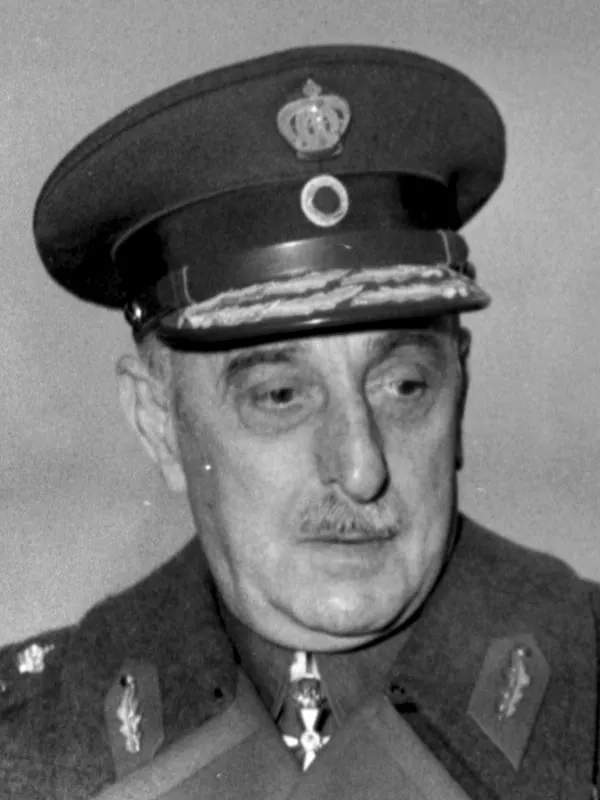
- Born:
- 9 December 1883, Athens
- Died:
- 4 October 1955, Athens
- Author:
- Łukasz
- Photo:
- autor nieznany, CC BY-SA 4.0, Wikimedia Commons

Alexandros Papagos was the commander who led the Greek army to victory over Italy in the winter of 1940–1941, in the first successful land campaign against the Axis powers. A cavalryman from an aristocratic family with close ties to the royal court, he helped to restore the monarchy in 1935, and as chief of the general staff he was one of the pillars of the dictatorship of Ioannis Metaxas. On the day of the Italian invasion, 28 October 1940, he became commander-in-chief. He threw back the Italians in the mountains of Epirus and the Pindus and carried the war onto Albanian soil, but in the spring of 1941 he was unable to stop the Germans. He survived the occupation and German camps, in 1949 led the government army to victory in the civil war, became the only professional officer in Greek history to receive a field marshal’s baton, and spent the last three years of his life as prime minister.
Cavalryman and monarchist
He was born on 9 December 1883 in Athens. His father, Leonidas Papagos, came from the island of Syros and was a general who, among other posts, served as aide-de-camp to the king. His mother, Maria, came from the wealthy Averoff family: her father was the politician Dimitrios Averoff and her uncle the great benefactor Georgios Averoff, after whom a Greek cruiser was named. Alexandros began studying law in Athens but soon chose the army instead. In 1902 he entered the Royal Military Academy in Brussels and then trained at the cavalry school in Ypres. In 1906 he was commissioned as a second lieutenant of cavalry in the Greek Army. In 1911 he married the daughter of General Andreas Kallinskis-Roidis.
During the Balkan Wars of 1912–1913 he served at the headquarters of the heir to the throne – from 1913 King Constantine I. When the National Schism tore the country apart during the First World War, Papagos, a committed royalist, sided with the king. In 1917, after Eleftherios Venizelos took power, he was dismissed from the army and exiled to the islands. He returned to service in 1920, after the monarchists’ victory, and in the war with Turkey was chief of staff of a cavalry brigade and then of a cavalry division in Anatolia. After the defeat of 1922 and the military coup he was dismissed once again. He returned to the army in 1926 as a colonel, became a major general in 1930 and deputy chief of the general staff in 1931, and in 1935, after commanding two army corps, a lieutenant general.
Beside the throne and the dictatorship
On 10 October 1935 Papagos, together with the heads of the navy and the air force, forced the resignation of the government of Panagis Tsaldaris and became minister for military affairs in the cabinet of General Georgios Kondylis, who at once proclaimed the restoration of the monarchy. After the return of King George II he kept the ministry in the next government; in March 1936 he became inspector general of the army and on 1 August 1936 chief of the general staff. Three days later the army under his direction secured the introduction of Metaxas’s dictatorship. In the spring of 1936, when the Liberals were negotiating with the communists for support for their government, Papagos is said to have warned the king that the army would not allow the communists any share in power.
As a man of the court and chief of staff, he spent four years preparing the armed forces for war. He reorganised the army, directed the construction of fortifications on the Bulgarian border, known as the Metaxas Line, built up stocks and drew up plans for defence against an attack by Italy and Bulgaria. In Epirus these plans provided for a mobile defence and a gradual withdrawal to gain time for mobilisation. Most of the money was swallowed up by the fortifications in the north-east, and some of the weapons ordered abroad did not arrive before the war. In 1940 a special law allowed him to remain in post although he had passed retirement age. In August 1940, after the sinking of the cruiser Elli, he proposed mobilising two corps. Metaxas, unwilling to provoke the Italians, agreed at the time to mobilise only two divisions, and further call-ups were carried out quietly, by summoning reservists individually by name.
Commander-in-chief
When on 28 October 1940 Metaxas rejected the Italian ultimatum and Italy attacked Greece, Papagos assumed the post of commander-in-chief and moved into his headquarters in the Hotel Grande Bretagne in Athens. In the first days of the war he acted cautiously, instructing the troops in Epirus above all to hold the passes of the Pindus and not to bleed themselves white on the border. His most important decision, however, was to transfer to the Albanian front most of the reserves and some of the divisions from the Bulgarian border once it became clear that Bulgaria would stay neutral. The Italian offensive of General Sebastiano Visconti Prasca bogged down in the mud of Epirus, and at the beginning of November the Julia Alpine Division was surrounded in the Pindus mountains and thrown back.
On 14 November Papagos went over to the counter-offensive. On 22 November the Greeks took Korçë in Albania, and in the weeks that followed also Sarandë, Gjirokastër and, in January 1941, the Klisura pass. The front settled several dozen kilometres inside Albania. The war in the mountains, in snow and bitter frost, with supplies brought up by mule and by women from the surrounding villages, cost both sides tens of thousands of dead, wounded and frostbitten. In March 1941 the Greeks repulsed a great Italian spring offensive that Mussolini watched in person. Papagos became a national hero, and his victories over the army of a great power were widely reported in the Allied press.
Greece faces Germany
From the beginning of 1941 it was clear that Germany would enter the war. On 22 February 1941, at the Tatoi palace, Papagos took part in a conference with the British Foreign Secretary Anthony Eden, the Chief of the Imperial General Staff John Dill and the Commander-in-Chief Middle East Archibald Wavell, attended also by the king and Prime Minister Alexandros Koryzis. It was agreed there that a British expeditionary corps would come to Greece and that the joint defence would rest on a line along the Aliakmon river in central Macedonia. The two sides, however, understood differently whether and when the Greek forces would withdraw from the forward Metaxas Line and from Albania. The British believed that the Greeks had agreed to do so at once; Papagos maintained that it was to depend on the attitude of Yugoslavia. As a result the main Greek forces remained in Albania, eastern Macedonia was defended by the weak garrison of the Metaxas Line, and the Aliakmon line by the British with small Greek forces. Historians still argue over whether Papagos made a mistake or simply had no choice, because an army exhausted by a winter in the mountains was no longer capable of a rapid withdrawal without losing its equipment and its morale.
On 6 April 1941 Germany attacked Greece and Yugoslavia. The garrisons of the Metaxas Line fought bravely, but the German panzer divisions bypassed them through Yugoslavia and took Salonika on 9 April. Papagos authorised the cut-off army of eastern Macedonia to capitulate. The withdrawal from Albania began too late. On 20 April General Georgios Tsolakoglou, without the authority of the commander-in-chief, signed the capitulation of the Army of Epirus to the Germans, which on 23 April, at Mussolini’s demand, was repeated with the Italians taking part. Papagos condemned the step and refused to take part in the negotiations. On 23 April he resigned his command. He did not leave with the king and the government for Crete but remained in the occupied country.
Occupation and the camps
During the occupation Papagos lived in Athens under surveillance. With other senior officers he set up a clandestine military organisation known as the Military Hierarchy, whose task was to prepare the army to be rebuilt at the moment of liberation. In July 1943 the Germans arrested him and deported him to the Reich together with several other generals. He was held in a number of places and finally in Dachau concentration camp as one of the special prisoners – hostages of value to the Nazis. At the end of April 1945 the SS moved this group, some 140 people from many countries, to South Tyrol. There, near Niederdorf, the hostages were freed thanks to the intervention of a Wehrmacht detachment, and at the beginning of May they were taken over by the Americans. Papagos returned to Greece in 1945.
The civil war and the marshal’s baton
On his return he held no post in the army. He served as Grand Chamberlain of the court, and in July 1947, as a mark of honour, he was promoted to the very rarely conferred rank of full general (stratigos). Meanwhile the country had plunged into a civil war between the government and the communist Democratic Army of Greece. On 19 January 1949 Papagos became commander-in-chief of the armed forces with sweeping powers. His authority enabled him to impose his will both on the Greek generals and on the American military mission, with which there had previously been disputes. With substantial American help, including aircraft using napalm, the government army destroyed the main partisan forces in the Grammos and Vitsi mountains in the summer of 1949. In the autumn of 1949 Papagos became the first and only professional officer in Greek history to be made a field marshal. The British officer and historian Christopher Woodhouse judged him an excellent staff officer and a master of the political side of war, but a commander with little experience of directing a battle who seldom visited the front.
Prime minister
In May 1951, after a clash with the court, Papagos left the army and founded a party, Ellinikos Synagermos (the Greek Rally), modelled on de Gaulle’s movement. In the elections of September 1951 it won more than 36 per cent of the vote. The court feared that the popular marshal might reach for dictatorial power. In the elections of November 1952, held under a new majoritarian electoral law, Papagos’s party won 49 per cent of the vote and 239 of the 300 seats, and that same November he himself became head of the government.
His cabinet rebuilt a country devastated by a decade of war. In 1953 the drachma was devalued by half, which stabilised the currency and ushered in a period of rapid economic growth. Greece, a member of NATO since 1952, concluded an agreement on military bases with the United States and a Balkan alliance with Yugoslavia and Turkey. The opposition accused the government of doing nothing to heal the wounds of the civil war or to ease the repression of the left. The biggest foreign-policy problem became Cyprus, whose Greek population demanded union with Greece. In 1954 Papagos, albeit reluctantly, brought the question before the United Nations, and in 1955 an armed struggle against the British began on the island. Relations with Turkey deteriorated sharply, and in September 1955 came the Istanbul pogrom, directed against the city’s Greeks.
From the beginning of 1955 Papagos was seriously ill. He died in Athens on 4 October 1955, still in office as prime minister. King Paul entrusted the office to the young minister of public works, Konstantinos Karamanlis.
Significance
Papagos has gone down in history above all as the victor of Albania. Under his command the army of a small, poor country, armed with obsolete weapons from several different states, halted and threw back the forces of a great power that enjoyed superiority in aircraft and tanks. Mussolini’s defeat in Greece wrecked Italy’s prestige, made it dependent on Germany and drew the Wehrmacht into the Balkans in the spring of 1941. Critics faulted Papagos for his caution, his stubbornness in keeping the army in Albania in the spring of 1941 and his failed cooperation with the British. For Greeks, however, he remained, alongside Metaxas, a symbol of the “epic of 1940”. His memoirs, The Battle of Greece 1940–1941, are one of the basic sources for the history of the campaign, and the Athens district of Papagou bears his name.
Sources
Commanded in battles
(02)Often appears with
People who appear in the same events.