Germany
Wilhelm List
Commander of the 14th Army (1939) and the 12th Army (1939–1941), Wehrmachtbefehlshaber Südost (1941), commander of Army Group A (1942), field marshal (1940)
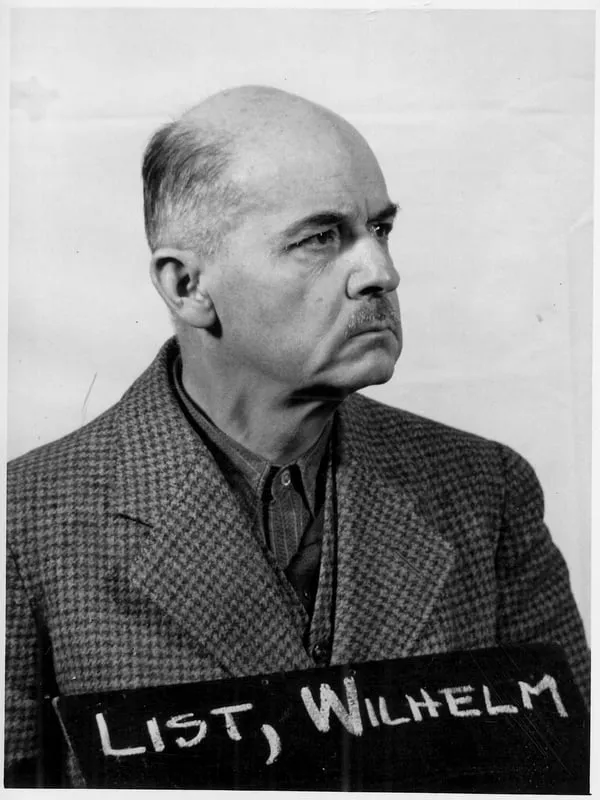
- Born:
- 14 May 1880, Oberkirchberg near Ulm (Württemberg, German Empire)
- Died:
- 16 August 1971, Garmisch-Partenkirchen (West Germany)
- Author:
- Łukasz
- Photo:
- Office of Military Government for Germany, United States, domena publiczna, Wikimedia Commons

Wilhelm List was a Bavarian staff officer, an outstanding trainer of officers in the Reichswehr and one of the most senior generals of the Wehrmacht. In September 1939 his 14th Army struck southern Poland from Upper Silesia, Moravia and Slovakia and took Kraków; in 1940 the 12th Army followed the tanks through the Ardennes; and in the spring of 1941, by then a field marshal, List directed the assault on Greece and southern Yugoslavia, the fastest and most complete German campaign of the war. In the autumn of 1941, as the senior German commander in the Balkans, he bore responsibility for the mass execution of hostages in occupied Serbia and Greece. In 1942 he led Army Group A into the Caucasus, and when the offensive stalled Hitler dismissed him and took over command himself. After the war an American tribunal at Nuremberg sentenced him to life imprisonment for war crimes, yet he was a free man again by 1952.
A Bavarian staff officer
Siegmund Wilhelm Walther List was born on 14 May 1880 in Oberkirchberg near Ulm, in Württemberg, the son of a physician, Walter List. When he was ten the family moved to Munich, where he completed his secondary schooling at a gymnasium. In July 1898 he joined a Bavarian engineer battalion as a volunteer; he was commissioned as a second lieutenant in 1900 and became battalion adjutant in 1904. From 1908 to 1911 he studied at the Bavarian War Academy in Munich, which opened the way to the general staff. In March 1914, by then a captain, he was posted to the central office of the Bavarian general staff.
During the First World War List served as a staff officer. In 1914–1915 he was on the staff of the II Bavarian Army Corps on the Western Front; then, after a serious illness and an operation, on the staff of Army Group Strantz; and in 1917–1918 he was first staff officer of the 8th Bavarian Reserve Division, which fought against Romania in Transylvania and later in Flanders. English-language works sometimes repeat the claim that one of his subordinates was Corporal Adolf Hitler. This is a mistake: the regiment in which Hitler served was known as the “List Regiment” after its first commander, Colonel Julius List, who was killed near Ypres in 1914. Wilhelm List never commanded that regiment.
The Reichswehr
The end of the war found List at the Bavarian War Ministry in Munich. According to his biographer he intended to leave the army at the time, but after the assassination of the Bavarian prime minister Kurt Eisner he joined the Freikorps of General Franz von Epp and took part in the bloody suppression of the Bavarian Soviet Republic in the spring of 1919. He stayed on in the Reichswehr. As commander of a rifle battalion in Kempten im Allgäu, he took part in the action against Hitler’s Munich putsch in November 1923.
For the next ten years List devoted himself almost entirely to training. Until 1926 he ran the secret training of general staff officers in the 7th Division in Munich – training forbidden to Germany by the Treaty of Versailles – and then moved to the Reichswehr Ministry in Berlin, where from 1927, succeeding Werner von Blomberg, he headed the army’s training department. In 1930 he became commandant of the infantry school in Dresden, at the time the army’s only officer school, and rose to the rank of Generalleutnant.
A general of the Third Reich
On 1 October 1933 List took over the 4th Division and the military district in Dresden, which in 1935 was expanded into IV Army Corps. He had little sympathy for the Nazis. According to his biographer, during the Night of the Long Knives in 1934 his Dresden district was the only one apart from Munich’s to protest sharply against the shootings carried out by the SS. Through his chief of staff, the future conspirator Friedrich Olbricht, members of the military opposition sought contact with him several times: during the crisis that followed the removal of Werner von Fritsch in 1938, before the campaign in the West and in 1942. List heard them out but did not join the conspiracy.
In February 1938 he was given command of an army group in Kassel, and after the Anschluss of Austria he took over a new army group command in Vienna, charged with incorporating the Austrian army into the Wehrmacht. In March 1939 his troops marched into Moravia, and on 1 April 1939 he was promoted to Colonel General.
Poland and France
In September 1939 List commanded the 14th Army on the southern wing of General Gerd von Rundstedt’s Army Group South. His troops attacked on 1 September from Upper Silesia, Moravia and Slovakia, pushed the Kraków Army eastwards, entered Kraków on 6 September and drove on across the San towards Lwów (Lviv), closing the encirclement of the Polish forces from the south. SS and police units followed in the wake of the 14th Army’s advance. Udo von Woyrsch’s operational group murdered Jews in Silesia and Lesser Poland, and several hundred people were killed in and around Przemyśl at that time. According to his biographer, unease in the army ran so high that in an order of the day of 1 October 1939 List wrote of the soldiers’ “obvious dissatisfaction” with everyone who wore SS uniform. For the Polish campaign he received the Knight’s Cross.
In October 1939 his staff was transferred to the West as the headquarters of the 12th Army. In May 1940, as part of Army Group A, the 12th Army advanced through the Ardennes behind the panzer divisions and forced the Meuse at Mézières and Sedan. When on 17 May Ewald von Kleist relieved the insubordinate Heinz Guderian of his command, it was List who smoothed over the quarrel and allowed Guderian to press on under the guise of a “reconnaissance in force”. In June his army broke through the French front on the Aisne near Rethel, and Guderian’s panzer group, now placed under List, pushed across the Langres plateau to the Swiss border, cutting off the French forces on the Maginot Line. On 19 July 1940 Hitler promoted List, together with eleven other generals, to field marshal.
The Balkans
In the winter of 1940–1941 the 12th Army was moved to Romania in order to strike at Greece through Bulgaria. List negotiated the terms of passage with the Bulgarian general staff, and for several weeks his army waited on the Danube until Bulgaria joined the Tripartite Pact. On 2 March 1941 it crossed the river, and by mid-March it stood on the Greek frontier. After the coup in Belgrade Hitler ordered Yugoslavia to be crushed at the same time, and List had nine days to regroup his army so that part of his armour could strike from Bulgaria towards Niš and Belgrade.
On 6 April 1941 the 12th Army attacked Greece and southern Yugoslavia. List’s plan did not call for storming the fortifications of the Metaxas Line but for outflanking them: the 2nd Panzer Division passed through the Yugoslav Strumica valley and took Salonika on 9 April, cutting off the Greek forces in Eastern Macedonia, while XL Panzer Corps entered Greece from the west by way of Skopje and Bitola, into the rear of the line held by the British corps of General Henry Maitland Wilson and of the Greek army fighting in Albania. The British fell back through Vevi, Olympus and Thermopylae, and on 20 April General Georgios Tsolakoglou, without his government’s consent, surrendered the Army of Epirus to Sepp Dietrich, commander of the SS brigade Leibstandarte. On 21 April at Larissa List signed a capitulation protocol with the Greeks that left the Italians out. Benito Mussolini protested to Hitler, who ordered the act to be repeated on 23 April in Salonika in the presence of Italian representatives – something List’s biographer called outright a public snub to the victorious commander. Meanwhile Yugoslavia had capitulated on 17 April, on 27 April the Germans entered Athens, and at the end of the month the remnants of the British corps were evacuated from the Peloponnese.
Wehrmachtbefehlshaber Südost
When the campaign ended List became Wehrmachtbefehlshaber Südost, the supreme Wehrmacht commander in occupied Greece and Serbia, with the military commanders in Serbia, Salonika and southern Greece under him. In the summer of 1941, after the German invasion of the Soviet Union, a rising broke out in Serbia led by communist partisans and by the royalist detachments of Dragoljub Mihailović. List responded with reprisals against the civilian population. In September General Franz Böhme, subordinate to List, became plenipotentiary commanding general in Serbia, and on 16 September the chief of the OKW, Wilhelm Keitel, ordered that 50 to 100 hostages be killed for every German soldier who fell. According to German studies, on 4 October 1941 List ordered camps to be set up for hostages who were to be shot in the event of partisan attacks. In October 1941 troops under Böhme shot thousands of civilians in Serbia, including at Kraljevo and Kragujevac, and most of the adult male Serbian Jews also fell victim to the autumn executions. In Greece, on 17 October 1941, in reprisal for a partisan attack, the Macedonian villages of Ano and Kato Kerdilia were destroyed and more than two hundred of their inhabitants shot. Some historians attribute this order directly to List.
In mid-October 1941 List underwent an appendectomy, which served as a pretext for removing him from his post. In the spring of 1942 Hitler sent him on an inspection tour of Norway and northern Finland to assess preparations against a possible British landing. Hitler disliked List and did not want to give him a new command. He changed his mind only under pressure from Franz Halder, chief of the army general staff, and Keitel.
The Caucasus and dismissal
In July 1942, during the great summer offensive on the southern sector of the Eastern Front, List took command of the newly formed Army Group A, which was to capture Rostov-on-Don and then the Caucasus oilfields. His troops took Rostov at the end of July and Maykop on 9 August, but the oilfields had been destroyed by the Russians. At the end of August the offensive stalled in the Caucasus mountains and on the Terek, short of Grozny. Fuel and ammunition were running short, and the air force had been shifted to Stalingrad. On 7 September Hitler sent General Alfred Jodl, chief of the OKW operations staff, to List’s headquarters to hurry him along. Jodl agreed with List that the forces were insufficient, which enraged Hitler. On 9 September List was relieved, and for more than two months Hitler commanded Army Group A himself before handing it over to Kleist. According to witnesses, Hitler commented on the dismissal by saying that “Field Marshal List commanded sluggishly”. Two weeks later Halder lost his post as well.
List was never given another assignment. He did not ask for a new post, and after the 20 July 1944 plot he did not send Hitler a telegram professing loyalty, as many generals did. He lived in Vienna and then in Garmisch-Partenkirchen, where the Americans detained him in the last days of the war.
Trial and final years
In 1947 List stood before an American military tribunal at Nuremberg as the principal defendant in the so-called Hostages Trial, the seventh of the Nuremberg trials conducted by the Americans after the trial of the major war criminals. Twelve generals were charged with shooting hostages, reprisal killings of civilians in Greece, Albania and Yugoslavia, the destruction of villages and the killing of prisoners of war. List maintained that he had been carrying out the orders of Hitler and Keitel and that the blame for the atrocities lay with those who had waged partisan warfare. The tribunal held that the partisans had not been lawful combatants and that the taking of hostages could in certain circumstances be permissible, but that the mass executions in the Balkans had exceeded every limit many times over. It also found that it was precisely from the highest-ranking commanders, such as List, that resistance to orders contrary to international law could be expected. On 19 February 1948 List was sentenced to life imprisonment.
In January 1951 John McCloy, the American High Commissioner in Germany, rejected his plea for clemency, pointing out that List had approved methods of fighting the partisans too brutal to be justified. Even so, in December 1952, less than five years after the verdict, List was released from Landsberg prison on grounds of poor health. He lived for almost another twenty years and died in Garmisch-Partenkirchen on 16 August 1971, aged 91.
Assessment
List was one of the ablest and most respected commanders of the German army. A product of the Reichswehr – matter-of-fact, self-assured and reserved – he did not court the regime’s favour and made no secret of his distance from the Nazis, which is why Hitler never trusted him. His campaign in the spring of 1941, in which within three weeks he shattered the Yugoslav and Greek armies and drove the British expeditionary corps off the continent, was one of the Wehrmacht’s most spectacular victories, and his dismissal in the Caucasus showed that by 1942 Hitler would no longer tolerate opposition from his own field marshals.
His distance from Nazism did not, however, prevent him from waging a war in which the occupied population became a target. In Poland in 1939 his army advanced alongside units that murdered Jews, and in Serbia and Greece in 1941 it was he, as supreme commander, who introduced the principle of collective responsibility that in the years that followed cost the lives of tens of thousands of civilians. His early release, like the fate of other convicted Wehrmacht generals, belongs to the history of the Cold War.
Sources
Commanded in battles
(03)Mentioned in battles
(02)Often appears with
People who appear in the same events.
On the timeline
(25)1939
1940
1941
January
February
March
April
- 06
- Key eventGermany attacks YugoslaviaOn 6 April 1941 Germany invaded Yugoslavia without declaring war and the Luftwaffe bombed Belgrade. The partly mobilised army quickly fell apart.
- Key eventGermany attacks GreeceOn 6 April 1941 the 12th Army struck Greece from Bulgaria. The Metaxas Line forts beat off the first attacks; at night an ammunition ship blast wrecked Piraeus.