1940–1941: The war in the Balkans
German invasion of Greece
- Dates:
- 6–30 April 1941
- Front:
- Balkans
- Location:
- Mainland Greece and the southern part of Yugoslav Macedonia: the Metaxas Line on the Bulgarian border, the Strumica and Vardar valleys, Salonika, the Klidi Pass near Vevi, the Aliakmon Line and the Mount Olympus massif, the Vale of Tempe, Epirus and the Metsovo Pass, Thermopylae, the Isthmus of Corinth, Athens, and the ports of Attica and the Peloponnese, including KalamataOn the battle map →
- Sides:
- Nazi GermanyWilhelm ListGreeceAlexandros PapagosUnited Kingdom, Australia and New ZealandHenry Maitland Wilson
- Result:
- Victory for Nazi Germany. Within three weeks the German 12th Army broke through the Greek and British defences, forced the surrender of the Greek armies in eastern Macedonia (9–10 April) and in Epirus (20–23 April), and on 27 April took Athens. The British W Force fell back southwards and by 30 April had evacuated some 50,000 soldiers from Greece, losing all its heavy equipment and several thousand men taken prisoner. The King and the Greek government moved to Crete and fought on, while the country was divided into German, Italian and Bulgarian zones of occupation.
- Author:
- Natalia
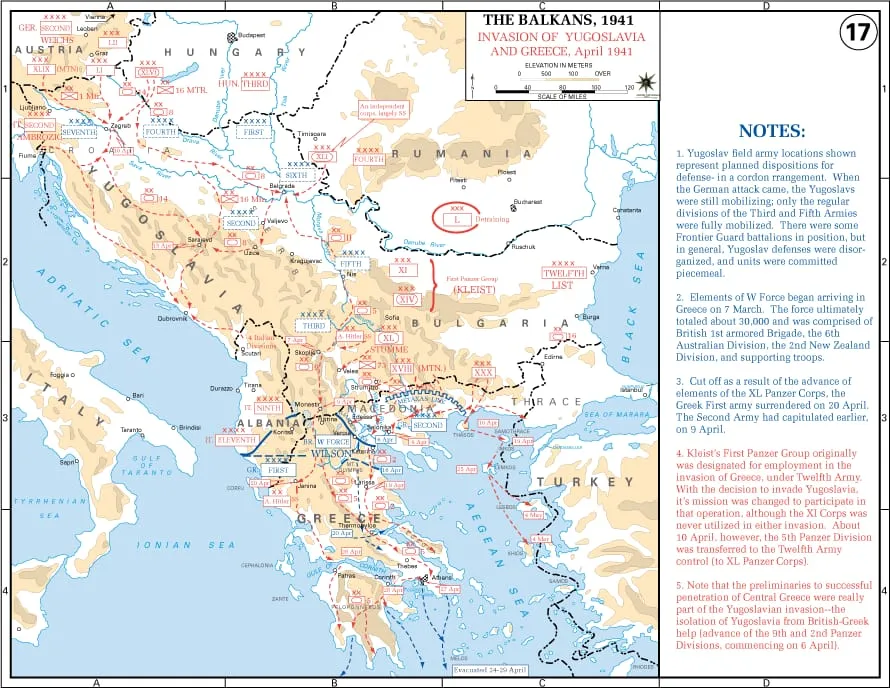
The German invasion of Greece, carried out under the codename Marita, was a three-week campaign in which the Wehrmacht settled a war the Italians had been unable to win since October 1940. On 6 April 1941, the same day as the attack on Yugoslavia, Field Marshal Wilhelm List’s German 12th Army struck from Bulgaria at the Greek fortifications along the border and, at the same time, through southern Yugoslavia, outflanking them from the west. The main Greek forces, fourteen divisions, were then deployed in Albania facing the Italians, after five months of the Greco-Italian War. The Bulgarian border was held by some 70,000 soldiers, while central Macedonia was to be covered by the British, Australian and New Zealand corps of Lieutenant General Henry Maitland Wilson, which had been arriving from Egypt since March.
Within four days the Germans had taken Salonika and forced the surrender of the troops holding the Metaxas Line, while their panzer divisions passed through the old Monastir, that is Bitola, into the rear of the defensive line on the Aliakmon river. The British fell back through Thessaly to Thermopylae, and a German SS brigade cut the line of retreat of the Greek army in Albania, which capitulated on 20 April. On 27 April the Germans entered Athens, and by 30 April they held the whole of the Peloponnese. Most of Wilson’s corps managed to escape by sea to Crete and Egypt, but it left all its heavy equipment behind in Greece. The campaign was one of the Wehrmacht’s swiftest victories of the war, and for Britain yet another evacuation of troops from the Continent, after Norway and Dunkirk.
Name and dates
The Germans called the operation Unternehmen Marita. The same name was borne by Adolf Hitler’s Directive No. 20 of 13 December 1940, which provided for the occupation of the northern coast of the Aegean and, if necessary, of the whole of mainland Greece. English-language literature speaks of the Battle of Greece, Greek literature of the Battle of Greece or the German invasion. Some accounts treat the war against Yugoslavia and Greece together as the Balkan campaign. The codename Marita is sometimes stretched to cover the airborne landing on Crete as well, but that operation had a name of its own (Merkur, “Mercury”) and is usually treated as a separate battle.
The campaign is taken to have begun on 6 April 1941, when at dawn German troops crossed the Bulgarian–Greek and Bulgarian–Yugoslav borders, and to have ended on 30 April. On that day, according to a German study prepared after the war for the US Army, the last British soldiers in the Peloponnese were evacuated or taken prisoner and the fighting ceased, while in Athens a collaborationist government was formed under General Georgios Tsolakoglou. German units were still occupying islands in the Aegean at the beginning of May (Lesbos and Chios on 4 May), and the war for Greece went on in Crete, but the fighting on the mainland ended in the last days of April.
Background
Hitler regarded the Italian attack on Greece of 28 October 1940 as a mistake that had drawn the British into the Balkans. From November British aircraft operated from Greek airfields, and from them RAF bombers could reach the Romanian oilfields at Ploiești, without which the Reich could not wage war against the Soviet Union. When General Alexandros Papagos’s Greek army drove the Italians deep into Albania and Benito Mussolini began asking Berlin for help, Hitler signed Directive No. 20 on 13 December. List’s 12th Army began to assemble in Romania; in the spring it was to cross Bulgaria to the Aegean. Winter and the lack of bridges delayed the crossing of the Danube, and only when Bulgaria joined the Tripartite Pact on 1 March 1941 did German divisions enter the country and take up positions on the Greek border.
In January the Prime Minister, Ioannis Metaxas, had turned down a British offer to send a small corps, so as not to provoke the Germans. After his death the new Prime Minister, Alexandros Koryzis, accepted help. On 22 February, at the Tatoi palace near Athens, the Foreign Secretary, Anthony Eden, and the Chief of the Imperial General Staff, General John Dill, agreed with the Greeks that Britain would send ground forces and that the joint defence would rest on a line along the Aliakmon. At the beginning of March, after disputes with Papagos, who had not withdrawn his divisions from the Bulgarian border, a compromise was adopted: both the Metaxas Line and the Aliakmon Line would be defended. From 7 March the troops of Operation Lustre were unloading at Piraeus: Major General Iven Mackay’s 6th Australian Division, Major General Bernard Freyberg’s 2nd New Zealand Division and the British 1st Armoured Brigade. The whole force came under the headquarters of Lieutenant General Thomas Blamey’s Australian I Corps and, after Wilson’s name, was called W Force.
Everything changed in the last week of March. On 25 March Yugoslavia joined the Tripartite Pact, on condition that it would not let German troops pass through, but two days later in Belgrade officers overthrew the government and the regent. On 27 March itself Hitler resolved to destroy Yugoslavia together with Greece. For the 12th Army’s planners this was a problem, since within nine days they had to regroup their forces so that part of them could strike at Belgrade, but it was also an opportunity: through southern Yugoslavia they could bypass the Metaxas Line and emerge, via Bitola, in the rear of the Aliakmon Line – exactly what the British had feared from the start. In the Mediterranean the Battle of Cape Matapan at the end of March deterred the Italian fleet from the convoy routes to Greece, but in Libya Rommel’s first offensive had just begun to push back British forces weakened by the Greek expedition. The 6th Australian Division was already in Greece, but the second Australian division and the Polish Carpathian Brigade, which were to have joined it, stayed in Africa.
Opposing forces
List sent three corps against Greece and southern Yugoslavia. General Georg Stumme’s XL Panzer Corps, with the 9th Panzer Division, the 73rd Infantry Division and the reinforced SS motorised regiment Leibstandarte SS Adolf Hitler under Josef “Sepp” Dietrich, was to cross Yugoslav Macedonia towards Skopje and Bitola and then turn south. It was later joined by the 5th Panzer Division, transferred from Ewald von Kleist’s panzer group. General Franz Böhme’s XVIII Mountain Corps, with the 2nd Panzer Division, the 5th and 6th Mountain Divisions, the 72nd Infantry Division and the 125th Infantry Regiment, was to storm the Metaxas Line and outflank it through the Strumica valley. XXX Corps, with two infantry divisions, advanced through Thrace to the Aegean. Air support came from General Wolfram von Richthofen’s VIII Air Corps with several hundred aircraft, including Junkers Ju 87 dive-bombers, which in the mountain gorges proved a decisive weapon. From Albania the Italian 9th and 11th Armies kept up the pressure on the Greeks.
Greece had a dozen or more divisions under arms, but almost all of them were in Albania. Fourteen of them, divided between the Army of Epirus and the Army of Western Macedonia, were fighting the Italians from the Ionian Sea to the lakes near Korçë. The Bulgarian border was held by General Konstantinos Bakopoulos’s Army of Eastern Macedonia: three infantry divisions in fortified positions, a brigade on the Nestos river and a weak motorised division by Lake Doiran, some 70,000 men in all. The Metaxas Line, a chain of self-contained forts built from 1936 onwards, made good use of the mountainous terrain, but it was manned far more thinly than planned. The Army of Central Macedonia, that is the 12th and 20th Infantry Divisions, had been under Wilson’s command since 28 March.
At the time of the German attack W Force numbered, according to the most commonly cited figures, some 53,000 men, of whom only a part were combat troops. It had about a hundred tanks, mostly light and worn out in the desert, and little anti-tank or anti-aircraft weaponry. The RAF in Greece, commanded by Air Commodore John D’Albiac, comprised a few squadrons and was no match for the Luftwaffe. The corps’ equipment had been prepared for war in the desert, not in the mountains, and its only main supply artery was a single-track railway running north from Piraeus.
Course of the campaign: the Metaxas Line and Salonika (6–10 April)
Early on the morning of 6 April the German minister in Athens, Victor zu Erbach-Schönberg, informed Prime Minister Koryzis that the Reich’s troops were entering Greece to remove the British from it. Koryzis replied that Greece would defend itself. While they were talking, shots were already being fired on the border. Fort Rupel in the Struma gorge and the neighbouring works took the attack of the 5th Mountain Division and the 125th Infantry Regiment, supported by artillery and dive-bombers. German reports from the first day spoke of the attack on the Rupel Pass having been repulsed despite the heaviest air support, and of heavy losses. The 125th Regiment suffered so badly that after reaching its objective it had to be withdrawn from the fighting. Most of the more than twenty forts held out through the first days, and some of their garrisons went on fighting in underground galleries even after the Germans had passed them by. The breakthrough came from the 6th Mountain Division, which crossed a snow-covered ridge at a point the Greeks considered impassable and on the evening of 7 April cut the railway to Salonika. In the east, XXX Corps took Xanthi (PL) on 8 April and reached the Nestos.
The decision, however, came from the west, through Yugoslav territory. On 6 April the 2nd Panzer Division entered the Strumica valley, where the poorly mobilised Yugoslav troops offered little resistance; on 8 April it crossed the mountains, smashed a Greek motorised division south of Lake Doiran, and on the morning of 9 April its spearhead drove into Salonika. The Army of Eastern Macedonia was cut off from the rest of the country. According to Greek accounts, the high command left the decision to Bakopoulos, and on 9 April he signed a surrender that came into force the following day. The forts that were still fighting were ordered to lay down their arms, and some of the soldiers managed to get away by sea from the coast. The Germans disarmed the Greeks and sent them home. Böhme, the commander of XVIII Corps, is said to have expressed his admiration for the defenders of the forts, and in his Reichstag speech of 4 May Hitler said that of all their opponents only the Greeks had fought with the utmost courage and contempt for death.
Meanwhile Stumme’s XL Corps crossed Yugoslav Macedonia. On 7 April the 9th Panzer Division took Skopje, and on 8 April the SS vanguard entered Prilep, cutting the Belgrade–Salonika railway and severing Yugoslavia from its only potential allies. On the evening of 9 April the Germans stood north of Bitola, a dozen or so kilometres from the Greek border.
On the first night of the war the Luftwaffe also dealt a blow to the British rear. In a raid on Piraeus during the night of 6–7 April bombs hit the British freighter Clan Fraser, which was unloading ammunition and some 200 tons of TNT. At around 3.15 a.m. the ship blew up. The explosion was heard in Athens, red-hot debris set fire to neighbouring ships and warehouses, and the main port through which W Force was supplied was put out of normal operation for a long time.
Course of the campaign: Vevi, Olympus and the Vale of Tempe (10–18 April)
On 10 April XL Corps set off south from Bitola into the valley of Florina. The British had expected this thrust, and Wilson hastily assembled a force named after its commander, Mackay Force: Brigadier George Vasey’s Australian 19th Brigade, British riflemen, New Zealand machine-gunners, artillery and the Greek Dodecanese Regiment. Its task, as Wilson put it, was to “stop a blitzkrieg down the Florina valley” until the Greek divisions from the Vermio could withdraw on foot to a new line. The Germans fought their first engagement with the British before noon on 10 April north of the small town of Vevi. On 11 April the SS took Vevi, but stalled in front of the Klidi Pass, held by Australians and British, in a snowstorm and piercing cold for which soldiers from the desert were not prepared. At dusk on 12 April, after a day of reconnaissance, the SS regiment launched a frontal attack and after heavy fighting broke through the defences. Mackay Force withdrew during the night, losing some of its men and equipment.
On 13 April the 9th Panzer Division attacked towards Ptolemaida, where the British 1st Armoured Brigade blocked the road. The German tanks went round the position through the marshes and at nightfall struck from the flank. The British lost the hills and, according to the German study, abandoned more than thirty tanks and guns, while German losses amounted to four tanks. This was the only major armoured clash of the whole campaign. On the morning of 14 April the Germans drove into Kozani. At the same time SS units turned west towards Kastoria to cut the line of retreat of the Greeks from Albania. On 13 and 14 April, at the Klisoura (Kleisoura) Pass east of Kastoria – not to be confused with the Albanian pass taken by the Greeks in January – the Greek 20th Division, exhausted by night marches and without artillery ammunition, held up the Leibstandarte for a day until its defence gave way at noon on 14 April.
As early as 13 April Wilson decided to fall back to the Aliakmon–Olympus line and then further, to Thermopylae. That line was formed by three passages: the Servia pass above the Aliakmon, the Olympus pass and the narrow coastal strip below the castle at Platamonas, where the railway ran through a tunnel. They were held by Australians and New Zealanders. At Servia and in the Olympus pass the 9th Panzer Division and the 6th Mountain Division were held up for three days. At Platamonas the New Zealand 21st Battalion beat off a motorcycle battalion supported by tanks during the night of 14–15 April, but on 16 April the 2nd Panzer Division attacked again – with a hundred tanks, according to the German study – and the New Zealanders withdrew across the Pineios river into the Vale of Tempe. They were ordered to hold it until 19 April “even if it meant extinction”. Reinforced by two Australian battalions as the so-called Allen Force, they fought on 17 and 18 April against tanks and Ferdinand Schörner’s mountain troops. On the morning of 18 April the Germans crossed the river, and by evening the defence had collapsed. Its resistance, however, gave the rest of the corps time to pass through the road junction at Larissa, which the Germans did not take until 19 April.
The retreat was carried out under incessant air attack, against which the few British fighters could not protect the crowded mountain roads.
Course of the campaign: the decision to evacuate and the surrender of the Army of Epirus (14–23 April)
The defeat at Vevi and the retreat from the Aliakmon sealed the fate of the expedition. General Archibald Wavell, the British Commander-in-Chief Middle East, was in Greece from 11 to 13 April and warned Wilson that he would get no reinforcements. The British, however, could not themselves propose to withdraw from a country they had promised to fight for. Papagos was the first to do so, suggesting to Wilson that W Force should leave Greece to spare the country destruction. On 16 April the two generals met at Lamia and Wilson announced a withdrawal to Thermopylae. On 17 April Rear Admiral Harold Baillie-Grohman, sent from Cairo to prepare the evacuation, arrived in Athens. On 18 April, after a meeting attended by King George II, Papagos and Wilson, Prime Minister Koryzis took his own life. On 19 April Wavell flew into Athens, and on 21 April the final decision was taken on Operation Demon, the evacuation of the troops to Crete and Egypt. That same day the banker Emmanouil Tsouderos, a Cretan by birth, became the new Prime Minister.
The fate of the Greek army in Albania was the most tragic of all. For many days its commanders refused to give up without a fight the ground won from the Italians, and Wilson later wrote bitterly of the “fetish” that not a yard of ground could be yielded to the Italians. The first units began to withdraw only on 13 April, when the Germans were already in Kozani, and the Italians set off after them in cautious pursuit. The divisions marched on foot through the Pindus mountains, with mule-drawn baggage trains, under air attack. Meanwhile the Leibstandarte came out in their rear by way of Grevena. After a fight at the Metsovo Pass, at an altitude of more than 1,500 metres, the SS men had closed the last line of retreat by 20 April, and on 21 April they were in Ioannina.
The Army of Epirus then numbered fourteen divisions on paper, but it was exhausted by five months of war. For a week its officers had been warning Papagos that morale was collapsing. On 20 April the commander of the Army of Western Macedonia, General Georgios Tsolakoglou, together with two other generals, removed General Ioannis Pitsikas from command and, without the consent of the government or the Commander-in-Chief, offered to surrender – but to the Germans only. The offer was accepted by Sepp Dietrich. Hitler ordered the talks to be kept secret from the Italians and granted the Greeks honourable terms: the soldiers were not to go into captivity but, once disarmed, to return home, and the officers kept their side arms. On 21 April Tsolakoglou signed a protocol with List’s chief of staff. Mussolini demanded that the Greeks surrender to the Italians as well, and his troops renewed their attacks in Epirus, which the Greeks repulsed. Only after Mussolini intervened with Hitler was a third instrument of surrender signed in Salonika on 23 April, with an Italian representative taking part. Papagos condemned the general’s unauthorised decision, but he no longer had an army to command. The number of soldiers who laid down their arms in Epirus is usually given as more than 200,000. That same day, 23 April, the King and the government flew to Crete.
Course of the campaign: Thermopylae, Corinth and Athens (19–27 April)
W Force took up its last position before Athens at a place every soldier knew from school. Freyberg’s New Zealanders stood in the coastal pass at Thermopylae, where in 480 BC Leonidas had held out against the Persians, and Mackay’s Australians at the Brallos Pass in the mountains to the west. Freyberg and Mackay told their men that there would be no more retreats. Mackay later said that he had not been thinking of evacuation and expected them to hold for two weeks until the enemy’s superior strength told. On 23 April, however, the order to withdraw came, and the position was now to be held by just two brigades: the 6th New Zealand and Vasey’s Australian 19th. Vasey is credited with the words “Here we are and here we bloody well stay.” Before noon on 24 April tanks of the 5th Panzer Division and riflemen of the 6th Mountain Division attacked them. The defenders beat off attacks all day, destroying a dozen or so tanks according to New Zealand and Australian accounts, and during the night of 24–25 April withdrew to a new covering position near Thebes. In the morning the Germans found empty trenches.
At dawn on 26 April the Germans tried to close the escape route to the Peloponnese. Gliders and two battalions of the 2nd Parachute Regiment landed on both sides of the Corinth Canal to seize the only bridge linking the peninsula with the mainland. The bridge was taken and German sappers set about removing the demolition charges, but before they could clear them away an explosion dropped the span into the canal together with the soldiers standing on it. According to one version a stray shell hit the charges; according to another, a British sapper, Captain John Tyson, deliberately set them off with a rifle shot. The paratroopers took Corinth and, by their own reports, captured more than 2,000 prisoners, including some 900 British and Australians, at a cost of 63 killed, 158 wounded and 16 missing. The operation came too late: most of W Force was already on the beaches of the Peloponnese or had crossed the isthmus earlier.
On the morning of 27 April motorcyclists of the 2nd Panzer Division, who had bypassed the last British rearguard by way of the island of Euboea, rode into an empty, shuttered Athens. The Germans drove straight to the Acropolis and hoisted the swastika flag there. According to a legend that soon spread through the occupied country, the evzone standing guard over the Greek flag, Konstantinos Koukidis, wrapped himself in it and leapt from the rock; historians are not certain whether the story is true. That same day an SS detachment that had made its way into the Peloponnese from the west via Missolonghi and Patras reached Corinth by rail, and sappers put up a temporary crossing beside the wrecked bridge, over which the 5th Panzer Division moved south.
The evacuation and Kalamata (24–30 April)
Operation Demon began during the night of 24–25 April. Royal Navy ships under Admiral Andrew Cunningham approached small harbours and beaches after dark, since Piraeus had been wrecked and by day the Luftwaffe ruled the sea. Each night several thousand men were taken off from Porto Rafti and Rafina in Attica, from Megara, Nafplio, Monemvasia and Kalamata, and before dawn the ships sailed for Crete or Alexandria. Lorries, guns and tanks were destroyed on the shore. The greatest tragedy came on 27 April: the Dutch troopship Slamat, which had waited too long to embark soldiers off Nafplio, was sunk by dive-bombers, and the destroyers HMS Diamond and HMS Wryneck, which had rescued the survivors, were sunk in another raid a few hours later. Nearly a thousand men died; of the roughly 500 soldiers aboard Slamat, eight survived.
The worst end came at Kalamata in the south of the Peloponnese, where several thousand soldiers from various units had gathered, among them Australians, New Zealanders from reinforcement units, Cypriots, Palestinians and Yugoslav refugees. On the evening of 28 April the vanguard of the 5th Panzer Division broke into the town. A New Zealand sergeant, Jack Hinton, led a counter-attack in which he destroyed a German gun and machine-gun nests with grenades, for which he was awarded the Victoria Cross. The Germans were driven off the quayside, but the ships, warned of fighting in the port, took off only a few hundred men that night. On 29 April some 7,000–8,000 soldiers left behind in and around Kalamata laid down their arms. By 30 April the last groups had been taken off or captured, while individual soldiers went on hiding with Greeks for a long time and made their way by boat to Crete and Turkey.
According to British figures, a little over 50,000 men in all were evacuated from Greece, roughly four out of every five soldiers of W Force. The Greek navy and merchant marine helped, and suffered heavy losses in doing so. Winston Churchill later wrote that in those days aircraft sank 26 ships, 21 of them Greek. The surviving Greek warships made their way to Alexandria and fought on alongside the Royal Navy.
Losses
British, Australian and New Zealand losses amounted, according to British tallies, to 11,840 men, counting killed, wounded and prisoners, and according to other calculations that also include auxiliary units, to a somewhat higher figure, though still well under 20,000. Most of them were prisoners, taken mainly in the last days in the Peloponnese. The Australian official history gives 320 killed, 494 wounded and 2,030 taken prisoner for the Australians; the New Zealand one gives 291 killed, 599 wounded and 1,614 taken prisoner for the New Zealanders. Almost all the corps’ equipment remained in Greece: tanks, artillery, thousands of vehicles. The RAF lost about 200 aircraft, according to British figures.
German losses were small. A study prepared after the war by German officers for the US Army speaks of about 1,100 killed and 4,000 wounded and missing in Greece. In his speech of 4 May Hitler gave 1,099 killed, 3,752 wounded and 385 missing for the whole Balkan campaign, Yugoslavia included – roughly what, according to that study, the Germans lost in Greece alone – which is why some historians regard these figures as understated. Greek losses in the fighting against the Germans were never precisely established, as they were subsumed in the overall toll of the war of 1940–1941, in which, by Greek reckoning, more than 13,000 soldiers were killed, mostly in Albania. In all, some 270,000 Greeks were taken prisoner, but almost all of them were soon released and sent home.
Significance
In three weeks Greece, which had been defeating the Italians for half a year, was beaten, and Britain lost its last ally fighting on the European continent. The King and Tsouderos’s government were evacuated to Crete and from there to Egypt and London, and formally Greece as a state never capitulated. The country was divided into zones of occupation: the Germans kept Athens, Salonika and key islands, the Italians occupied most of the country, and Bulgaria eastern Macedonia and Thrace. The occupation brought the Great Famine of the winter of 1941–1942, a resistance movement, reprisals against the civilian population and, later, civil war.
The campaign did not end the struggle for Greece. A large part of the evacuated troops landed on Crete, where in May 1941 they had to face German paratroopers in the Battle of Crete. For the Australians and New Zealanders, who bore the brunt of the fighting, Greece became yet another expedition conceived in London and ending in an evacuation under fire, like Gallipoli in 1915. In Britain the decision to intervene was long criticised. General Alan Brooke called it a clear strategic blunder, because it deprived Wavell of his reserves just as Erwin Rommel was retaking Cyrenaica. Its defenders, led by Eden and Churchill, replied that Britain could not abandon its only ally and that Greece had delayed the attack on the Soviet Union.
That last argument was also repeated by Hitler himself, who towards the end of the war blamed “the Greek campaign” for delaying Operation Barbarossa. Most historians, however, believe that the date of 22 June was set above all by shortcomings in the preparations and a late, wet spring, and that the divisions used in Greece were back in the east in time. What the campaign did show, once again, was the effectiveness of the German panzer divisions and air force, this time in high mountains. Field Marshal List commanded the German forces in the Balkans until the autumn of 1941, and after the war he stood trial before an American tribunal at Nuremberg in the so-called Hostages Trial and was convicted of crimes against the civilian population of Greece and Yugoslavia.