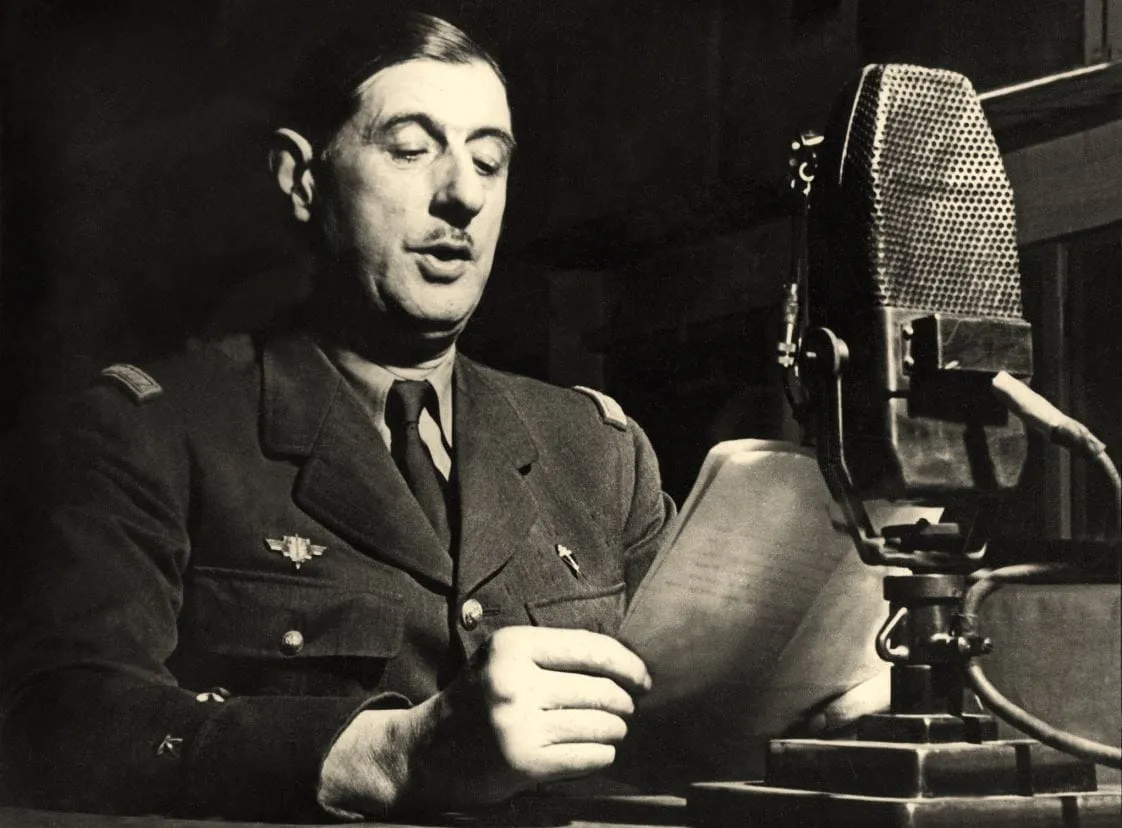
On the evening of 18 June 1940, from a BBC studio in London’s Broadcasting House, Brigadier General Charles de Gaulle, until a few days earlier under-secretary of state at the Ministry of War, spoke to the French people. The day before, the new prime minister, Marshal Philippe Pétain, had announced on the radio that “the fighting must stop” and had asked the Germans for armistice terms. De Gaulle spoke for about four minutes. France, he argued, had lost a battle, but the war – a world war – went on: France had a colonial empire, an ally that ruled the seas and access to the industry of the United States. He called on French soldiers, engineers and armaments workers who were, or might find themselves, on British territory to get in touch with him. He ended with a sentence that passed into history: “Whatever happens, the flame of French resistance must not and shall not die.”
Only a handful of people heard the appeal, and no recording of it survives. Ten days later, on 28 June, the British government recognised de Gaulle as leader of all Free Frenchmen. From these two dates grew Free France, and 18 June became the French symbol of the refusal to accept defeat.
Some war chronologies record under 18 June that de Gaulle set up the French Committee of National Liberation (Comité français de la Libération nationale), a French government-in-exile, on that day. This is a mistake. On 18 June de Gaulle founded no committee and no government; he made a radio speech. The French Committee of National Liberation came into being three years later, on 3 June 1943 in Algiers, with de Gaulle and General Henri Giraud as co-chairmen. Before that, on 24 September 1941, de Gaulle had set up the French National Committee in London, the first body to act as a government. In June 1940 he had nothing but a microphone, a few associates and Churchill’s backing. British recognition came only on 28 June.
From Bordeaux to London
The French government left Paris on 10 June and, after a few days in the châteaux of the Loire, ended up in Bordeaux. De Gaulle, appointed under-secretary of state by Prime Minister Paul Reynaud on 5 June, was the most outspoken advocate of fighting on in that government. He wanted to move the army and the government to North Africa and carry on the war from the empire. He flew to London twice, on 9 and 16 June. On 16 June he dictated to Reynaud over the telephone from London the British proposal for a Franco-British union. When he flew back to Bordeaux that evening, he found that Reynaud had resigned and that President Albert Lebrun had entrusted the government to Pétain, who intended to ask for an armistice. So came about Pétain’s accession to power.
There was no place for de Gaulle in the new government. The Minister of National Defence was General Maxime Weygand, who had been Commander-in-Chief since May and had long believed the war was lost. De Gaulle feared arrest. Reynaud had 100,000 francs from the secret fund handed to him. At about nine in the morning of 17 June de Gaulle and his aide-de-camp, Lieutenant Geoffroy de Courcel, drove to Mérignac airfield, ostensibly to see off General Edward Spears, Winston Churchill’s personal representative to the French government. At the last moment they boarded his aircraft, a twin-engined de Havilland Flamingo. Spears later told how he had hauled de Gaulle aboard as the machine was already moving. De Gaulle and Courcel regarded this version as literary embellishment. All that is certain is that the departure had been quietly prepared and that de Gaulle was deliberately breaking with his country’s government.
Shortly after 12.30 p.m. the aircraft landed at Heston aerodrome near London. At that very moment the French were listening to Pétain on the radio: “It is with a heavy heart that I tell you today that the fighting must stop.” At around 3 p.m. de Gaulle was with Churchill in Downing Street. He set out his intention: France must fight on even if the government in Bordeaux laid down its arms, and he himself wished to speak on the radio as soon as the request for an armistice became a fact. Churchill agreed at once and put the BBC at his disposal.
The British Cabinet hesitates
18 June was a tense day in London. In the afternoon Churchill made a great speech in the House of Commons, ending with the words that if the British Empire lasted for a thousand years, men would still say of those days: “This was their finest hour.” Earlier the War Cabinet had met, but without the prime minister, who was preparing his speech. The ministers judged that a broadcast by de Gaulle was undesirable as long as there was a chance that Pétain’s government might act in the Allied interest. What mattered most was the French fleet, the second largest in Europe after the British. Britain wanted the ships to sail for British ports or at least not to fall into German hands. London sent further emissaries to Bordeaux, and a radio attack by a French general on the very government with which it was negotiating could only do harm. According to French accounts, the strongest doubts were held by the Foreign Secretary, Lord Halifax, Neville Chamberlain and Clement Attlee.
Lobbying behind the scenes changed the decision. Spears and the Minister of Information, Duff Cooper, who knew the text of the speech, won the ministers over one by one. A handwritten amendment to the minutes of the meeting shows that the Cabinet finally agreed. It did, however, set a condition: the speech must not attack the French government. De Gaulle lunched with Duff Cooper that day and agreed to tone down the opening sentences. According to his own later account, he himself believed that until the armistice came into force the government in Bordeaux should be left even the slightest chance of changing its mind. Pétain’s name was not mentioned in the speech.
De Gaulle had drafted the text while still in Bordeaux; in the afternoon he revised it in a flat in Seamore Place, “smoking one cigarette after another”, and Élisabeth de Miribel typed it up. At about 6 p.m. he arrived at the BBC and recorded the speech. According to most accounts it was broadcast at 10 p.m. London time in a French-language programme. The BBC repeated it several times the following day.
What de Gaulle said
The version actually broadcast is known thanks to the Swiss military monitoring service, which took it down in German in its bulletin of 19 June. It began with the sentences agreed with the British. What follows is a translation of that version; the middle paragraphs correspond to the text de Gaulle later published:
The French government has asked the enemy on what honourable terms a cessation of hostilities would be possible. It has declared that if those terms were contrary to the honour, dignity and independence of France, the struggle must go on.
No doubt we have been, we are, crushed by the enemy’s mechanical strength on land and in the air. Far more than the numbers of the Germans, it is their tanks, their aircraft and their tactics that force us back. It is the German tanks, aircraft and tactics that so surprised our commanders as to lead them to the position they are in today.
But has the last word been spoken? Must hope be extinguished? Is the defeat final? No!
Believe me: I know what I am talking about, and I tell you that for France nothing is lost. The very means that have beaten us can one day bring us victory.
For France is not alone! She is not alone! She is not alone! Behind her stands a vast empire. She can ally herself with the British Empire, which rules the sea and fights on. Like England, she can make unlimited use of the enormous industry of the United States.
This war is not confined to the unhappy soil of our country. This war has not been settled by the Battle of France. This war is a world war. For all the errors, all the delays, all the suffering, the world still holds every means needed to crush our enemies one day. Struck down today by mechanical force, we shall be able to win in the future through a superiority in mechanical force. Here the fate of the world is being decided.
I, General de Gaulle, at present in London, call on the French officers and soldiers who are on British soil or who come to be on it, with or without their weapons; I call on the engineers and workers specialised in the armaments industry who are on British soil or who come to be on it, to make contact with me.
Whatever happens, the flame of French resistance must not and shall not die.
In the version that de Gaulle printed from August 1940 in the bulletin of the Free French Forces, later in his War Memoirs and in every collection of his speeches, the first paragraph is replaced by sentences from the original draft: “The commanders who have stood for many years at the head of the French armies have formed a government. This government, citing the defeat of our armies, has entered into contact with the enemy in order to end the fighting.” For decades this was believed to be the wording of the appeal. The softening of the opening at British insistence was explained only thanks to the Swiss transcript, found and published in 1990.
It is also worth noting whom de Gaulle was addressing. This was not a call to build an underground movement at home. The general was speaking above all to soldiers and armaments specialists who were in Britain. Several tens of thousands of French troops were then in the British Isles, evacuated from Dunkirk during Operation Dynamo, from Norway and, for some days now, from the ports of western France under Operation Aerial. The word “resistance” used in the last sentence, however, entered the language of politics for good. The movement that grew up in France in the following years was simply called the Résistance.
Who heard it
In popular memory the French crowded round their wireless sets on the evening of 18 June. In reality very few people heard the appeal. The country was in chaos, millions of refugees were on the roads, and de Gaulle’s name was known to politicians and soldiers, not to the wider public. Several politicians, among them Léon Blum, Pierre Mendès France and Maurice Schumann, later the spokesman of Free France on the BBC, afterwards claimed to have heard it that evening. Historians treat some of these recollections with caution, because after the war having heard the appeal became a matter of pride.
More people learned of the appeal from the newspapers. On 19 June the British The Times and the Daily Express printed the text supplied by the Ministry of Information. Some dailies in the still unoccupied south of France also reprinted it – the Marseilles Le Petit Provençal on its front page, for example, and Le Progrès of Lyons. A wider public heard de Gaulle only on 22 June, the day the armistice with Germany was signed. That speech, similar in content but sharper towards Pétain’s government, was recorded and has survived. It is the one heard in documentary films, often wrongly captioned “18 June”.
Another sentence often confused with the appeal is the famous “France has lost a battle! But France has not lost the war!” It comes from the poster “To All Frenchmen”, which de Gaulle signed at the beginning of August 1940 and which was put up on the streets of London.
Between 19 and 28 June
Bordeaux reacted swiftly. On 19 June Weygand, as Minister of National Defence, ordered de Gaulle to return to France. De Gaulle replied ironically on 20 June that he had at once begun looking for a way back, since he had no other intention than “to serve by fighting”. He did not return. On 22 June his promotion to temporary general was revoked, and on 23 June Lebrun, at Weygand’s request, signed a decree retiring “Colonel de Gaulle” as a disciplinary measure.
For several days the British were unsure whom to back. They still hoped that someone of greater standing would emerge in North Africa or in Bordeaux: a head of government, a minister or a senior general. Some of the French politicians who wanted to fight on, among them the former interior minister Georges Mandel, Édouard Daladier and Pierre Mendès France, sailed for Morocco on 21 June aboard the Massilia. They expected the government to move there. It did not, and Pétain’s authorities treated the Massilia’s passengers as deserters. The colonial governors and the commanders in North Africa, led by General Charles Noguès in Morocco, submitted to Bordeaux after brief hesitation. In June not a single member of the government, not a single marshal and not a single senior commander went over to de Gaulle.
On 22 June France signed the armistice with Germany. That evening de Gaulle spoke on the BBC again. On 23 June the British government declared that the government in Bordeaux could no longer be regarded as the government of an independent state. It also announced that it would recognise a provisional French National Committee if one were formed. De Gaulle spoke of this plan on the radio the same evening. Within a few days the idea had collapsed. Prominent Frenchmen in London, among them Jean Monnet, declined to join a committee in which de Gaulle would play first fiddle, and believed that the fight should be carried on alongside the British rather than under the leadership of an unknown general.
According to de Gaulle’s War Memoirs, when he called on Churchill on 27 June the prime minister said: “You are alone? Well, I recognise you alone.” On 28 June the British government issued a communiqué: “His Majesty’s Government recognise General de Gaulle as leader of all Free Frenchmen, wherever they may be, who rally to him in support of the Allied cause.” De Gaulle replied on the radio that this undertaking was “of great weight and deep significance”. He announced that French land, sea and air forces were being formed under his command.
The recognition had clear limits. London did not recognise de Gaulle as head of a government, nor his movement as a government-in-exile. It recognised him as leader of the volunteers who wanted to fight alongside Britain. Formally, diplomatic relations between London and Pétain’s government lasted until July, when the French side broke them off after Operation Catapult. The status of the Free French was still to be defined by an agreement drafted by the lawyer René Cassin, one of the first civilians to join de Gaulle.
The first volunteers
The response was modest. Most of the French soldiers in Britain chose to go home, and many of them later ended up in German captivity. De Gaulle was joined by part of the 13th Demi-Brigade of the Foreign Legion, withdrawn from Narvik, and by individual officers, airmen and sailors. At the end of July 1940 the Free French Forces numbered about 7,000 men. The best-known episode of those weeks was the departure of the men of the small Breton island of Sein. Between 24 and 26 June more than 120 fishermen and young men sailed from there to England to enlist with de Gaulle. Reviewing his first volunteers, the general is said to have remarked that the island of Sein made up a quarter of France. On 23 June the first French overseas territory to rally to Free France was the state-owned property on St Helena, the sites associated with Napoleon.
Significance
On 18 June 1940 neither a government nor an army came into being. A little-known general without a mandate challenged the right of the lawful government to conclude an armistice in France’s name. That is precisely why the day became so important. Pétain’s government had parliament, the president and most of the French behind it; de Gaulle had only the conviction that the war was just beginning. In his reading of the world situation he was right. He foresaw that the war would become global and that its outcome would be decided by empire, command of the sea and American industry. In June 1940 this sounded like wishful thinking. The case for fighting on also rested on the Franco-British undertaking of 28 March 1940 that neither country would conclude a separate armistice with Germany.
The difference between de Gaulle and the other governments-in-exile that arrived in London in those same weeks was fundamental. Queen Wilhelmina, King Haakon VII and the Polish authorities – evacuated from France to Britain in those days under General Władysław Sikorski and President Władysław Raczkiewicz – preserved the constitutional continuity of their states. De Gaulle had no such continuity. He built his legitimacy from nothing, in opposition to a government that most of the world, including the United States and the USSR, recognised. Hence his later obstinacy in disputes over the standing of Free France, which so irritated Churchill and Franklin Delano Roosevelt.
The consequences came quickly. On 3 July, as part of Operation Catapult, the Royal Navy opened fire on French warships at Mers-el-Kébir, killing almost 1,300 French sailors, which turned many Frenchmen away from Free France. On 10 July parliament granted Pétain full powers and Vichy France was born. On 4 July a military court sentenced de Gaulle in absentia to four years’ imprisonment, and on 2 August a military court in Clermont-Ferrand sentenced him to death for treason. On 7 August de Gaulle signed an agreement with Churchill on the status and funding of the Free French Forces. At the end of August he was joined by Chad under its governor Félix Éboué and by most of French Equatorial Africa. The movement adopted the Cross of Lorraine as its emblem.
Only with time did 18 June become a founding myth. As early as the first anniversary, in 1941, de Gaulle declared the day to be the birth date of Free France. After the war the appeal was held to mark the beginning of the entire French Resistance, even though the resistance at home grew up largely independently of London and de Gaulle began to court it only in 1941. In 2005 the manuscript of the appeal, the recording of 22 June and the poster “To All Frenchmen” were inscribed on UNESCO’s Memory of the World Register. Since 2006 18 June has been a national day of remembrance in France.
Sources
Meanwhile
(04)Elsewhere, within a week.
- 17 June 1940 · Western FrontThe sinking of the LancastriaOn 17 June 1940 the Luftwaffe sank the overcrowded liner Lancastria off Saint-Nazaire. Several thousand died, and Churchill banned any reporting of it.
- 16 June 1940 · PolandThe Kutno GhettoOn 16 June 1940 the Germans moved the Jews of Kutno into a ghetto in the disused Konstancja sugar factory. Some 7,000 people were crammed into a few hectares.
- 15 June 1940 · Western FrontOperation AerialOn 15 June 1940 the British began evacuating troops from the ports of western France. By 25 June they had also taken off Poles, Czechoslovaks and some French.
- 14 June 1940 · Western FrontThe Germans enter ParisOn 14 June 1940 German troops entered Paris, declared an open city, without a fight. A swastika flag was hoisted over the Eiffel Tower.
Related events
(04)The same battle, people or subject.
- 16 June 1940 · PoliticsPétain becomes Prime Minister of FranceOn 16 June 1940 at Bordeaux Reynaud resigned and President Lebrun entrusted the government to Marshal Pétain. That night France asked for an armistice.
- 10 June 1940 · PoliticsThe French government leaves ParisOn 10 June 1940 the French government left Paris for châteaux along the Loire. After talks with Churchill at Briare and Tours it reached Bordeaux on 14 June.
- 28 May 1940 · PoliticsThe War Cabinet crisisOn 25–28 May 1940 Halifax wanted to sound out peace terms via Mussolini. Churchill, backed by Chamberlain and Labour, won the government over to fighting on.
- 28 March 1940 · DiplomacyThe Anglo-French pledge against a separate peaceOn 28 March 1940 Britain and France pledged not to make a separate armistice or peace with Germany. The Council also decided to mine Norwegian waters.