Germany
Helmuth James von Moltke
Lawyer in Berlin, expert on the law of war in the Foreign Office/Abwehr of the OKW (1939–1944), co-founder of the Kreisau Circle
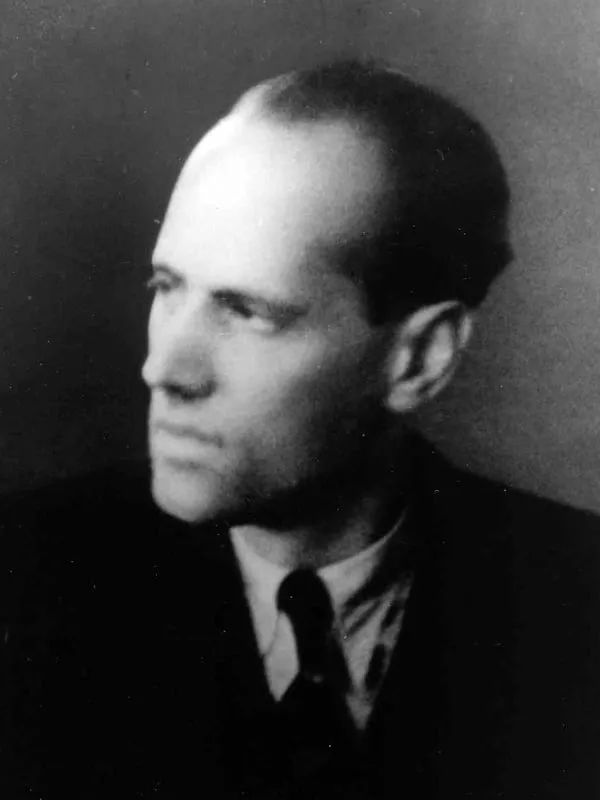
- Born:
- 11 March 1907, Kreisau, today Krzyżowa (Silesia, German Empire)
- Died:
- 23 January 1945, Berlin
- Author:
- Natalia
- Photo:
- HopsonRoad at English Wikipedia, CC BY-SA 3.0, Wikimedia Commons

Helmuth James Graf von Moltke was a lawyer and landowner from Silesia who spent the whole war working as an expert on international law in the Wehrmacht’s military intelligence service, while at the same time founding one of the most important groups of the German opposition – the one the Gestapo later named the Kreisau Circle. He was not a conspirator in the strict sense: he did not prepare an attempt on Adolf Hitler’s life and for a long time opposed one. He was engaged in something the regime considered just as dangerous – thinking about how to rebuild Germany after the fall of Nazism as a state governed by the rule of law within a united Europe. Arrested in January 1944, he was brought before the People’s Court after the 20 July plot and hanged at Plötzensee on 23 January 1945. His wartime letters to his wife are among the most important testimonies of the German resistance, and the family estate – today Krzyżowa in Poland – has become a symbol of Polish–German reconciliation.
Kreisau and two worlds
He was born on 11 March 1907 on the Kreisau estate in Lower Silesia, near Świdnica – today’s Krzyżowa. The estate had been bought in 1867 by Field Marshal Helmuth von Moltke, the victor of the wars against Austria and France, with a grant he received after the victory over Austria. The childless field marshal passed Kreisau on to the family of his brother Adolf; Helmuth James was Adolf’s great-grandson, and thus the great-grandnephew of the victor of Königgrätz (Sadowa) and Sedan.
The second world was his mother’s family. Dorothy, née Rose Innes, was born in South Africa into a family of British descent; her father, Sir James Rose Innes, was Chief Justice of the Union of South Africa and one of the leading liberals of the Cape Colony. Helmuth James grew up in a bilingual home, in an atmosphere more Anglo-Saxon than Prussian, and his parents, who were Christian Scientists, attached little importance to the family’s military tradition. All his life he moved easily in British circles and had many friends there; his mother, to whom he was very close, died in 1935.
The “Red Count”
He studied law and political science in Breslau (Wrocław), Vienna, Heidelberg and Berlin. In Vienna he became close to the circle of the educational reformer Eugenie Schwarzwald, and it was there, at her summer house on the Grundlsee (PL), that in 1929 he met Freya Deichmann, the daughter of a Cologne banker; they married in October 1931. They had two sons: Helmuth Caspar (born 1937) and Konrad (born 1941).
While still a student, in 1928, he joined the historian and sociologist Eugen Rosenstock-Huessy in organising the so-called work camps at Löwenberg (Lwówek Śląski), in which students, young workers and peasants worked together and discussed public affairs. Several participants in these gatherings later joined the Kreisau Circle. In 1929, when the agricultural crisis brought the debt-laden estate to the brink of bankruptcy, the 22-year-old student took over its management and saved Kreisau from a forced sale; he set aside part of the land for new peasant farms, which outraged the neighbouring landowners and earned him the nickname of the “Red Count”.
A lawyer in Hitler’s state
When Hitler came to power, Moltke was completing his legal training. In 1934 he passed the assessor’s examination but gave up a career as a judge, which in practice required joining the NSDAP. He became a lawyer in Berlin, specialising in international and private law. According to his biographers, he helped Jews and other persecuted people at that time to transfer their assets and emigrate, among other things in negotiations over the forced “Aryanisation” of businesses. At the same time, in 1935–1938, he trained in London and Oxford to become an English barrister and passed the examinations; this gave him the chance to leave Germany, which he did not take. He visited Britain often, talked to politicians and journalists and warned them about Nazism.
A lawyer in the Abwehr
From 6 September 1939 Moltke served as a civilian expert on the law of war and international law in the international law group of the Foreign Office/Abwehr of the Wehrmacht High Command (OKW), under Admiral Wilhelm Canaris. The post gave him access to documents that few others could see and freedom to travel around occupied Europe. He wrote legal opinions and tried to use them to obstruct criminal orders: he was one of the few officials who demanded that Soviet prisoners of war be treated in accordance with the Geneva Convention of 1929, and in the occupied Netherlands he argued that shooting hostages was unlawful and politically harmful. In April 1942 he went to Norway on an Abwehr mission together with Dietrich Bonhoeffer, where – according to his biographers – he supported the imprisoned primate of the Norwegian Church, Bishop Eivind Berggrav. In the autumn of 1943, according to some historians, he had a part in warning the Danish resistance about the deportation of the Jews, which made possible their escape to Sweden.
He knew what was happening in the East. In the autumn of 1941, a few weeks after Babi Yar, he wrote to his wife about a thousand people being murdered every day and a thousand Germans growing used to murder, and asked what he would say when someone asked him what he had done at the time. In a letter of 1942 to his British friend Lionel Curtis, smuggled out via Stockholm, he described the concentration camps and argued that some Germans were beginning to understand that what was happening was a sin for which they bore responsibility. In the spring of 1943 he took the text of the last leaflet of the White Rose to Scandinavia, from where it reached Britain and then, dropped by the RAF, returned to the skies over Germany.
The Kreisau Circle
From 1940 Moltke and Peter Yorck von Wartenburg, a lawyer and civil servant from another old Silesian family, gathered people convinced that the regime would fall and that Germany would have to be rebuilt from the ground up. They met in Berlin flats in Derfflingerstraße and Hortensienstraße, and three larger meetings – in May and October 1942 and in June 1943 – were held at Kreisau. The group was deliberately diverse: alongside aristocrats and officials it included Social Democrats (Julius Leber, Theodor Haubach, Carl Mierendorff, Adolf Reichwein), the diplomat Adam von Trott zu Solz, the Protestant theologian Eugen Gerstenmaier and the Jesuits Augustin Rösch and Alfred Delp. Moltke wanted the future Germany to grow out of an understanding between Christians of both denominations and the labour movement.
The fruit of these discussions was the “Principles for the New Order” of 9 August 1943 and instructions for the future regional commissioners: a state under the rule of law founded on Christian ethics and respect for human dignity, small self-governing communities as a school of citizenship, economic reform, trial of the criminals by the courts, and Germany as part of a united, federal Europe. For a long time Moltke opposed an attempt on Hitler’s life – he did not want to begin a new state with a murder, feared a new “stab in the back” legend and believed that the defeat had to be total for the Germans to understand it. He did, however, try to make contact with the Allies: in 1943 he twice went to Istanbul, where he hoped to meet the Americans, but to no avail – the West, bound by the principle of unconditional surrender, did not trust the German opposition.
Arrest
On 19 January 1944 the Gestapo arrested Moltke – not for the Circle, of which it as yet knew nothing, but for warning the diplomat Otto Kiep that he was under surveillance. Kiep moved in the social circle around Hanna Solf, which had been infiltrated by a Gestapo informer; for many of its members this ended in death sentences. Moltke was held in protective custody, including in the prison block of the Ravensbrück camp, and for six months his case seemed capable of being settled. Without him the Circle lost its centre; Yorck, Leber, Trott and Haubach drew closer to the group around Colonel Claus von Stauffenberg, which was preparing the assassination.
After 20 July 1944 the Gestapo’s special commission of inquiry uncovered the links between the Kreisau group and the conspirators, as well as their constitutional plans. Yorck was executed on 8 August, after the first trial of the conspirators, and Trott, Reichwein and Leber in the following months. Moltke became a defendant in a high treason case and in the autumn was moved to the prison in the Berlin district of Tegel. The prison chaplain there, Harald Poelchau, carried the prisoners’ letters: thanks to him the defendants agreed on a line of defence – they had talked about the future but had not planned a coup – and Moltke wrote to his wife almost every day, while she was able to reply by the same route.
Trial and last letters
The trial of Moltke, Delp, Gerstenmaier, Franz Sperr and several other defendants opened on 9 January 1945 before the People’s Court, presided over by its president, Roland Freisler. Moltke’s letters show that Freisler quickly dropped the charge of complicity in the assassination attempt and concentrated on the conversations themselves – on the fact that the count had discussed Germany after Hitler with Jesuits and bishops and had not denounced the plans of others. Moltke recorded a remark by the judge that he regarded as the heart of the whole case: Christianity and National Socialism had only one thing in common – “we demand the whole man”.
On 11 January he was sentenced to death. In his letters of the following days Moltke wrote that he had stood before the court not as a Protestant, a landowner, an aristocrat, a Prussian or a German, but “as a Christian and nothing else”, and that he would be executed for having thought – not for any deed. To his sons he left an explanation that since 1933 he had tried to mitigate the effects of Nazi rule for its victims and to prepare for change, because his conscience drove him to it. On 23 January 1945 he was hanged in Plötzensee Prison; among those who died there the same day were Haubach, Sperr, Eugen Bolz, Nikolaus Groß and Erwin Planck. Delp was executed on 2 February. Moltke’s ashes were scattered so that no grave would remain.
Freya and the memory of Krzyżowa
Freya von Moltke, who had herself taken part in the Circle’s meetings, survived the war with her sons at Kreisau. She hid her husband’s letters on the estate – according to her recollections, among other places in beehives – and took them with her when in the autumn of 1945 she left Silesia, which had passed to Poland. After several years in South Africa, her mother-in-law’s homeland, she returned to Germany, and from 1960 lived in Vermont in the United States, where she died in 2010. The publication in 1988 of Briefe an Freya 1939–1945 (Letters to Freya) made the correspondence one of the fundamental sources for the history of the German resistance; Polish editions include Ostatnie listy z więzienia Tegel (Last Letters from Tegel Prison, 1993) and a biography by Günter Brakelmann (2009). Of his co-defendants, Eugen Gerstenmaier survived; from 1954 to 1969 he was President of the Bundestag.
In the Federal Republic Moltke became one of the key figures in the memory of the resistance – alongside Stauffenberg and Sophie Scholl, but as a representative of civilian, moral and pro-European resistance. In Poland his legacy acquired a special dimension. On 12 November 1989, three days after the fall of the Berlin Wall, a Mass of reconciliation was celebrated at Krzyżowa in the presence of Prime Minister Tadeusz Mazowiecki and Chancellor Helmut Kohl, remembered for their exchange of the sign of peace. In 1990 the Krzyżowa Foundation for Mutual Understanding in Europe (PL) was established; it rebuilt the ruined estate and since 1998 has run an international youth meeting centre there. Freya von Moltke supported this work and visited Krzyżowa.
Significance
Moltke did not change the course of the war and did not try to kill the dictator. His significance lies elsewhere: he showed that even within the apparatus of Hitler’s state – in the Wehrmacht High Command itself – it was possible to use the law to save people, and that resistance could consist in preparing a Germany that after defeat would be a state under the rule of law in a united Europe. The trial before Freisler exposed the nature of Nazi justice: the court itself admitted that it was punishing a thought, not a deed. The Kreisau Circle was not free of the limitations of its era and milieu, and its programme remained on paper, but many of its ideas – federalism, self-government, European integration, the reckoning with crimes – later found a place in West German democracy. That its symbol became Krzyżowa in Poland, a meeting place for young Poles and Germans in the country that in 1939 was the first to fall victim to Hitler, gave his life a significance reaching beyond the history of the war itself.
Sources
Often appears with
People who appear in the same events.