Germany
Roland Freisler
State secretary in the Prussian and then the Reich Ministry of Justice (1933–1942), participant in the Wannsee Conference, president of the People's Court (1942–1945)
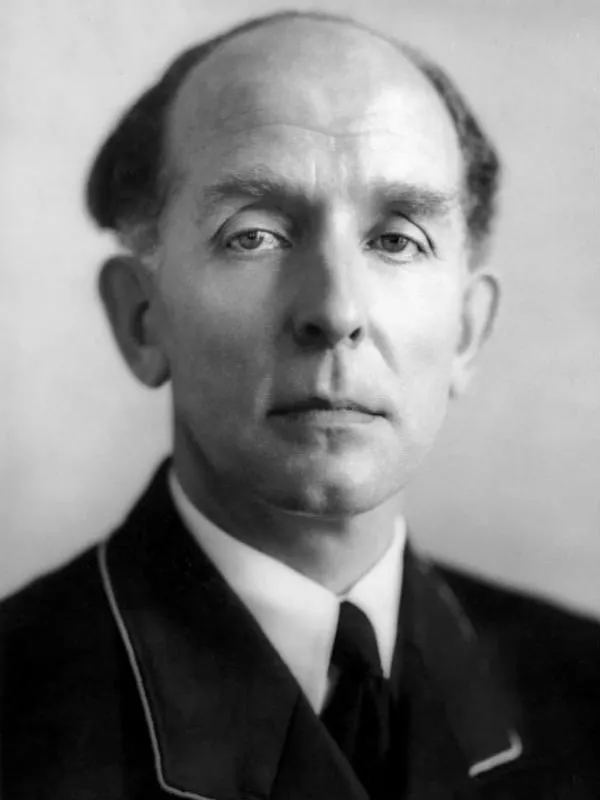
- Born:
- 30 October 1893, Celle (Province of Hanover, German Empire)
- Died:
- 3 February 1945, Berlin
- Author:
- Natalia
- Photo:
- Heinscher, CC BY-SA 3.0 DE, Wikimedia Commons

Roland Freisler was a lawyer who made his career in the Third Reich as an ideologue and practitioner of “National Socialist criminal law”, and who went down in history as president of the People’s Court (Volksgerichtshof) – the court before which, in 1942–1945, opponents of the regime were brought, from the students of the White Rose to a field marshal and the plotters of 20 July 1944. The trials he conducted, with shouting, mockery and defendants cut off in mid-sentence, became a symbol of a judiciary that had stopped pretending to be independent. He was killed in Berlin on 3 February 1945, during an American air raid, and never stood trial for what he had done.
Celle, Kassel and captivity in Russia
He was born on 30 October 1893 in Celle in the Province of Hanover, the son of Julius Freisler, an engineer and teacher at a building school, who came from Moravia. The family moved frequently and finally settled in Kassel, where Roland passed his school-leaving examinations in 1912. He began studying law in Jena.
When the First World War broke out he volunteered. According to his German biographers, he fought in Flanders in the autumn of 1914, where he was wounded, and later went to the Eastern Front as an officer cadet. In the autumn of 1915 he was taken prisoner by the Russians in Volhynia and spent the rest of the war in a camp for officers.
To this period belongs an episode that would follow him for the rest of his life. After the October Revolution and the Treaty of Brest-Litovsk, the camps for German prisoners in Soviet Russia were given self-government; according to accounts repeated in the literature, Freisler then cooperated with the Bolsheviks, was one of the camp’s commandants and, during the civil war, served as a commissar for food supply. How far this was conviction and how far a means of survival is unknown – sources from the period are scanty, and Freisler himself did not speak of it. He did not return to Germany until 1920. The label of “Bolshevik” stuck to him so firmly that – as the recorded table talk at headquarters shows – Adolf Hitler was still calling him that during the war.
Lawyer and NSDAP agitator
On his return he completed his studies; in 1922 he obtained a doctorate in labour law at Jena, and in 1923 he passed the state law examination. In 1924 he and his brother Oswald opened a law practice in Kassel – Oswald handled civil cases, Roland criminal ones, including the defence of Nazis charged with political violence. In 1928 he married Marion Russegger; they had two sons.
Politically he travelled quickly from left-wing sympathies to the far right. In 1924 he stood on the list of the völkisch National Socialist Bloc and became a town councillor in Kassel, and in July 1925 he joined the NSDAP. He made his name as a fierce polemicist: he brought lawsuits against local politicians and journalists, clashed sharply with the Social Democrats on the town council and – according to researchers of his career – insulted judges and colleagues in the courtroom as a lawyer. He defended party members – in 1931, together with Hans Frank, he also defended SA leaders accused of instigating riots on the Kurfürstendamm. In 1932 he entered the Prussian Landtag.
State secretary
After Hitler came to power his career gathered pace. In March 1933 he became a member of the Reichstag and head of the personnel department of the Prussian Ministry of Justice, and as early as June state secretary in that ministry. He used the post to purge the judiciary and the bar, from which Jews and political opponents were removed. When, in 1934–1935, the Prussian ministry was merged into the Reich Ministry of Justice, Freisler remained there as state secretary, responsible among other things for criminal law and the enforcement of sentences.
He was one of the most active authors of the new criminal law. He wrote and lectured on a “criminal law of the will” – punishment for intent alone rather than for the act – and on the principle that a judge should rule as the Führer would rule. He was active in Hans Frank’s Academy for German Law, chairing its criminal law committee. In 1938, when Hitler demanded the death penalty for an offender who under the law then in force faced only imprisonment, the ministry, with his involvement, drafted a retroactive law within a few days – an example cited in the literature of the abandonment of the principle nullum crimen sine lege.
After the outbreak of war he supported harsher laws and the expansion of the special courts (Sondergerichte), which he called “the summary courts of the home front”. His ministry took part in drafting the Night and Fog decree, and in 1941–1942 Freisler himself wrote an extensive commentary in the ministry’s journal Deutsche Justiz on the ordinance on criminal justice against Poles and Jews (PL) of 4 December 1941 – an act which, in the territories annexed to the Reich, allowed Poles and Jews to be punished with death for almost any offence against Germans.
Wannsee
On 20 January 1942 Freisler represented the Ministry of Justice at the Wannsee Conference, convened by Reinhard Heydrich to coordinate the “Final Solution of the Jewish question” among the ministries. After the death of the minister, Franz Gürtner, in 1941, the ministry was run by the state secretary Franz Schlegelberger as acting minister, so Freisler, the second state secretary, was the most senior official the ministry could send. The minutes drawn up by Adolf Eichmann recorded no objection from any of the fifteen participants; the presence of a representative of the justice system meant that the ministry took note of the plan to deport and exterminate the Jews of Europe without raising any legal reservations.
President of the People’s Court
In April 1942 the Reichstag granted Hitler the right to remove judges without due process, and in August the president of the People’s Court, Otto Georg Thierack, became minister of justice. On 20 August 1942 Hitler appointed Freisler as his successor. The court, created in 1934 for cases of high treason and treason against the state, came in time to try people for “defeatism” and “undermining military strength” as well – in other words, for words. There was no appeal against its verdicts.
Under Freisler the number of death sentences rose sharply. According to figures cited in the German literature, the court handed down more than 5,000 death sentences in 1942–1945, about 2,600 of them by the First Senate, presided over by Freisler – roughly as many as all the other senates over the court’s entire existence. Freisler himself openly called the court a political court. Shouting, interrupting the accused, sneering and humiliation were fixtures of his trials; court-appointed defence counsel usually kept silent. One of the victims was Elfriede Scholz, sister of the writer Erich Maria Remarque, condemned in 1943 for remarks about the war being lost; according to accounts, Freisler said that her brother had “unfortunately escaped us”.
The White Rose and 20 July
On 22 February 1943 Freisler flew to Munich to try members of the White Rose – Sophie and Hans Scholl and Christoph Probst – in a single day. He sentenced all three to death, and they were guillotined that same afternoon. In April, in a second trial, he condemned Professor Kurt Huber, among others, to death.
After the assassination attempt of 20 July 1944 Hitler decided that the conspirators would be tried not by a military court but by the People’s Court. According to accounts, he said that Freisler would deal with it – “he is our Vyshinsky” – a reference to the prosecutor of the Moscow show trials. The trial of the first group of conspirators, including Field Marshal Erwin von Witzleben, opened on 7 August in the chamber of the Berlin Kammergericht. Freisler mocked the defendants, who had been deprived of belts and braces and had to hold up their trousers; according to accounts, he called Witzleben a “dirty old man”. The hearings were filmed for propaganda, but the footage proved useless: the judge’s shouting drowned out the accused, and their composure did not fit the image of traitors. The film was never shown in cinemas.
In the months that followed, more people connected with the plot came before Freisler, including some who had taken no part in preparing the assassination. In January 1945 he sentenced Helmuth James Graf von Moltke, justifying the verdict by nothing more than conversations about Germany after Hitler; Moltke recorded Freisler’s remark that Christianity and National Socialism had only one thing in common – both “demand the whole man”. The count was hanged on 23 January. On 2 February Freisler sentenced Klaus Bonhoeffer and Rüdiger Schleicher, among others, to death.
Death in an air raid
On the morning of 3 February 1945 the court was sitting in its building on Bellevuestraße, near Potsdamer Platz. In the dock was Fabian von Schlabrendorff, an officer involved in the conspiracy against Hitler. When the American raid on Berlin, one of the heaviest of the entire war, began, the hearing was halted and the accused were taken to the shelter.
The circumstances of Freisler’s death have been described in different ways. According to one version, based mainly on Schlabrendorff’s account, the judge stayed in the building to retrieve files and was killed at around 11.08 a.m., crushed by part of the ceiling when a bomb hit the building – he was supposedly found with folders in his hands, among them Schlabrendorff’s file. According to another, accepted in most studies, he was hit by a bomb splinter in the courtyard or in the street, on his way to the shelter. The story of the judge who died saving documents is thus only one version. What is certain is that Freisler died in the court building or right next to it. According to Schlabrendorff, his death was certified by a doctor who was the brother of Rüdiger Schleicher, whom Freisler had sentenced the day before.
He was buried without publicity in his wife’s family grave in the Waldfriedhof Dahlem; his name was not put on the headstone. Schlabrendorff’s trial resumed in March 1945 and – according to his own account – he was acquitted, although the Gestapo did not set him free. Harry Haffner became the new president of the court. It went on passing death sentences until April, though without the publicity Freisler had given it.
No verdict
Death from an American bomb meant that Freisler never answered for his judgments. He did not face the Judges’ Trial, one of the twelve Nuremberg trials held by American military tribunals in 1947, in which Schlegelberger, among others, was tried. The reckoning with the remaining judges of the People’s Court in the Federal Republic came to nothing in practice: none of them was finally convicted, and the best-known trial – of Hans-Joachim Rehse, one of the judges who had sat alongside Freisler – ended in acquittal in 1968.
Freisler’s case resurfaced in 1985, when it emerged that his widow had been receiving a pension supplement justified on the grounds that her husband, had he survived the war, would have earned more as a lawyer. That same year the Bundestag declared in a resolution that the People’s Court had not been a court in the sense of a state governed by the rule of law but an instrument of terror, and that its verdicts had no legal force; they were annulled by statute in 1998.
Place in the war
Freisler commanded no army and issued no deportation orders, yet he was one of the men without whom Hitler’s state could not have functioned as it did. As an official he helped to create a law that replaced the act with intent and made the judge an executor of the Führer’s will; as the ministry’s representative he sat at the table at Wannsee; as president of the People’s Court in the last years of the war he passed death sentences for leaflets, for words spoken in a shop and for conversations about the country’s future. In German memory he has remained above all the screaming judge of the newsreels of the 20 July plotters’ trial – an image of a judiciary wholly subordinated to dictatorship, which after the war became one of the most frequently invoked arguments for judicial independence.
Sources
Often appears with
People who appear in the same events.