Germany
Claus von Stauffenberg
Chief of staff to the commander of the Replacement Army (1944), colonel of the General Staff, executor of the assassination attempt of 20 July 1944
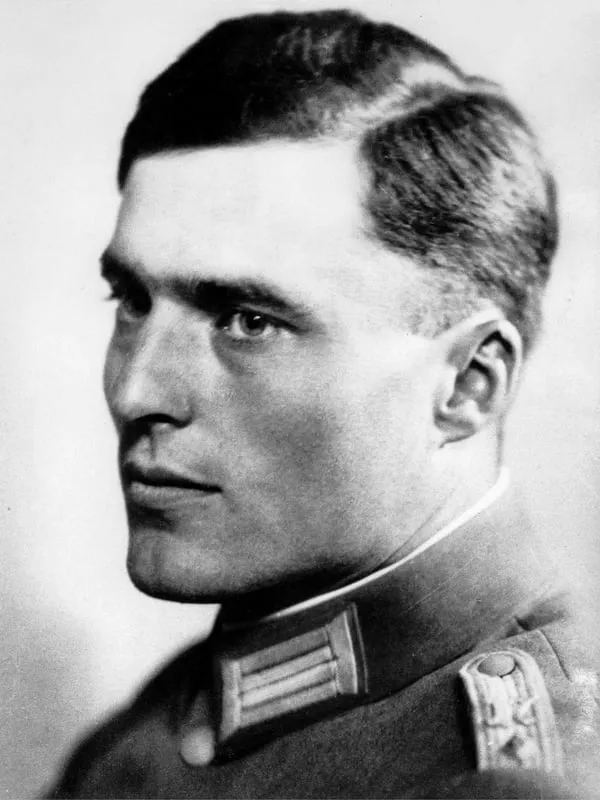
- Born:
- 15 November 1907, Jettingen (Bavaria, German Empire)
- Died:
- 21 July 1944, Berlin
- Author:
- Łukasz
- Photo:
- autor nieznany, domena publiczna, Wikimedia Commons

Claus Schenk Graf von Stauffenberg was a professional cavalry and staff officer who, in the last year of his life, became the central figure of the military conspiracy against Adolf Hitler. As chief of staff to the commander of the Replacement Army he had access to briefings at headquarters, and on 20 July 1944 he planted the bomb at the Wolf’s Lair himself before attempting to set a military coup in motion in Berlin. Hitler survived, and Stauffenberg was shot that same night in the courtyard of the Bendlerblock. His path – from an aristocrat captivated by the poetry of Stefan George, and an officer who in 1933 welcomed the National Socialist seizure of power, to would-be assassin – is one of the most frequently described and most fiercely contested biographies of the German resistance.
Childhood and the George circle
He was born on 15 November 1907 at the castle of Jettingen in Bavarian Swabia, the youngest son of Alfred Schenk Graf von Stauffenberg, a senior official at the court of the kings of Württemberg, and Caroline, née Gräfin von Üxküll-Gyllenband, a lady-in-waiting to the queen. His twin brother Konrad died the day after birth; his elder brothers, Alexander and Berthold, were also twins. The family came from the Catholic nobility of Swabia and Franconia, and through his mother Claus was a great-grandson of the Prussian army reformer August von Gneisenau. He was raised a Catholic, attended the Eberhard-Ludwigs-Gymnasium in Stuttgart and played the cello, and despite poor health in his youth became a keen horseman.
At school he joined the Neupfadfinder youth movement, which cultivated chivalric ideals and revered the poet Stefan George. In the spring of 1923 the Stauffenberg brothers were introduced to the “Master” and entered the innermost circle of his admirers – an elitist, nationalist-conservative coterie that nurtured the idea of a “secret Germany” (Geheimes Deutschland), a spiritual community nobler than the actual state. According to his biographers, George remained an authority for Claus for the rest of his life, and his ideas are one of the keys to the officer’s later decisions.
Cavalryman in Bamberg
After passing his school-leaving examinations in March 1926, Stauffenberg surprised those around him – he had been interested in architecture and had long been ill – by choosing a military career. On 1 April 1926 he joined the 17th Bavarian Cavalry Regiment in Bamberg as an officer cadet. He completed the obligatory courses at the infantry school in Dresden and the cavalry school in Hanover, passed his officer’s examination sixth in his year and as the best cavalryman, for which he received a sword of honour. On 1 January 1930 he was commissioned as a lieutenant. On 26 September 1933 in Bamberg he married Nina Freiin von Lerchenfeld; they had five children, the youngest of whom, a daughter, Konstanze, was born after her father’s death.
Like many officers of his generation, Stauffenberg distrusted the Weimar Republic and was close to the so-called Conservative Revolution. Biographers cite testimony that in the early 1930s he saw Hitler as a “man of action” and that before the presidential election of 1932 he backed him against Paul von Hindenburg. He welcomed Hitler’s assumption of power and the “coordination” (Gleichschaltung) of the state that followed, as a letter to George of June 1933 shows; yet he never joined the NSDAP, and kept an aristocratic distance from the party and the SA. In August 1934, together with the whole army, he swore the oath of personal loyalty to Hitler – an oath that for several years would remain his argument against joining the conspiracy.
After two years as a riding instructor in Hanover, in October 1936 he was among the first hundred officers sent on the shortened course of the War Academy in Berlin, where he met, among others, Albrecht Mertz von Quirnheim, who would be with him in his final hours. From 1 July 1938 he was the second staff officer (Ib, responsible for supply) of the 1st Light Division in Wuppertal under Erich Hoepner; after the Munich Agreement the division marched into the Sudetenland.
Poland, France and the General Staff
In the September Campaign the 1st Light Division advanced as part of Walter von Reichenau’s Tenth Army from Upper Silesia via Wieluń and the Warta towards Radom, ending the campaign between Modlin and Warsaw. Stauffenberg was responsible for its supply. From this period comes a frequently quoted letter to his wife in which he described the population of Poland as an “unbelievable rabble”, with “a great many Jews and a great deal of mixed population”, and wrote of prisoners who would be useful to German agriculture. Historians judge the letter differently: Heinrich August Winkler and Saul Friedländer see it as evidence that Stauffenberg then shared the basic assumptions of Nazi racial policy, while his biographer Peter Hoffmann rejects the label “antisemite” and insists the letter be read in context. From the same weeks, however, comes an account that he had a German officer who ordered the shooting of two Polish women brought before a court martial.
In the winter of 1939/1940 Stauffenberg’s kinsman Peter Yorck von Wartenburg and Ulrich Wilhelm Schwerin von Schwanenfeld tried to persuade him to become adjutant to the Commander-in-Chief of the Army, Walther von Brauchitsch, and to take part in the coup then being planned. He refused, citing his oath. His division, renamed the 6th Panzer Division, passed through the Ardennes in May 1940 as part of Panzer Group Kleist, crossed the Meuse at Monthermé during the breakthrough at Sedan and reached the English Channel. In his letters from the French campaign Stauffenberg made no secret of his admiration for the victory. On 27 May 1940 he was transferred to the Army High Command (OKH), where he headed Group II of the Organisation Department – the section responsible for the structure, armament and new formations of the field army. In this role he took part in the organisational preparations for the attack on the Soviet Union; in April 1941 he was promoted to major, and on 1 January 1943 to lieutenant colonel of the General Staff.
Turning against Hitler
His work at the OKH gave him an overview of the situation on the whole Eastern Front that ordinary staff officers lacked. As late as December 1941 he approved of Hitler’s taking direct command of the army, but in 1942 his criticism grew rapidly. Biographers point to several sources of this change: Hitler’s chaotic leadership, ever more detached from reality; the army’s enormous losses; reports of the mass murder of Jews and Soviet prisoners of war behind the front; and a brutal occupation policy that he considered both criminal and suicidal – at that time he was pressing for better treatment of the volunteers of the Eastern Legions. According to witnesses, as early as 1942 he was saying among trusted officers that Hitler had to be killed, and at the turn of 1942 and 1943 he sounded out front-line commanders, including Field Marshal Erich von Manstein, on whether they would support a move against the dictator – without result. Historians disagree over how much weight moral motives carried in his decision and how much the conviction that Hitler was leading Germany to defeat; the sources point to an interweaving of both.
Tunisia and his wounds
After more than two years of staff work he asked for a front-line posting, and at the beginning of 1943 he became the first staff officer (Ia) of the 10th Panzer Division in Tunisia, which was covering the retreat of Erwin Rommel’s forces. He arrived when the Tunisian campaign was already lost for the Axis. On 7 April 1943, during the division’s withdrawal near Mezzouna, his car was strafed by Allied aircraft. At a field hospital near Sfax his right hand and two fingers of his left hand were amputated; he also lost his left eye. Contrary to expectations he did not retire – according to witnesses, it was during his convalescence that he became convinced he had to act.
The Replacement Army and Operation Valkyrie
The Chief of the General Staff, Kurt Zeitzler, sent the badly wounded officer to Berlin, where on 1 October 1943 Stauffenberg became chief of staff of the General Army Office under General Friedrich Olbricht, one of the leaders of the military conspiracy. Together with Olbricht, Mertz von Quirnheim and Henning von Tresckow he reworked the Valkyrie plan – officially intended to suppress internal unrest, such as a revolt of forced labourers – into a disguised plan for a coup d’état: once Hitler had been killed, the Replacement Army was to seize executive power in the military districts and arrest officials of the NSDAP, the SS and the Gestapo. Stauffenberg also maintained contacts with the civilian opposition – Ludwig Beck, Carl Goerdeler, the Social Democrat Julius Leber and members of the Kreisau Circle. The conspirators’ programmes, known mainly from Gestapo copies, promised an end to the war, the restoration of the rule of law and an end to the persecution of the Jews, but many of them, drawn from the conservative elites, did not want a return to parliamentary democracy. The British historian Richard J. Evans judged Stauffenberg’s political convictions to be anti-democratic and nationalist and denied him the role of a model for posterity; other scholars stress his readiness for a broad understanding, including talks with communists in June 1944.
After the Allied landings in Normandy Germany’s defeat was certain, but Stauffenberg – like Tresckow, to whom are attributed the words that the assassination had to be attempted “at any cost”, if only as a testimony – concluded that this did not release him from the duty to act. In June 1944 he became chief of staff to the commander of the Replacement Army, General Friedrich Fromm, and on 1 July he was promoted to colonel. The post gave him access to briefings at Hitler’s headquarters, but it also meant that the same man had both to plant the bomb and to direct the coup in Berlin. On 11 July at the Berghof and on 15 July at the Wolf’s Lair he carried explosives with him but did not detonate them – partly because Heinrich Himmler, whom the conspirators wanted to kill at the same time, was not with Hitler.
20 July 1944
On the morning of 20 July Stauffenberg flew with his adjutant, Lieutenant Werner von Haeften, from Rangsdorf to East Prussia. The briefing, brought forward because of a visit by Mussolini, was held – as it had been since early July – in a wooden hut. In the rush, the maimed officer managed to arm only one of the two charges. He placed his briefcase under the table close to Hitler and left on the pretext of a telephone call. The bomb exploded at 12.42 p.m. in the hut, which held 24 men; four were killed, and Hitler was only slightly injured. Convinced that he was dead, Stauffenberg got out of the headquarters compound, landed at Rangsdorf at around 3.45 p.m. and reached the Bendlerblock at around 4.30 p.m., where only then was Valkyrie properly set in motion. The conspirators arrested Fromm, who refused to take part, and for several hours Stauffenberg tried by telephone to convince the commanders of the military districts that Hitler was dead. But the orders from the Bendlerblock clashed with teleprinter messages from the Wolf’s Lair, most officers waited, and Major Otto-Ernst Remer, after speaking to Goebbels and to Hitler himself, turned his guard battalion against the conspirators. With that, the fate of the 20 July plot and of the coup that accompanied it was sealed.
In the evening loyal officers took control of the Bendlerblock, and Stauffenberg was wounded in the arm. Fromm, freed – according to historians, partly in order to cover up his own knowledge of the conspiracy – invoked a supposed summary court martial and had Stauffenberg, Olbricht, Mertz von Quirnheim and Haeften shot. The execution took place in the courtyard of the Bendlerblock by the headlights of cars a few minutes after midnight, and thus already on 21 July (the death certificate and some historians give 20 July). According to witnesses, Haeften shielded Stauffenberg with his own body. His last words have come down in two versions: “Long live holy Germany!” or – in an allusion to George – “Long live secret Germany!”. The bodies were buried in the cemetery of St Matthew’s, but Himmler had them exhumed and burned and the ashes scattered.
Family and collective punishment
The investigation took in hundreds of people; Roland Freisler’s People’s Court staged show trials, and according to the German Resistance Memorial Centre (Gedenkstätte Deutscher Widerstand) more than 200 people connected with the plot were executed. Claus’s brother Berthold was put to death on 10 August 1944 in Plötzensee prison. Himmler announced that the Stauffenberg family would be exterminated; in the end the relatives were subjected to Sippenhaft – the collective liability of kin. The pregnant Nina von Stauffenberg was sent to Ravensbrück concentration camp, and on 27 January 1945, in Frankfurt an der Oder, she gave birth to a daughter, Konstanze. The four elder children were placed under the false name “Meister” in a children’s home in Bad Sachsa; the family recovered them only in June 1945.
Memory
In the first post-war years many Germans regarded the conspirators as traitors who had broken their oath in wartime. The turning point was the trial of Otto-Ernst Remer in Braunschweig in 1952: prosecuted by Fritz Bauer for defaming the conspirators, Remer was convicted, and the court declared Hitler’s state a state without law, against which resistance had been legitimate. In the Federal Republic Stauffenberg gradually became a symbol of the “other Germany”: in 1955 the Bendlerstraße was renamed Stauffenbergstraße, the German Resistance Memorial Centre operates in the Bendlerblock, and on the anniversary of the attempt the Bundeswehr holds a ceremonial swearing-in of recruits there, alternating with the square in front of the Reichstag. The dispute over the man continues: critics recall his earlier support for Hitler, the letter from Poland and his anti-democratic views; defenders point out that, as one of the few senior officers to do so, he risked his own life and his family to stop the war and the regime’s crimes. In the history of the Second World War, Stauffenberg’s attempt was the last serious effort to overthrow Hitler from within; its failure meant that the war would go on for another ten months – until Germany’s total defeat.
Sources
Often appears with
People who appear in the same events.