Germany
Dietrich Bonhoeffer
Lutheran pastor and theologian, lecturer at the University of Berlin, head of the Confessing Church seminary at Finkenwalde (1935–1937), Abwehr agent (1940–1943)
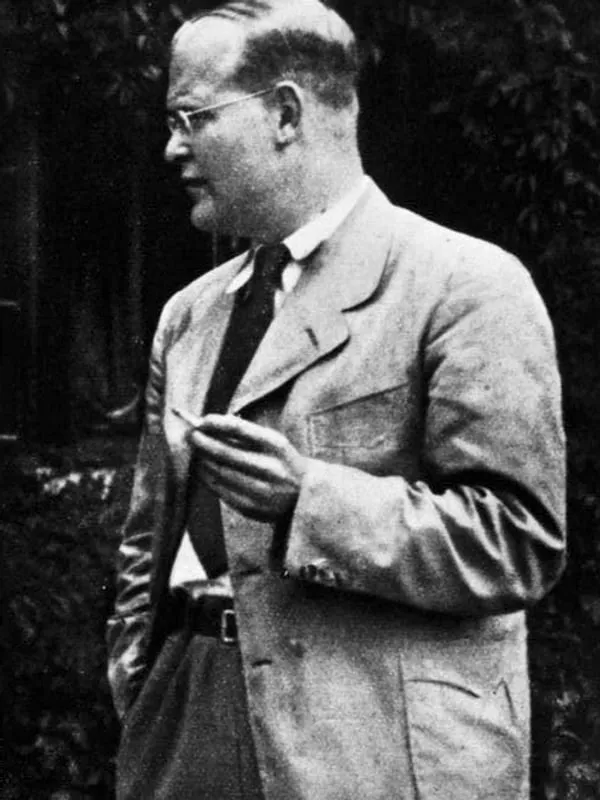
- Born:
- 4 February 1906, Breslau, today Wrocław (Silesia, German Empire)
- Died:
- 9 April 1945, Flossenbürg concentration camp
- Author:
- Natalia
- Photo:
- autor nieznany, CC BY-SA 3.0 DE, Wikimedia Commons

Dietrich Bonhoeffer was a Lutheran pastor and one of the most influential Protestant theologians of the 20th century, and at the same time one of the few German clergymen who moved from opposing Nazi church policy to taking part in the conspiracy against Adolf Hitler. From the first weeks of the Third Reich he warned against the cult of the leader and defended Jews and Christians of Jewish descent; he ran an illegal seminary of the Confessing Church; and during the war, shielded by a post in military intelligence, he used his journeys abroad on behalf of the opposition. Arrested in 1943, he wrote letters in prison that went round the world after the war. He was hanged at Flossenbürg concentration camp less than a month before Germany’s surrender.
Childhood in Wrocław and Berlin
He was born on 4 February 1906 in Wrocław (then Breslau), together with his twin sister Sabine – the sixth and seventh of eight children. His father, Karl Bonhoeffer, was a professor of psychiatry and neurology; his mother, Paula, née von Hase, came from a family of theologians and taught the children at home herself. In 1912 his father took up a chair in Berlin and the family moved to the capital, from 1916 living in the villa district of Grunewald. It was a household of the wealthy, liberal academic bourgeoisie, in which learning, music and independent judgement were prized and religious observance was rather restrained.
The First World War struck the family directly: in 1918 his brother Walter was killed on the Western Front. While still in his early teens, to the surprise of his elder brothers, Dietrich decided to become a theologian.
Theologian
He finished school in 1923, began his studies in Tübingen and from 1924 continued them at the University of Berlin, where among others he attended the lectures of the church historian Adolf von Harnack. His most important intellectual stimulus became the theology of the Swiss theologian Karl Barth, who rejected the identification of revelation with culture and nation. In 1927, at the age of 21, Bonhoeffer gained his doctorate with Sanctorum Communio, on the Church as a community; in 1928 he spent a year as curate in the German parish in Barcelona; and in 1930 he completed his habilitation with Akt und Sein (Act and Being).
He spent the academic year 1930/1931 on a fellowship at Union Theological Seminary in New York. American theology, including the lectures of Reinhold Niebuhr, struck him as shallow, but the stay itself changed him profoundly. Through a fellow student, the African American Frank Fisher, he regularly attended a Baptist church in Harlem, and he encountered racial segregation in the South and the spirituality of Black Americans. The French pacifist Jean Lasserre drew his attention to the Sermon on the Mount as a call to peace across national boundaries.
On his return he became an assistant in the theology faculty in Berlin; in November 1931 he was ordained, and he taught a confirmation class in the working-class district of Wedding. He also became involved in the ecumenical movement: in the autumn of 1931 he was elected one of the youth secretaries of the World Alliance for Promoting International Friendship through the Churches. These contacts were later to be of enormous importance.
Against the “German Christians”
On 1 February 1933, two days after Hitler was appointed chancellor, Bonhoeffer gave a radio talk in Berlin on the concept of the leader. He warned that a leader who allows himself to be made into an idol becomes a “misleader”; the broadcast was cut off before the end – whether deliberately is not known. After the boycott of Jewish shops and the law removing Jews from the civil service, he wrote the essay “The Church and the Jewish Question” in April 1933. In it he argued that the Church had a duty to question the state about the legitimacy of its actions and to help its victims, including non-Christians, and in the last resort not only to bandage the victims under the wheel but “to fall into the spokes of the wheel itself”. He opposed the introduction into the Church of the Aryan paragraph, which barred clergy of Jewish descent from office.
In the summer of 1933 the pro-Hitler German Christians movement seized control of the Protestant Church, and Ludwig Müller became Reich Bishop. Their opponents gathered around Pastor Martin Niemöller in the Pastors’ Emergency League, and in May 1934 they formed the Confessing Church and issued the Barmen Declaration, which rejected the subordination of faith to any authority other than Christ. Bonhoeffer belonged to its most radical wing: in 1936 he wrote the much-discussed sentence that whoever knowingly separates himself from the Confessing Church in Germany separates himself from salvation, and he was disappointed that Barmen had been silent about the Jews.
From October 1933 to April 1935 he was pastor of two German congregations in London. There he became friends with the Anglican Bishop of Chichester, George Bell, who became his most important advocate in Britain. In August 1934, at an ecumenical conference on the Danish island of Fanø, he called on the churches of the world to speak out together against war, saying that peace must be “dared”, because there is no way to it through security.
Finkenwalde
In the spring of 1935 he returned to Germany to run a preachers’ seminary of the Confessing Church for candidates for the ministry who had refused to be trained under the supervision of the official Church. The seminary operated briefly at Zingst on the Baltic and from June 1935 on the Finkenwalde estate near Stettin (today Zdroje in Szczecin). There Bonhoeffer combined the study of theology with a common life of daily prayer, meditation on Scripture and mutual confession – which struck many Protestants as suspiciously “Catholic”. Among the seminarians was Eberhard Bethge, who became his closest friend and later his biographer and editor.
In August 1936 the authorities withdrew his right to teach at the university. The Gestapo closed the seminary in September 1937 and arrested some of its graduates; Bonhoeffer continued the training in secret, in so-called collective pastorates in vicarages in Western Pomerania, including Koszalin and Słonowice, until March 1940. In 1937 he published Nachfolge (Discipleship, known in English as The Cost of Discipleship), in which he set “cheap grace” – forgiveness without repentance and obedience – against the “costly grace” of the disciple who follows Christ and pays the price for it. He described the experience of Finkenwalde in the short book Life Together (1939).
In 1938 his twin sister Sabine left for Britain via Switzerland with her husband, the lawyer Gerhard Leibholz, who was of Jewish descent, and their daughters. After Kristallnacht in November 1938 Bonhoeffer marked the date of the pogrom in his Bible beside Psalm 74, which speaks of the burning of God’s meeting places in the land.
In June 1939, facing call-up into the army, he went to New York, where friends, among them Niebuhr, had arranged a post for him. After a few weeks, however, he decided to return. In a letter to Niebuhr he wrote that he would have no right to take part in the rebuilding of Christian life in Germany after the war if he did not share the trials of this time with his people. In July 1939, a few weeks before the outbreak of war, he was back in Berlin.
In the Abwehr and the conspiracy
In 1940 the Gestapo banned him from public speaking, and in March 1941 from publishing. His path into the conspiracy was opened by his brother-in-law, the lawyer Hans von Dohnanyi, husband of his sister Christine, who worked in Admiral Wilhelm Canaris’s Abwehr alongside General Hans Oster and was one of the leading figures of the military opposition. From the autumn of 1940 Bonhoeffer was formally an informant for the Abwehr’s Munich station. This protected him from conscription and allowed him to travel abroad; he spent the winter of 1940/1941 at the Benedictine monastery of Ettal, working on his Ethics, which he never completed.
Bonhoeffer knew that for a Christian, taking part in preparing an assassination meant taking guilt upon himself. He did not justify it with a theory of tyrannicide but with responsibility: whoever sees a crime and can prevent it, yet does nothing, also becomes guilty. In 1941 and 1942 he travelled to Switzerland, and in April 1942 to occupied Norway with Helmuth James von Moltke. In May 1942, in Sigtuna in Sweden, he met Bishop Bell and passed on to him information about the conspirators, together with a request for a signal as to how the Allies would treat Germany once Hitler had been overthrown. Bell put the matter to the Foreign Secretary, Anthony Eden, but the British government did not reply. Bonhoeffer also helped with the so-called Operation 7, in which the Abwehr, under the pretext of an intelligence mission, brought a dozen or so people whom the Nazis classed as Jews out to Switzerland in 1942.
In January 1943 he became engaged to the 18-year-old Maria von Wedemeyer, granddaughter of the Pomeranian landowner Ruth von Kleist-Retzow, who had supported the Finkenwalde seminary. A few weeks later, in March 1943, officers of Henning von Tresckow made unsuccessful attempts to kill Hitler, of which Dohnanyi’s circle was aware.
Tegel
On 5 April 1943 the Gestapo arrested Bonhoeffer and Dohnanyi. The investigation began with currency irregularities connected with Operation 7; Bonhoeffer was charged with evading military service and undermining the nation’s fighting strength, not with taking part in the conspiracy, of which the investigators as yet knew nothing. For a year and a half he was held in the military remand prison in Berlin-Tegel. He won the trust of some of the guards, who smuggled out his letters to his parents and to Bethge. In them he wrote of “a world come of age”, of a “religionless Christianity” that speaks of God not at the margins of life but at its centre, and of a Church that is the Church only when it exists for others. He also wrote poems, among them “Who Am I?”.
After the 20 July plot of 1944 his situation became hopeless. In September the Gestapo found at Zossen the documents Dohnanyi had hidden. Bonhoeffer abandoned a planned escape when his brother Klaus was arrested, so as not to endanger his family, and on 8 October he was taken to the Gestapo cellars on Prinz-Albrecht-Strasse. There, at the end of 1944, he wrote the poem “Von guten Mächten” (“By Gracious Powers”). On 2 February 1945 Roland Freisler sentenced Klaus Bonhoeffer and their brother-in-law Rüdiger Schleicher to death. On 7 February Dietrich was taken to Buchenwald, from where on 3 April the SS took him south with other special prisoners.
Flossenbürg
At the beginning of April 1945 Canaris’s diaries were found at Zossen. According to the post-war testimony of the SD official Walter Huppenkothen, on 5 April Hitler gave a verbal order that the Abwehr circle was not to survive the war. On 8 April, after a short service he held for his fellow prisoners in the school at the village of Schönberg in the Bavarian Forest, Bonhoeffer was taken to Flossenbürg concentration camp. As a farewell he gave the British officer Sigismund Payne Best a message for Bishop Bell: “This is the end – for me the beginning of life.” That evening an SS summary court presided over by the judge Otto Thorbeck, with Huppenkothen as prosecutor and with no defence counsel and no record, sentenced him to death together with Canaris, Oster, the judge Karl Sack and Captain Ludwig Gehre. At dawn on 9 April they were hanged, along with Theodor Strünck. The camp doctor’s well-known account of the pastor’s calm death, part of the story of the execution of Dietrich Bonhoeffer, is now doubted by researchers. His body was burned, and there is no grave.
Dohnanyi was murdered in Sachsenhausen concentration camp on 8 or 9 April, and during the night of 22–23 April, in the midst of the fighting for Berlin, SS men shot Klaus Bonhoeffer and Rüdiger Schleicher. Dietrich’s parents learned of his death only at the end of July 1945, from a radio broadcast of a memorial service in London conducted by Bishop Bell.
Legacy
In 1949 Bethge published the Ethics, and in 1951 the letters and notes from prison under the title Widerstand und Ergebung (Resistance and Submission), known in the English-speaking world as Letters and Papers from Prison. Translated into dozens of languages, the book influenced post-war theology, the ecumenical movement and civil rights movements: Bonhoeffer was invoked by activists around Martin Luther King, by opponents of apartheid and by the opposition in East Germany.
In Germany the road to recognition was long. For years part of society and of the Church saw the conspirators as traitors; in 1956 the Federal Court of Justice acquitted Thorbeck, finding the Flossenbürg court to have been formally lawful. The sentences of 8 April were not quashed until the 1990s. In 1998 a statue of Bonhoeffer was placed among the ten martyrs of the 20th century above the west door of Westminster Abbey. His native city commemorates him with a monument (PL) beside St Elizabeth’s Church in Wrocław.
His place in the history of the war
Bonhoeffer commanded no soldiers and did not change the course of the war, and the conspiracy he served failed to remove Hitler. Yet his path shows what resistance looked like in a state in which most churches accepted the regime or confined themselves to defending their own affairs. From protesting against the Aryan paragraph in 1933 he went on to conspiracy within the Reich’s own military apparatus, and his death at Flossenbürg, together with Canaris and Oster, was among the last acts by which the regime, in the final weeks of the war, destroyed the German opposition. The letters from Tegel made him one of the best-known witnesses to that resistance.
Sources
Often appears with
People who appear in the same events.