- Category:
- Military operations
- Front:
- Western Front
- Date:
- 16 December 1944
- Author:
- Łukasz
- Battle:
- Battle of the Bulge
- Tags:
- Wehrmacht, United States, Belgium, Adolf Hitler
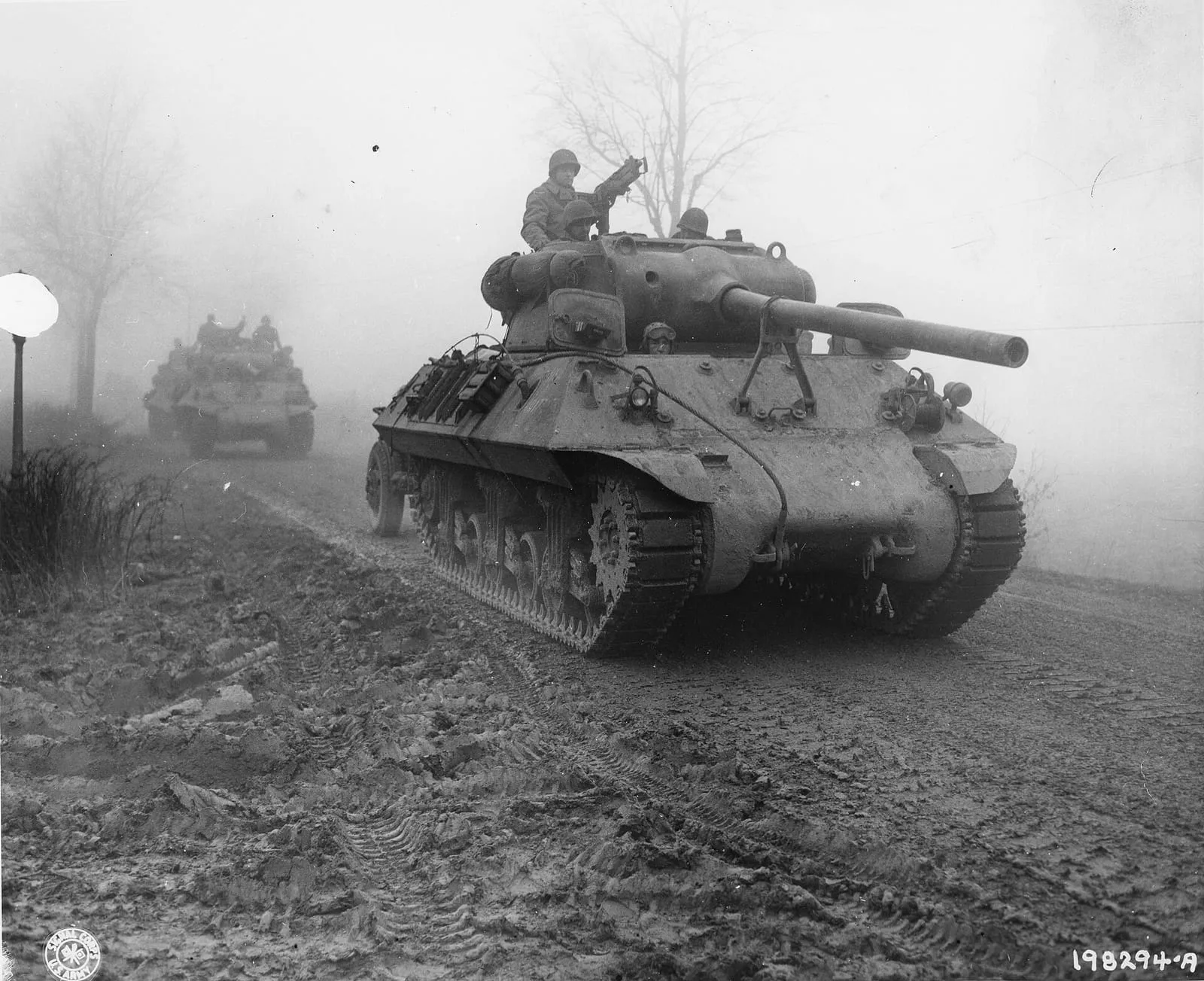
At 5.30 a.m. on 16 December 1944, along a front of more than 100 km stretching from Monschau in the north to Echternach in Luxembourg in the south, several thousand German guns and rocket launchers opened fire. An hour later the infantry emerged from the fog, followed by the tanks. Three German armies struck into the wooded hills of the Ardennes, a sector the Americans regarded as the quietest on the entire Western Front and had manned most thinly. The last great German offensive in the west had begun – known in the English-speaking world as the Battle of the Bulge, after the wedge that the German attack drove into the Allied lines.
War chronologies sum it up thus: the Battle of the Bulge begins as German forces try to break through the front in the Ardennes, the main aim of Hitler’s plan being to recapture Antwerp. That captures the essence of the event. Antwerp, liberated in September, had been receiving Allied convoys for less than three weeks and was to become the main supply port for the armies advancing on Germany. Retaking it was the operational objective, but behind it lay a political one: to break up the Western coalition.
Hitler’s decision
Adolf Hitler announced the idea of a counter-offensive in the west to his closest associates on 16 September 1944 at his headquarters in East Prussia, once the front had stabilised after the defeat in France. He reasoned that in the east space still allowed room for defence, whereas in the west every kilometre brought the Allies closer to the Ruhr. The blow was to fall through the Ardennes – the same route the Wehrmacht had taken in May 1940 at the opening of the French campaign. The objectives were the crossings of the Meuse and then Antwerp. Capturing the port would cut the British 21st Army Group and the First Canadian Army off from the Americans, deprive them of supplies and – as Hitler hoped – bring about a “second Dunkirk”.
His further calculations were political. Hitler regarded the coalition of Britain, the United States and the USSR as an alliance of necessity that would fall apart after a single heavy blow. A defeat in the west was to induce London and Washington to negotiate and to give Germany time to shift forces against the Red Army and to bring in new weapons – jet aircraft and new types of U-boat.
The operation was named Wacht am Rhein (“Watch on the Rhine”). The name sounded defensive and was meant to suggest that the reserves being assembled would be used to defend the Rhine line; in early December the plan was renamed Herbstnebel (“Autumn Mist”). The preparations were shrouded in secrecy unusual even for the Wehrmacht: few officers knew of the plan, orders were carried by couriers, and units moving up to the front travelled by night. On 20 November Hitler left the Wolf’s Lair, and on the evening of 10 December he left Berlin for the Adlerhorst headquarters at Ziegenberg near Bad Nauheim, from where he intended to direct the offensive in person. On 11 and 12 December he briefed the divisional commanders there, presenting the plan to them in a long speech.
Rundstedt’s and Model’s doubts
The generals who were to carry out the plan did not believe it could succeed. Field Marshal Gerd von Rundstedt, once again Commander-in-Chief West since September, and Field Marshal Walter Model, commander of Army Group B, which was to deliver the attack, considered Antwerp an objective beyond the reach of the forces at Germany’s disposal. Model is said to have dismissed the plan with the remark that it did not have a leg to stand on – or so his officers related. Both proposed a “small solution”: a pincer attack north of the Ardennes to encircle and destroy the American forces around Aachen, without a march to the sea. Hitler rejected all such variants. He allowed changes only in matters of detail, and wrote on the orders in his own hand that they were “not to be altered”.
Rundstedt remained a rather symbolic figure in this operation; after the war he claimed that his only role had been to mount guard outside the headquarters. In practice the offensive was directed by Model and by Hitler himself, who decided even the details of the artillery preparation.
Three armies
Three armies of Army Group B were assigned to the attack. In the north, on the most important axis, stood the Sixth SS Panzer Army under Oberstgruppenführer Josef “Sepp” Dietrich, a former commander of Hitler’s bodyguard. Its I SS Panzer Corps, with the Leibstandarte and Hitlerjugend divisions, was to break through the Elsenborn ridge and the Amblève valley to the Meuse between Liège and Huy, and then drive on Antwerp. II SS Panzer Corps waited as the second echelon. Hitler gave the leading role to an SS formation for political reasons too: victory was to be the victory of his most loyal soldiers.
In the centre attacked the Fifth Panzer Army of General Hasso von Manteuffel, regarded as one of the Wehrmacht’s ablest armoured commanders. His corps were to surround the American units on the Schnee Eifel ridge, take the road junctions of St. Vith and Bastogne and reach the Meuse around Namur and Dinant. In the south General Erich Brandenberger’s Seventh Army, weak and almost without tanks, was to shield the left flank of the attack against the expected counter-blow from the south.
According to the American official history (Hugh M. Cole), the Germans concentrated some 200,000 men, nearly 1,000 tanks and assault guns and about 1,900 guns for the initial assault; figures given in other studies are similar but differ. These were the last reserves the Reich could muster: newly raised Volksgrenadier divisions, armoured units rebuilt after the defeat in Normandy, and crews often made up of recruits and of sailors and airmen transferred to the infantry. The weakest point of the plan was fuel. Stocks were sufficient for part of the way; the troops were to capture the rest from American dumps.
A thin line
On the other side, the Ardennes front was a place of rest and training for the Americans. General Omar Bradley, commander of the 12th Army Group, had deliberately accepted the risk of holding this sector weakly in order to have forces for attacks in the north – towards the Roer dams and in the Hürtgen Forest – and in the south, in Lorraine, where George Patton’s Third Army was advancing. The forest, narrow roads and deep valleys were thought to be terrain unsuited to a major offensive in winter.
The largest part of the Ardennes front, about 140 km, was held by Major General Troy Middleton’s VIII Corps of Lieutenant General Courtney Hodges’s First Army. It had three infantry divisions and part of an armoured division. The 28th and 4th Infantry Divisions had been sent to the Ardennes after bloody fighting in the Hürtgen Forest to make good their losses and rest. The 106th Infantry Division, wholly inexperienced, had taken up its positions on the Schnee Eifel only a few days earlier, relieving the 2nd Infantry Division. To its north, in the neighbouring V Corps, stood the 99th Infantry Division, also without combat experience, and behind it the 2nd Division, which was just then attacking towards the Roer dams. Each regiment was stretched over a dozen or more kilometres; between the strongpoints in the villages there were gaps watched only by patrols. According to the American official history, some 83,000 American troops stood in the sector of the attack when it began.
Surprise
The offensive took the entire Allied command by surprise – from regimental commanders to Dwight Eisenhower’s headquarters. The Allies had grown used to learning the enemy’s intentions from decrypted Ultra signals. This time the Germans passed their orders by courier and over landlines within the Reich, and kept strict radio discipline – intelligence historians, F. H. Hinsley among them, write that Ultra gave only indirect indications: requests for air reconnaissance over the Ardennes, rail traffic in the Eifel, regrouping of armoured units. Staff officers interpreted these as preparations for a counter-attack in the event of an American breakthrough on the Roer. The warnings that did appear – among others from the First Army’s intelligence chief, Colonel Benjamin Dickson, and SHAEF’s intelligence chief, Major General Kenneth Strong – were not taken as heralding an offensive. The prevailing belief was that the exhausted Wehrmacht was no longer capable of a major offensive operation, and that Field Marshal Rundstedt, regarded as a cautious professional, would not gamble his last reserves. No one allowed for the fact that the decisions were being made by Hitler.
The weather helped the Germans. From mid-December low cloud, fog and snow hung over the Ardennes; reconnaissance aircraft could not see the concentration of troops, and Allied air power, including the Ninth Air Force, could not attack the columns. Hitler had set the date of the attack precisely for a period of bad weather, which was to deprive the Allies of their greatest advantage – command of the air.
Greif and Stösser
The plan included two special operations. The first, codenamed Greif, was entrusted to Otto Skorzeny, known for freeing Mussolini and for a recent operation in Budapest. His 150th Panzer Brigade, equipped with captured American vehicles and German tanks disguised to look like American ones, was to race for the Meuse bridges once the front had been broken and seize them before the main forces arrived. Small teams of English-speaking soldiers in American uniforms and jeeps were to infiltrate behind the lines, cut communications, switch signposts and sow confusion. Wearing such disguise outside combat entitled the enemy to treat those captured as spies, which is what later happened.
The second operation, Stösser, was the Wehrmacht’s last airborne drop. A force of some 1,200 paratroopers under Colonel Friedrich August von der Heydte was to seize a crossroads on the Hautes Fagnes plateau, north of Malmedy, in the first hours of the attack and block the road to American reserves. Because the lorries that were to bring the paratroopers to the airfields arrived late, the drop was postponed to the night of 16/17 December. Inexperienced aircrews scattered the jumpers over a vast area, and many even landed in Germany.
The first day
The day did not go the Germans’ way. In the north, where the decision was to fall, the 99th Infantry Division, though surprised and split up, held on in the woods in front of the villages of Krinkelt and Rocherath and near Losheimergraben. At Lanzerath the intelligence and reconnaissance platoon of the 394th Infantry Regiment under Lieutenant Lyle Bouck – eighteen men – held off a battalion of German paratroopers all day before being taken prisoner towards evening. Waiting on that road was the battle group of SS-Obersturmbannführer Joachim Peiper, the spearhead of the 1st SS Panzer Division Leibstandarte. Instead of passing through the gap within a few hours, it was stuck in traffic jams on ruined roads and moved on only after midnight.
In the centre Manteuffel, who instead of a long artillery barrage sent small assault groups forward and lit the battlefield with searchlights reflected off the clouds, achieved more. His infantry bypassed two regiments of the 106th Division on the Schnee Eifel and began to close a ring around them. Further south the regiments of the 28th Division, scattered in villages along the River Our, held out in Hosingen, Marnach and Clervaux, delaying the Germans on their way to Bastogne. On the southern flank the 4th Infantry Division and part of the 9th Armored Division held their ground around Echternach. By the end of the day there had been no complete breakthrough anywhere, and the German timetable, which assumed reaching the Meuse within a few days, had already slipped.
That same afternoon, 16 December, a German V-2 rocket struck the Rex cinema in Antwerp during a screening; according to Belgian findings, more than 560 people were killed, nearly 300 of them Allied soldiers. It was the deadliest single V-weapon strike of the war – and a reminder that the port towards which the German divisions were heading had been under bombardment for months.
The Allied response
News from the Ardennes reached headquarters slowly, because German artillery had cut many telephone lines. Bradley was with Eisenhower at Versailles that day to discuss infantry replacements. At first he judged it to be a local attack intended to draw forces away from the Roer dams and the Saar. Eisenhower took a more serious view of the situation. That very evening, 16 December, he ordered two armoured divisions to the Ardennes: the 7th from the Ninth Army in the north and the 10th from Patton’s Third Army in the south. The first was to prove decisive in the defence of St. Vith, the second in the defence of Bastogne. Over the following days SHAEF committed its only reserves, the 82nd and 101st Airborne Divisions, which were resting in France after the fighting in the Netherlands.
Place in the war
The Ardennes offensive lasted until the end of January 1945 and was the largest battle fought by the US Army in the Second World War. In the first week the Germans drove a wedge some 100 km deep into the front, but they failed to take St. Vith or Bastogne in time, and their spearheads came to a halt a few kilometres short of the Meuse. The very day after the attack began, Peiper’s battle group murdered American prisoners near Malmedy, and in the weeks that followed Belgian civilians as well; these crimes became one of the most notorious strands of the post-war trials. When the weather improved, Allied aircraft fell upon the German columns, and counter-attacks from the north and south pushed the Germans back to their start line.
Hitler achieved none of his objectives. Antwerp remained in Allied hands and the coalition survived, although the dispute over who deserved credit for the defence strained relations between the American commanders and Field Marshal Bernard Montgomery. The losses on both sides are estimated in tens of thousands killed, wounded and missing. The Americans could replace theirs; the Germans no longer could. The armoured divisions and fuel used up in the Ardennes were missing on the Vistula in January 1945, when the Red Army launched an offensive that there was nothing left to stop.
Sources
Meanwhile
(04)Elsewhere, within a week.
- 15 December 1944 · SocietyThe disappearance of Glenn MillerOn 15 December 1944 a plane carrying Major Glenn Miller from England to Paris vanished over the Channel. No wreck was found; the cause is still disputed.
- 15 December 1944 · PacificThe landing on MindoroOn 15 December 1944 the Americans landed unopposed near San Jose on Mindoro. Airfields on the island were to cover the coming invasion of Luzon.
- 17 December 1944 · PacificTyphoon CobraOn 18 December 1944 Typhoon Cobra struck Halsey’s Third Fleet in the Philippine Sea. Three destroyers capsized and 790 sailors were killed.
- 14 December 1944 · PacificThe Palawan massacreOn 14 December 1944 Japanese soldiers at Puerto Princesa drove 150 American prisoners into shelters, doused them in petrol and set them alight. Eleven survived.
Related events
(04)The same battle, people or subject.
- 16 January 1945 · Western FrontThe link-up at HouffalizeOn 16 January 1945 patrols of the US First and Third Armies met near Houffalize. The Bulge was cut, but pushing the Germans back went on until 28 January.
- 26 December 1944 · Western FrontThe relief of BastogneOn 26 December 1944 tanks of Patton’s 4th Armored Division broke through to encircled Bastogne, opening a narrow corridor to the 101st Airborne Division.
- 24 December 1944 · Western FrontThe counter-offensive in the ArdennesOn 24 December 1944 Collins’s VII Corps resolved to strike the German 2nd Panzer Division at Celles. Patton had been driving on Bastogne since 22 December.
- 3 January 1945 · Western FrontThe attack on HouffalizeOn 3 January 1945 the US First Army attacked from the north towards Houffalize. The Allies chose a shallow pincer at mid-salient, not a cut at its base.