United States
Anthony McAuliffe
Artillery commander of the 101st Airborne Division (1942–1944), acting division commander at Bastogne (1944), commander of the 103rd Infantry Division (1945), Seventh Army (1953–1955) and US Army Europe (1955–1956), General (1955)
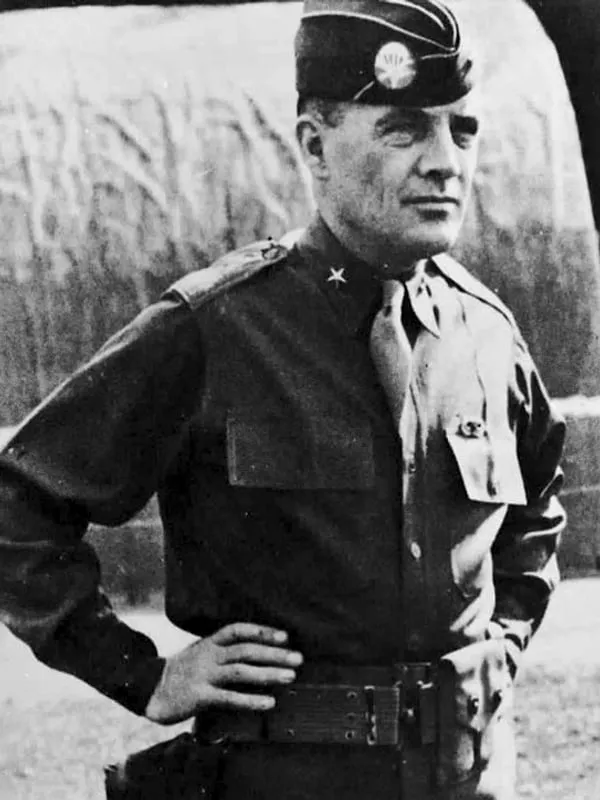
- Born:
- 2 July 1898, Washington, D.C. (United States)
- Died:
- 11 August 1975, Chevy Chase (Maryland, United States)
- Author:
- Natalia
- Photo:
- autor nieznany, domena publiczna, Wikimedia Commons

For more than twenty-five years Anthony Clement McAuliffe served in the US Army as a conscientious, little-known artilleryman. One word made him famous. In December 1944, while the commander of the 101st Airborne Division was in the United States, McAuliffe, as his stand-in, directed the defence of encircled Bastogne in the Ardennes, and he answered the German demand for surrender briefly: “Nuts!”. The reply became one of the best-known lines in American military history. It also summed up well the stubborn defence of a town without which the German offensive could not develop.
Washington, Morgantown and West Point
He was born on 2 July 1898 in Washington, into a family of Irish descent. In 1916–1917 he studied at West Virginia University in Morgantown. When the United States entered the Great War, in 1917 he entered the military academy at West Point. The army needed officers quickly at the time, and his class was put through an accelerated course. McAuliffe graduated in November 1918, just after the Armistice of Compiègne, and was commissioned as a second lieutenant in the field artillery. He was too late to reach the front. Soon afterwards he paid a short visit to Europe and toured the recent battlefields in France.
Twenty years in the artillery
In 1920 he completed the artillery school, and then for more than a decade he did routine service in the small peacetime US Army. Promotion came slowly in those years. He did not make captain until the mid-1930s. He later completed the course at the Command and General Staff School at Fort Leavenworth and, in June 1940, the Army War College. He thus belonged to the group of officers from whom the army could choose its senior commanders in wartime.
Shortly before the attack on Pearl Harbor he was posted, as a lieutenant colonel, to the supply division of the War Department General Staff. There he worked on introducing new equipment. According to his biographers, he oversaw, among other things, work on the cross-country vehicle that went down in history as the jeep and on the hand-held anti-tank rocket launcher called the bazooka. Both later became symbols of the American army of the war.
The 101st Airborne Division
In August 1942 the 101st Airborne Division was formed, and McAuliffe, by then a brigadier general, took command of its divisional artillery. This was a new kind of force: guns and ammunition had to be brought onto the battlefield by glider or dropped by parachute. McAuliffe was over forty at the time, but he went through parachute training alongside his men.
On the night of 5/6 June 1944 the division landed on the Cotentin Peninsula behind Utah Beach to cover the Normandy landings. McAuliffe jumped with it. The drop was badly scattered, and for the first hours commanders gathered their men into small groups, often from different regiments. The division then fought at Carentan, among other places, and in July returned to England.
In September 1944 the 101st Division took part in Operation Market Garden. McAuliffe landed in the Netherlands by glider. His division seized the bridges and the stretch of road between Eindhoven and Veghel and for many days defended this corridor against German counter-attacks. The soldiers called it “Hell’s Highway”. The operation failed to achieve its aim, and after the defeat at Arnhem the division fought on until the end of November on “the Island” between the Waal and the Rhine. It was then moved to the camp at Mourmelon-le-Grand near Reims for rest and replacements.
Bastogne
On 16 December 1944 the Germans launched their offensive in the Ardennes. The commander of the 101st, Major General Maxwell Taylor, happened to be at conferences in the United States, and his deputy was in England. McAuliffe therefore took command. On the evening of 17 December the division was ordered to the front. On the afternoon of 18 December McAuliffe drove ahead to Bastogne and met the commander of VIII Corps, Major General Troy Middleton. Bastogne was the junction of seven roads, and without it the Germans could not properly supply their forces pushing west. On the night of 18/19 December the division’s regiments arrived in the town by lorry. Many units lacked winter clothing and enough ammunition when Bastogne was encircled.
McAuliffe commanded more than his own division. Combat Command B of the 10th Armored Division, the remnants of shattered units and several corps artillery battalions also came under his orders. An artilleryman by training, he placed his guns in the middle of the perimeter so that they could fire on any threatened sector. Ammunition was the greatest shortage, and battery commanders were given strict limits on the number of rounds. By noon on 21 December units of General Heinrich von Lüttwitz’s XLVII Panzer Corps had closed the ring around the town.
On 22 December two German officers and two soldiers approached the lines of the 327th Glider Infantry Regiment under a white flag. They brought a note signed “The German Commander”. According to most accounts, it had been drawn up by Lüttwitz’s staff. The note gave the Americans two hours for an “honourable surrender” and threatened to destroy the town with artillery fire. According to witnesses, McAuliffe first asked what the Germans wanted. When he heard that they were demanding surrender, he exclaimed “Aw, nuts!”, crumpled the paper and threw it away. His staff officers then pondered what to reply. Lieutenant Colonel Harry Kinnard suggested that the general’s first word should itself be the answer. So the shortest reply of the war came into being: “To the German Commander. NUTS! The American Commander.”
The note was taken to the Germans by the commander of the 327th Regiment, Colonel Joseph Harper. The German officer did not understand the word. Harper is said to have explained that it simply meant “go to hell”. The choice of word suited McAuliffe. His aide recalled that he was the only general he knew who never swore. News of the reply – “Nuts!” – spread quickly through the encircled units and raised the soldiers’ morale. The threatened bombardment did not come on the scale announced, but the Germans kept attacking, and the Luftwaffe bombed the town at night.
The next day the skies over the Ardennes cleared. Transport aircraft dropped ammunition, medicines and food to the defenders. On Christmas Eve McAuliffe sent his men a short Christmas message. In it he wrote that the Germans had surrounded the division, but that their demand for surrender had received the answer it deserved. On Christmas Day the defenders beat off the strongest German attack, on the north-western sector, around Champs and Hemroulle.
On 26 December at 4.50 p.m. tanks of Lieutenant Colonel Creighton Abrams’s 37th Tank Battalion of the 4th Armored Division broke through to Bastogne from the south. McAuliffe greeted the tank crews with the words “I am mighty glad to see you” – the relief of Bastogne had arrived. A day later Taylor returned to the division and took over command from him. The fighting around Bastogne continued for several more weeks, until the end of the Ardennes offensive.
A cross from Patton and the 103rd Division
For the defence of Bastogne McAuliffe received the Distinguished Service Cross, the US Army’s second-highest combat decoration. According to army records, it was presented to him in person by the commander of the Third Army, General George Patton, on 30 December 1944. The whole 101st Division became the first division in the history of the US Army to receive a collective award for outstanding gallantry, the Distinguished Unit Citation. It was presented to the troops at Mourmelon in March 1945 by General Dwight Eisenhower.
On 15 January 1945 McAuliffe was promoted to major general and received his first independent divisional command: the 103rd Infantry Division in Alsace. In the second half of March 1945 the division broke through the fortifications of the Siegfried Line and on 23 March reached the Rhine valley. In April it pursued the retreating German forces through Württemberg. On 27 April its units entered Landsberg, where they liberated the subcamps of the Kaufering complex, part of the Dachau concentration camp. The division then advanced through Innsbruck to the Brenner Pass. There, at the beginning of May, it met units of the Fifth Army coming up from Italy. McAuliffe commanded the 103rd Division until July 1945.
After the war: from chemical weapons to command in Europe
After the war he held staff and administrative posts. He was Chief of the Army’s Chemical Corps and then Assistant Chief of Staff for Personnel (G-1) in Washington. In 1949 he attended the Washington premiere of the film Battleground. The film did not portray him directly, but it included a scene showing the German ultimatum and the Germans’ bewilderment at his reply.
In 1953 he returned to Europe as commander of the Seventh Army in West Germany. In 1955–1956 he commanded all US ground forces in Europe (US Army Europe). On 1 March 1955 he was promoted to full general, the highest rank in peacetime. By then the Germans were allies of the United States in NATO, and the Bundeswehr was just being formed. The general of Bastogne was thus in command of an army that was to defend Western Europe against the Soviet Union together with its former enemy.
He retired in 1956. Until 1963 he was vice-president for personnel at the chemical company American Cyanamid. From 1960 he also chaired the New York State Civil Defense Commission, at a time when fallout shelters were being built across the United States. He spent his last years in Chevy Chase, Maryland. He died of leukaemia in August 1975 at the age of 77 and was buried in Arlington National Cemetery.
Significance
McAuliffe was no great strategist and did not command armies in decisive campaigns, as Patton or Omar Bradley did. His place in the history of the war rests on a single week in December 1944. The defence of Bastogne blocked the most important road junction in the middle of the Ardennes. For many days the Germans had to tie down considerable forces around the town, and their armoured spearheads, thrust out towards the Meuse, could not be properly supplied through it. The stubborn defence of the town was one of the reasons why the Ardennes offensive achieved none of its objectives.
The word “Nuts!” passed into the language and the legend of the war. Its memory is especially alive in Bastogne itself. The town’s main square is named after General McAuliffe, and in one corner of it stands a Sherman tank with a hole made by a German shell. Every December the town holds ceremonies commemorating the defence. The new headquarters of the 101st Division at Fort Campbell, opened in 2009, is called McAuliffe Hall. In Pennsylvania a stretch of state highway was named after him. For American soldiers McAuliffe remained the model of a commander who, in a hopeless position, lost neither his composure nor his sense of humour.
Sources
Commanded in battles
(01)Often appears with
People who appear in the same events.