Germany
Karl Liebknecht
Member of the Reichstag (1912–1916), leader of the Spartacus League, co-founder of the Communist Party of Germany (1918–1919)
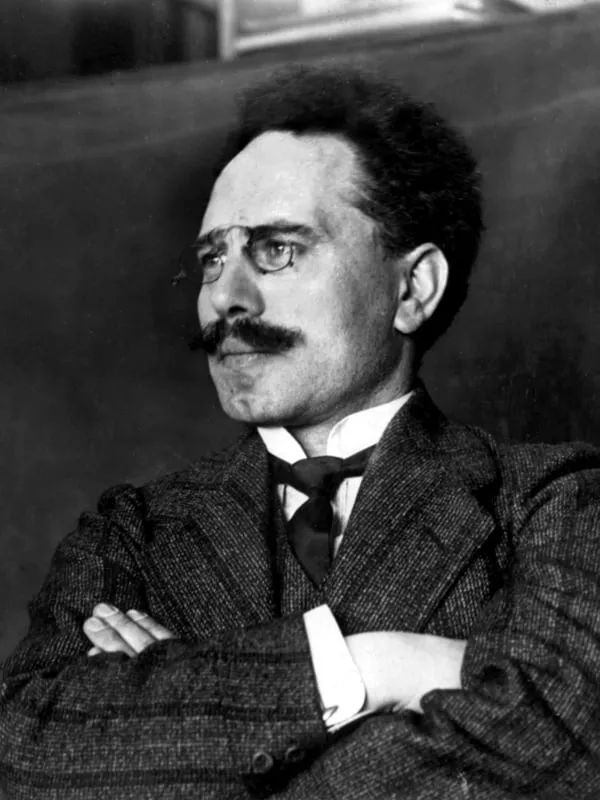
- Born:
- 13 August 1871, Leipzig (Kingdom of Saxony)
- Died:
- 15 January 1919, Berlin
- Author:
- Natalia
- Photo:
- Copyright G. G. Bain, domena publiczna, Wikimedia Commons

Karl Liebknecht was the loudest opponent of the war in imperial Germany and the symbol of the radical wing of the German Revolution. The son of one of the founders of German social democracy, a lawyer and a parliamentarian, he had already been sent to a fortress before 1914 for a pamphlet against militarism. In December 1914 he was the only member of the Reichstag to vote against war credits, and in 1916, for shouting “Down with the war!” in a Berlin square, he was sentenced to more than two years’ penal servitude. On 9 November 1918 he proclaimed a “free socialist republic”; together with Rosa Luxemburg he led the Spartacus League, and at the turn of 1918 and 1919 he co-founded the Communist Party of Germany. After the Spartacist uprising was crushed, he was murdered by officers of one of the volunteer units fighting on the government’s side. His death, for which no one was ever truly held to account, divided German Social Democrats and Communists for decades, until Hitler’s victory destroyed them both.
The son of a party founder
He was born on 13 August 1871 in Leipzig, the second of five sons of Wilhelm Liebknecht, who together with August Bebel created German social democracy. According to surviving family documents, his godfathers – though absent from the christening – were Karl Marx and Friedrich Engels. His childhood was spent in the shadow of the Anti-Socialist Laws, which banned the party’s activity from 1878 to 1890 and drove his father out of Leipzig.
He studied law and economics in Leipzig and Berlin, did his military service as a one-year volunteer in a Guards pioneer battalion, and in 1897 took his doctorate at the University of Würzburg. In 1899 he opened a law practice in Berlin with his brother Theodor, and in 1900 he joined the Social Democratic Party of Germany (SPD) and married Julia Paradies, with whom he had three children. He made his name in 1904 at a trial in Königsberg, where together with Hugo Haase he defended Social Democrats accused of smuggling illegal literature into Russia. As counsel in political trials he denounced the empire’s “class justice” and the abuse of recruits in the army.
Antimilitarist
Militarism was his chief enemy. Liebknecht helped to found the Socialist Youth International and chaired its bureau from 1907 to 1910. In 1907 he published the pamphlet “Militarism and Anti-Militarism”, in which he argued that the army served not only for wars against other states but also for suppressing the “internal enemy” – the labour movement – and called for agitation among young people before they were called up. The Prussian war minister demanded that the author be prosecuted. In October 1907 the Reich Court in Leipzig convicted Liebknecht of preparing high treason and sentenced him to eighteen months’ fortress confinement. The trial made him a hero to Berlin’s workers, and Emperor Wilhelm II demanded telegraphed reports on its progress.
He served his sentence in the fortress at Glatz (Kłodzko). While still in prison, in 1908, he was elected to the Prussian House of Representatives, one of the first Social Democrats to win a seat there despite the three-class franchise. His wife died in 1911, and a year later he married the art historian Sophie Ryss, a native of Rostov-on-Don. In January 1912 he won a Reichstag seat in the Potsdam–Spandau constituency, until then regarded as a conservative stronghold. In 1913 he revealed that the Krupp concern had been bribing War Ministry officials to obtain confidential information. The scandal shook public opinion but did not change armaments policy.
Alone against the war
When war broke out in August 1914, Liebknecht was convinced that the Social Democratic parliamentary group would reject the war credits. At the group’s meeting on 3 August he found himself in the minority, and on 4 August, obedient to the principle of voting as a bloc that he himself had defended for years, he raised his hand for the credits together with the whole party. He soon regretted it. In the autumn he travelled to occupied Belgium, where he gathered accounts of mass reprisals by German troops against the civilian population, for which even the Social Democratic press called him a traitor. On 2 December 1914, when the Reichstag voted on a further round of credits, he was the only deputy who did not rise from his seat. The president of the chamber refused to enter his written statement of reasons in the record.
In February 1915 the military authorities called him up to a construction labour battalion behind the front. As a soldier he could not engage in political activity outside parliament, but he used his leave to attend sittings to organise the opponents of the war. Together with Rosa Luxemburg, Franz Mehring and others he formed the “Internationale” group, from which the Spartacus Group emerged on 1 January 1916, named after the illegal “Political Letters” signed with the pseudonym Spartacus. On 12 January 1916 the SPD parliamentary group expelled him. In those same weeks he was one of the very few German parliamentarians to demand an explanation in the Reichstag of the fate of the Armenians in Germany’s ally, Turkey. When he was finally given the floor in April 1916, right-wing and liberal deputies shouted him down, and one of them snatched his notes from him.
On 1 May 1916, on Potsdamer Platz in Berlin, he headed an anti-war demonstration and shouted: “Down with the war! Down with the government!” He was arrested on the spot. On the day of his trial tens of thousands of Berlin workers went on strike in solidarity, which is regarded as the first political mass strike in Germany during the war. In August 1916 a higher court increased his sentence to four years and one month’s penal servitude for treason in wartime. He served it in the prison at Luckau in Lusatia. In the meantime German social democracy split: in April 1917 the opponents of the war founded the Independent Social Democratic Party of Germany (USPD), which the Spartacists joined as a separate faction.
November 1918
On 23 October 1918, when the government of Prince Max von Baden declared an amnesty for political prisoners, Liebknecht was released. Crowds greeted him at Berlin’s Anhalter Bahnhof, and the embassy of Soviet Russia gave a reception in his honour. From his first days of freedom he urged the Independents and the radical shop stewards from the factories to prepare an uprising, but they kept postponing the date. In the end the revolution was set off by the sailors’ mutiny in Kiel, which grew into a revolution across Germany.
On 9 November 1918, about two hours after Philipp Scheidemann had proclaimed the German Republic from a window of the Reichstag, Liebknecht spoke from a balcony of the Royal Palace in Berlin and proclaimed the “free socialist republic of Germany”. Two proclamations on the same day showed that the revolution had two different aims. The Social Democrats of Friedrich Ebert wanted parliamentary democracy and early elections; Liebknecht wanted power for workers’ and soldiers’ councils on the Russian model. He did not join the government, although the Independent Socialists offered him a place in it. On 11 November the Spartacists reconstituted themselves as the independent Spartacus League, and Liebknecht and Luxemburg began publishing the daily Die Rote Fahne (The Red Flag). Liebknecht, a brilliant orator, spoke at countless rallies and became for the middle classes the embodiment of the Bolshevik threat, and for right-wing paramilitaries target number one.
Most workers, however, did not follow him. The national congress of councils in December 1918, at which Liebknecht and Luxemburg were denied the right to speak, came out in favour of elections to a National Assembly. Between 30 December and 1 January the Spartacists and other far-left groups founded the Communist Party of Germany. Among the founders was Hugo Eberlein, who a few weeks later represented the KPD at the founding congress of the Comintern in Moscow.
January 1919
When on 4 January 1919 the government dismissed Berlin’s left-wing police president, Emil Eichhorn, an uprising broke out in the city. Liebknecht was carried away by the size of the demonstrations and by false reports that the garrison would go over to the revolution. Against the advice of Luxemburg, who considered the rising premature, he joined the Revolutionary Committee and became one of its three chairmen, alongside Georg Ledebour of the USPD. The committee declared the Ebert–Scheidemann government deposed, but it was unable to direct the crowds and for several days wavered between fighting and negotiating. Government troops under Gustav Noske, relying on the volunteer Freikorps, crushed the uprising by 12 January.
Liebknecht did not leave Berlin. He hid with Luxemburg in several flats, finally in the Wilmersdorf district. On 15 January Die Rote Fahne carried his last article, “In Spite of Everything!” (Trotz alledem!), in which he predicted that today’s defeated would be tomorrow’s victors. That evening a local citizens’ militia arrested him and took him to the Hotel Eden, the headquarters of the Guards Cavalry Rifle Division. Its de facto commander, Captain Waldemar Pabst, decided to have both leaders killed. At about 10.45 p.m. a group of naval officers drove the beaten Liebknecht to the Tiergarten park. By the Neuer See lake the driver feigned a breakdown, and Liebknecht was shot in the back as he walked along an unlit path. The body was handed in at an ambulance station as that of an unknown man. The division announced that he had been killed while trying to escape.
Funeral and perpetrators
On 25 January 1919 Liebknecht was buried, together with 31 other victims of the January fighting, in the cemetery at Friedrichsfelde, then on the outskirts of Berlin. Tens of thousands of people followed the coffins. Beside his grave an empty coffin was placed for Rosa Luxemburg, whose body had not yet been found. The divisional court martial that tried some of the perpetrators in May 1919 acquitted the officers who had escorted Liebknecht. Several of them, including Kapitänleutnant Horst von Pflugk-Harttung, who had commanded the transport, were never punished. In later years Pabst boasted that he had ordered Liebknecht and Luxemburg to be “executed” and claimed that he had acted with Noske’s knowledge.
Significance
Liebknecht was not a great theorist like Luxemburg. He was above all an agitator and a man of action, brave to the point of recklessness, whose strength lay in moral protest against the war and whose weakness was a lack of political calculation. In January 1919 his decision to support an attempt to overthrow the government two weeks before the first free elections gave the army and the Freikorps a pretext to crush the entire radical left. Some historians see it as an expression of the same contempt for parliamentarism with which, a year earlier, the Bolsheviks had dispersed the Russian Constituent Assembly.
His murder had consequences reaching far beyond 1919. For the Communists it became proof that the Social Democrats were traitors to the working class, and in the 1930s, when on Moscow’s orders the KPD branded the SPD “social fascists”, the memory of January 1919 fuelled that hatred. The divided left proved unable to unite against Adolf Hitler, who after 1933 destroyed both parties. The impunity of the murderers showed, in turn, that political opponents could be killed in the Weimar Republic. Among later victims of right-wing assassins were Matthias Erzberger in 1921 and Walther Rathenau in 1922. In 1935 the Nazis demolished the revolutionaries’ monument at Friedrichsfelde cemetery, and the graves were levelled.
After the war Liebknecht became the namesake of hundreds of streets, schools and factories in East Germany, and a town in the Donbas, today’s Soledar, bore his name. Every January a march in honour of Liebknecht and Luxemburg goes to Friedrichsfelde cemetery in Berlin, where they are commemorated at the Memorial to the Socialists.
Sources
Often appears with
People who appear in the same events.