Germany
Gustav Noske
Governor of Kiel (1918), member of the Council of People's Deputies (1918–1919), Reich Minister of Defence (1919–1920), Oberpräsident of the Province of Hanover (1920–1933)
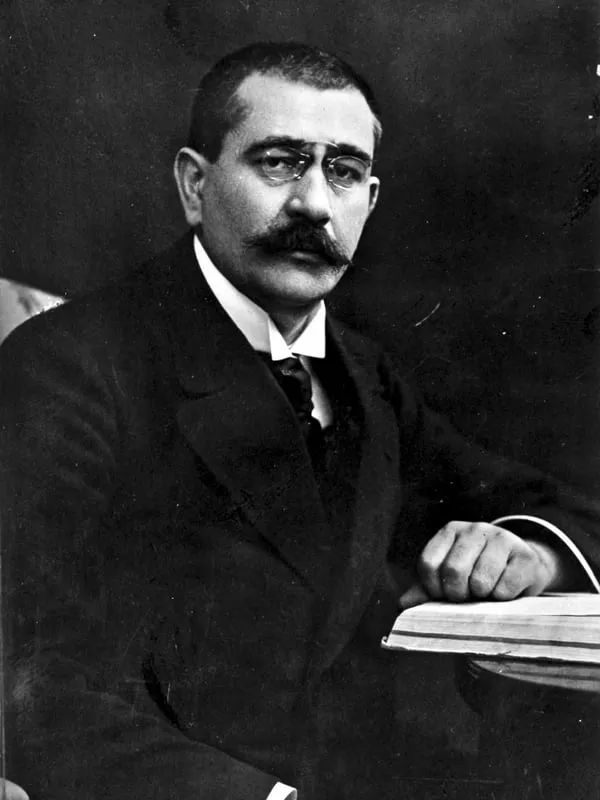
- Born:
- 9 July 1868, Brandenburg an der Havel (Prussia)
- Died:
- 30 November 1946, Hanover
- Author:
- Natalia
- Photo:
- autor nieznany, domena publiczna, Wikimedia Commons

Gustav Noske was one of the most controversial politicians of German social democracy. The son of a weaver and a basket-maker by trade, he rose through the labour movement to become its expert on the army and navy, although he had never served in the forces himself. In November 1918 the government sent him to mutinous Kiel to calm the sailors. He did not stop the revolution, but he placed himself at its head in the city where it had begun. A few weeks later, as a member of the revolutionary government and then as the first defence minister of the Weimar Republic, he used the volunteer Freikorps units to crush left-wing uprisings bloodily. He said of himself that “someone has to be the bloodhound”. To some he was the man who saved Germany from Bolshevism and civil war; to others, the man who delivered the republic into the hands of its enemies. The units he used produced the cadres of the nationalist paramilitary groups, including the Nazi SA. In 1933 the Nazis removed him from office, and after the attempt on Hitler’s life in July 1944 he was imprisoned.
Worker and journalist
He was born on 9 July 1868 in Brandenburg an der Havel, the son of the weaver Karl Noske. After elementary school, in 1882, he was apprenticed to a basket-maker. As a journeyman he worked in several German towns and abroad, for eleven to thirteen hours a day, with no social protection whatsoever. At seventeen he co-founded a basket-makers’ trade union, and in 1884 he joined the social democratic party, which at the time operated in semi-legality under Bismarck’s Anti-Socialist Laws and from 1890 bore the name Social Democratic Party of Germany. In 1891 he married Martha Thiel, with whom he had three children.
He rose quickly through the party ranks. In 1892 he became leader of the social democrats in his native Brandenburg, and then a party journalist: he edited the Brandenburger Zeitung, from 1897 the Königsberger Volkstribüne, and from 1902, for sixteen years, he was editor-in-chief of the Volksstimme in Chemnitz. He was self-taught, hard-working and pragmatic, with little patience for the theoretical disputes that absorbed the party.
The Reichstag’s military expert
In 1906 Noske won a by-election in the Chemnitz constituency and entered the Reichstag, where he sat without a break until the end of the Empire. Although he was no soldier, he soon took up military, naval and colonial affairs. In 1907 he made his name with a speech in which, replying to the war minister’s attacks on the social democrats, he gave an assurance that if Germany were attacked, the workers too would defend the fatherland. This earned him the respect of the right and the distrust of the party’s left wing. Unlike many of his comrades, he did not condemn colonialism as such, but criticised only the way colonial policy was conducted. From 1912 he was one of the parliamentary party’s chief speakers on the naval budget.
When war broke out in August 1914, Noske, like most social democrats, regarded it as defensive and voted for the war credits. During the war he belonged to the party’s right wing, which supported the government and rejected a split. When the radical opponents of the war formed the Independent Social Democratic Party of Germany in 1917, Noske stayed with the majority led by Friedrich Ebert. In the autumn of 1918, when defeat had become obvious, he called on Kaiser Wilhelm II in the Reichstag to abdicate as “one great gesture”.
Kiel
At the beginning of November 1918, the mutiny of the sailors of the High Seas Fleet, who refused to take part in a final battle planned by Admirals Reinhard Scheer and Franz von Hipper, turned into an open uprising in Kiel. The governor of the fortress, Admiral Wilhelm Souchon, asked Berlin to send “a prominent Social Democratic deputy” to calm the sailors. The government of Chancellor Max von Baden sent Noske, who was regarded as a naval expert, together with State Secretary Conrad Haußmann. Noske arrived on the evening of 4 November, when the city was already in the mutineers’ hands, and addressed the crowds on the Wilhelmplatz.
He quickly grasped that the revolt could not be extinguished, but that it could be brought under control. He promised an amnesty and a speedier armistice, while at the same time seizing the initiative. The sailors elected him chairman of the soldiers’ council, and on 7 November he replaced Souchon as governor of Kiel. He thus became the leader of the very movement he had wanted to halt. He could not, however, stop it from spreading: the sailors carried the revolution to one city after another, on 9 November the monarchy fell, and Ebert became head of the government. Noske remained in Kiel until the end of December, restoring order there and discipline in the navy.
“Someone has to be the bloodhound”
In December 1918 power in Berlin was exercised by the Council of People’s Deputies, made up of Ebert’s Social Democrats and the Independent Socialists. After bloody fighting with a unit of mutinous sailors at Christmas, the Independents left the government, and on 29 December Noske joined the Council with responsibility for the army and navy. At the beginning of January 1919, an uprising of the Spartacists and left-wing socialists broke out in Berlin. By Noske’s own account, when the question arose among the leaders of who would command the government troops, he replied: “Very well! Someone has to be the bloodhound – I am not afraid of the responsibility.”
Since the old army was falling apart, Noske relied on the volunteer Freikorps (PL), formed by professional officers and made up largely of nationalist-minded front-line soldiers and young men. Within a few days the uprising had been crushed. Estimates of the dead range from just over a hundred to about two hundred. On 15 January 1919, officers of the Guards Cavalry Rifle Division (Garde-Kavallerie-Schützen-Division) murdered the Spartacist leaders Karl Liebknecht and Rosa Luxemburg. Captain Waldemar Pabst, who directed the operation, claimed years later, in a letter found in 1970, that it could not have taken place without Noske’s consent. Noske denied this, and historians assess the claim in different ways. What is certain is that the perpetrators were treated with extraordinary leniency.
Minister of Defence
On 13 February 1919 Noske became Reich Minister of Defence in the government of Philipp Scheidemann, the first Social Democrat in German history to hold the post. He oversaw the building of a new army, the Reichswehr, while continuing to suppress left-wing revolutionary movements throughout the country. In March 1919, during the fighting in Berlin, he issued an order that anyone caught bearing arms against government troops was to be shot on the spot. According to German studies, around 1,200 people were killed in the March fighting. At the beginning of February the Freikorps crushed the soviet republic in Bremen, and at the beginning of May the one in Munich, where several hundred people died. Noske gave the Freikorps a free hand and shielded the soldiers from accountability for their violence.
His policy saved the government and cleared the way to elections for the National Assembly, which adopted the Weimar Constitution in August 1919, but it came at a high price. The left, including a large part of the working class, never forgave the Social Democrats for this violence, and the rift between Social Democrats and Communists lasted until the end of the republic. The officers and men of the Freikorps did not become defenders of democracy. They despised it, and many of them later turned up in the paramilitary groups of the far right, among the murderers of republican politicians and in the Nazi SA.
The Kapp Putsch
Under pressure from the Allies, who under the Treaty of Versailles required the army to be reduced, Noske ordered at the end of February 1920 that some of the Freikorps be disbanded, including the naval brigade of Lieutenant Commander Hermann Ehrhardt. On 13 March 1920 the brigade marched into Berlin, and the nationalist politician Wolfgang Kapp and General Walther von Lüttwitz announced that they had taken power. The Reichswehr command refused to defend the government, and the ministers had to flee the capital. The putsch collapsed after a few days in the face of a general strike and the civil servants’ refusal to cooperate. The trade unions and some of the Social Democrats nonetheless held Noske responsible for having nurtured the republic’s enemies. A few days after the putsch collapsed he was forced to resign.
Hanover and the Third Reich
In 1920 Noske became Oberpräsident of the Prussian Province of Hanover, that is, the head of its administration. He held this office until 1933, far from high politics. The party no longer wished to put him forward as a candidate for the Reichstag. In 1920 he published his memoirs, Von Kiel bis Kapp (“From Kiel to Kapp”). His image in the eyes of the right was also shaped by a photograph in which, in the summer of 1919, he posed in bathing trunks together with President Ebert. The nationalist press made him a symbol of the republic’s weakness and absurdity.
After Adolf Hitler came to power, Hermann Göring, who had taken charge of the Prussian Ministry of the Interior, removed Noske from office. He was first sent on leave and then, in September 1933, formally dismissed under the Nazi civil service law. He was not, however, persecuted as many other Social Democrats were, and he kept his pension. He maintained contacts with opposition circles. The conspirators around Carl Goerdeler envisaged him as political commissioner in one of the military districts in the event of a successful coup. After the failed attempt on Hitler’s life on 20 July 1944, the Gestapo arrested him. He was held in the camp at Fürstenberg, part of the Ravensbrück complex, and then in the prison on Lehrter Straße in Berlin. At the end of April 1945, in the days when Berlin was being captured, he regained his freedom.
Last years and assessment
By the end of the war he was 77 and played no further political role. He died in Hanover on 30 November 1946. His memoirs, Erlebtes aus Aufstieg und Niedergang einer Demokratie (“Experiences from the Rise and Fall of a Democracy”), appeared posthumously in 1947; in them he blamed, among other things, the influence of “Eastern” Marxists for the radicalisation of the German labour movement.
For a hundred years the assessment of Noske has divided historians and the Social Democrats themselves. His defenders stress that in the winter of 1918–1919 the government had no forces other than the Freikorps, and that without the suppression of the uprisings there would have been no elections, no constitution and no parliamentary republic. His critics point out that Noske made no attempt to create an army loyal to the republic, relied on its sworn enemies and gave them licence to use violence. In this way, they argue, the republic surrendered its monopoly of force in its very first months to men who in 1920 backed the Kapp Putsch and in the years that followed swelled the ranks of Hitler’s movement. The path from the Freikorps of 1919 to the SA is one of the important threads in the history that led Germany to 1933 and to the Second World War.
Sources
Often appears with
People who appear in the same events.