Germany
Rosa Luxemburg
Co-founder of the SDKP (1893), leading figure of the SPD's left wing (1898–1914), leader of the Spartacus League and co-founder of the KPD (1918–1919)
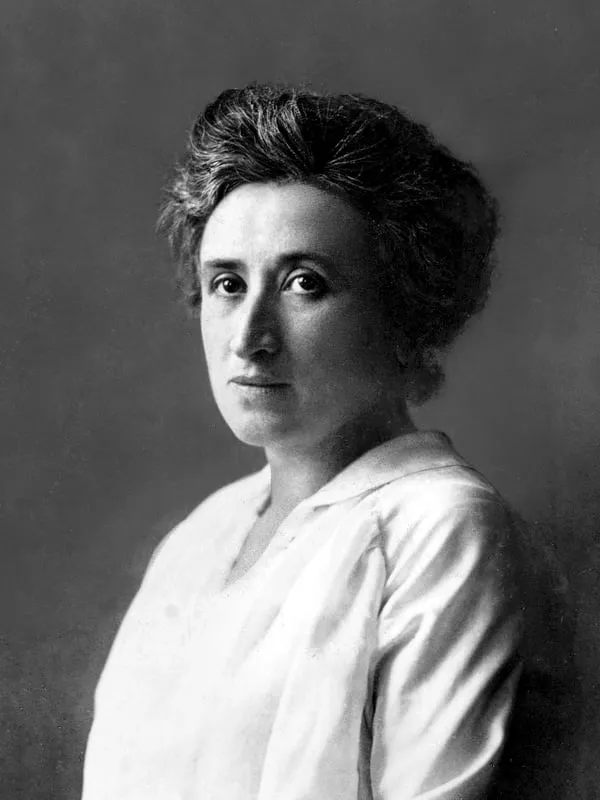
- Born:
- 5 March 1871, Zamość (Kingdom of Poland, Russian Empire)
- Died:
- 15 January 1919, Berlin
- Author:
- Łukasz
- Photo:
- autor nieznany, domena publiczna, Wikimedia Commons

Rosa Luxemburg was one of the most outstanding figures of European socialism and one of the most contested figures in Polish history. Born into a Jewish family in Zamość and raised in Warsaw, she helped to found the Social Democracy of the Kingdom of Poland, which fought the slogan of Polish independence as an illusion that distracted workers from the class struggle. In Germany she became the leading theorist of the left wing of Social Democracy, an implacable opponent of war and militarism, and at the same time one of the first critics of the Bolshevik dictatorship on the left. During the revolution of 1918 she led the Spartacus League with her comrade Karl Liebknecht and co-founded the Communist Party of Germany. After the suppression of the Spartacist uprising, which she had opposed, she was murdered by officers of a volunteer unit fighting on the government’s side. Her death cemented the split in the German left, which in the 1930s smoothed Hitler’s path, and the Nazis made her a symbol of supposed “Jewish Bolshevism”.
Zamość and Warsaw
Rozalia Luxenburg was born in Zamość, the fifth and youngest child of the timber merchant Eliasz (Edward) Luxenburg and Lina, née Löwenstein. Her date of birth is uncertain. Documents, which were in any case issued later, give 25 December 1870, but the family always celebrated her birthday on 5 March, and she herself gave the year as 1871 and claimed that the date in her birth certificate had been altered. Biographers usually accept 5 March 1871. A clerical error changed the spelling of the surname to Luxemburg. The family was assimilated and secular; at home they spoke Polish and German, and her mother read Mickiewicz and Schiller to the children. Polish literature, Mickiewicz above all, stayed with Rosa all her life.
In 1873 the Luxenburgs moved to Warsaw. As a child Rosa suffered from a hip condition, wrongly treated as tuberculosis, which left her with a slight limp for the rest of her life. At the Russian-language Second Girls’ Gymnasium in Warsaw she was the best pupil, but she was refused the gold medal because of her “oppositional attitude towards the authorities”. While still at school she joined the clandestine socialist party Proletariat (PL). At the end of 1888, threatened with arrest, she left illegally for Switzerland.
Zurich and the dispute over independence
In Zurich, the only place in the German-speaking world where women could study on equal terms with men, she studied natural sciences, law and economics. In 1897 she defended a doctoral thesis on the industrial development of Poland. In it she argued that the economy of the Kingdom of Poland had grown so closely bound up with the Russian market that restoring an independent state would be a step backwards. In Zurich she met Leo Jogiches, a revolutionary from Wilno (Vilnius), who for some fifteen years was her partner and, to the end, her closest political collaborator.
In 1892 the Polish Socialist Party (PPS) was founded, combining socialism with the struggle for independence. Luxemburg, Jogiches, Julian Marchlewski and Adolf Warski came out against this programme in the Paris-based journal Sprawa Robotnicza (The Workers’ Cause). They believed that Polish workers could liberate themselves only together with Russian workers, by overthrowing Tsarism and capitalism throughout the empire, and that independence was an ideal of the gentry and the bourgeoisie. At the congress of the Second International in Zurich in August 1893, Ignacy Daszyński challenged her mandate, and most delegates recognised only the pro-independence socialists as representatives of Poland. In the same year her group founded the Social Democracy of the Kingdom of Poland, renamed in 1900 the Social Democracy of the Kingdom of Poland and Lithuania (SDKPiL). The young Felix Dzerzhinsky was also a member.
The dispute over independence ran through her whole life. Luxemburg regarded nationalism as a tool with which the propertied classes distracted workers from the struggle for their own interests, and she opposed both Polish nationalism and the right of nations to self-determination proclaimed by Lenin. In her well-known series “The National Question and Autonomy” (1908–1909) she proposed autonomy for the Kingdom of Poland within a democratic Russia. To Józef Piłsudski and his PPS she was an opponent, to the National Democrats an enemy, and to antisemites a convenient example with which to raise the spectre of “Jewish” socialism.
In German Social Democracy
In 1898, in order to obtain German citizenship, she entered into a sham marriage with Gustav Lübeck, the son of acquaintances from Zurich, settled in Berlin and joined the Social Democratic Party of Germany (SPD). At first she campaigned among Polish workers in Silesia, but she soon became one of the party’s sharpest pens. In the pamphlet Social Reform or Revolution? (1899) she took on Eduard Bernstein, who argued that socialism could be achieved through gradual reforms. In her view reforms were only a means, and the goal remained the seizure of power by the proletariat. As a Jew, a woman and a foreigner, she met with much prejudice within the party.
In 1904 she served several weeks in prison in Zwickau for insulting the Kaiser in an election speech. In the same year she criticised Vladimir Lenin’s conception of the party, accusing him of wanting to subordinate the workers’ movement to a centralised group of professional revolutionaries. When revolution engulfed Russia and the Kingdom of Poland in 1905, she came to Warsaw with Jogiches under a false name in December. In March 1906 she was arrested and held in the Tenth Pavilion of the Warsaw Citadel. She was released in July on bail paid by her family and returned to Germany. She described the experience of the revolution in the pamphlet The Mass Strike, the Political Party and the Trade Unions, in which she argued that the general strike was the workers’ most important weapon.
From 1907 she taught political economy at the SPD party school in Berlin, where her pupils included Wilhelm Pieck, later president of the German Democratic Republic. In 1910 she broke with Karl Kautsky, the party’s chief theorist, who rejected her calls for a political strike. In 1913 she published her most important theoretical work, The Accumulation of Capital, in which she argued that in order to grow, capitalism had constantly to subjugate non-capitalist areas, which led to imperialism and colonial wars. She warned ever more forcefully of a European war. In September 1913, at rallies in and around Frankfurt am Main, she called on workers not to take up arms against their French brothers. In February 1914 she was sentenced to a year in prison for it.
War and prison
On 4 August 1914 the SPD’s parliamentary group voted for war credits. For Luxemburg this was a catastrophe for the whole International. According to her friends, she contemplated suicide at the time. On 5 August she gathered a group of opponents of the war at her home, among them Franz Mehring, Marchlewski, Hugo Eberlein and Pieck. Liebknecht soon joined them. Out of the “Internationale” group grew the Spartacus Group in 1916.
She spent almost the entire war behind bars. From February 1915 to February 1916 she served her sentence from the Frankfurt case in the women’s prison in Berlin. There she wrote The Crisis of Social Democracy, published under the pseudonym Junius, an indictment of the war as an imperialist slaughter and of Social Democracy as its accomplice. A few months after her release, in July 1916, she was locked up without trial in “protective custody”. She was held in Berlin, in the fortress at Wronki near Poznań and finally in the prison in Breslau (Wrocław). From there she wrote letters which after her death also made her a literary figure, and articles that were smuggled out.
She greeted the Russian Revolution with hope, but in the manuscript The Russian Revolution, written in the Breslau prison in 1918, she sharply criticised the Bolsheviks for dispersing the Constituent Assembly, abolishing freedom of the press and of assembly, and for their terror. It was then that she wrote her most famous sentence: “Freedom is always freedom for the one who thinks differently.” She warned that without free elections and freedom of speech public life would die away and power would pass to a handful of leaders. The text was published only in 1922, by her friend Paul Levi.
Revolution and death
The November Revolution threw open the prison gates. Luxemburg was released in Breslau on 9 November 1918 and the next day arrived in Berlin, grey-haired and in poor health. With Liebknecht she edited the daily Die Rote Fahne (The Red Flag). She demanded power for the workers’ and soldiers’ councils, the disarming of the officers and the socialisation of industry, and regarded the government of Friedrich Ebert as a guardian of the old order. At the same time she rejected terror on the Bolshevik model. In the programme of the Spartacus League of December 1918, later adopted by the Communist Party of Germany (KPD), she wrote that the communists would never take power except by the clear will of the great majority of the masses. At the founding congress of the KPD at the turn of 1918 and 1919 she argued for taking part in the elections to the National Assembly, but the delegates outvoted her.
When an uprising broke out in Berlin on 5 January 1919, she considered it premature and unprepared and sharply criticised Liebknecht for joining the Revolutionary Committee. She did not publicly dissociate herself from the uprising, and Die Rote Fahne called for struggle. After it was crushed by the Freikorps (PL) of Gustav Noske, she refused to leave Berlin. On 14 January her last article appeared, “Order Prevails in Berlin”, in which she predicted that the revolution would return.
On the evening of 15 January a citizens’ militia arrested her and Liebknecht in a flat in Wilmersdorf and took them to the Hotel Eden, the headquarters of the Guards Cavalry Rifle Division. Captain Waldemar Pabst decided that both were to die. As she was led out of the hotel, a soldier, Otto Runge, struck her down with blows of his rifle butt. She was thrown unconscious into a car and, a few dozen metres further on, shot in the temple. Lieutenant Kurt Vogel was long held to be the killer; historians now identify the man who fired as Lieutenant Hermann Souchon of the navy. The body was thrown into the Landwehr Canal. The division announced that Luxemburg had been killed by an enraged mob. On 25 January an empty coffin was buried beside Liebknecht’s grave. Her body was recovered from a lock on the canal only on 31 May. She was buried on 13 June 1919 in the cemetery at Friedrichsfelde, and Paul Levi gave the graveside address.
The perpetrators were tried in May 1919 by a court martial of their own division. Runge received two years in prison and Vogel two years and four months, and not for murder. A few days after the verdict Vogel fled to the Netherlands with the help of Wilhelm Canaris, later head of military intelligence of the Third Reich. A few weeks after Luxemburg, in March 1919, Jogiches, who had been establishing the names of her killers, was murdered in a Berlin prison.
Legacy
After Luxemburg’s death a dispute over her legacy began. Lenin called her an “eagle” who, despite her mistakes, remained a great revolutionary, but once the German Communist Party had submitted to Moscow, “Luxemburgism” came to be fought as a heresy. In 1931 Joseph Stalin publicly condemned her views. The Communist Party of Germany, obedient to the Comintern, called the Social Democrats “social fascists”. The memory that Luxemburg and Liebknecht had died at the hands of soldiers of a government led by Social Democrats fed the hostility between the two parties, which lasted until 1933 and eased Adolf Hitler’s path to power. For the Nazis and the whole of the far right, Luxemburg – a Jew, a Pole and a communist – was the embodiment of the enemy. In 1935 the Nazis demolished the monument to the revolutionaries in the Friedrichsfelde cemetery. In 2009 the Berlin forensic pathologist Michael Tsokos suggested that a body kept in the basement of the Charité hospital might be Luxemburg’s, and that the grave held the remains of another woman. Tests proved inconclusive.
Her Polish party outlived her by two decades. In December 1918 the SDKPiL merged with the PPS-Left to form the Communist Workers’ Party of Poland, which rejected the reborn Polish state as bourgeois and during the Polish–Soviet War sided with Soviet Russia. In 1920 Marchlewski and Dzerzhinsky joined the Provisional Polish Revolutionary Committee, which was to take power after a Red Army victory. In 1938 the Comintern dissolved the Communist Party of Poland on the charge that it had been infiltrated by Polish intelligence, and most of its leaders living in the USSR, Warski among them, perished in the Great Purge. The official cult of Luxemburg in East Germany and communist Poland passed over her criticism of the Bolsheviks, and in Poland she remains a divisive figure to this day: to some an outstanding thinker and a defender of freedom within socialism, to others an enemy of Polish independence.
Sources
Often appears with
People who appear in the same events.