Germany
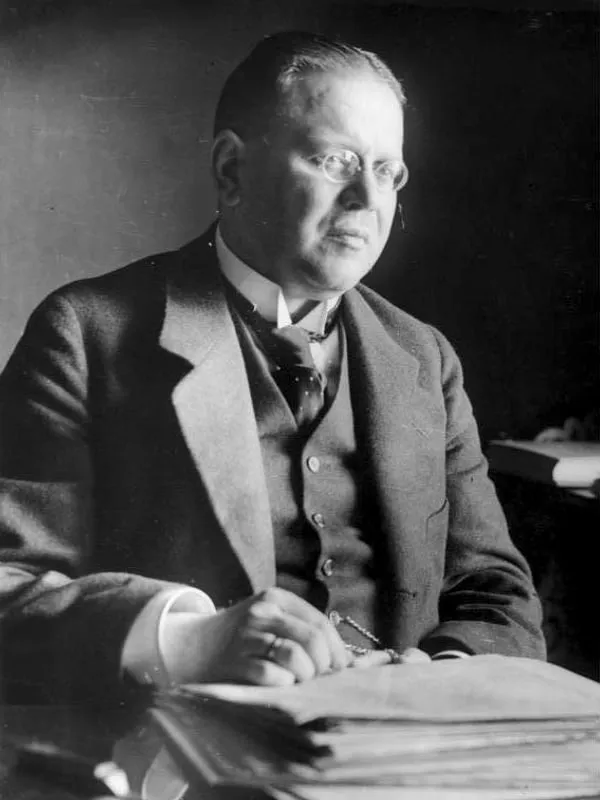
Matthias Erzberger
Member of the Reichstag (1903–1921), head of the German armistice delegation (1918), Vice-Chancellor and Finance Minister (1919–1920)
- Born:
- 20 September 1875, Buttenhausen (Württemberg)
- Died:
- 26 August 1921, Bad Griesbach (Baden)
- Author:
- Natalia
- Photo:
- Kerbs, Diethart, CC BY-SA 3.0 DE, Wikimedia Commons

Matthias Erzberger was the most energetic, the most influential and the most hated German parliamentarian of his day. The son of a village tailor from Württemberg and a deputy of the Catholic Centre Party, in 1914 he drew up programmes of sweeping annexations, yet three years later he was one of the first politicians to say publicly that Germany could not win the war. On 11 November 1918, as head of the German delegation, he signed in the forest of Compiègne the armistice that the generals had demanded. In the Weimar Republic he was Vice-Chancellor and Finance Minister; he persuaded the government to accept the Treaty of Versailles and rebuilt the Reich’s tax system. The right turned him into the symbol of the “November criminals” who had supposedly robbed Germany of victory. In 1921 he was murdered by nationalist assassins. His fate is one of the clearest examples of how the stab-in-the-back myth poisoned German politics long before Hitler came to power.
Early life and the Reichstag
He was born on 20 September 1875 in Buttenhausen in the Kingdom of Württemberg, into the family of a tailor who earned extra money as a postman. He trained at a teachers’ seminary, taught briefly at an elementary school and in 1896 became a journalist on the Catholic Deutsches Volksblatt in Stuttgart. He was active in Catholic associations and the Christian trade unions. In 1900 he married Paula Eberhard. In 1903, aged 28, he was elected to the Reichstag for the Biberach constituency. He quickly made a name for himself, though his unceremonious style irritated the Centre’s old leaders. He was hard-working, had an excellent command of figures and wrote countless articles.
He first gained prominence in 1905–1906 through his campaign against abuses in the colonies. During the war against the Herero and Nama in German South West Africa he exposed a series of scandals in the colonial administration. The dispute over the colonial budget led to the dissolution of the Reichstag in December 1906, and Chancellor Bernhard von Bülow fought the election campaign against the Centre and against Erzberger personally. Later Erzberger became one of parliament’s leading experts on public finance. He helped shape the financial reform of 1909 and in 1912–1913 supported the expansion of the army.
From annexations to the Peace Resolution
In August 1914 Erzberger was carried away by the general enthusiasm. In a memorandum of September he demanded the annexation of Belgium and of the French Channel coast, the iron-ore basin of Longwy and Briey, the break-up of Russia and a great colonial empire in Central Africa. Chancellor Theobald von Bethmann Hollweg put him in charge of propaganda abroad, especially in Catholic and neutral countries. Erzberger built up a wide network of informants and travelled on diplomatic missions. In 1915, together with Bülow, he tried in vain to keep Italy neutral. In February 1916 in Constantinople he discussed the fate of the Christians with the Turkish leaders and, as one of the few German politicians to do so, tried to do something about the Armenian genocide, though his memorandum went unanswered.
From the autumn of 1916 he doubted victory ever more clearly. On 6 July 1917, at a meeting of the Reichstag’s main committee, he showed with figures that submarine warfare would not force Britain to capitulate and called for a negotiated peace. That same day the Social Democrats, the Centre and the liberals set up the Inter-Party Committee, the nucleus of the future Weimar coalition. A few days later Bethmann Hollweg fell, and on 19 July the Reichstag adopted, by 212 votes to 126, the Peace Resolution, of which Erzberger was the principal author. It rejected “forced” annexations but did not rule out gains obtained by agreement. Erzberger achieved his main aim: the Social Democrats went on voting for war credits. From then on the right hated him as it hated no one else. When at a confidential Centre meeting he revealed a pessimistic memorandum by the Austro-Hungarian foreign minister Ottokar Czernin, and the document later reached the Entente, he was accused of treason, although it was never proved that the leak came from him.
Compiègne
On 3 October 1918 Erzberger joined the government of Prince Max of Baden as a secretary of state without portfolio. A few days earlier the Supreme Army Command – Field Marshal Paul von Hindenburg and General Erich Ludendorff – had demanded an immediate request for an armistice. On 6 November, when word came that Marshal Ferdinand Foch would receive German envoys, the government put Erzberger at the head of the delegation. The chancellor hoped that a Catholic civilian known as an advocate of peace would be better received than a Prussian general. Erzberger agreed reluctantly. The generals who had led the country to defeat were glad to leave the mission to him.
On the evening of 7 November the delegation crossed the front line, and on the morning of 8 November it stood before Foch in the forest of Compiègne. The marshal had the terms read out and allowed 72 hours for a reply. Erzberger asked for an immediate cessation of hostilities, warning of the disintegration of the army and of Bolshevism, but Foch refused. Meanwhile revolution had broken out in Germany, Kaiser Wilhelm II had abdicated and power had passed to Friedrich Ebert. On the evening of 10 November authority arrived to sign the armistice, with Hindenburg reminding the delegates that it had to be signed even without concessions. Erzberger and his colleagues won only minor ones. At five in the morning on 11 November he signed the armistice, the first of the four German plenipotentiaries to do so. He also read out a protest against the harshness of the terms, which ended with the words: “A nation of seventy million suffers, but it does not die.”
As chairman of the armistice commission he then negotiated with Foch at Trier the successive extensions of the armistice, each time at the price of new concessions. It was a humiliating and thankless task. For the right his name became bound up with the defeat, although he had not caused it.
Versailles and financial reform
In January 1919 Erzberger was elected to the National Assembly in Weimar and joined the government of Philipp Scheidemann as a minister without portfolio. When in May the Allies presented their peace terms, he came out in favour of signing the treaty, against the foreign minister Ulrich von Brockdorff-Rantzau. He argued that refusal would mean occupation, the break-up of the Reich and hunger, and that the army, as the generals themselves admitted, was in no state to defend itself. Scheidemann resigned, and in the new government of Gustav Bauer Erzberger became Vice-Chancellor and Finance Minister. On 28 June 1919 Germany signed the Treaty of Versailles.
As Finance Minister he carried out the reform that still bears his name. It gave the Reich its own taxes and its own revenue administration, freeing it from dependence on the federal states, introduced an inheritance tax and placed a heavier burden on the wealthiest. The state had to repay huge war debts and soon reparations as well. For property owners and for the right this was further proof that Erzberger was ruining Germany.
Vilification and assassination
The campaign against him was led by the former vice-chancellor Karl Helfferich, a politician of the German National People’s Party, whose pamphlet Fort mit Erzberger! (“Away with Erzberger!”) accused him of lying and of mixing private business with affairs of state. Erzberger sued him for libel. In January 1920, during the trial, a former officer cadet shot and wounded him outside the court building. In March the court sentenced Helfferich to no more than a small fine and found some of the charges proven. Erzberger had to resign from the government. In June 1920 he was re-elected to the Reichstag and began preparing his return to high politics.
On 26 August 1921, while out walking at Bad Griesbach in the Black Forest, he was shot dead by two former naval officers, Heinrich Tillessen and Heinrich Schulz, members of the far-right Organisation Consul. The assassins fled to Hungary, where the regime of Admiral Miklós Horthy gave refuge to German nationalists. They were convicted only after the Second World War. Part of the right-wing press openly applauded the crime. A year later the same organisation murdered the foreign minister Walther Rathenau.
Significance
In his lifetime Erzberger had the reputation of an opportunist who changed his views as circumstances dictated, and even sympathisers admitted that he harmed himself by his carelessness in money matters. The right never forgave him the Peace Resolution, the armistice, the Treaty of Versailles or the taxes. His murder showed that in the Weimar Republic the far right was ready to kill the politicians it blamed for the defeat, and that a large part of the judiciary and of public opinion looked on indulgently. Throughout the 1920s and the early 1930s Hitler and the Nazis repeated the slogan of the struggle against the “November criminals”, among whom Erzberger was a leading figure.
The American historian Klaus Epstein, author of the standard biography of 1959, judged him one of the ablest German politicians of his age: the man who in 1917 was the first to grasp that the annexationist dreams of 1914 were an illusion, who brought the Centre into alliance with the liberals and the Social Democrats, and who took upon himself responsibility for the consequences of a defeat from which the generals had fled. His more recent biographer, Christopher Dowe, called his book “A Life for Democracy”. In 1940, when Hitler accepted France’s capitulation in the same railway carriage in the forest of Compiègne, the preamble to the Franco-German armistice declared that it was in that very carriage, on 11 November 1918, that the German people’s time of suffering had begun, and promised to erase its “deepest humiliation”. It was the last act in the settling of scores with the man who had put the first signature there.
Sources
Often appears with
People who appear in the same events.