Germany
Friedrich Ebert
Chairman of the SPD (1913–1919), Reich Chancellor (9–10 November 1918), Chairman of the Council of People's Deputies (1918–1919), Reich President (1919–1925)
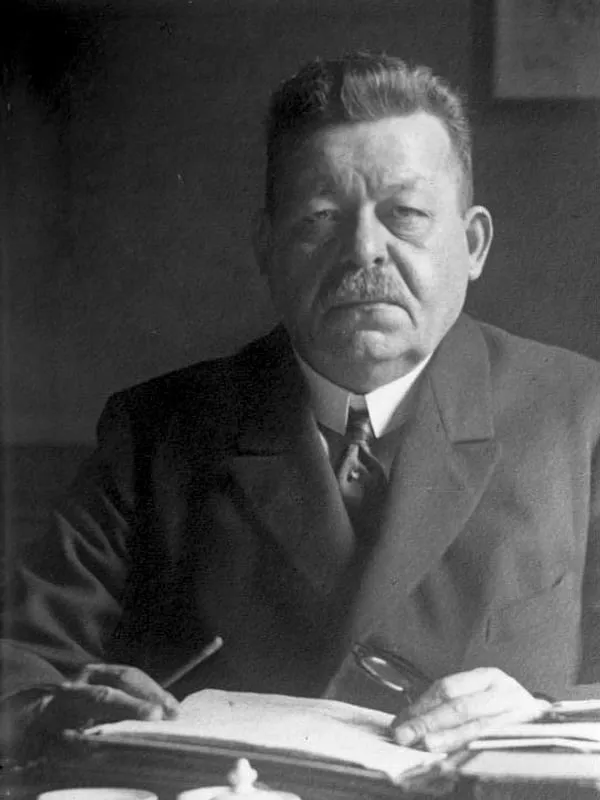
- Born:
- 4 February 1871, Heidelberg (Grand Duchy of Baden)
- Died:
- 28 February 1925, Berlin
- Author:
- Łukasz
- Photo:
- Georg Pahl, CC BY-SA 3.0 DE, Wikimedia Commons

Friedrich Ebert, a tailor’s son from Heidelberg and a saddler by trade, rose from travelling journeyman to head of state. From 1913 he led the Social Democratic Party of Germany, the largest party in the Reich. Throughout the war he supported the defence of the country, and when the empire collapsed in the autumn of 1918 he took over power from the last chancellor, came to an understanding with the generals and led Germany to elections and the Weimar constitution. As the first Reich President he defended the republic against communists and nationalists. For the history of the road to the Second World War he is a key figure for two reasons. It was his decisions of 1918–1919 that shaped the republic which Hitler overthrew fifteen years later: a republic built on a compromise with the old army and the civil service. And the campaign of vilification of which he was the victim, with its charges of “treason” and of a “stab in the back” to the army, was one of the first great victories of far-right propaganda.
Saddler and activist
He was born on 4 February 1871 in Heidelberg, one of nine children of the master tailor Karl Ebert and his wife Katharina. The family lived modestly. He was baptised in the Catholic Church but drifted away from it in adult life. In 1885–1888 he trained as a saddler, but according to his biographers he broke off his apprenticeship shortly before the end and never took the journeyman’s examination. He then spent three years travelling around Germany, from Karlsruhe and Munich to Hanover and Bremen. Around 1889, while Bismarck’s Anti-Socialist Laws were still in force, he joined the socialist party and the saddlers’ trade union. He set up union branches where there were none, and ended up on employers’ blacklists.
In 1891 he settled in Bremen, where he spent fourteen years. He was briefly an editor of the local Social Democratic newspaper and then ran a tavern that became a meeting place for trade unionists. In May 1894 he married Louise Rump; they had four sons and a daughter. In the tavern Ebert gave workers legal and welfare advice, until in 1900 the unions employed him as a workers’ secretary. That same year he entered Bremen’s parliament, the Bürgerschaft. What increasingly absorbed him was not theory but the practical improvement of workers’ lives: insurance, wages, working conditions. Elections and parliamentary work were his main instruments of change.
In the party leadership
In 1905 he was elected to the party executive and moved to Berlin. He was an organiser rather than an orator or theorist: he put the party apparatus and finances in order, reconciled the party with the unions and created organisations for young workers. In 1912 he won a Reichstag seat in a run-off in the constituency of Elberfeld-Barmen, today part of Wuppertal. The Social Democrats then became the largest group in parliament. After the death of August Bebel, the party congress at Jena on 20 September 1913 elected Ebert co-chairman, alongside Hugo Haase, by 433 votes out of 473. He set himself the aim of preserving the unity of a party torn between the revolutionary left and the reformists.
War and split
In August 1914 Ebert was away from Berlin. Together with the party treasurer, Otto Braun, he took the party funds to Zurich, as it was feared the authorities would ban Social Democracy. By the time he returned, the parliamentary group had already decided to vote for war credits, and Ebert backed the decision at once. Like most German workers, he believed that Germany was fighting a defensive war, above all against Tsarist Russia. In return for loyalty he counted on reforms, especially the abolition of Prussia’s three-class franchise.
This policy of “civil truce” (Burgfrieden), however, split the party. From December 1914 Karl Liebknecht voted against the credits, and the opposition group grew. Ebert upheld the principle that the parliamentary group votes as one, and in 1916 he had the opposition expelled from the group, which from then on he led jointly with Philipp Scheidemann. In April 1917 those expelled founded the Independent Social Democratic Party of Germany (USPD). The war struck Ebert personally too: in 1917 two of his sons, Georg and Heinrich, were killed.
Ebert put his faith in parliament rather than revolution. In 1917, together with Matthias Erzberger of the Centre Party and the Liberals, he formed the Inter-Party Committee of the Reichstag majority, which on 19 July passed a resolution calling for a peace without annexations. In January 1918, when a great strike broke out in Berlin’s armaments industry, he joined the strike committee together with Scheidemann. He later claimed that he had done so in order to end the strike as quickly as possible and not to leave the workers to the far left. The right never forgave him for it.
Autumn 1918
At the end of September 1918 the Supreme Army Command demanded an armistice and a government based on a parliamentary majority. Ebert persuaded his hesitant party to join the government of Prince Max von Baden. If the Social Democrats did not reach agreement with the bourgeois parties, he argued, revolution would decide the matter, and after what had happened in Russia no sensible person could want that. The constitutional reforms that came into force on 28 October turned Germany into a parliamentary monarchy. Ebert believed that this was enough.
At the beginning of November revolution broke out in the naval ports and spread across the country. Ebert concluded that only the abdication of Wilhelm II could now save the situation. On 7 November, according to the chancellor’s memoirs, he told him: “If the Kaiser does not abdicate, the social revolution is unavoidable. But I do not want it; indeed, I hate it like sin.” On 9 November the revolution reached Berlin. The chancellor announced the Kaiser’s abdication on his own authority and around midday handed the chancellorship over to Ebert, something the constitution did not empower him to do. Ebert wanted a national assembly to decide the form of government, and he was indignant when, a few hours later, Scheidemann proclaimed the republic from the Reichstag.
The Council of People’s Deputies and the pact with Groener
On 10 November an assembly of Berlin’s workers’ and soldiers’ councils approved a six-member revolutionary government, the Council of People’s Deputies, made up of three Social Democrats and three Independents. Formally Ebert and Haase chaired it jointly; in practice Ebert ran it, keeping internal and military affairs for himself. That evening he received a telephone call from General Headquarters at Spa from the First Quartermaster General, Wilhelm Groener. The army recognised the new government and undertook to bring the troops home in good order; the government, for its part, was to support the officer corps in maintaining discipline and fighting Bolshevism. Thus the Ebert–Groener pact came into being. On 11 November Erzberger signed the armistice in the Forest of Compiègne.
Ebert regarded his government as the receiver of the empire’s bankrupt estate. His aims were simple: to bring home millions of soldiers, to feed the country and to hand power to an elected assembly as soon as possible. On 10 December, welcoming the returning Guards divisions to Berlin, he told the soldiers that “no enemy has vanquished you”. He meant to honour them, but unwittingly he fed the nascent stab-in-the-back myth, according to which the undefeated army had been betrayed by revolutionaries at home. At the congress of councils in mid-December a large majority of delegates backed elections to a national assembly.
At the end of December, after bloody fighting with mutinous sailors in Berlin, the Independent Socialists left the government, and Gustav Noske took charge of military affairs. In January 1919 Ebert agreed that the Spartacist uprising should be put down by volunteer units of the Freikorps (PL). On 15 January their officers murdered Liebknecht and Rosa Luxemburg. From that moment a gulf opened between Social Democrats and Communists that did not close until 1933.
Reich President
Elections were held on 19 January 1919, and on 11 February the National Assembly, sitting in Weimar, elected Ebert Reich President. In June 1919, when Scheidemann’s government resigned, Ebert brought about a new cabinet that accepted the Treaty of Versailles. He believed there was no alternative, though at the same time he sought its revision. In August 1919 he signed the new constitution. Its Article 48, which allowed the president to govern by decree in an emergency, was used often by Ebert to save the republic. In the hands of his successor the same article became, in 1930–1933, an instrument for dismantling democracy.
There was no shortage of crises. In March 1920, during the Kapp Putsch, the army refused to defend the government, which had to flee Berlin. The putsch collapsed after a few days in the face of a general strike and the refusal of civil servants to co-operate. Soon afterwards, with Ebert’s consent, the army and the Freikorps bloodily suppressed a workers’ uprising in the Ruhr. The year 1923 brought the French and Belgian occupation of the Ruhr, hyperinflation, communist plans for an uprising in Saxony and Thuringia, and Adolf Hitler’s Munich putsch. Ebert agreed to military intervention against the left-wing governments of Saxony and Thuringia, but no action was taken against right-wing Bavaria. For several months he transferred full executive power to the commander of the army, General Hans von Seeckt. The republic survived, but Ebert became estranged from his own party, which accused him of applying different standards to right and left.
Vilification and death
Throughout his presidency the right attacked Ebert relentlessly. He was mocked as a “saddler” and a “publican”, and a photograph of the president and Noske in bathing trunks, published in 1919, was reprinted for years. Ebert brought some 200 libel suits. The heaviest blow came at the end of 1924. A journalist who had accused him of treason for his part in the January strike was convicted by a court in Magdeburg of insulting the president, but in the reasoning of its judgment of 23 December the court found that, in the legal sense, Ebert had committed high treason. The verdict struck at the republic itself: here was a German court agreeing with those who claimed that the army had been betrayed by the socialists. Ebert was rehabilitated only posthumously.
Because of the trial he put off an operation for appendicitis. He died of peritonitis in Berlin on 28 February 1925, aged 54, and was buried in Heidelberg. In the popular election of spring 1925 his successor was Field Marshal Paul von Hindenburg, the symbol of the old Germany and co-author of the stab-in-the-back myth. Eight years later it was Hindenburg who appointed Hitler chancellor.
Assessment
Ebert remains one of the most controversial figures in German history. In his lifetime the left called him a traitor to the workers, and the nationalists a “November criminal”. In East Germany he was portrayed as a servant of the generals and the bourgeoisie; in the Federal Republic, as the father of German parliamentary democracy. Today a foundation linked to the SPD bears his name.
Historians agree that in November 1918 Ebert averted chaos and a Russian-style civil war, ensured the orderly return of the army and brought about free elections. The dispute concerns the price. Gerhard A. Ritter, Susanne Miller and Heinrich August Winkler believe that, fearing Bolshevism, he placed too much trust in the old elites: he made no attempt to build an army loyal to the republic or to democratise the administration and the courts, even though the workers’ and soldiers’ councils gave him a basis for doing so. Hagen Schulze and others reply that a modern state could not function without a professional bureaucracy and that radical change threatened to tear the country apart. For the history of the road to 1939, what matters most is that the army and the judiciary, which Ebert left untouched, never became republican. The army to which he owed his survival in 1918 did not stand up for the republic against the putschists in March 1920, and the judges of Magdeburg gave the far right official confirmation of its myth. The paradox of his life is that a man who wanted reform, not revolution, placed himself at the head of a revolution in order to stop it.
Sources
Mentioned in battles
(01)Often appears with
People who appear in the same events.