Germany
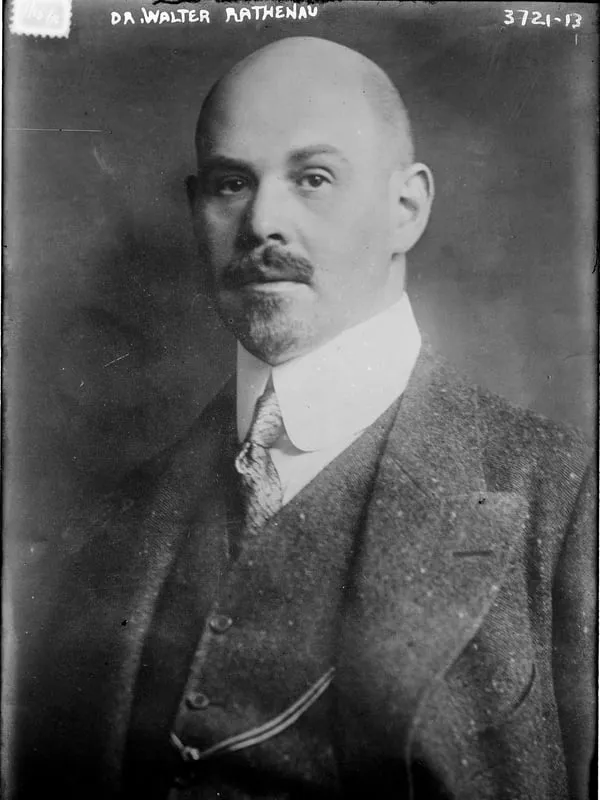
Walther Rathenau
Head of the War Raw Materials Department (1914–1915), Minister of Reconstruction (1921), German Foreign Minister (1922)
- Born:
- 29 September 1867, Berlin
- Died:
- 24 June 1922, Berlin
- Author:
- Natalia
- Photo:
- Bain News Service, domena publiczna, Wikimedia Commons

Walther Rathenau was one of the most remarkable figures of the Weimar Republic: a great industrialist who wrote works of philosophy, a Jew who felt himself above all a German, and a liberal who organised Germany’s war economy during the war. As Foreign Minister he signed the Treaty of Rapallo with Soviet Russia on 16 April 1922, which broke the isolation of both states and opened an era of German–Soviet rapprochement that was so dangerous for Poland. To the far right he was the symbol of everything it hated: the republic, the “policy of fulfilment” towards the victors, and Jews in high office. On 24 June 1922 he was murdered by nationalist terrorists. His death showed how deeply the hatred from which Nazism grew a few years later had already penetrated German politics.
The son of the founder of AEG
He was born in Berlin on 29 September 1867, the eldest son of the industrialist Emil Rathenau and Mathilde, née Nachmann. His father, who had bought a licence for Thomas Edison’s patents, founded the electrical engineering concern AEG (Allgemeine Elektricitäts-Gesellschaft), one of the largest enterprises of Imperial Germany. Walther studied physics, chemistry and philosophy in Strasbourg and Berlin, where he gained his doctorate in 1889, and then mechanical engineering in Munich.
In 1890–1891 he did his one-year volunteer service in an elite regiment of the Guards Cuirassiers. He wanted to become a reserve officer, but as a Jew he was not admitted to the examination. He refused to convert to Christianity, which would have opened that path to him. The experience of belonging to the elite and at the same time being rejected by it stayed with him all his life. In 1897 he published a much-discussed essay, “Höre, Israel!” (“Hear, O Israel!”), in which he called on German Jews to assimilate fully and to become a “German tribe”, like the Swabians or the Saxons. The essay, written in a harsh tone, was read by some as a plea for integration and by others as an expression of Jewish self-hatred.
From 1893 he built electrochemical works at Bitterfeld, and from 1899 he served on the management of AEG. In 1912 he became chairman of its supervisory board, and he sat on the supervisory boards of several dozen other companies. He was a supporter of cartels and mergers, and at the same time a critic of soulless, mechanised capitalism. In his books Zur Kritik der Zeit (1912) and Zur Mechanik des Geistes (1913) he wrote about the “mechanisation of the world” and the need for spiritual renewal. He was a friend of the writer Gerhart Hauptmann and of the journalist Maximilian Harden, with whom he later fell out. In 1907 and 1908 he accompanied the State Secretary for the Colonies, Bernhard Dernburg, on tours of inspection to Africa, and in his report he called the mass killing of the Herero in German South West Africa the greatest atrocity that German policy had brought about.
The war
At the start of the First World War Rathenau was one of the first to understand that the British blockade would cut Germany off from the raw materials without which a long war could not be fought. He persuaded the War Minister, Erich von Falkenhayn, to set up a War Raw Materials Department (Kriegsrohstoffabteilung) in the Prussian War Ministry, and from August 1914 to March 1915 he ran it himself. The department took control of stocks of strategic raw materials and allocated them to the armaments factories through special war companies. Without this system German war industry would probably have collapsed quickly.
During the war Rathenau became an advocate of a hard line. He favoured bombing London from airships and supported the industrialists’ demands that Belgian civilians be deported to work in Germany, which was later turned against him. In 1917 he published his most widely read book, Von kommenden Dingen (“Of Things to Come”), an outline of a new economic order in which the state and industry were to cooperate for the common good. In October 1918, when Germany asked for an armistice, he appealed in the press for a mass call-up of the population in order to obtain better peace terms. The appeal found no response.
A politician of the republic
After the war Rathenau was one of the founders of the left-liberal German Democratic Party. He took part in the work of the socialisation commission, and in July 1920 attended the Spa Conference as an expert, where the Allies discussed disarmament and reparations with the Germans. In May 1921, after the London Ultimatum had imposed on Germany a payment plan of 132 billion gold marks, Chancellor Joseph Wirth appointed him Minister of Reconstruction. Rathenau became the face of the so-called policy of fulfilment. He believed that Germany should try in good faith to pay, in order to show that the demands could not be met and so persuade the victors to reduce them. In October 1921 he concluded an agreement at Wiesbaden with the French minister Louis Loucheur on deliveries of German goods to the war-devastated departments of France. At the end of October, when the League of Nations awarded Poland the greater part of industrial Upper Silesia and the Democrats left the government, he resigned, but continued to work for Wirth as a negotiator.
On 31 January 1922 he became Foreign Minister – the first German Foreign Minister of Jewish origin. He was among those who favoured an understanding with the West, and he hoped that the Genoa Conference, which opened on 10 April, would make it possible to ease the reparations question. When the British and French began talking to the Soviet delegation without the Germans, some of his officials, led by the head of the Eastern Department, Ago von Maltzan, began to press for a quick agreement with Moscow. On the night of 15–16 April, during the famous “pyjama conference” in his hotel room, Rathenau agreed after long hesitation. On 16 April he signed the Treaty of Rapallo with Georgy Chicherin. Germany and Soviet Russia established diplomatic relations and renounced their mutual claims. The treaty outraged the British and French and became for them proof of German disloyalty, although Rathenau himself never wanted an alliance with the Bolsheviks.
The assassination
The far right had long waged a campaign of hatred against Rathenau. It accused him of selling Germany out to the victors as a “politician of fulfilment” and of being, as a Jew, an agent of foreign powers. At nationalist rallies people sang a song calling for “the God-damned Jewish sow” to be shot. After Rapallo, Wilhelm Henning, a deputy of the German National People’s Party, wrote that Rathenau and his masters would be “called to account” by the German people. The assassination was prepared by Organisation Consul, a secret society of former naval officers from the brigade of Hermann Ehrhardt, which a year earlier had murdered Matthias Erzberger and on 4 June 1922 had tried to kill Philipp Scheidemann.
On the morning of Saturday 24 June 1922 Rathenau was driving in an open car from his villa in the Berlin district of Grunewald to the ministry on the Wilhelmstraße. Despite warnings he travelled without police protection. On a bend of the Koenigsallee his car was overtaken by a car driven by the student Ernst Werner Techow. Erwin Kern, sitting in the back, fired at the minister with a submachine gun, and Hermann Fischer threw a grenade into the car. Rathenau was killed on the spot or died a few minutes later. Kern and Fischer were in hiding for several weeks. On 17 July the police surrounded them at Saaleck Castle in the valley of the Saale. Kern was killed by a police bullet and Fischer shot himself. Techow and more than a dozen other defendants, among them the future writer Ernst von Salomon, were tried in October 1922 and sentenced to prison terms. The trial did not expose the role of the leadership of Organisation Consul. Historians are now convinced that the order was given by Ehrhardt himself, who hoped that the assassination would provoke an uprising on the left and allow the right to seize power.
The assassination shook Germany. In the Reichstag Chancellor Wirth, pointing at the benches of the nationalists, cried out that “the enemy stands on the right”. Millions of people took part in demonstrations across the country, and on the day of the funeral, 27 June, transport in Berlin came to a halt. President Friedrich Ebert issued a decree for the protection of the republic, and on 21 July the Reichstag passed the Law for the Protection of the Republic, under which most of the German states banned the NSDAP. Bavaria, where Adolf Hitler was active, did not impose the ban.
Legacy
Rathenau did not live to see the consequences of Rapallo. The treaty he had signed with such hesitation became the basis of German–Soviet relations for a whole decade. Under its cover the Reichswehr and the Red Army carried on secret military cooperation, and in 1926 Germany and the Soviet Union confirmed it with the Treaty of Berlin. In Poland Rathenau’s name was from then on associated with German–Russian rapprochement over Warsaw’s head, although he himself had been an advocate of an understanding with the West.
His death, however, proved more important. Rathenau was the most prominent victim of the wave of political murders in which right-wing assassins killed hundreds of people between 1919 and 1922. The antisemitic agitation that killed him was the same agitation on which the NSDAP grew. After Hitler came to power, the Nazis officially honoured his murderers: on 17 July 1933 at Saaleck Castle, in the presence of Ehrhardt, Heinrich Himmler and Ernst Röhm, a plaque in memory of Kern and Fischer was unveiled, while the memorial plaque at the scene of the assassination was removed. After 1945 Rathenau was often called “the first victim of the Third Reich”, and the historian Martin Sabrow observed that he was just as much the last victim of nostalgia for the Empire. His fate was a warning that the Weimar Republic failed to heed: the people who hated it were restrained only briefly, and ten years later they took power.
Sources
Often appears with
People who appear in the same events.