Japan
Kiichirō Hiranuma
President of the Privy Council (1936–1939, 1945), Prime Minister of Japan (January–August 1939), Home Minister and Minister of State in the Konoe governments (1940–1941)
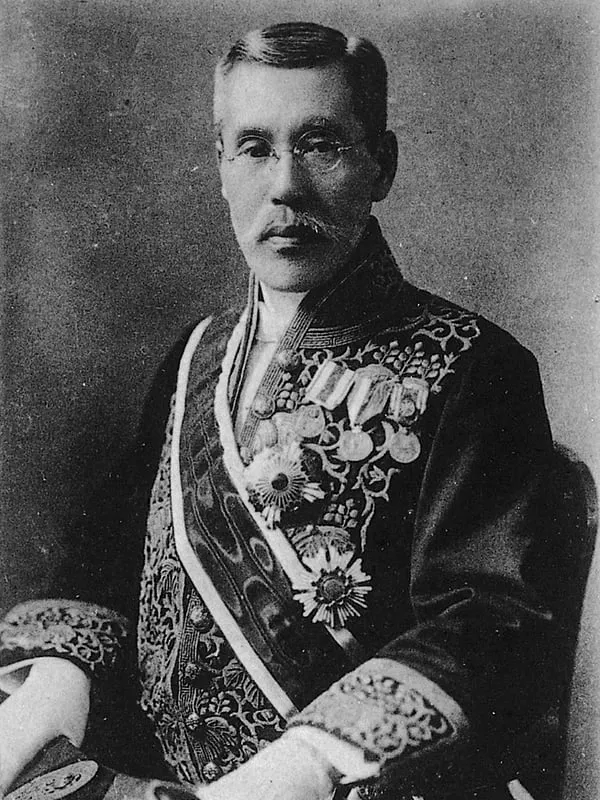
- Born:
- 25 October 1867, Tsuyama (Japan)
- Died:
- 22 August 1952, Tokyo (Japan)
- Author:
- Łukasz
- Photo:
- autor nieznany, domena publiczna, Wikimedia Commons

Kiichirō Hiranuma was a Japanese lawyer who moved from the office of prosecutor general into high politics and for a quarter of a century guarded what he saw as the essence of the Japanese state: the inviolable authority of the emperor and a moral order founded on Confucianism. Founder of the nationalist National Foundation Society and for many years vice-president and president of the Privy Council, in 1939 he was Prime Minister for eight months. It was his government that argued over an alliance with Hitler, fought the war at Khalkhin Gol and fell when Germany came to terms with the Soviet Union. In August 1945 Hiranuma was among the small circle that decided on surrender, while at the same time fighting to preserve the emperor’s full powers. The Tokyo tribunal sentenced him to life imprisonment.
A Meiji-era prosecutor
He was born on the 28th day of the 9th month of the 3rd year of the Keiō era by the old lunar calendar, that is 25 October 1867 (some sources give 28 September), in Tsuyama (PL) in Mimasaka province, the son of a low-ranking samurai (PL) of the local domain. He was brought up on the Chinese classics and the warrior ethic, and throughout his life he felt close to the Mito school, which saw Japan as a state with a unique, divine essence (kokutai), bound by the tie between the nation and its sacred ruler. He regarded the rapid westernisation of the Meiji (PL) years with distaste.
In 1888 he graduated top of his class in law from the Imperial University, today’s University of Tokyo, and in the same year joined the Ministry of Justice. He served as a judge and then as a prosecutor, and made his name in corruption trials in which members of parliament and ministers sat in the dock. In 1910–1911, as prosecutor in the so-called High Treason case, an alleged anarchist plot against the life of Emperor Mutsuhito, he demanded the death penalty for Shūsui Kōtoku and other defendants. The trial was held behind closed doors, and twelve people were executed. In 1911 Hiranuma became Vice-Minister of Justice, in 1912 Prosecutor General, and in 1921 President of the Great Court of Cassation, the highest court in the land. A whole circle of younger lawyers grew up around him in the ministry, still loyal to him in the 1930s.
Defender of the kokutai
In September 1923, after the Great Kantō earthquake, he became Minister of Justice in the government of Admiral Gonnohyōe Yamamoto. He resigned with the whole cabinet in January 1924, when the government took responsibility for a communist’s attempt on the life of the heir to the throne, the regent Hirohito. Hiranuma saw the attempt as proof that foreign ideologies were undermining the state, and in 1924 he took the lead of the Kokuhonsha, the National Foundation Society. It brought together senior officials, lawyers and officers, among them General Sadao Araki and Admiral Kanji Katō, and preached the defence of the imperial system against socialism, liberalism and party corruption.
In 1924 Hiranuma joined the Privy Council, the emperor’s advisory body that reviewed treaties, constitutional laws and decrees. In April 1926 he became its vice-president and held the post for ten years, and in October of that year he was made a baron. In those years the council was a bastion of conservatives, and Hiranuma used it to make life difficult for party governments. He opposed ratification of the London Naval Treaty of 1930, which limited the fleet; in 1931 he backed the army after its unauthorised seizure of Manchuria; and later he argued for Japan’s withdrawal from the League of Nations.
He was repeatedly named as a candidate for Prime Minister, but the last of the great Meiji statesmen, Prince Kinmochi Saionji, who recommended heads of government to the emperor, would not hear of him. The liberal Saionji saw Hiranuma as an enemy of parliamentary government and the Kokuhonsha as an organisation dangerously close to fascism. Hiranuma himself rejected the comparison: he regarded fascism as a foreign invention, as useless to Japan as democracy. In 1934 Saionji blocked his promotion to president of the Privy Council. Hiranuma took that office only in March 1936, after the bloody putsch by young officers of 26 February, and then dissolved the Kokuhonsha.
Prime Minister of 1939
On 5 January 1939, after the resignation of Prince Fumimaro Konoe, Hiranuma became Prime Minister. He inherited the war in China, which was supposed to end quickly but had already lasted a year and a half, and a dispute that had torn the previous government apart. The army, and above all the War Minister Seishirō Itagaki, wanted to turn the Anti-Comintern Pact into a full military alliance with Germany and Italy. The Foreign Minister Hachirō Arita and the Navy Minister Mitsumasa Yonai accepted an alliance against the USSR, but not a commitment that might drag Japan into war with Britain and the United States. The Prime Minister, himself a fervent anti-communist, stood closer to the latter. Dozens of meetings of the five ministers produced no decision, and in May Germany and Italy concluded the Pact of Steel without Japan.
The year 1939 brought Hiranuma two more crises. From May the Kwantung Army, acting largely on its own initiative, waged an ever larger war against the Red Army on the Mongolian border, which ended in August in defeat at the Battle of Khalkhin Gol. In June the army blockaded the British concession at Tientsin, and although the Tientsin incident ended in concessions from London, on 26 July the United States gave notice to terminate its commercial treaty with Japan, a sign of the economic pressure to come. The government also received Wang Jingwei in Tokyo, with whom the Japanese were preparing a Chinese government to rival Chiang Kai-shek’s.
News of the Molotov–Ribbentrop Pact of 23 August struck Tokyo just as Japanese divisions were dying under Soviet artillery fire at Khalkhin Gol. The partner from the Anti-Comintern Pact had come to terms with the main adversary without a word of warning. On 28 August Hiranuma announced his resignation, declaring that a “complicated and incomprehensible” situation had arisen in Europe. The words, fukuzatsu kaiki in Japanese, went down in history as an admission that the whole policy towards Germany had gone bankrupt. The government formally stepped down on 30 August, and the new Prime Minister was General Nobuyuki Abe, who kept Japan out of the war in Europe.
Against Matsuoka and the New Order
After Konoe’s return to power in July 1940, Hiranuma became one of the leaders of the conservative opposition to the New Order movement and its crowning creation, the Imperial Rule Assistance Association. In a single-party mass organisation he saw a new shogunate that would strip the emperor of his prerogatives, and he feared radicals with socialist leanings. Konoe, himself disappointed by his creation, brought him into the government in December 1940, first as Minister of State and from 21 December as Home Minister. Hiranuma skilfully disarmed the Association: he announced in parliament that it would not engage in politics, replaced its leadership and placed it under the supervision of his ministry. As minister he also defended the state cult of Shintō.
He opposed the Tripartite Pact and the Foreign Minister Yōsuke Matsuoka, who was removed from the government in July 1941 by a cabinet reshuffle owed in no small part to Hiranuma’s efforts. In Konoe’s third government Hiranuma was a minister without portfolio and often met the American ambassador Joseph Grew, looking for a way to ease relations with the United States. On 14 August 1941 a gunman from the ultranationalist group Kinnō Makotomusubi shot him six times at his home. Hiranuma survived and recovered, but the attack showed how dangerous it was in Tokyo to seek an understanding with America; our article on the Imperial Conference of 6 September describes that atmosphere. In October 1941 he left the government together with Konoe.
Among the senior statesmen
As a former Prime Minister, Hiranuma belonged during the war to the jūshin, the informal circle of senior statesmen who, after Saionji’s death in 1940, advised the emperor on the choice of head of government. In the summer of 1944, after the loss of Saipan, he worked with Konoe, Admiral Yonai and the Lord Keeper of the Privy Seal Kōichi Kido to bring about the fall of the Tōjō government. He then backed General Kuniaki Koiso and, in April 1945, Admiral Kantarō Suzuki. On 9 April 1945 he again became president of the Privy Council.
In that capacity he took part in the night-time Imperial Conference of 9–10 August 1945, after Hiroshima and the Soviet declaration of war. He put awkward questions to the military about coastal defence and feeding the population and warned of internal unrest. He supported acceptance of the Potsdam Declaration, but it was he, according to historians, who forced a change to its only condition: Japan accepted the terms on the understanding that they did not prejudice the prerogatives of the emperor as sovereign ruler, rather than merely his legal status. This amendment, described in the article on the acceptance of the declaration with a reservation, expressed his whole creed, and at the same time complicated the exchange with the Allies. On the morning of 15 August, during the Kyūjō incident, a band of fanatics led by Captain Takeo Sasaki set fire to his house; Hiranuma managed to escape.
Trial and last years
On 2 December 1945 the occupation authorities ordered his arrest as a Class A war crimes suspect, and the next day he resigned from the Privy Council. From April 1946 he was held in Sugamo prison. Before the International Military Tribunal for the Far East he stood alongside Kōki Hirota as the only civilian former Prime Minister in the dock. On 12 November 1948 the tribunal found him guilty of taking part in a conspiracy to wage aggressive war and of waging aggressive war against China, the United States, the British Commonwealth, the Netherlands and the Soviet Union, including the war at Khalkhin Gol, fought while he was Prime Minister. It acquitted him of the charges concerning the war with France in Indochina, the fighting at Lake Khasan and war crimes in the strict sense, because it found no evidence linking him directly to them. The sentence was life imprisonment.
At the beginning of 1952, gravely ill, Hiranuma was released on parole. He died on 22 August 1952 in the Keiō University hospital in Tokyo. He was buried in Tama Cemetery and at the Ankoku-ji temple in his native Tsuyama.
Assessment
Hiranuma was not a warmonger in the mould of the Kwantung Army officers; as Prime Minister he held back the alliance with Germany, and in 1941 he sought an understanding with America. Historians nonetheless see him as one of the architects of the state that led Japan into war: a prosecutor who for years pursued the left and the liberals as enemies of the kokutai, a patron of right-wing officials and officers, an opponent of parliamentary government and naval disarmament. His verdict remains disputed, because the charge of a years-long conspiracy fitted poorly a man who often disagreed with Tōjō and Matsuoka. There is no doubt, however, that in the last days of the war he fought less for peace terms for the nation than for the emperor to keep the power he had guarded all his life.
Sources
Mentioned in battles
(01)Often appears with
People who appear in the same events.