Japan
Shunroku Hata
Commander of the Central China Expeditionary Army (1938), Minister of War (1939–1940), commander of the China Expeditionary Army (1941–1944), commander of the Second General Army at Hiroshima (1945), field marshal (from 1944)
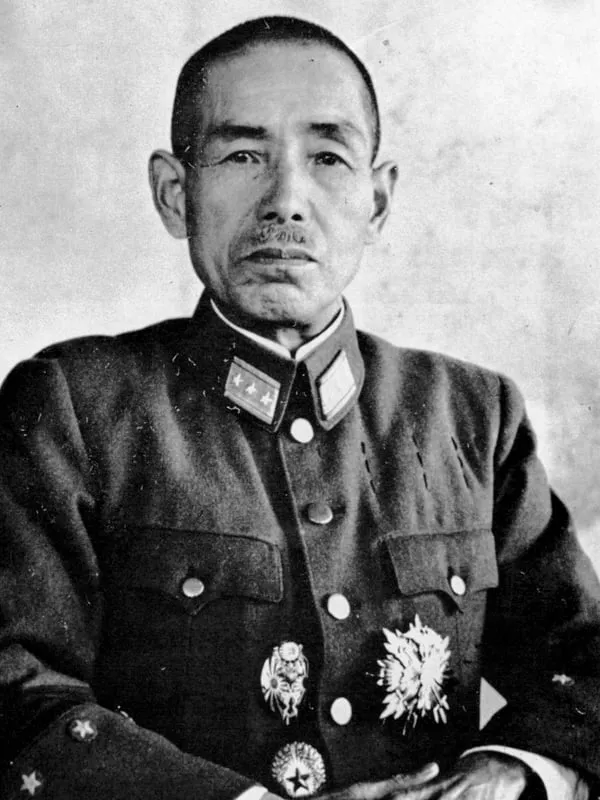
- Born:
- 26 July 1879, Tokyo (Japan)
- Died:
- 10 May 1962, Tanakura, Fukushima Prefecture (Japan)
- Author:
- Natalia
- Photo:
- autor nieznany, domena publiczna, Wikimedia Commons

Shunroku Hata was one of the few Japanese generals who held posts at the very top of the military hierarchy throughout the war with China and the Pacific War, and yet he seldom made the front pages. A gunner and staff officer who enjoyed the Emperor’s trust, in 1938 he took over command of the forces in central China from Iwane Matsui, in 1939–1940 he was Minister of War, and it was his resignation that toppled the last pre-war government inclined to seek an understanding with Britain and the United States. From 1941 to 1944 he commanded the whole Japanese army in China, including during the punitive campaign after the Doolittle Raid and the great Ichi-Go offensive, and he spent the last months of the war in Hiroshima as commander of the defence of western Japan. The Tokyo tribunal sentenced him to life imprisonment.
Son of an Aizu samurai
He was born on 26 July 1879. Japanese biographies give Tokyo as his birthplace, while some Western accounts connect him with Fukushima Prefecture, where his family came from: his father was a samurai of the former domain of Aizu, which in the Boshin War of 1868 had stood on the losing side of the shogunate. The family moved for a few years to Hakodate in Hokkaido, and when the boy was fourteen his father died. There was no money for a prestigious secondary school, so Shunroku chose the free cadet school. In 1900 he graduated from the Military Academy as an artilleryman, he fought as a lieutenant in the Russo-Japanese War and was wounded, and in 1910 he graduated from the Army Staff College at the top of his class. His elder brother Eitarō also served in the army; he rose to general and died in 1930 as commander of the Kwantung Army.
In 1912 Hata went to Berlin as assistant military attaché. He observed the First World War from Europe, and in 1919 he was a member of the Japanese delegation to the peace conference in Paris. After his return he commanded a regiment and a brigade of heavy artillery, headed the operations section and then the whole First (Operations) Bureau of the General Staff. In 1931 he became a lieutenant general and inspector of artillery, in 1933 commander of the 14th Division, at the end of 1935 head of the army air service, and in 1936 commander of the Taiwan Army. He was the kind of officer the court valued: calm, dependable, with no links to the factions of young plotters.
The war in China
After the war with China broke out in 1937, his career gathered pace. In November he was promoted to full general and became Inspector General of Military Training, one of the three most important posts in the army. According to Japanese biographers, after the Nanking massacre he advised the war minister to change the command in China. In February 1938 he himself replaced Matsui at the head of the Central China Expeditionary Army. His divisions took part in the Battle of Xuzhou, advancing from the south faster than planned; on 25 May Hata and the commander of the northern forces, Hisaichi Terauchi, made a ceremonial entry into the city, although the Chinese armies had managed to slip out of the encirclement. In the summer and autumn he directed the great offensive on Wuhan, which gave Japan another city but did not end the war.
Minister of War
In May 1939 Hata became chief aide-de-camp to Emperor Hirohito. He stayed in the post for only three months: when the Hiranuma government fell in August, the Emperor demanded that the war minister in the new cabinet of General Nobuyuki Abe should be either Hata or Yoshijirō Umezu. He hoped that a trusted general would hold the army back from an alliance with Germany. Hata took over the ministry on 30 August 1939, on the eve of the war in Europe, and Japan stayed out of it at the time. He kept the post in the government of Admiral Mitsumasa Yonai, formed in January 1940.
After the defeats of France and the Netherlands in the spring of 1940, the conviction prevailed in the army that Japan should bind itself to Germany and reach for the colonies of South-East Asia. The Yonai government and its foreign minister Hachirō Arita stood in the way. The army leadership decided to bring it down. Hata received a letter from the Chief of the General Staff, Prince Kan’in, actually written by his deputy, and on 16 July he resigned, and the army refused to name a successor. Since the war minister had to be a general on the active list, the government fell. Fumimaro Konoe became prime minister, and two months later Japan signed the Tripartite Pact. Hata never publicly explained himself over this decision. Japanese biographers present him more as a cog in the army’s machine than as the instigator, but it was precisely the overthrow of the Yonai government that weighed most heavily against him after the war.
Commander in China
In March 1941 Hata returned to China as commander-in-chief of the China Expeditionary Army, that is, of all Japanese forces in China proper. According to Japanese accounts, in the summer of that year, when Tokyo was considering an attack on the USSR and then war with the United States, he sent officers to the General Staff with the view that the war in China had to be settled first. He convinced no one.
The gravest charges against his command concern 1942. After the Doolittle Raid, Imperial General Headquarters demanded the destruction of the airfields in eastern China on which American bombers could land. Hata and the commander of the 13th Army, General Shigeru Sawada, decided that the Chinese forces defending them also had to be smashed, and they enlarged the operation. The Zhejiang–Jiangxi campaign lasted from May to September. According to Chinese sources more than 250,000 civilians died in it, among them victims of Japanese biological weapons and of reprisals against villages that had helped the American airmen. On 13 August 1942 Hata’s command proclaimed regulations on enemy airmen, applied retroactively, under which a military court in Shanghai sentenced eight prisoners from the raid to death; three were shot. In May 1943 the 11th Army under his command, carrying out an operation in western Hubei, committed the Changjiao massacre.
In 1944 Hata directed the largest land operation in the history of the Japanese army, the Ichi-Go offensive. His staff added to the objectives set in Tokyo the destruction of as much of the Chinese army as possible. On 25 May he moved to Wuhan to supervise the drive south in person, and on 2 June 1944 he was made a field marshal. He was the last officer of the Japanese army and navy to receive that dignity. The offensive took Changsha, Hengyang, Guilin and Liuzhou, destroyed the American airfields and linked Japan’s conquests from Manchuria to Indochina, but it did not knock China out of the war. When in July, after the fall of the Tōjō government, the former prime ministers were looking for a successor, Hata’s name was on the list, but he lacked enough support. In November 1944 he handed over the command in China and returned home to take up once more the post of Inspector General of Military Training.
Hiroshima and the surrender
In April 1945, when a successor to Prime Minister Koiso was being chosen, Hideki Tōjō proposed Hata as head of government, but the other former prime ministers backed Admiral Kantarō Suzuki. In the same month the army at home was split into two commands preparing the defence against invasion: Hata took the Second General Army, responsible for western Japan, with its headquarters in Hiroshima. On the morning of 6 August he was in the city when the atomic bomb fell on it. He survived, and in the following days, as the highest-ranking surviving commander, he directed the rescue effort and issued an order to keep order in the devastated city.
On the morning of 14 August the Emperor summoned three field marshals: Hajime Sugiyama, Admiral Osami Nagano and Hata. The first two argued for fighting on. Hata openly admitted that he did not believe his forces could repel a landing. Japanese historians consider that these words confirmed Hirohito in his conviction that defending the home islands was impossible. That same day Hata signed, with the other top commanders, a declaration that the army would submit to the Emperor’s decision, which cut off from the army leadership the young officers preparing the coup in the palace. One officer of his own staff, Lieutenant Colonel Michinori Shiraishi, nevertheless fell victim to the coup, shot together with his brother-in-law, the commander of the Imperial Guard. After the surrender Hata asked to be stripped of his field marshal’s rank as a sign of responsibility for the army’s defeat.
Trial and last years
Arrested by the Americans, he came before the International Military Tribunal for the Far East as the only field marshal among the defendants. The prosecution concentrated on the overthrow of the Yonai government. Yonai himself, called as a defence witness, stubbornly pleaded loss of memory and would not admit that Hata had worked for the cabinet’s fall. The chief prosecutor, Joseph Keenan, is said to have admitted afterwards that the admiral was simply shielding his former minister. The tribunal nevertheless found that as war minister Hata had considerable influence on government policy, favoured Japanese domination of East Asia, helped to bring about Yonai’s fall and so opened the way to the alliance with Germany. It found him guilty of conspiracy and of waging aggressive wars (counts 1, 27, 29, 31 and 32) and of disregarding his duty to prevent war crimes (count 55): in 1938 and in 1941–1944 troops under his command had committed atrocities on a large scale over a long period, and he either knew and did nothing, or failed to check whether his orders on the humane treatment of prisoners and civilians were obeyed. He was acquitted of taking part in the fighting at Lake Khasan and Khalkhin Gol and of the charge of ordering crimes to be committed. On 12 November 1948 he was sentenced to life imprisonment.
In Sugamo prison he wrote bitterly about the navy, which in his view had first pushed for war and after the defeat had laid all the blame on the army. He was released on parole in 1954 (some sources give 1955), after six years in prison. From 1958 he headed the Kaikōsha, the association of former army officers, which looked after veterans and the families of the fallen. To the end of his life he remained grateful to Yonai for his testimony. He died on 10 May 1962 of a brain haemorrhage that struck him during the unveiling of a memorial to the war dead in Tanakura in Fukushima Prefecture; some sources give Tokyo as the place of death. He was the last surviving Japanese field marshal.
Assessment
Hata was neither an ideologue nor an adventurer like the officers who staged the Mukden incident. The Emperor and the court saw him as a moderate man and for that very reason placed him in the war ministry. His story shows, however, how little one man’s moderation counted against the will of an institution: in 1940, when the army demanded it, Hata handed in the resignation that decided the alliance with Hitler, and in China for more than three years he commanded troops whose atrocities the tribunal found to be widespread. At the end of the war he was one of the few commanders who told the Emperor the truth about the hopelessness of fighting on.
Sources
Commanded in battles
(02)Often appears with
People who appear in the same events.