Japan
Kōichi Kido
Minister of Education, of Health and Welfare (1937–1939) and Home Minister (1939), Lord Keeper of the Privy Seal (1940–1945)
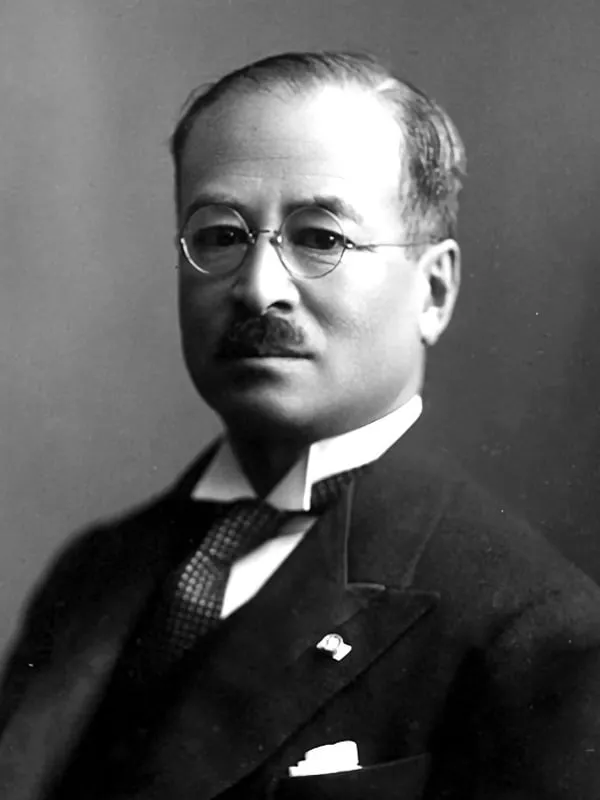
- Born:
- 18 July 1889, Tokyo (Japan)
- Died:
- 6 April 1977, Tokyo (Japan)
- Author:
- Natalia
- Photo:
- autor nieznany, domena publiczna, Wikimedia Commons

For the five most important years Kōichi Kido was the closest political adviser to Emperor Hirohito. As Lord Keeper of the Privy Seal in 1940–1945 he commanded no army and ran no ministry, but it was he who put candidates for prime minister before the emperor, passed the emperor’s wishes on to politicians and decided whom the sovereign would receive. In October 1941 he proposed General Hideki Tōjō as head of government, which opened the way to war with America. In 1945 he was among the men who persuaded the emperor to accept surrender. After the war his detailed diary became one of the most important pieces of evidence before the Tokyo tribunal, which sentenced him to life imprisonment.
Aristocrat and official
He was born on 18 July 1889 in the Akasaka district of Tokyo into a family of marquises. His father Takamasa was the nephew and adopted heir of Takayoshi Kido, one of the leaders of the Meiji Restoration, from whom the family derived its title. Kōichi was educated at Gakushūin, the school for the aristocracy, a year ahead of Fumimaro Konoe, who remained his friend for life. He studied law at Kyoto University, where he attended the lectures of the Marxist economist Hajime Kawakami.
After graduating in 1915 he joined the Ministry of Agriculture and Commerce. In 1917 he inherited his father’s title of marquis and a seat in the House of Peers. He then worked at the Ministry of Commerce and Industry, where he was one of the officials who prepared state control over key branches of industry. He married Tsuru, daughter of General Gentarō Kodama, a hero of the war with Russia.
At court and in government
In 1930, on Konoe’s recommendation, Kido became chief secretary to the Lord Keeper of the Privy Seal, then Nobuaki Makino. For six years he watched at close quarters as the army seized Manchuria without consulting the government and young officers murdered politicians. During the mutiny of 26 February 1936, when the rebels killed among others the previous Lord Keeper, Kido advised the court to stand firm: no new government until the mutiny had been crushed.
In October 1937, with the war in China already under way, he joined Konoe’s first government as Minister of Education, and in January 1938 he took over the newly created Ministry of Health and Welfare. From January to August 1939 he was Home Minister in the government of Kiichirō Hiranuma. During that time, in the Tientsin crisis, he made no attempt to curb anti-British rallies. The Tokyo tribunal later found that in these years Kido zealously supported the war in China and, as Minister of Education, worked to foster a warlike spirit in the country.
Keeper of the Privy Seal
On 1 June 1940 Kido became Lord Keeper of the Privy Seal. The office, modest on paper, carried enormous influence: the Lord Keeper was the emperor’s standing adviser, and as the aged last genrō, Prince Kinmochi Saionji, withdrew into the background (he died in November 1940), it was Kido who began to summon the former prime ministers to choose a new head of government. As early as July 1940 Kido brought about the second Konoe government. Together with Konoe he worked to replace the parties with a single political movement, from which the Imperial Rule Assistance Association emerged. According to the tribunal’s findings he did not inform Saionji of the preparations for the Tripartite Pact with Germany and Italy.
He took his most important decision in October 1941. When Konoe, unable to reconcile the talks with America with the army’s demands, resigned, Kido rejected the idea of a government headed by a prince of the imperial family and on 17 October won the former prime ministers over to the candidacy of the army minister, General Hideki Tōjō. He later explained that only the army’s own leader, loyal to the emperor, could hold it back from war. Tōjō was to start afresh and not consider himself bound by the resolution of the conference of 6 September, which had set a deadline for the decision on war. The review, however, changed nothing, and Tōjō’s appointment in practice meant consent to war if the talks failed. Kido wavered when the navy voiced doubts; on 30 November he advised the emperor to summon its commanders, and only their assurances put the court at ease. The tribunal found that Kido had not advised the emperor to oppose the war, either at the last moment or earlier, when it might have made a difference.
Towards surrender
When the war began to go badly, Kido started looking for a way out. In the summer of 1944, after the fall of Saipan, he set Tōjō conditions for the court’s continued support that in practice could not be met, and brought about the resignation of his government. From early 1945 he arranged talks for the emperor with former prime ministers, and in June he drew up his own plan for ending the war, based on a personal initiative by the emperor. On 22 June, on the initiative of the emperor and Kido, the government decided to ask the Soviet Union to mediate. Moscow stalled, and Prime Minister Kantarō Suzuki publicly brushed aside the Potsdam Declaration with silence.
After the bombing of Hiroshima and the Soviet declaration of war, Kido worked behind the scenes. On 9 August he agreed with the prime minister that the emperor would call a conference in his presence and settle the dispute, and later, together with Foreign Minister Shigenori Tōgō, he persuaded the hesitant Suzuki to accept the Allied reply. He also advised that the emperor should speak to the nation on the radio himself, because without that the army might not obey the order. On the night of 14–15 August, during the officers’ coup attempt, the rebels searched the palace for him as one of the men chiefly responsible for the surrender. He hid in an underground room, while another group set fire to his house.
Trial and last years
Kido still acted as an intermediary between the court and the occupation authorities, but on 6 December 1945 the Americans ordered his arrest, and on 16 December he reported to Sugamo Prison. He handed his diary, kept since 1930, to the prosecution, hoping it would clear the emperor. The prosecutors used it against many of the defendants, and against Kido himself. In November 1948 the International Military Tribunal for the Far East found him guilty of conspiracy to wage wars of aggression and of waging war against China, the United States, Britain and the Netherlands, and sentenced him to life imprisonment. It acquitted him, however, of responsibility for war crimes: it found the evidence insufficient to hold him responsible for the atrocities at Nanking, and held that from 1941 his office gave him no influence over the conduct of the troops.
From prison Kido advised Hirohito to abdicate once the occupation ended and so take responsibility for the defeat on himself; the emperor did not take the advice. In 1955 he was released on parole on health grounds (some sources give 1953), and in 1958 he was pardoned. He spent his last years at Ōiso (PL) on Sagami Bay and in Tokyo. He died on 6 April 1977 in the Imperial Household Agency hospital in Tokyo, aged 87.
Assessment
Kido’s diary, published after the war, remains one of the basic sources for the history of Japan in 1930–1945. It shows a man whose main aim was to protect the emperor and the imperial system, rather than to prevent the war or to win it. That is why judgements of Kido conflict. Some see him as a courtier who in 1941 handed power to the army because he feared its revolt more than a war with America. Others stress that in 1945 it was he who prepared the way for the emperor’s decision and helped carry it through against the army. The Tokyo tribunal saw him above all as a politician who could have tried to stop the war and did not.
Sources
Often appears with
People who appear in the same events.
On the timeline
(16)1936
1939
1940
1941
1944
1945
July
August
- 14
- The Kyūjō incidentOn the night of 14–15 August 1945 War Ministry officers seized the Imperial Palace to stop the surrender broadcast. The coup collapsed by morning.
- The last raids on JapanOn 14 August 1945 over a thousand US aircraft struck Japan in the last great B-29 operation; air combat still went on on 15 and 18 August.