France
Ferdinand Foch
Supreme Commander of the Allied Armies (1918), Marshal of France (1918), British Field Marshal (1919) and Marshal of Poland (1923)
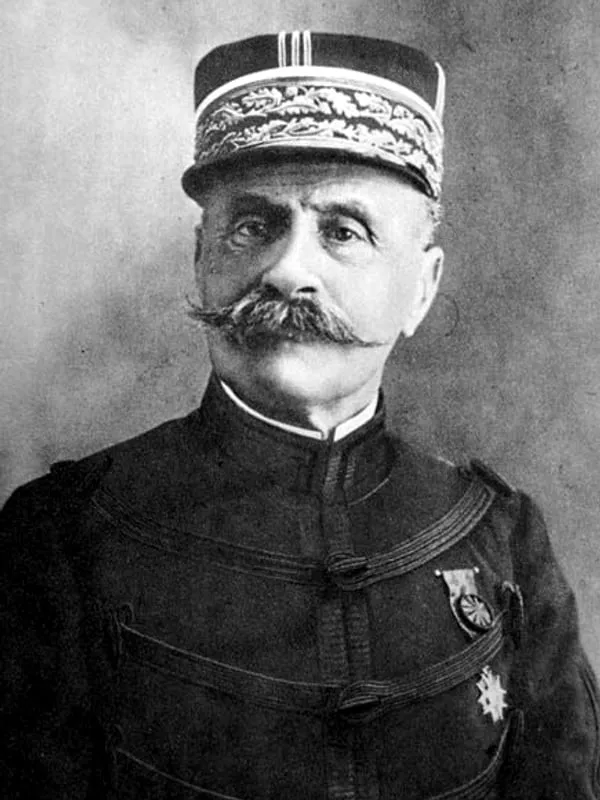
- Born:
- 2 October 1851, Tarbes (France)
- Died:
- 20 March 1929, Paris
- Author:
- Łukasz
- Photo:
- Åhlén & Åkerlund, 1915, domena publiczna, Wikimedia Commons

Ferdinand Foch was the only commander of the First World War to direct the armies of several nations at once. Before 1914 he was France’s best-known military theorist; in the first years of the war he held commands on the Marne, in Flanders, in Artois and on the Somme; and in the spring of 1918, at the moment of greatest danger, the Allies entrusted him with the joint direction of their armies on the Western Front. He halted the last German offensives, went over to the counter-attack and in November, in his railway carriage in the Forest of Compiègne, dictated to the Germans the terms of the armistice. For the history of the road to the Second World War, what he did and said afterwards matters too. He demanded the permanent separation of the Rhineland from Germany, warned that the Treaty of Versailles would not give France security, and supported a reborn Poland. He was a Marshal of France, a British Field Marshal and a Marshal of Poland. In 1940 Hitler chose his carriage as the place to humiliate France.
Youth and teacher of the army
He was born on 2 October 1851 in Tarbes, at the foot of the Pyrenees, into the devout Catholic family of a civil servant. He was educated at Jesuit colleges, the last of them in Metz. In 1870 he volunteered for the infantry, but his regiment saw no fighting in the Franco-Prussian War. France’s defeat and the loss of Alsace and Lorraine – above all the sight of Metz in German hands – shaped his whole generation. Foch entered the École Polytechnique, became an artillery officer and in 1885 a student at the École supérieure de guerre, the French staff college.
From 1895 to 1901 he taught military history, strategy and tactics there. His lectures, published as Des principes de la guerre (1903) and De la conduite de la guerre (1904), revived French military thinkers’ interest in Napoleon and Clausewitz. Foch taught that wars are won by the will to victory, and that defence can be no more than a prelude to attack. His pupils and successors reduced these views to a doctrine of the offensive at any price (offensive à outrance), although Foch himself warned against reckless attack. For a Catholic whose brother was a Jesuit, a career in the anticlerical Third Republic was not easy. Even so, in 1907 he became a brigadier general and soon afterwards commandant of the staff college, which he headed until 1911. According to a well-known anecdote, it was Prime Minister Georges Clemenceau who appointed him to the post, paying no heed to his Jesuit brother. In 1913 Foch took over the elite XX Corps at Nancy, which covered the border with Germany.
1914–1917: from the Marne to disfavour
In August 1914 XX Corps fought in the failed French offensive in Lorraine and suffered heavy losses at Morhange. On 22 August, the bloodiest day of the war for the French, his only son, Germain, and his son-in-law were killed. At the end of August the Commander-in-Chief, General Joseph Joffre, gave Foch a detachment that was soon renamed the Ninth Army. His chief of staff was then Lieutenant Colonel Maxime Weygand, who would remain at his side until the end of the war. In the Battle of the Marne the Ninth Army held the centre of the front at the edge of the marshes of Saint-Gond. It fell back but did not break, and Foch counter-attacked without pause. The famous line about his centre giving way and his right falling back, and therefore attacking, is more a later legend than a genuine report, but it captures his attitude well.
In October Joffre made him his deputy in the north. Foch co-ordinated the French, British and Belgian armies in Flanders, at the First Battle of Ypres and on the Yser. Formally he had no authority over the Allies, but he learned to lead them by persuasion. In 1915–1916, as commander of Army Group North, he conducted bloody and largely fruitless offensives in Artois and then the French part of the Battle of the Somme. In December 1916 he lost his command, officially on grounds of health. He returned in May 1917, after the failure of General Robert Nivelle’s offensive, as Chief of the General Staff and adviser to the government. In the autumn he went to Italy after the disaster of Caporetto and helped to organise French and British assistance.
1918: Allied commander
On 21 March 1918 the Germans struck on the Somme and broke through the front of the British Fifth Army. A gap threatened to open between the British and French armies, and both commanders-in-chief, Douglas Haig and Philippe Pétain, were thinking chiefly of their own tasks. On 26 March, at a conference at Doullens, the French and British governments charged Foch with co-ordinating the Allied armies on the Western Front. He won the politicians over by his resolve: they had to fight in front of Amiens, where the troops stood, and not give up another step. On 3 April at Beauvais he was given the strategic direction of operations, and on 14 April the title of Commander-in-Chief of the Allied Armies in France. His authority rested on trust and on the French reserves, since each commander-in-chief could appeal to his own government.
He husbanded his reserves even when the British in Flanders begged for help, and he failed to foresee the German blow on the Aisne at the end of May, when the Germans once again reached the Marne. In July, however, he refused to let the prepared counter-offensive be postponed. On 18 July the French struck the flank of the German salient on the Marne, and on 24 July Foch told the commanders-in-chief that they would go over to the offensive along the whole front. On 6 August he was made a Marshal of France, and two days later the British and French routed the Germans at Amiens. From then on Foch gave the enemy no respite. Instead of a single great breakthrough, he mounted a series of blows at different points of the front, breaking each off as it lost momentum and starting another elsewhere. At the end of September a general offensive began from the Meuse to the sea. His watchword was: “Everyone to the battle!”
Compiègne
When in October Germany asked President Wilson for an armistice, Foch became the principal author of its military terms. On 25 October at Senlis he heard the commanders-in-chief: Haig counselled moderation, while the American General John Pershing would rather have had no armistice at all and marched on Berlin. Foch took the middle course: Germany was to surrender so many weapons and give up so much ground that it could not resume the war, and the Allies were to stand on the Rhine, from where they could strike deep into the Reich if need be. He did not want to prolong a war that could be won on such terms. Asked by the politicians whether he would prefer to go on fighting, he replied, by his own account, that he had no right to shed a single drop more blood if the aim could be achieved without it.
On 8 November he received the German delegates, led by Matthias Erzberger, in his carriage in the Forest of Compiègne. When he asked what they wanted, he made them request the armistice terms outright; he refused to halt the fighting during the talks and gave them 72 hours to reply. He left the details to Weygand and the British admiral Rosslyn Wemyss. In the early hours of 11 November he signed the armistice, which came into force at 11 a.m. That same day he went to see Clemenceau, while Paris celebrated victory. At each extension of the armistice at Trier, Foch dictated new terms to the Germans, and in February 1919 he forced them to stop fighting the insurgents of the Greater Poland Uprising.
The Rhine and Versailles
At the Paris Peace Conference Foch was the chief advocate of the demand that the left bank of the Rhine be separated from Germany and made into one or more states tied to France, or at least that the river crossings be occupied permanently. He argued that the Rhine was the only frontier that France and her allies could defend effectively against a more populous Germany. President Wilson and the British Prime Minister David Lloyd George rejected the plan as contrary to the right of nations to self-determination. Clemenceau accepted a compromise: a fifteen-year occupation of the Rhineland, a demilitarised zone east of the Rhine, and American and British guarantees for France. Foch considered this a mistake and said so so openly that he fell out with Clemenceau. The guarantees collapsed when the United States Senate failed to ratify the treaty.
The remark attributed to him – that the Treaty of Versailles was not a peace but an armistice for twenty years – is known chiefly from later accounts, including Winston Churchill’s. Even if it was not uttered in exactly that form, it reflects his fears well. From 1919 Foch chaired the Allied Military Committee at Versailles, which oversaw German disarmament, and the French Supreme War Council. He also argued for a broader Allied intervention in Russia against the Bolsheviks, but the governments would not agree to a large expedition.
A friend of Poland
Foch was one of the Western commanders best disposed towards Poland. He supported the formation of a Polish army in France and its transfer to Poland in 1919, and at Trier in February 1919 he forced Germany to halt the fighting in Greater Poland. In 1920, during the Polish–Soviet War, he advised on Polish affairs, and his long-serving chief of staff Weygand went to Warsaw with the Allied mission. On 5 February 1921, at the military academy of Saint-Cyr, Józef Piłsudski unpinned the Virtuti Militari cross from his own uniform and decorated Foch with it. On 13 April 1923 President Stanisław Wojciechowski conferred on him the title of Marshal of Poland. Foch received his baton at the beginning of May, when he came to Poland. He visited Warsaw and Lwów (Lviv), among other places, and crowds greeted him as a hero. Streets in many Polish towns were named after him.
Final years and memory
In the 1920s Foch was a monumental figure. He travelled to Britain and the United States, where he was received with great honours, wrote his memoirs and guarded his place in history, which led to quarrels with Clemenceau. To the end he believed that France had squandered its victory by giving up the Rhine. He died in Paris on 20 March 1929 and was laid to rest in the church of Les Invalides, where Napoleon also lies. He did not live to see the remilitarisation of the Rhineland in 1936 or the defeat of France in 1940, which many French people regarded as the fulfilment of his warnings.
His carriage stood in a museum in the clearing in the Forest of Compiègne where the armistice had been signed, next to a monument to the marshal. In June 1940 Hitler had it placed on the very same spot, and there France had to sign an armistice with Germany. The clearing was destroyed and the carriage taken to Germany, but on Hitler’s orders Foch’s statue was left standing, to gaze out over a wasteland.
Assessment
Foch owes his fame above all to the last eight months of the war. The British historian Elizabeth Greenhalgh, author of the most important modern biography, stresses that his greatest achievements were holding the coalition together, managing reserves skilfully and imposing a relentless tempo of attacks on the enemy. Critics point out that his pre-war teaching contributed to the cult of the offensive that cost France hundreds of thousands of men in 1914, and that in 1915–1916 he waged costly and fruitless offensives.
On the road to the Second World War Foch was above all a voice that went unheeded. He understood that a Germany undefeated on its own soil and spared the occupation of the whole country would want to reverse the outcome of the war, and he demanded guarantees that France’s allies were unwilling to give. His armistice deprived Germany of the ability to fight on in 1918, but it did not change the conviction of many Germans that they had never lost the war at all.
Sources
Mentioned in battles
(02)Often appears with
People who appear in the same events.