Poland
Michał Karaszewicz-Tokarzewski
Commander of the Service for Poland's Victory (1939), commander of the ZWZ under Soviet occupation (1940), deputy commander of the Polish Army in the East (1943–1944)
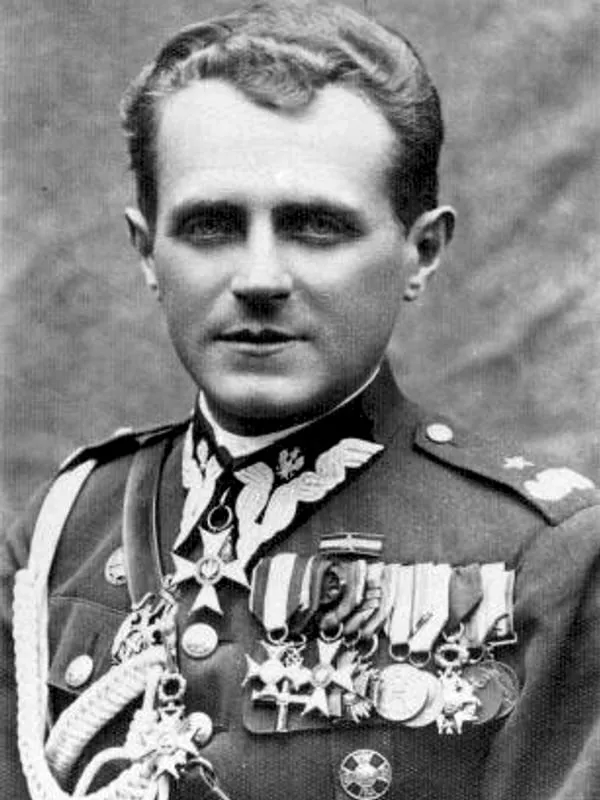
- Born:
- 5 January 1893, Lwów (Galicia, Austria-Hungary)
- Died:
- 22 May 1964, Casablanca (Morocco)
- Author:
- Łukasz
- Photo:
- autor nieznany, domena publiczna, Wikimedia Commons

Michał Tokarzewski, who turned his conspiratorial pseudonym “Karasiewicz” into the second part of his surname, belonged to the generation of Piłsudski’s followers for whom conspiracy was the school of their youth. As a student he was active in independence organisations, fought in the Legions and in the Polish Military Organisation, and in reborn Poland became one of the youngest generals. On the night of 26 to 27 September 1939, in besieged Warsaw, he founded the Service for Poland’s Victory, the first organisation of the Polish Underground State, from which grew the Union of Armed Struggle and the Home Army. The new authorities in exile did not trust him and pushed him into the background. Arrested by the NKVD, he went through the Soviet camps and the Lubyanka, and spent the rest of the war in the army of Gen. Władysław Anders. He was also an unusual figure for a general: a theosophist, a Freemason and a priest of the Liberal Catholic Church.
Lwów, Drohobych and the Legions
He was born on 5 January 1893 in Lwów (some sources give 21 December 1892), into the family of Bolesław Tokarzewski and Helena née Lerch. He spent his childhood and youth in Drohobych, where he passed his school-leaving examinations in 1911. He studied law at the University of Lwów and then medicine at the Jagiellonian University. Even before the First World War he joined the independence movement: he belonged to the PPS – Revolutionary Faction (PL), the Union of Active Struggle and the Riflemen’s Association, whose units he commanded in Sambir and Drohobych. For completing the Riflemen’s Association officer course he received the “Parasol” badge from Józef Piłsudski. He also served as a one-year volunteer in the Austrian army.
In August 1914 he joined the Polish Legions. He commanded battalions in the 5th and 6th Infantry Regiments, and later the 5th Regiment. In October 1914, at Laski, he was severely wounded in the chest. After the oath crisis of 1917 the Austrians briefly imprisoned him and drafted him into their army. He then moved over to the Polish Military Organisation and worked in it in Russia and Ukraine.
A general of the Second Polish Republic
In November 1918, as a lieutenant colonel, he took command of the 5th Infantry Regiment of the Legions and led the relief of the Poles fighting for Lwów against the Ukrainians. In 1919 he took part in the Vilnius expedition, and afterwards held posts in the Ministry of Military Affairs, where he headed the infantry department. In 1924, aged 31, he became a brigadier general.
In the interwar years he commanded in turn the 19th Infantry Division (PL) in Wilno and the 25th Infantry Division in Kalisz, was head of the Personnel Bureau of the Ministry of Military Affairs, and in the 1930s commanded corps districts in Grodno, Lwów and Toruń. In the May Coup of 1926 he sided with Piłsudski. He himself considered himself a socialist.
Outside the army he led a life that set him apart from his fellow generals. He belonged to several Masonic lodges and was one of the most active Polish Freemasons, as well as a theosophist; and in 1926 he was ordained a priest in the Liberal Catholic Church (PL).
The Bzura and Warsaw
In September 1939, from 11 September, he commanded the operational group bearing his name (PL) in the Pomorze Army and fought with it in the Battle of the Bzura. After the defeat he made his way through the Kampinos Forest to besieged Warsaw, where he became deputy commander of the Warsaw Army under Gen. Juliusz Rómmel.
On 26 September, when Rómmel decided to begin capitulation talks, and an envoy of the Commander-in-Chief arrived in the city with authorisation to create a conspiracy, Rómmel passed his plenipotentiary powers to Tokarzewski “with the task of continuing the struggle to preserve independence and the integrity of the borders”. That very night Tokarzewski swore in the first officers of the new organisation, the Service for Poland’s Victory. It was to cover the whole country, rebuild the army and create centres of provisional authority. Its command included, among others, Col. Stefan Rowecki, and in the following weeks Tokarzewski built around the SZP a Main Political Council from representatives of the former anti-Sanacja opposition.
Pushed aside and arrested
The government of Gen. Władysław Sikorski in Paris, however, saw in him a Piłsudski loyalist and one of Rydz-Śmigły’s men. On 13 November 1939 Sikorski replaced the SZP with the Union of Armed Struggle under Gen. Kazimierz Sosnkowski. In January 1940 the country was divided into two zones: the German occupation was to be directed from Warsaw by Rowecki, Tokarzewski’s former deputy, and he himself was to direct the Soviet occupation from Lwów. The historian Paweł Wieczorkiewicz considered this appointment almost a provocation, because in Przemyśl and Lwów the general was too well known to go underground effectively.
At the beginning of March 1940, on his way to Lwów, Tokarzewski was detained by the NKVD as he crossed the German-Soviet demarcation line on the San. He carried papers in the name of Tadeusz Mirowy and was not initially recognised. On 4 September 1940 a Special Board of the NKVD sentenced “Tadeusz Mirowy” for illegally crossing the border to five years in a labour camp, counted from 7 March 1940. He was sent to a camp in the far north (according to the IPN near Arkhangelsk, according to other studies near Vorkuta), and when the NKVD established his true identity he was taken to the Lubyanka prison in Moscow. The Lwów underground that he was meant to lead had by then been deeply infiltrated by the NKVD.
In Anders’s army
He was freed by the German-Soviet war and the Sikorski–Mayski agreement. In August 1941 he left prison and took command of the 6th Lwów Infantry Division (PL), being formed in the Polish army in the USSR at Totskoye. With Anders’s army he went to Iran and the Middle East. He was appointed major general with seniority from 1 January 1943. In March 1943 he became deputy commander of the Polish Army in the East and commander of units in the Middle East, and in 1944 he also commanded the III Polish Corps (PL), then being formed. From December 1944 he remained at the disposal of the Minister of National Defence.
Exile
After the war he stayed in Great Britain. Like many officers in exile, he earned his living by manual work: he was, among other things, a night watchman, a packer, a worker in a radio equipment factory and an orderly in an English hospital. He was active in veterans’ organisations, in the Main Commission of the National Treasury, in the Council of the Study of Underground Poland and in the Józef Piłsudski Institute in London, of which he was a co-founder. He gave lectures on the beginnings of the Home Army. In 1954, during the split in the emigration, President August Zaleski appointed him Inspector General of the Armed Forces and Minister of National Defence.
In spring 1964 he went to Morocco for treatment. In March of that year the exile authorities promoted him to full general. He died on 22 May 1964 in Casablanca, and the next day President Zaleski posthumously awarded him the Order of the White Eagle. He was buried in Brompton Cemetery in London; in 1992 his ashes were moved to Powązki in Warsaw.
Remembrance
The rehabilitation of his memory in Poland came after 1989. In 1991 a silver collector’s coin bearing his likeness was issued, and streets in Warsaw, Kraków, Łódź and Poznań, among other places, are named after him. The day the SZP was founded, 27 September, is observed as Polish Underground State Day. His three-volume biography, titled “Po trzykroć pierwszy” (“Three Times First”), was published in 2000–2002 by Daniel Bargiełowski. His fate also shows how heavily the political divisions of the pre-war period weighed on the Polish conspiracy in the first months of the occupation: the creator of the underground army was removed from its leadership above all because of his political pedigree.
Sources
- ipn.gov.pl · 195658,Wojciech Kujawa General Michal Tokarzewski Karaszewicz
- przystanekhistoria.pl · 104983,General Michal Tokarzewski Karaszewicz
- dzieje.pl/node/104677
- dzieje.pl/node/142305
- dzieje.pl/node/110331
- przystanekhistoria.pl · 76189,ZWZ z trzech perspektyw
- Michał Tokarzewski-Karaszewicz · Wikipedia (pl)
- Służba Zwycięstwu Polski · Wikipedia (pl)
- Michał Tokarzewski-Karaszewicz · Wikipedia (en)
Mentioned in battles
(02)Often appears with
People who appear in the same events.