Poland
Leopold Okulicki
Commander of the ZWZ under Soviet occupation (1940–1941), chief of staff of the Polish Army in the USSR (1941–1942), commander of the Home Army (1944–1945) and of the “NIE” organisation
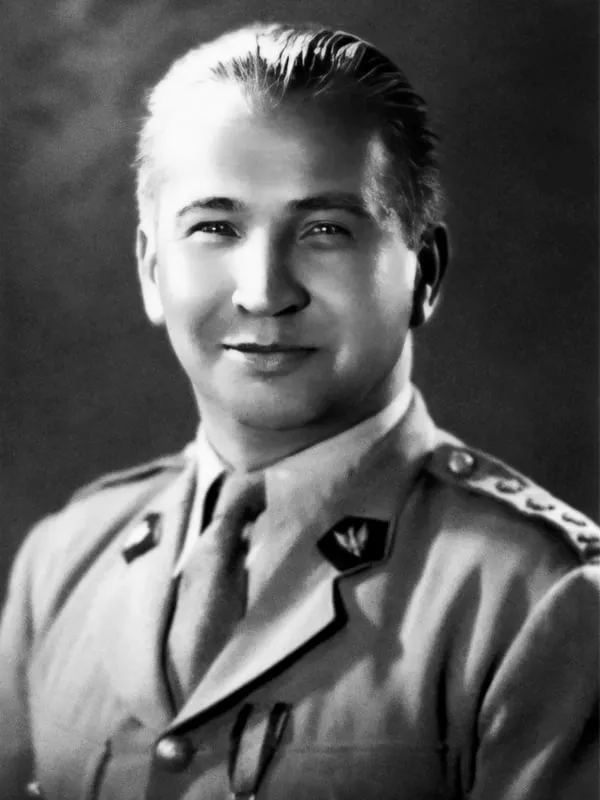
- Born:
- 12 November 1898, Bratucice (Galicia, Austria-Hungary)
- Died:
- 24 December 1946, Moscow (Soviet Union)
- Author:
- Natalia
- Photo:
- autor nieznany, CC BY-SA 4.0, Wikimedia Commons

Leopold Okulicki, “Niedźwiadek” (“Little Bear”), was the son of a peasant from near Bochnia who travelled the whole road of a soldier of his generation – from the Legions, through the Polish–Soviet War and the defence of Warsaw in 1939, to the underground, Soviet prisons, the Polish Army in the USSR and a parachute jump into occupied Poland. In the autumn of 1944, after the fall of the Warsaw Uprising, of which he had been one of the chief advocates, he became the last commander of the Home Army, and on 19 January 1945 he disbanded it. Two months later the NKVD treacherously arrested him together with other leaders of the Polish Underground State; in June 1945 a court in Moscow sentenced him to ten years’ imprisonment. He died in a Soviet prison on Christmas Eve 1946, and his fate became a symbol of what befell the Home Army’s soldiers after the war.
From Bratucice to the Legions
He was born on 12 November 1898 in the village of Bratucice near Okulice, in Galicia, into a peasant family that lived off an eight-hectare farm. His father, Błażej, had changed the family name from Kicka to Okulicki. In 1910 Leopold began secondary school in Bochnia. From 1913 he belonged to the Riflemen’s Association, and as a teenager he ran away from school to join the 3rd Infantry Regiment of the Polish Legions. By 1916 he was a sergeant and had been wounded. After the Oath Crisis of 1917 he was drafted into the Austrian army, from which he deserted in early 1918 to work for the Polish Military Organisation in Kraków and Bochnia. In the autumn of 1918 he took part in disarming the troops of the partitioning powers, and then, as an officer of the 4th Legions Infantry Regiment, set out to relieve Lwów (Lviv).
The wars for the borders and a staff career
He was wounded near Lwów in February 1919 and passed his school-leaving examinations while recovering. From the spring of that year he fought in the Polish–Soviet War – around Wołkowysk, near Lida and Mołodeczno and on the Berezina – as a company commander and later as acting battalion commander. In June 1920 he was wounded again. For his courage he received the Silver Cross of the Virtuti Militari and three times the Cross of Valour; the command of the 2nd Legions Infantry Division described him as “one of the bravest officers in the regiment”.
In 1922 he married Władysława Jabłońska in Kielce; their only son, Zbigniew, was born in 1924. In 1923–1925 Okulicki completed the Higher Military School and embarked on the typical career of a General Staff officer: until 1930 he served at the headquarters of Corps District III in Grodno (he was promoted to major in 1928), then commanded a battalion, taught tactics at Rembertów and was chief of staff of the 13th Borderlands Infantry Division at Równe. From 1935 he worked in Section III (Operations) of the General Staff, where in 1936 he took over the “East” department and in the spring of 1939 the situation department. In 1936 he became a lieutenant colonel. A keen amateur footballer, in 1936 he headed the football section of Legia Warsaw.
September 1939 and the underground
The outbreak of war found him at the General Staff. When Germany invaded Poland, Okulicki remained in the capital and during the defence of Warsaw was chief of staff of the “West” sector; from 18 September he commanded a forward group named after him on the western approaches to the city. At his own request he led an attack that took Blizne, Jelonki and Chrzanów, and he held these positions until the capitulation of Warsaw. On 29 September General Juliusz Rómmel awarded him the Gold Cross of the Virtuti Militari.
He did not go into captivity: on 28 September he took the oath before General Michał Tokarzewski-Karaszewicz and joined the newly forming Service for Poland’s Victory. He became commander of its Łódź district, and from early 1940 of the Łódź district of the Union of Armed Struggle (ZWZ). He operated under the pseudonym “Kula” (“Bullet”) and was sought by the Germans on wanted posters. In March 1940 it was he who brought Major Henryk Dobrzański “Hubal” the order from the ZWZ commander Stefan Rowecki to disband his unit; “Hubal” did not obey it. In May 1940 Okulicki was promoted to colonel.
Lwów, the Lubyanka and Lefortovo
In November 1940 Okulicki, as “Mrówka” (“Ant”), took over in Lwów the command of the ZWZ in the territories occupied by the USSR after the invasion of 17 September 1939. The Lwów underground was already deeply infiltrated by the NKVD, and on the night of 21/22 January 1941 he too was arrested. After a short spell in a Lwów prison, where Ivan Serov spoke with him, he was taken to Moscow. The investigation at the Lubyanka, and later in Lefortovo prison, went on for months; according to his biographers it included torture, among it the “conveyor” – interrogation carried on without a break for sleep – which left him with heart disease and impaired eyesight.
Historians judge his conduct under interrogation differently. Janusz Kurtyka held that Okulicki rejected the offer of collaboration and “behaved with dignity”. Jan M. Ciechanowski and Andrzej Leon Sowa point to his handwritten statement of May 1941, in which he described the structure and personnel of the SZP–ZWZ and argued for cooperation with the USSR against Germany; Okulicki himself later reported that the NKVD had already known this information, which is plausible. A note by Serov in his “diary”, published in Russia in 2017, claiming that Okulicki was a provocateur working with the NKVD, has not been supported by any published documents.
In Anders’s army
He was saved by the German–Soviet war. After the launch of Operation Barbarossa and the conclusion of the Sikorski–Maisky Agreement on 30 July 1941, Okulicki – following the intervention of General Władysław Anders – left the Lubyanka in August and became chief of staff of the Polish army being formed in the USSR. He set up a unit to document the martyrdom of Poles in the USSR and to search for well over ten thousand missing officers; on his instructions Cavalry Captain Józef Czapski collected information on them. In December 1941 he accompanied General Władysław Sikorski and Anders to the Kremlin, when the Polish–Soviet declaration was signed. On 18 March 1942, during another conversation between Anders and Stalin and Molotov, when Stalin said that the officers might have “scattered” in the territories occupied by the Germans, Okulicki retorted: “Impossible, we would have known about it.”
Under Soviet pressure, and in agreement with Anders, he handed over the post of chief of staff to General Zygmunt Bohusz-Szyszko and in the spring of 1942 took command of the 7th Infantry Division, forming at Kermine in Uzbekistan, with which he moved to Iran and the Middle East; he commanded it until June 1943. The news in April 1943 of the discovery of the graves at Katyn – the victims of the Katyn massacre whom he had been searching for – came as a shock to him; according to his biographers it decided him to volunteer to be parachuted into Poland, accepting that the underground struggle would continue under Soviet occupation too. In the summer of 1943 he travelled to London for Sikorski’s funeral and backed the new Commander-in-Chief, General Kazimierz Sosnkowski. From October 1943 he ran the training centre at Ostuni in Italy for volunteers to be sent into Poland.
Cichociemny and the Warsaw Uprising
On the night of 21/22 May 1944 he parachuted from a British Halifax, in Operation Weller 29, onto a reception site near Wierzbno, some 24 km from Kraków, as one of the Cichociemni (“the Silent and Unseen”) – soldiers trained in the West for underground warfare. He was appointed brigadier general with effect from the date of the jump. As “Kobra” he became, on 3 June, chief of operations and first deputy to the chief of staff of the Home Army headquarters, General Tadeusz Pełczyński. On 27 July General Tadeusz Bór-Komorowski designated him as his successor should he lose command, and as commander of the secret cadre organisation “NIE” (Niepodległość – “Independence”), which was meant to survive a possible occupation of the country by the Red Army.
In the last days of July, as the Red Army approached the Vistula, Okulicki was among the most determined advocates at headquarters of fighting for Warsaw – against the line of Sosnkowski, who wanted to limit Operation Tempest. He argued that the capital had to be liberated by Polish forces before the Soviets entered; opponents such as Colonel Janusz Bokszczanin accused him of disregarding the real balance of forces. On 31 July, after a morning briefing at which the start of fighting had been postponed, it was Okulicki and Pełczyński who persuaded Bór-Komorowski to issue the order that led to the outbreak of the Warsaw Uprising. After Pełczyński was badly wounded, he headed the Home Army headquarters staff from 6 September. On 28 September he took part in a meeting with the Government Delegate Jan Stanisław Jankowski at which it was decided to open capitulation talks, and that same day he received a second Gold Cross of the Virtuti Militari.
The last commander of the Home Army
Bór-Komorowski, who intended to go into captivity together with his soldiers, held that the capitulation of the uprising could not mean the capitulation of the whole underground, and on 1 October 1944 he designated Okulicki as his successor. The government in London hesitated: President Władysław Raczkiewicz recognised him on 3 November only as acting commander, and appointed him commander only on 21 December 1944, and then with narrower powers than Bór had had, which Okulicki protested against. He left Warsaw with the civilian population through the Dulag 121 camp at Pruszków, escaped from a transport and established himself in the Częstochowa area. He proposed to London ending Tempest and not revealing Home Army units to the Red Army – after the experience of Wilno and Lwów, where units that had come into the open were disarmed and their officers arrested; the Commander-in-Chief’s staff rejected most of these proposals. In December he learned that his son Zbigniew, an officer cadet in the II Corps, had been killed on 8 July 1944 near Osimo during the fighting for Ancona.
When the Vistula–Oder offensive began in January 1945 and the Soviets entered Warsaw on 17 January, the Home Army could no longer operate as an army. On 19 January 1945 Okulicki – with the consent of the Commander-in-Chief and on the basis of the government’s instruction of 16 November 1944 – issued the order disbanding it. In it he released the soldiers from their oath while calling on them to go on working for the recovery of full independence, because, as he wrote, “the present Soviet victory does not end the war”. At the same time, through secret orders, he preserved a skeleton network of staffs, weapons and communications as a base for “NIE”. The order was meant to deprive the NKVD of a pretext for repression, but it did not stop the arrests and deportations of underground soldiers.
Pruszków and the Trial of the Sixteen
After the Yalta Conference, which settled on the “reorganisation” of the government imposed on Poland, Okulicki and Jankowski received letters in March 1945 from a “Colonel Pimenov” inviting them to talks with a “General Ivanov” – in reality Serov. Okulicki suspected a trap, but at Jankowski’s express wish agreed to go with him. In doing so he broke the instructions of Anders, General Stanisław Kopański and Prime Minister Tomasz Arciszewski not to enter into talks with the Soviets. On 27 March 1945 Okulicki, Jankowski and Kazimierz Pużak were arrested at Pruszków, and the remaining underground leaders the next day; all of them were taken to Moscow, to the Lubyanka. For several weeks Moscow kept silent about their fate; only at the beginning of May did Molotov admit in San Francisco that they were in Soviet hands, and at the end of May Stalin presented Okulicki to Harry Hopkins as a particularly dangerous criminal.
In the Trial of the Sixteen, held in Moscow on 18–21 June 1945 – at the same time as the talks on the government from which the Provisional Government of National Unity emerged, with the participation of Stanisław Mikołajczyk – he was the principal defendant. The charges of “diversion” behind the Red Army’s lines and of collaboration with the Germans were false. Okulicki declined a Soviet defence lawyer, defended the good name of the Home Army and the purpose of the Warsaw Uprising (he presented the court with nine reasons for it), and repeated that good relations with the USSR were possible only if Poland was independent. On 21 June 1945 he was sentenced to ten years’ imprisonment – the heaviest sentence in the trial.
Death in Moscow
In prison he wrote a memorandum to Stalin in defence of the Home Army; in London, meanwhile, an order by General Kopański of October 1945 struck him off the strength of the Polish Armed Forces “for record-keeping purposes”. Okulicki died in Moscow on 24 December 1946. The Soviet authorities, pressed in 1955 by notes from the United States and Britain, stated that he had died of a heart attack in the Lubyanka and that his body had been cremated at the Donskoy Cemetery crematorium. According to another version he died in the hospital of Butyrka prison, where he had earlier been on hunger strike. His fellow prisoners from the trial, Adam Bień and Antoni Pajdak, claimed that on Christmas Eve 1946 they heard him being led out of his cell to be executed, and Serov noted that Okulicki had been “liquidated in prison”. The circumstances of his death have never been fully explained.
Memory
On 19 April 1990 the Plenum of the Supreme Court of the USSR discontinued Okulicki’s case for lack of any criminal offence, which amounted to his rehabilitation. In 1995 he was posthumously awarded the Order of the White Eagle. He has symbolic graves at Powązki in Warsaw, and streets, schools and the 11th Lesser Poland Territorial Defence Brigade bear his name. In 2012 the Sejm, the lower house of the Polish parliament, declared that his fate “symbolises the post-war fate of the soldiers of the Home Army and of Poland”. Historians still argue about his role in the decision to launch the uprising and about his conduct under interrogation in 1941. Yet the path of the last Home Army commander – from the order disbanding the army to the sentence of a Moscow court and death in prison – shows how the Second World War ended for Poland: with liberation from German occupation followed by subjugation to Moscow.
Sources
Commanded in battles
(01)Mentioned in battles
(02)Often appears with
People who appear in the same events.