Battle of the Bzura
- Dates:
- 9–22 September 1939
- Front:
- Poland
- Location:
- The Bzura basin between Łęczyca, Kutno, Łowicz and Sochaczew, and the triangle between the Bzura and the Vistula as far as the Kampinos Forest and the approaches to Warsaw and ModlinOn the battle map →
- Sides:
- PolandTadeusz Kutrzeba, Władysław BortnowskiNazi GermanyGerd von Rundstedt, Johannes Blaskowitz, Walter von Reichenau
- Result:
- German victory. The Poznań and Pomorze Armies were encircled and destroyed, though some of their troops broke through to Warsaw and Modlin. The Polish offensive nonetheless delayed the German assault on the capital.
- Author:
- Łukasz
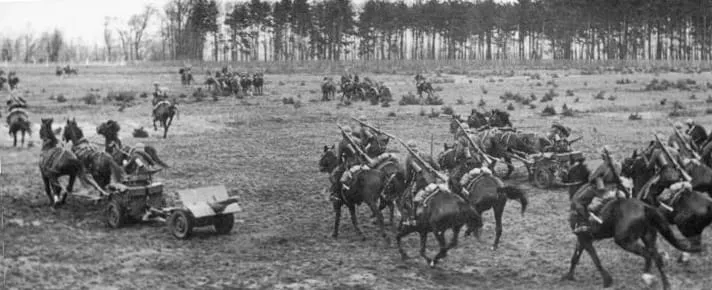
The Battle of the Bzura was the largest battle of the September Campaign and the only operation in it in which the Polish Army went over to the offensive on a large scale. On 9 September 1939 two Polish armies – the Poznań Army under Major General Tadeusz Kutrzeba and the Pomorze Army under Major General Władysław Bortnowski, both falling back from Greater Poland and Pomerania towards Warsaw – struck from the line of the Bzura at the exposed northern flank of the German 8th Army under General Johannes Blaskowitz. Surprise was complete. For three days the Poles drove the Germans southwards, taking prisoners and recapturing towns. Yet the German command needed only to turn back part of the forces advancing on Warsaw and the Vistula to trap the Polish armies in a pocket. From 16 September, with crushing superiority in the air and in armour, it destroyed them in the triangle between the Bzura and the Vistula. Several tens of thousands of soldiers broke through to Warsaw and Modlin, but most of the force was killed or taken prisoner.
Name and dates
In Polish historical writing the name “Battle of the Bzura” has become established. The battle is also called the “Battle of Kutno”, since both armies concentrated around that town, and after 1945 the fighting was commemorated on the Tomb of the Unknown Soldier in Warsaw with a plaque reading “KUTNO 10–17 IX 1939”. After 1990 the inscription was changed to “BZURA 9–22 IX 1939”. In Germany it is known as the Battle of the Bzura (Schlacht an der Bzura) or, as in the Polish tradition, the Battle of Kutno.
The dates of the battle are not settled beyond dispute. The battle is best dated from 9 to 22 September 1939, following most Polish studies and Kutrzeba himself, who used it in the title of his post-war book on the battle. On 9 September the Polish offensive began. On 22 September Kutrzeba reached Warsaw, Brigadier General Mikołaj Bołtuć was killed near Łomianki, and the last fighting was dying down in the pocket west of the Bzura. Some studies, especially German and English-language ones, end the battle on 18 or 19 September, when the main Polish forces in the encirclement laid down their arms and the first groups broke through the Kampinos Forest.
Background
Under the Polish operational plan “West”, the Polish Army was to defend itself close to the frontier, so as not to surrender Pomerania, Greater Poland and Silesia to the Germans without a fight, and then fall back to the line of the great rivers. The Poznań Army stood in the Greater Poland “balcony” that jutted out to the west. It had four infantry divisions (the 14th, 17th, 25th and 26th), the Greater Poland and Podolian Cavalry Brigades, and National Defence battalions. To its north, in the Polish Corridor and along the lower Vistula, stood the Pomorze Army; to its south, the Łódź Army under Major General Juliusz Rómmel.
The German plan envisaged two army groups closing the main Polish forces in a pincer west of the Vistula. Army Group North under General Fedor von Bock was to cut the Polish Corridor and strike from East Prussia, while Army Group South under General Gerd von Rundstedt delivered the main blow from Silesia towards Warsaw. The Germans all but bypassed Greater Poland. Facing the Poznań Army were weak frontier-guard units, while its neighbours bore the brunt of the Wehrmacht’s main forces.
In the first days of the war the Pomorze Army suffered heavy losses in the Tuchola Forest. Its remnants retreated south-east through Bydgoszcz, the scene of bloody events on 3 September, and through Toruń and Włocławek. The Łódź Army could not withstand the pressure of the 8th and 10th Armies and broke up into several groups. The Poznań Army, almost intact, had been carrying out an order to withdraw eastwards, towards Koło, Kutno and Warsaw, since 3 September. From the first days of the war Kutrzeba had urged the Commander-in-Chief, Marshal Edward Rydz-Śmigły, to let him strike southwards into the flank of the German 8th Army as it attacked the Łódź Army. The Commander-in-Chief refused and ordered the withdrawal to continue. Kutrzeba later held that this was the moment when the best chance of a counter-offensive was lost, while the Germans were still far from the Vistula.
On the night of 6–7 September the Commander-in-Chief left Warsaw. Communications with the armies were breaking down, and on 8 September tanks of the German 4th Panzer Division reached the outskirts of the capital, opening the siege of Warsaw. The Germans had already entered Kraków on 6 September. The Poznań and Pomorze Armies now found themselves in the rear of the German forces advancing on Warsaw. They could either flee further east, at the risk of being cut off from the Vistula crossings, or attack. On the morning of 8 September Kutrzeba made contact with the Chief of Staff of the Commander-in-Chief, Brigadier General Wacław Stachiewicz, and obtained permission to attack across the Bzura east of Łęczyca. According to some accounts, formal confirmation from the Commander-in-Chief reached him only on 11 September, when the fighting was already under way.
The Germans did not know what they were facing. Their air reconnaissance had lost sight of Kutrzeba’s army, and the staffs concluded either that it had withdrawn by rail through Warsaw across the Vistula or that its strength was insignificant. The Pomorze Army was regarded as destroyed after its defeat in the Corridor. Blaskowitz’s 8th Army was marching east along the southern bank of the Bzura, directing its main forces towards Warsaw. Its northern flank was covered by the 30th Infantry Division of General Kurt von Briesen, strung out over several tens of kilometres.
Forces and commanders
By the most commonly cited estimates, the Polish force numbered some 225,000 men. It comprised the four infantry divisions of the Poznań Army, four divisions of the Pomorze Army (the 4th, 15th, 16th (PL) and 27th), the remnants of the 9th Infantry Division, shattered in the Corridor, three cavalry brigades – among them the Pomeranian, bled white in the Tuchola Forest – and National Defence battalions. Some of the Pomorze Army’s divisions were badly weakened. The Poles had little anti-tank weaponry or anti-aircraft artillery, and over the battlefield their air force was practically non-existent.
On 9 September Bortnowski placed himself under Kutrzeba, who in practice commanded the whole force, although the Commander-in-Chief never formally created a unified command over the two armies. The main striking force was the Operational Group of Brigadier General Edmund Knoll-Kownacki (the 14th, 17th and 25th Infantry Divisions); the 14th Division was commanded by Brigadier General Franciszek Wład. The cavalry was led by Brigadier General Roman Abraham and Brigadier General Stanisław Grzmot-Skotnicki. In the Pomorze Army the Operational Group “East” (PL) of Brigadier General Mikołaj Bołtuć (the 4th and 16th Infantry Divisions) stood out.
On the German side the first blow fell on the 8th Army, whose northern flank was formed by X Army Corps (the 24th and 30th Infantry Divisions). After a few days the conduct of the battle passed to the headquarters of Army Group South – Rundstedt and his chief of staff, General Erich von Manstein. The main forces of the 10th Army under General Walter von Reichenau entered the battle, including General Erich Hoepner’s XVI Corps with the 1st and 4th Panzer Divisions, turned back from Warsaw, together with the light divisions. From the west and north came units of the 4th Army under General Günther von Kluge, part of Army Group North. The SS regiment “Leibstandarte Adolf Hitler” also fought here. Air support was provided by the 1st and 4th Air Fleets of the Luftwaffe. In the final phase the Germans had more than a dozen divisions on the Bzura and, according to some studies, around 800 tanks, and their superiority in artillery and aircraft was overwhelming.
Course: the Polish offensive (9–12 September)
The offensive began on 9 September. Before noon the first Polish units attacked Łęczyca, and in the afternoon and evening the main forces of Knoll-Kownacki’s group struck across the Bzura. The blow fell on the 30th Infantry Division, strung out on the march along the river. The German regiments were broken and pushed back to the south. The Polish 17th Infantry Division under Colonel Mieczysław Mozdyniewicz drove the Germans from Góra Świętej Małgorzaty, the 14th Division took Piątek, and Łęczyca was recaptured. The cavalry reached the German supply lines and cut X Corps’ communications. According to some studies, in the first days the Germans lost around 1,500 killed and wounded and several thousand prisoners, mostly from the 30th Division.
On 10 and 11 September the Poles pushed further south, towards Ozorków, Głowno and Stryków. On the eastern flank Bołtuć’s group attacked Łowicz and in a night assault drove out the German 24th Infantry Division. By 12 September Polish units had in places advanced some 20 kilometres from the Bzura, to around the Ozorków–Stryków line. There the offensive came to a halt. The Germans were bringing up reserves, the Polish infantry was short of ammunition and supplies, and in daylight every movement of a column drew air attacks.
The Polish blow surprised the German command but did not paralyse it. Blaskowitz sent XIII Corps and the reserves of Army Group South against the Poles. On 10 and 11 September Rundstedt and Manstein decided to exploit the situation: rather than simply repel the attack, they would trap the Polish armies in an encirclement. Hoepner’s corps was turned back from Warsaw, XI and XV Corps of the 10th Army were brought up from the south, and from the west and north, along the Vistula, the 4th Army tightened the ring. The Polish attack did, however, halt the advance on the capital. The fighting on the Bzura pinned down part of the forces that were to storm Warsaw and gave its defenders time to prepare the city.
Course: the turn east (13–15 September)
On 12 September Kutrzeba concluded that a further advance southwards had no chance of success. He also learned that the remnants of the Łódź Army had fallen back to Modlin, so there was no longer anyone to link up with. He decided to break off the offensive and fight his way east, towards Warsaw. Under his plan the Pomorze Army was to strike across the Bzura near Łowicz towards Skierniewice, covering the regrouping of the Poznań Army, which was to shift towards the lower Bzura and Sochaczew. Polish units withdrew from the ground they had taken to the northern bank of the river.
On 14 September the 26th Infantry Division and part of the 16th Division forced the Bzura east of Łowicz, while Bołtuć’s group, in bloody fighting, attacked Łowicz again, which the Germans had meanwhile garrisoned much more strongly. The 26th Division’s attack went in under heavy fire and soon collapsed. Around noon Bortnowski, who had received an unverified report that German tanks were approaching from Warsaw, halted the attack and ordered the division back across the Bzura. In the evening, without consulting Kutrzeba, he ordered the entire Pomorze Army to cross to the northern bank of the river. This decision wrecked the chances of Bołtuć’s group at Łowicz and remains the most harshly judged episode of the battle. Bołtuć is said to have demanded that Bortnowski be relieved of command. Some historians explain Bortnowski’s conduct by exhaustion and a breakdown after the defeat in the Corridor; others point out that German tanks were indeed already moving towards the Bzura.
Meanwhile, around Sochaczew, heavy fighting was under way against units of Hoepner’s corps, which was closing the road to Warsaw from the east. On 15 and 16 September the Poles were driven out of Sochaczew. Kutrzeba’s force found itself in a triangle bounded by the Bzura, the Vistula and German divisions attacking from every side.
Course: encirclement and destruction (16–22 September)
On 16 September the Germans launched a concentric attack. The divisions of the 4th Army advanced from the west and north, the 8th Army from the south, and units of the 10th Army with its panzer and light divisions from the east and south-east. The Luftwaffe bombed Polish columns, river crossings and the villages where staffs and supply trains were quartered. On 17 September it carried out over the Bzura the largest air operation of the entire campaign. That same day the Red Army entered Poland, news which the soldiers in the pocket picked up from rumours and radio bulletins.
Kutrzeba decided to break through across the lower Bzura and the Kampinos Forest to Warsaw and Modlin. On the nights of 16–17 and 17–18 September units of the Poznań Army forced the river near Brochów and Witkowice, under fire from heavy artillery sited on the high right bank of the Vistula. Guns, supply trains and heavy equipment were abandoned. The Pomorze Army and part of the Poznań Army, which had not managed to cross, fought on around Iłów, Kiernozia and Osmolin, ever more tightly hemmed in and running out of ammunition and food.
Three Polish generals died in those days. General Wład, who on the night of 15–16 September had disbanded his division and was fighting his way across the Bzura with the remnants of its units, was gravely wounded in the woods near Iłów on 17 September and died the following day. General Grzmot-Skotnicki, wounded on 18 September near Tułowice, died in German captivity on 19 September. On 18 September, on the Vistula at Śladów, Wehrmacht soldiers murdered a group of prisoners from the units broken on the Bzura, together with local civilians. According to the findings of Polish historians, based on an eyewitness account, more than 300 people were killed, including around 150 prisoners of war (the Śladów massacre).
The groups that had crossed the Bzura fought their way through the Kampinos Forest, whose roads were cut by German units. On 19 September the 14th Jazłowiec Uhlan Regiment of the Podolian Cavalry Brigade, together with part of the 9th Uhlan Regiment, ran into the Germans at Wólka Węglowa (PL). Colonel Edward Godlewski led the regiment in a charge that broke through the German positions and opened the way to Warsaw for the uhlans, at a cost of about a hundred killed and as many wounded. Among those who got through to Warsaw and Modlin were both of General Abraham’s cavalry brigades, the remnants of the 15th and 25th Infantry Divisions, and Generals Knoll-Kownacki and Michał Tokarzewski-Karaszewicz. Kutrzeba and his staff reached the capital on 22 September. That same day General Bołtuć fell near Łomianki, on the edge of the forest.
In the pocket west of the Bzura most units laid down their arms on 18 and 19 September. Bortnowski was taken prisoner on 21 September. The last fighting by scattered groups died out around 22 September.
Losses
Figures for losses vary from source to source and are incomplete. Polish studies usually state that between about 15,000 and about 20,000 Polish soldiers were killed on the Bzura (some authors give around 16,500 killed and around 32,000 wounded). The Germans announced the capture of some 170,000 prisoners. Many studies repeat this figure, although it probably also includes stragglers from other formations rounded up in the area of the battle. Estimates of the number who broke through to Warsaw and Modlin range from over ten thousand to around 50,000.
German losses are hard to separate from the overall losses of the campaign, which according to German figures amounted to around 16,000 killed. Some studies attribute as many as around 8,000 German dead to the Battle of the Bzura; others give lower figures. The 30th and 24th Infantry Divisions, which took the first blow, suffered most heavily.
Significance
The Battle of the Bzura was the only large-scale offensive operation of the September Campaign and the largest attack on the Wehrmacht carried out by any army before 1941. For several days it diverted the German command’s attention from Warsaw and the Vistula. The Germans had to turn a panzer corps back from the capital, and the troops defending Warsaw gained time to prepare its defence. Yet the battle did not change the outcome of the campaign. It came too late, when the Germans had already reached the Vistula, and the two Polish armies, deprived of support from the air and from the west, could strike only a single blow. Once they were destroyed, no sizeable Polish forces remained west of the Vistula apart from those in Warsaw and Modlin.
Disputes over the battle went on for decades. Kutrzeba and many historians believed that an attack launched a few days earlier, while the Łódź Army was still holding out, might have achieved greater success, and they blamed the Commander-in-Chief. The lack of a unified command and Bortnowski’s decisions of 14 September were also criticised. Others point out that, given German superiority in aircraft and armour, no offensive from the Bzura could have reversed the course of the war – only prolonged it.
The battle became one of the most important symbols of September 1939, but also the source of a myth. The part played by the cavalry brigades fed the popular image of Poles fighting “with lances against tanks”, although Polish cavalry usually fought on foot, and mounted charges such as the one at Wólka Węglowa were the exception. The defenders of Warsaw held out for a few more days. On 28 September the capitulation of the capital was signed by Kutrzeba – the same general who had commanded on the Bzura. Today the memory of the battle is kept alive by the Museum of the Sochaczew Region and the Bzura Battlefield (PL) and by the war cemeteries along the Bzura and in the Kampinos Forest.