Soviet Union
Sergei Kamenev
Commander of the Eastern Front (1918–1919), Commander-in-Chief of the Armed Forces of the Republic (1919–1924), Chief of Staff of the Red Army (1925), Deputy People's Commissar for Military and Naval Affairs (1927–1934)
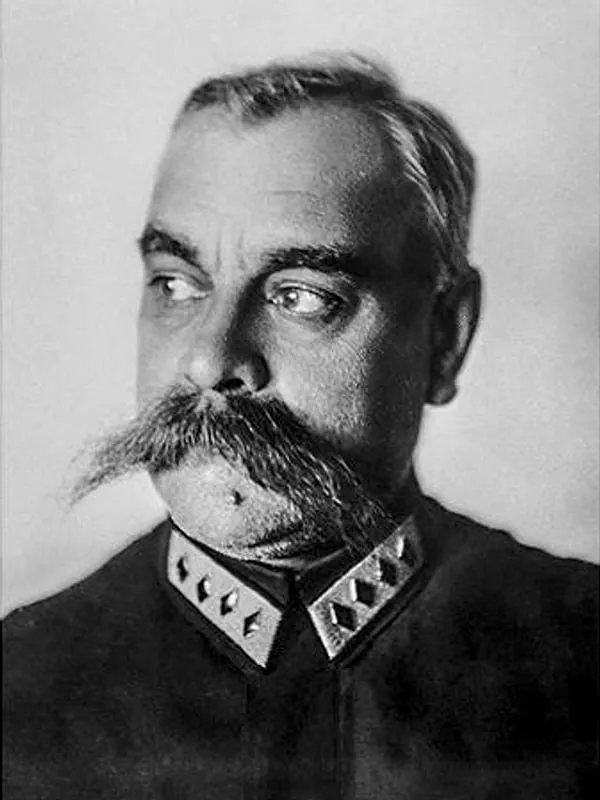
- Born:
- 16 April 1881, Kiev (Russian Empire)
- Died:
- 25 August 1936, Moscow (USSR)
- Author:
- Łukasz
- Photo:
- autor nieznany, CC BY 4.0, Wikimedia Commons

Sergei Kamenev was a professional officer of the tsarist General Staff who after the revolution entered the service of the Bolsheviks and from 1919 to 1924 was Commander-in-Chief of all the armed forces of Soviet Russia. It was he who directed the operations in which the Red Army defeated Admiral Kolchak, General Denikin and General Wrangel, and in 1920 he was in overall command of the war against Poland. His orders for the South-Western Front to hand over the First Cavalry Army to support the troops advancing on Warsaw were not carried out in time, and the dispute over who was to blame dragged on in the Soviet army for two decades. He was neither a politician nor a member of the party leadership, but a specialist whom the Bolsheviks needed. He should not be confused with Lev Kamenev, one of the leaders of the Bolshevik party, to whom he was not related. He died a natural death in 1936, on the very day his namesake was shot, and a year later he was posthumously declared a participant in a military conspiracy.
General Staff officer
He was born on 16 April 1881 (4 April in the Julian calendar) in Kiev into a family of the nobility. His father was a military engineer. He graduated from the Kiev Cadet Corps, in 1900 from the Alexander Military School in Moscow and in 1907, with distinction, from the Nicholas General Staff Academy in St Petersburg. He served in the 165th Lutsk Infantry Regiment in Kiev and then as a staff officer in Suwałki and in the Vilna Military District.
In the First World War he was a staff officer of the Russian 1st Army, and in December 1915 he was promoted to colonel. His contemporaries saw him as a conscientious and hard-working staff officer, “neither better nor worse than the others”. In March 1917, after the February Revolution, he took command of the 30th Poltava Infantry Regiment. After the Bolshevik seizure of power, the soldiers, who in the disintegrating army elected their commanders, made him chief of staff of the 15th Corps and then of the 3rd Army. In the spring of 1918, after the German offensive, he directed the army’s demobilisation.
In the Red Army
In April 1918 Kamenev volunteered for the Red Army and became military head of the Nevel sector of the so-called Western Screen, the covering force facing the German troops. In the summer he commanded a division at Vitebsk, and in September 1918 he took command of the Eastern Front, which was fighting on the Volga and in the Urals against the Czechoslovak Legion and the armies of Admiral Alexander Kolchak. In May 1919, following a dispute with the then Commander-in-Chief, Ioakim Vatsetis, he was briefly removed, but after protests from members of the front’s Revolutionary Military Council he was reinstated. His troops, including the armies of Mikhail Tukhachevsky and Mikhail Frunze, drove Kolchak back beyond the Urals.
On 8 July 1919 Kamenev replaced Vatsetis as Commander-in-Chief of all the Armed Forces of the Republic. The change was forced through the Central Committee by members of the Eastern Front’s Revolutionary Military Council, backed by Stalin, against the wishes of the Commissar for War, Leon Trotsky, who had defended Vatsetis. Trotsky, although he subsequently worked with Kamenev, later described him as a capable commander with imagination and a readiness to take risks, but “lacking depth and firmness”. Formally Kamenev was subordinate to the Revolutionary Military Council of the Republic, chaired by Trotsky. As Commander-in-Chief he directed the operations in which, in the autumn of 1919, Denikin’s offensive on Moscow and General Yudenich’s march on Petrograd were halted, and the White armies in southern Russia were then destroyed. He built up the Commander-in-Chief’s staff with a group of former tsarist officers such as Boris Shaposhnikov, who later became Chief of the General Staff of the Red Army under Stalin.
Commander-in-Chief in the war against Poland
In 1920 Kamenev directed the war against Poland. In the spring he was preparing a strike in Belarus, which was pre-empted by the Polish Kiev expedition. In the summer, as Tukhachevsky’s Western Front advanced on Warsaw and the South-Western Front of Alexander Yegorov, with Joseph Stalin as its commissar, advanced on Lwów (Lviv), it was Kamenev who had to decide how to divide the forces. Under his July plan the two fronts were to strike at Warsaw together, but after talks with Tukhachevsky he concluded that the Western Front would take the Polish capital on its own. When it became clear in August that Tukhachevsky was short of forces and that his left flank was exposed, Kamenev ordered on 11 and 13 August that the 12th Army and Semyon Budyonny’s First Cavalry Army be transferred to him. The command of the South-Western Front, supported by Stalin, procrastinated and went on assaulting Lwów, and the Cavalry Army set off northwards only on 20 August, when the Battle of Warsaw had already been lost.
His critics accused Kamenev of lacking firmness towards the front commanders and their political patrons, and of taking his decisions too late. Lenin himself, Trotsky wrote, was afterwards greatly disappointed by his reports. In 1929, in his book “Lvov–Warsaw”, Yegorov shifted the responsibility for the defeat onto Tukhachevsky and the high command – that is, onto Kamenev.
After the war with Poland Kamenev directed the elimination of the last centres of resistance: Wrangel’s army in the Crimea in the autumn of 1920, Makhno’s forces, the peasant Tambov rebellion, the uprising in Karelia in 1921–1922 and the Basmachi movement in Central Asia. In April 1924, when after Lenin’s death Stalin’s supporters were pushing Trotsky out of the army, the post of Commander-in-Chief was abolished.
The 1920s and 1930s
After 1924 Kamenev was Inspector of the Red Army and lectured at the Frunze Military Academy, and in 1925 he was for a few months Chief of Staff of the Red Army before Tukhachevsky replaced him. From 1927 to 1934 he was deputy to the People’s Commissar for Military and Naval Affairs, Kliment Voroshilov. He joined the Communist Party only in 1930. He helped to create Osoaviakhim, a mass paramilitary organisation that trained the population in shooting, flying and air defence, and he was involved in Arctic exploration, including the rescue of the survivors of Umberto Nobile’s airship Italia in 1928 and of the ship Chelyuskin in 1934.
In 1934 his post was abolished and Kamenev took over the Air Defence Directorate of the Red Army, a clear demotion. In 1935, when personal ranks were introduced in the army, he was given the rank of Komandarm 1st Rank, while five commanders who had been his subordinates in the Civil War – Voroshilov, Tukhachevsky, Yegorov, Budyonny and Vasily Blyukher – became marshals.
Death and posthumous accusations
Sergei Kamenev died suddenly of a heart attack in Moscow on 25 August 1936. On the same day Lev Kamenev and Grigory Zinoviev, condemned in the first Moscow show trial, were shot in the cellars of the NKVD. The urn with the commander’s ashes was buried with military honours in the Kremlin Wall. Less than a year later, in June 1937, after Tukhachevsky’s arrest, the NKVD posthumously declared him one of the participants in a “military-fascist conspiracy” in the Red Army. His name disappeared from encyclopedias and histories of the Civil War, and the plaque bearing his name was removed from the Kremlin Wall. No formal case was opened against him, however, and his family was not persecuted. The plaque was restored in the 1960s.
Significance
Kamenev belonged to the generation of tsarist General Staff officers without whom the Bolsheviks would not have won the Civil War. Former colonels and generals such as he, Shaposhnikov or Yegorov gave the Red Army the skills needed to plan and command large-scale operations, while the party ensured their loyalty through commissars. For Polish history Kamenev is the Soviet Commander-in-Chief of 1920. His decisions, and above all his failure to enforce his orders on Stalin and the command of the South-Western Front, are among the central threads of the debate over the causes of the Red Army’s defeat at Warsaw. The posthumous accusations of 1937, in turn, show that in the Great Purge even dead commanders were written into an invented conspiracy that Stalin used to massacre the Red Army’s officer corps before the Second World War.