Russia
Alexander Kolchak
Commander of the Black Sea Fleet (1916–1917), Supreme Ruler of Russia and Commander-in-Chief of the White armies (1918–1920)
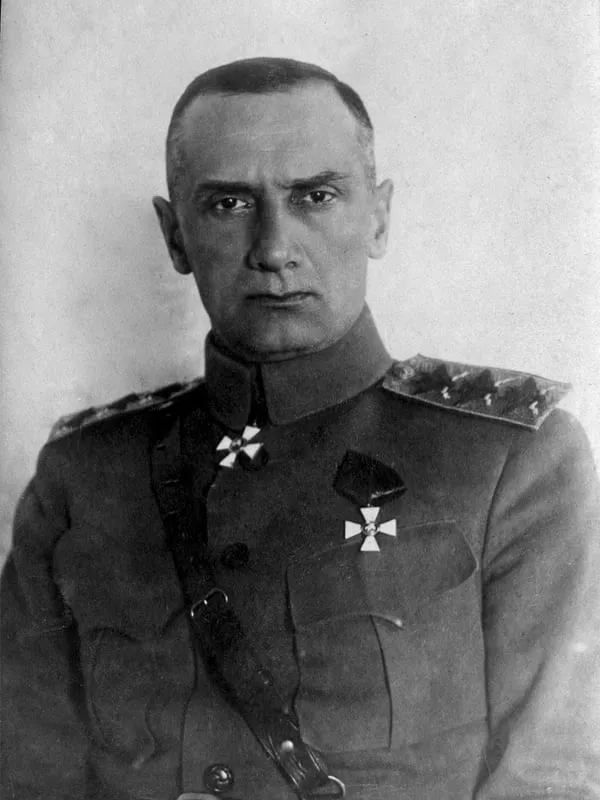
- Born:
- 16 November 1874, Alexandrovskoye near St Petersburg (Russian Empire)
- Died:
- 7 February 1920, Irkutsk (Russia)
- Author:
- Natalia
- Photo:
- autor nieznany, domena publiczna, Wikimedia Commons

Admiral Alexander Vasilyevich Kolchak was one of the most tragic figures of the Russian Civil War. Before he became a politician he had already made his name as an Arctic explorer, a defender of Port Arthur, a master of mine warfare in the Baltic and the youngest vice admiral in the Russian navy. In November 1918 officers in Omsk handed him dictatorial power, and the admiral took the title of Supreme Ruler of Russia, which the other White leaders recognised. In the spring of 1919 his armies came close to the Volga, but in the autumn they fell apart, and he himself, handed over by the Czechoslovaks, died at the hands of the Bolsheviks. His defeat delivered Siberia and the Russian Far East to Soviet power, and the defeat of the Whites sealed the birth of a state that, twenty years later, all of Europe would have to reckon with.
Origins and the Arctic
He was born on 16 November 1874 (4 November in the Julian calendar) at Alexandrovskoye near St Petersburg, in the settlement attached to the armaments works, where his father, a retired major general of the naval artillery and a veteran of the defence of Sevastopol in the Crimean War, worked as an engineer. In 1888 he entered the Naval Cadet Corps, graduating with distinction in 1894. He served in the Baltic and the Pacific and published work on hydrology.
In 1900–1902 he took part, as hydrologist and cartographer, in Baron Eduard Toll’s Russian polar expedition aboard the Zarya, which explored the Taymyr Peninsula and the New Siberian Islands. Toll went on further north with three companions and disappeared. In 1903 Kolchak led a rescue expedition which, by boat and sledge, reached Bennett Island and found traces and notes left by Toll, but not Toll himself. The Russian Geographical Society awarded him the Great Konstantin Gold Medal, and from then on the navy called him “Kolchak the Polar”. His study of the ice of the Kara and Siberian seas was for decades regarded as the standard work on the subject.
Port Arthur
News of the outbreak of the Russo-Japanese War reached him in Yakutia, on his way back from the Arctic. On 5 March 1904 in Irkutsk he married his fiancée Sofia Omirova, who had been waiting for him for years, and set off at once for Port Arthur. Admiral Stepan Makarov, whom Kolchak regarded as his teacher, assigned him to the cruiser Askold. After Makarov’s death Kolchak commanded the destroyer Serdity. According to Russian sources, the Japanese cruiser Takasago sank in December on mines he had laid in August 1904. In the autumn he moved ashore and commanded an artillery battery until the fortress surrendered. Suffering from rheumatism and wounded, he was taken prisoner by the Japanese and sent to a hospital in Nagasaki, from where he was released to Russia. For Port Arthur he received the golden sword “For Bravery”.
Rebuilding the fleet and the Baltic
After the defeat, which destroyed almost the entire Russian fleet, Kolchak was one of a group of young officers who created the Naval General Staff in 1906. He tried to convince members of the Duma that Russia needed modern warships, submarines and naval aviation. In 1909–1910 he commanded the icebreaker Vaygach on a hydrographic expedition to the Chukchi Sea. In 1912 he moved to the Baltic Fleet under Admiral Nikolai von Essen.
In the First World War he was one of the architects of Russian mine warfare. He planned the mining of the Gulf of Finland, and in 1914–1915 he prepared, and personally led, night sorties by destroyers that laid mines in the approaches to German ports on the southern Baltic. From the autumn of 1915 he commanded the Mine Division and the defence of the Gulf of Riga. In 1916 he was promoted first to rear admiral and then, in the summer of the same year, to vice admiral, and took over the Black Sea Fleet – the youngest vice admiral in the history of the Russian navy.
The Black Sea Fleet and the revolution
In the Black Sea Kolchak had the exit from the Bosporus and the Bulgarian ports mined, which bottled up the German-Turkish battlecruiser Goeben and the cruiser Breslau in the Straits and almost paralysed Turkish shipping. The fleet supported the Russian forces in the Caucasus, and the admiral prepared a plan for a landing on the Bosporus that was to give Russia Constantinople. The heaviest loss of his command was the explosion of the magazine aboard the battleship Imperatritsa Mariya at Sevastopol on 20 October 1916 (7 October Old Style). Its cause was never established.
The February Revolution found him at Batumi. He was a monarchist and stood by his oath to the Tsar to the last. General Mikhail Alekseyev, who asked the commanders of the fronts for their views on the abdication of Nicholas II, did not ask the fleet commanders. Kolchak recognised the Provisional Government only once Headquarters (the Stavka) had confirmed it. For several months he maintained discipline in his fleet better than anyone else in Russia, but in the summer of 1917, under the influence of Bolshevik agitators, the sailors demanded that the officers be disarmed. When his turn came on 19 June 1917 (6 June Old Style) aboard the battleship Georgy Pobedonosets, he threw his golden sword from Port Arthur overboard and resigned his command.
In Petrograd the right saw him, alongside General Lavr Kornilov, as a candidate for dictator. Alexander Kerensky got rid of the troublesome admiral by sending him on a military mission to Britain and the United States, where he was to advise on mine warfare and on an operation in the Dardanelles that was supposedly being planned. It turned out that the Americans were planning no such operation. In October he was received by President Woodrow Wilson.
From Japan to Omsk
He learned of the Bolshevik seizure of power in Japan, on his way home. He recognised neither the new regime nor the separate peace with Germany, and offered to fight in the British army, even as a private. He was assigned to Mesopotamia, but was turned back at Singapore and sent to Manchuria. In the spring of 1918 in Harbin he was to organise an armed force against the Bolsheviks from the units guarding the Chinese Eastern Railway, but he fell out with the ataman Grigory Semyonov and with the Japanese, who preferred compliant atamans to an independent admiral. He did, however, become friends with the head of the British military mission, General Alfred Knox.
In the autumn of 1918 he travelled via Vladivostok to Omsk, the seat of the Provisional All-Russian Government, known as the Directory, which was dominated by the Socialist Revolutionaries (SRs). At the beginning of November he became its Minister of War and the Navy. On the night of 17–18 November 1918 Cossacks arrested the SR members of the Directory, and the Council of Ministers handed Kolchak dictatorial power with the title of Supreme Ruler of Russia. The admiral gave assurances that he would not follow “the path of reaction” and that after victory the people themselves would choose their form of government. In the course of 1919 his supreme authority was recognised by Anton Denikin in the south, by General Nikolai Yudenich outside Petrograd and by the Northern Government in Arkhangelsk.
Supreme Ruler
Kolchak knew nothing of land warfare or politics and called himself a “military technician”. The historian Richard Pipes wrote that he was a man of honour and a patriot but a disastrous administrator, in whose name corruption and atrocities were committed that he himself found repugnant. His government restored private ownership of land and factories, dissolved the soviets and suppressed the socialists. In December 1918 a workers’ uprising in Omsk was crushed, and several former members of the Constituent Assembly were murdered in prison without trial. Punitive detachments, atamans and generals such as Sergei Rozanov burned villages and shot hostages, driving the peasants into the partisan movement. On Kolchak’s orders the investigator Nikolai Sokolov looked into the murder of the imperial family in Yekaterinburg.
In March 1919 his armies struck westwards, took Ufa and by the end of April had come close to Kazan and Samara. The Great Powers, which had not recognised his government, made further aid conditional on promises: to convene a new Constituent Assembly, not to restore the old regime and to recognise the independence of Poland and Finland. In June 1919 Kolchak agreed to all the conditions, recognising Finland’s independence only de facto. The Red counter-offensive, however, shattered his armies. Mikhail Frunze retook Ufa and Mikhail Tukhachevsky crossed the Urals. Omsk fell on 14 November 1919. The Supreme Ruler’s trains, and with them the gold reserve of the Russian state, crept eastwards along a railway controlled by the Czechoslovak Legion, which by now wanted only to go home.
Irkutsk
At the end of December the Czechoslovaks halted the admiral’s train at Nizhneudinsk, and in Irkutsk power was seized by the Political Centre of the SRs and Mensheviks. On 4 January 1920 Kolchak renounced his authority in favour of Denikin, handing it over in the east to Semyonov. He travelled to Irkutsk under the protection of Allied flags, but on 15 January the Czechoslovaks, with the consent of the head of the Allied mission, the French General Maurice Janin, handed him over to the city authorities in exchange for free passage east. A few days later the Bolsheviks took power in Irkutsk. A commission of inquiry interrogated the admiral for two weeks, and the records of these interrogations are among the most important sources for his biography.
As the remnants of General Vladimir Kappel’s White forces advanced to his rescue, the Bolshevik revolutionary committee decided to kill the prisoner without trial. A coded note from Vladimir Lenin has survived, instructing that the matter later be presented as a decision of the local authorities, forced on them by the threat from the Whites. Many historians see it as an order to kill. On the night of 6–7 February 1920 Kolchak and his prime minister, Viktor Pepelyayev, were shot and their bodies pushed through a hole in the ice. According to witnesses, the admiral was calm and asked only that his wife in Paris be told he gave his blessing to their son.
Family and memory
Kolchak’s wife Sofia left for France with their son Rostislav in 1919. In the last years of his life the admiral was involved with Anna Timiryova, the wife of another officer, who went with him to prison in Irkutsk of her own free will and was then imprisoned and exiled by the Soviet authorities for decades. Rostislav Kolchak was mobilised into the French army in 1939 and was taken prisoner by the Germans in 1940.
In the Soviet Union Kolchak was a symbol of counter-revolution, and his name vanished from the maps, including from an island in the Kara Sea. In Russia after 1991 he became a hero to some and to others a criminal responsible for the terror in Siberia. Russian military courts and the Supreme Court refused to rehabilitate him in 1999 and 2001; even so, monuments to him were erected in St Petersburg and Irkutsk, and in 2008 a film about him, Admiral, was released.
For the road to the Second World War Kolchak’s defeat mattered in two ways. It consolidated Bolshevik power in Siberia and contributed to the victory of Lenin and his successor Joseph Stalin, and at the same time it showed how fleeting the Great Powers’ support for White Russia was. Japan, which preferred to work with the atamans rather than the admiral, remained in the Russian Far East until 1922, and the White émigrés in Harbin and Manchuria later became an instrument of its policy. The Polish 5th Rifle Division fought alongside the Whites in Siberia, and most of its soldiers ended up in Soviet captivity in 1920. To this day Kolchak divides Russians, as does the whole Civil War in which he died.
Sources
Commanded in battles
(01)Mentioned in battles
(01)Often appears with
People who appear in the same events.