1944: Operation Tempest and the Warsaw Uprising
Operation Tempest
- Dates:
- 15 January – 26 October 1944
- Front:
- Poland
- Location:
- The lands of the Second Polish Republic as the Eastern Front moved west: Volhynia, the Wilno and Nowogródek regions, Lwów and the south-eastern borderlands, Polesie, the Białystok region, the Lublin region, Warsaw, the Kielce region, Lesser Poland and the Łódź regionOn the battle map →
- Sides:
- Poland (Home Army)Tadeusz Bór-Komorowski, Leopold OkulickiNazi Germany
- Result:
- A partial military success and a political defeat. Home Army units, about 100,000 mobilised soldiers in all, fought the Germans and cooperated with the Red Army at Kovel, in Wilno, in Lwów and in the Lublin region, among other places, but after the front passed the NKVD disarmed them and arrested their commanders and the Delegatura's representatives. The USSR recognised neither the Polish authorities nor Poland's rights to the eastern lands. On 26 October 1944 Gen. Okulicki ended the operation.
- Author:
- Natalia
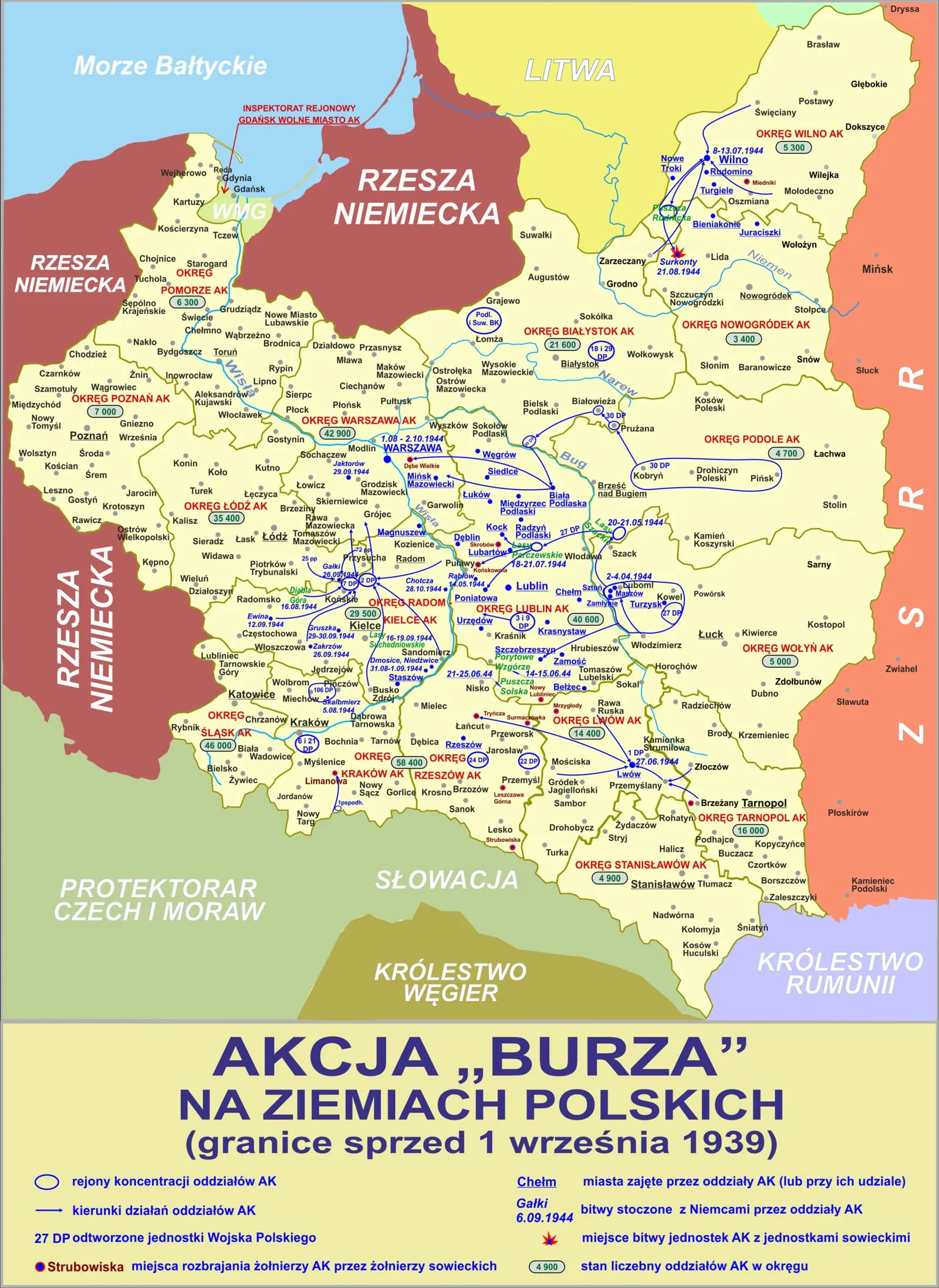
Operation Tempest was the largest military operation of the Home Army and at the same time its greatest political gamble. From January to October 1944, as the Eastern Front moved across the lands of the Second Polish Republic, Home Army units came out of hiding, struck at the rear of the retreating Germans and presented themselves to the advancing Red Army as hosts of the territory: soldiers of the Polish state, an ally of the anti-Hitler coalition, together with the revealing representatives of the civil authorities of the Polish Underground State. According to the most commonly cited estimates, about 100,000 soldiers were mobilised for it. On the battlefield the plan largely succeeded. Politically it ended in defeat: after every joint battle came the NKVD, which disarmed the Polish units, arrested the commanders and deported the soldiers deep into the Soviet Union.
Name and dates
Home Army headquarters documents speak of the “Tempest” plan, the literature of the “Tempest” action or operation; all three terms are in circulation. The codename covered operations conducted in a dozen or so Home Army districts, at different times and on different scales: from the battles of entire re-created divisions, through the seizure of small towns and sabotage on railway lines, to the Warsaw Uprising, which was its largest and most independent part.
The order for “Tempest” was issued by the Commander-in-Chief of the Home Army, Gen. Tadeusz Komorowski, “Bór”, on 20 November 1943. Armed operations began only when the front entered Polish lands. On the night of 3-4 January 1944 the Red Army crossed the pre-war Polish border near Rokitno in Volhynia; some studies, including the Polish Wikipedia, count the duration of the operation from that date. Here, however, its actual beginning is taken to be 15 January 1944, when the command of the Volhynia District of the Home Army announced mobilisation; the historians cited by dzieje.pl also date the start of “Tempest” this way. The first battle with the Germans was fought on 19 January at Zasmyki.
The end is taken to be 26 October 1944, when Bór-Komorowski’s successor, Gen. Leopold Okulicki, “Niedźwiadek”, issued the order to end the operation. This date is conventional. Smaller units still fought in November, especially in the Łódź and Kraków districts, and in January 1945, during the Soviet offensive, the Home Army carried out local armed operations in several western and southern districts, which is why some publications extend “Tempest” to January 1945. The codename “Deszcz” (“Rain”) was used in different districts for different things: in the Kielce region for “Tempest” itself, elsewhere for smaller operations in the autumn of 1944.
Background
From the beginning of the occupation the Polish underground prepared for a general uprising which was to break out at the moment of Germany’s collapse, on the order of the Commander-in-Chief from London. This plan assumed that the Western Allies would liberate Poland or that Germany would collapse from within, as in 1918. After Stalingrad it became clear that the Red Army would liberate the Polish lands and that the Home Army would be fighting a still-powerful German army, not the broken remnants of the occupier. Already in 1943 the Commander-in-Chief, Gen. Stefan Rowecki, “Grot”, was changing the plans in this direction and, as some studies report, warned that the Red Army would come to Poland not as an ally but as “the ally of our allies”. Rowecki was arrested by the Gestapo on 30 June 1943, and further work was carried on by his successor, Gen. Komorowski.
The political situation was decided by the events of spring 1943. When the Germans revealed the Katyn graves and the Polish government appealed to the International Red Cross, Moscow broke off diplomatic relations with the Polish government on 25 April. The government in London, led after General Sikorski’s death by Stanisław Mikołajczyk, foresaw in an instruction of 27 October 1943 that if relations could not be restored, the underground authorities and the Home Army were to remain in hiding and, in the face of repression, switch to self-defence. The Home Army commander and the Government Delegate for Poland, Jan Stanisław Jankowski, considered such a solution harmful: if representatives of the legal Polish authorities were absent from the lands occupied by the Red Army, their place would be taken by Communist organisations subservient to Moscow. Bór-Komorowski wrote that Home Army inaction would allow the “feigning of the Polish nation’s will to create a 17th Soviet republic”.
The order of 20 November 1943 was a compromise between these positions. In the last phase of the occupation Home Army units were to attack the rearguards of the retreating Germans and, towards the Red Army, “appear in the role of host”: reveal themselves to its commanders together with a representative of the civil authority and cooperate with it at the tactical level. Pre-war divisions and regiments were to be re-created from partisan and underground units, with their numbers and names, to stress the continuity of the Polish Army. The plan did not envisage fighting the Red Army, but neither did it recognise any border changes after 1 September 1939: in Volhynia, in Wilno and in Lwów, Home Army soldiers were to appear as soldiers of the Republic on its own territory. It thus passed over in silence what was the core of the dispute, that according to Moscow these were Soviet lands. A few days after the order, Churchill and Roosevelt agreed at the Tehran Conference that Poland’s eastern border should run approximately along the Curzon Line.
Large cities were at first excluded from “Tempest” in order to spare their inhabitants and monuments; Warsaw was to remain outside the fighting. Disagreements did not cease in London either. The Commander-in-Chief, Gen. Kazimierz Sosnkowski, viewed revealing oneself to the Red Army with growing mistrust, although on 12 February 1944 he agreed that “the will of the country is a factor which cannot simply be brushed aside”. In parallel, in the deepest secrecy, the cadre organisation NIE was being prepared, which was to survive a possible Soviet occupation.
Course: Volhynia (January-July 1944)
Volhynia was the first and hardest proving ground of “Tempest”. Since 1943 the Polish population had been defending itself here against the massacres carried out by the UPA, and Home Army and self-defence units had come into being above all to protect it. On 16 January 1944 the district commander, Col. Kazimierz Bąbiński (PL), “Luboń”, ordered a concentration of forces in the western part of Volhynia, around Kovel and Volodymyr-Volynskyi, and on 28 January decided to form the 27th Volhynian Infantry Division of the Home Army. At the time of mobilisation it numbered between 6,000 and 7,000 soldiers; from February it was commanded by Lt Col. Jan Wojciech Kiwerski, “Oliwa”. The division seized an area of about 80 by 40 kilometres and fought both the Germans and the UPA, which threatened its bases.
In March the division’s units found themselves in the front-line zone and established cooperation with the Red Army. Kiwerski agreed with the Soviet command on joint action in the Kovel operation: the Poles tied down German forces between the Turiya and the Bug, cut railway lines and roads, and on 12 April, together with Soviet guards cavalry, made an unsuccessful attack on Volodymyr-Volynskyi. A German counterattack, conducted among others by the SS Panzer Division “Wiking”, closed the ring around the division and the Soviet units cooperating with it on 15 April. On 18 April Kiwerski was killed. On the night of 20-21 April part of the division broke out of the encirclement; in the Kovel fighting, according to Polish studies, about 350 soldiers were killed and about 1,600 were dispersed.
After further weeks of fighting in the Szack forests the division, on the order of headquarters, crossed the Bug (the staff at the end of May, the main forces on the night of 9-10 June 1944) and headed for the Parczew forests in the Lublin region. Between January and June it fought more than a hundred battles and skirmishes. In Volhynia and Podolia the pattern that was to be repeated throughout the year was already apparent: Soviet commanders were glad to use the help of Polish units in the fighting, but had no intention of recognising them as the army of a foreign state. In Sarny a Soviet commander is said to have told a Polish starosta who had revealed himself: “You are fools, comrade, what starosta are you talking about.”
Course: the Wilno and Nowogródek regions (July 1944)
In the summer of 1944 the Soviet offensive in Belarus, Operation Bagration, gave “Tempest” a completely new tempo. At a briefing in Warsaw on 12 June the commanders of the Wilno and Nowogródek districts heard that seizing larger cities was necessary if Poland was to appear in the role of host. This is how the plan for Operation Ostra Brama was born: the forces of both districts under Lt Col. Aleksander Krzyżanowski, “Wilk”, were to attack Wilno themselves before the Russians entered it.
“Tempest” in the Wilno and Nowogródek regions began on 2 July. The attack on Wilno, hastened by the approach of the front, began on 7 July in daylight, without concentrating all the brigades, and broke down before the German fortifications. The same day the leading elements of the 3rd Belorussian Front reached the city, and in the following days Home Army units fought in the city alongside the Red Army until the German garrison surrendered on 13 July. A few days later, on 17 July, the NKVD arrested “Wilk” and some of his officers, invited to talks. According to a report by Ivan Serov and Gen. Ivan Chernyakhovsky for Stalin, more than 6,000 Home Army soldiers were disarmed; about 4,000 ended up in the camp at Miednik Królewski (PL), and from there, after refusing to join the army of Gen. Zygmunt Berling, the officers were deported to near Ryazan and the rank and file to Kaluga. Some brigades managed to disperse and return to conspiracy.
Course: Lwów and the south-eastern borderlands (July 1944)
In the south-east “Tempest” covered the Lwów, Tarnopol and Stanisławów sub-districts from mid-July. When Marshal Ivan Konev’s 1st Ukrainian Front reached Lwów in the Lwów-Sandomierz Offensive, Home Army units under Col. Władysław Filipkowski, “Janka”, joined the fighting, according to Polish literature about 3,000 soldiers in the city itself. From 22-23 July they fought alongside Soviet tanks and seized part of the districts. On 27 July the Germans left the city. Then the Wilno scenario repeated itself: at the Russians’ demand the Home Army units laid down their arms, Filipkowski and his officers flew to talks in Zhytomyr, where on the night of 2-3 August they were arrested, and in Lwów the NKVD also detained the district Government Delegate, Adam Ostrowski. Units that, after the fighting ended, set out from near Lwów to help Warsaw were treated in the same way.
Course: Polesie, the Białystok region and the Lublin region (July-August 1944)
In Polesie “Tempest” lasted only two weeks, from 15 to 30 July. The re-created 30th Infantry Division of the Home Army (PL), about a thousand soldiers strong, fought the Germans in the area of Brest, Kobryn and Bereza Kartuska, then ignored the Soviet demand to incorporate it into Berling’s army and set off west, towards fighting Warsaw; on the way it was surrounded and disarmed by Soviet troops.
In the Białystok district, where the Home Army was re-creating the 18th and 29th Infantry Divisions and the Suwałki and Podlasie Cavalry Brigades, operations lasted from mid-July to the second half of August, and individual units fought until the autumn. According to the English Wikipedia, based on Polish studies, about 7,000 soldiers took part in more than 200 engagements. But now not only Soviet armies passed through the district, but also their rear services; the Białystok Home Army felt repression longest and most severely, and the following year its soldiers were hit by the Augustów roundup.
In the Lublin region, where the Lublin District of the Home Army (PL) numbered, according to the IPN, about 60,000 sworn soldiers, “Tempest” began on 20 July, when the Red Army crossed the Bug. Within a few days Home Army units (the re-created 3rd and 9th Infantry Divisions, the 27th Volhynian Infantry Division, which had arrived from beyond the Bug, and smaller groupings, supported by the Peasant Battalions) attacked the retreating Germans on roads and railway lines. According to IPN historians’ findings, by 29 July the Home Army had seized seven localities on its own and a further eleven together with the Red Army. The 27th Division took, among others, Lubartów, Kock and Firlej, the 9th Division cooperated in the capture of Tomaszów Lubelski, and Home Army units also fought in Lublin itself, taken by the Russians on 24 July.
Here the end of “Tempest” came fastest. On 25 July at Skrobów the officers of the 27th Division were invited to a meeting with a Soviet general, while its units were surrounded and forced to lay down their arms; a day later the division was disbanded. Soldiers of the 3rd, 8th, 9th and 30th Divisions were also disarmed. The NKVD arrested the district commander, Col. Kazimierz Tumidajski (PL), “Marcin”, the commanders of the 3rd and 9th Divisions and the district Government Delegate. Some of the detained soldiers were put in an NKVD camp set up in the just-liberated German concentration camp at Majdanek, from where many were deported deep into the USSR. In those same days the Polish Committee of National Liberation, created in Moscow, installed itself in Lublin and proclaimed itself the only legal authority in Poland.
Course: Warsaw and the central districts (August-October 1944)
As reports from Wilno and Lublin reached headquarters at the end of July, the front was approaching Warsaw. The Home Army command decided that the capital, originally excluded from “Tempest”, could not be given up without a fight, and began the uprising there on 1 August. It was to be a “Tempest” on the greatest scale: taking the city with its own forces and receiving the Red Army through the legal Polish authorities. The Red Army did not resume its advance on Warsaw for six weeks, and the uprising ended on 2 October with capitulation, the destruction of the city and the deaths, according to the most frequently cited calculations, of about 16,000 insurgents and 150,000-200,000 civilians.
In the Radom-Kielce district “Tempest” lasted from 1 August to 6 October. Units of the Home Army’s 2nd Infantry Division helped the Russians hold the Sandomierz bridgehead (on the night of 31 July-1 August the group of Capt. Michał Mandziara (PL), “Siwy”, repulsed a German counterattack on the Koprzywianka) and on 3 August, together with Soviet tanks, took Staszów. On 14 August Bór-Komorowski ordered Operation “Zemsta” (“Revenge”), a march of armed units to the aid of Warsaw. The Kielce Corps of the Home Army, formed within it under Col. Jan Zientarski (PL), “Mieczysław”, numbered 6,430 men, but given the strength of German forces on the road to the capital the march was halted, and on 27 August the Commander-in-Chief approved that decision; the corps was disbanded. In Mazovia, units from the Kampinos Forest, organised in “Group Kampinos”, did join the fighting in the capital.
In the Kraków District, one of the largest in the Home Army, “Tempest” began on 23 July in its eastern part, around Rzeszów and Przemyśl, where the 22nd and 24th Infantry Divisions of the Home Army were being mobilised. An uprising in Kraków itself was considered, but abandoned. Fighting by smaller groupings continued here until November, and in the Łódź district from 14 August to 26 November.
End of the operation
After the fall of the Warsaw Uprising, Gen. Okulicki, designated by Bór-Komorowski as his successor, moved to the Częstochowa area. Around 8 October he proposed to the Staff of the Commander-in-Chief in London that conclusions be drawn from the contacts with the Red Army so far and that “Tempest” be halted. On 26 October 1944 he issued the order to end the operation. Forest units were demobilised and groupings were left in skeleton form; the government in London, in an instruction of November, already envisaged the dissolution of the Home Army, and “Niedźwiadek” was taking over the leadership of the “NIE” organisation.
Losses
The full losses of “Tempest” cannot be stated. Those killed in fighting the Germans are counted separately for individual districts: in Volhynia about 350 soldiers of the 27th Division were killed in the Kovel fighting alone, and in the Warsaw Uprising about 16,000 insurgents. The victims of Soviet repression are harder still to count. According to estimates cited by dzieje.pl, the NKVD imprisoned about 50,000 Home Army soldiers who took part in “Tempest”, mainly for refusing to join Berling’s army, and 20,000 to 30,000 people were deported deep into the USSR, from where most did not return. In many places Home Army soldiers were shot; in the borderlands and the Lublin region roundups and arrests continued throughout the autumn of 1944 and the following years.
Significance
Militarily, “Tempest” largely achieved its aims. Home Army units fought the Germans in several hundred battles and skirmishes, helped the Red Army to cross rivers and take cities, and the re-creation of pre-war divisions showed that the Polish Army in the homeland existed and fought. At the end of August 1944 the British and American governments recognised the Home Army as part of the Polish Armed Forces, entitled to combatant rights.
Politically the plan failed completely. Stalin had no intention of recognising either the government in London or Poland’s rights to Wilno and Lwów, and units subordinate to that government were for him an obstacle to building the authority of the PKWN. The Western Allies, informed by Home Army intelligence about the arrests, did not react in a way that could have changed Soviet policy; Moscow continued to portray the Home Army as weak and unwilling to fight. Revealing themselves to the Red Army meant for thousands of soldiers prison and the gulag, and the experience of Volhynia, Wilno, Lwów and Lublin led headquarters to the decision to fight in Warsaw before the Russians entered it.
The assessment of “Tempest” divides historians. Critics, among them some émigré commanders, consider that revealing structures to the NKVD was doomed to failure from the outset and made it easier for the Soviets to smash the underground. Defenders, such as Prof. Wiesław Jan Wysocki, stress that passivity would have surrendered the initiative to the Communists, and that, as he put it, “the fight was a necessity. For freedom, independence, for the integrity of the Republic.” Whatever the verdict, “Tempest” was the last attempt to decide Poland’s fate by Poland itself, before the decisions were taken at Yalta.
Places·Warsaw·Łódź·Lublin·Lwów·Wilno·Lublin region·Volhynia·Polesia·Wilno region·Eastern Borderlands
Sources
- Akcja „Burza” · Wikipedia (pl)
- dzieje.pl
- dzieje.pl · prof wysocki o akcji burza walka byla koniecznoscia
- ipn.gov.pl · 186438,Slawomir Poleszak Mariusz Zajaczkowski Zwalczanie podziemia antykomunistycznego
- 27 Wołyńska Dywizja Piechoty · Wikipedia (pl)
- Akcja „Burza” w Okręgu Radom-Kielce Armii Krajowej · Wikipedia (pl)
- Leopold Okulicki · Wikipedia (pl)
- NIE · Wikipedia (pl)
- Operation Tempest · Wikipedia (en)