Russia
Georgy Chicherin
People's Commissar for Foreign Affairs of Soviet Russia (1918–1923) and the USSR (1923–1930)
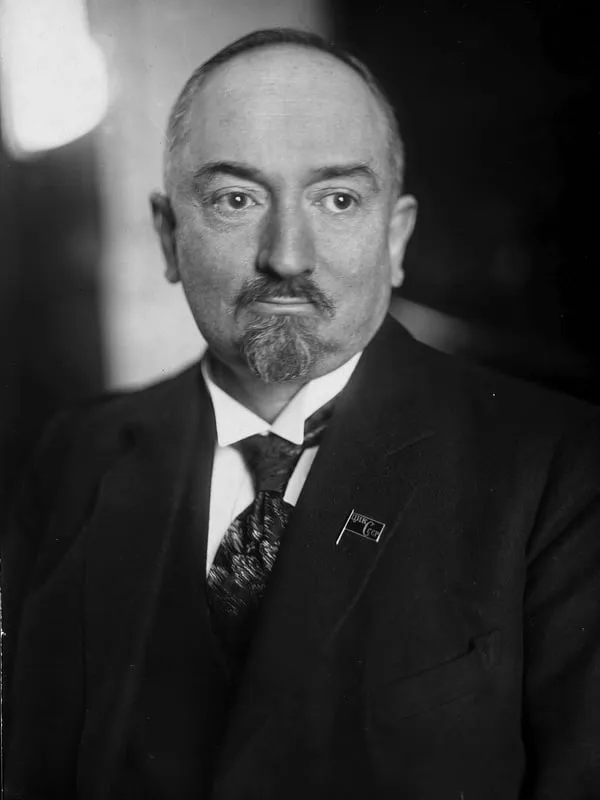
- Born:
- 24 November 1872, Karaul estate (Tambov Governorate, Russian Empire)
- Died:
- 7 July 1936, Moscow
- Author:
- Łukasz
- Photo:
- autor nieznany, domena publiczna, Wikimedia Commons

For twelve years Georgy Chicherin directed the foreign policy of a state that wanted to overthrow every other government in the world and yet had to talk to them, trade with them and sign treaties with them. The descendant of an old noble family and a former official of the tsarist Foreign Ministry, a polyglot and a connoisseur of music, he signed the Treaty of Brest-Litovsk for the Bolsheviks in 1918, and in 1922 at Rapallo he concluded with Germany the agreement that broke Soviet Russia’s isolation. He was the chief architect of the “Rapallo line” – close cooperation with Germany – which in the 1920s was the foundation of Soviet diplomacy and a constant threat to Poland. He did not live to see the Great Purge or the Molotov–Ribbentrop Pact, but he paved the way for them.
Aristocrat and revolutionary
He was born on 24 November 1872 (12 November by the Julian calendar) on the Karaul estate in Tambov Governorate, into an old noble family. His father, Vasily Chicherin, was a diplomat; his mother came from the Baltic baronial family of Meyendorff; and his uncle Boris was a well-known jurist and philosopher. His parents brought him up in a strict, pietistic faith. He graduated with distinction from a gymnasium in St Petersburg and in 1891–1895 studied history and philology at the university there. He spoke several European languages fluently and studied many others, including oriental ones. He played the piano, admired Wagner and Mozart, and the poet Mikhail Kuzmin was a friend of his youth.
In 1898, like his father before him, he entered the service of the Foreign Ministry and worked in its archive, where he helped write a history of the ministry. Increasingly, however, he was drawn to left-wing ideas. In 1904 he went to Germany for medical treatment and never came back. He soon joined the Russian Social Democratic Labour Party and aligned himself with its Menshevik faction. He devoted much of the fortune he had inherited to revolutionary activity. In 1907 he became secretary of the party’s foreign bureau. At the end of that year he was arrested in Berlin for using someone else’s passport and expelled from Prussia. He moved to Paris, where he was active in the French Socialist Party, and in 1914 to London.
From Brixton to Brest
During the war Chicherin, formerly a Menshevik, moved closer to the position of the Bolsheviks, who demanded an end to the war. In London he ran a committee to aid Russian political prisoners and exiles, which under his direction became a centre of agitation against tsarism and the war. After the February Revolution he helped émigrés return to Russia but did not stop preaching against the war. On 22 August 1917 the British authorities arrested him as a threat to national security and held him in Brixton prison. After the October Revolution the People’s Commissar for Foreign Affairs, Leon Trotsky, demanded his release and threatened that British subjects would not be allowed to leave Russia. Chicherin was freed on 3 January 1918, and by the second half of January he was in Petrograd. He joined the Bolshevik party and became Trotsky’s deputy.
He landed in the very midst of the young regime’s hardest decision. The Bolsheviks were negotiating at Brest-Litovsk with Germany and its allies, and after breaking off the talks and suffering the German offensive of February 1918 they had to accept far worse terms. It was Chicherin who travelled to Brest together with Grigory Sokolnikov, and on 3 March 1918 he was one of the signatories of the Treaty of Brest-Litovsk. Russia lost territories stretching from Finland and the Baltic lands to Ukraine. When Trotsky moved to the Commissariat for War, Chicherin ran the Commissariat for Foreign Affairs from March, and on 30 May 1918 he formally became People’s Commissar. In the summer of 1918 Vladimir Lenin wrote that Chicherin was an “excellent, extremely conscientious, intelligent and knowledgeable” worker whose only weakness was a lack of the ability to command.
Diplomat of the revolution
Chicherin had to build the diplomacy of a state that almost nobody recognised and that itself proclaimed old-style diplomacy to be a bourgeois relic. He worked almost without a break, usually at night, received visitors after midnight and was unable to delegate to his subordinates. In 1919 the British writer Arthur Ransome described him as a permanently exhausted man whose office opened in the late afternoon and worked until four in the morning. In 1918 he had to deal with the consequences of the assassination of the German envoy, Wilhelm von Mirbach, by the Left Socialist Revolutionaries, and in March 1919 he took part in the founding congress of the Comintern.
During the war with Poland he wrote notes to the government in Warsaw – in February 1919 to Ignacy Jan Paderewski, proposing talks on the disputed issues – and in July 1920, as the Red Army marched on Warsaw, he rejected a British offer of mediation based on the so-called Curzon Line. After the defeat at Warsaw the peace with Poland was negotiated in Riga by Adolph Joffe, but the line was set by Chicherin’s commissariat. The year 1921 brought a series of treaties with the southern neighbours: with Persia (26 February), Afghanistan (28 February) and the government of Mustafa Kemal in Ankara (the Treaty of Moscow of 16 March). In the same month the Peace of Riga and a trade agreement with Britain were signed.
Rapallo
His greatest fame came from the Genoa Conference in the spring of 1922, the first major conference since the revolution to which Soviet Russia was invited. Chicherin led a delegation that included Maxim Litvinov, Leonid Krasin and Joffe. At the opening session he gave a speech in French proposing general disarmament, which surprised and irritated the hosts. When the Western powers demanded repayment of the tsarist debts and compensation for nationalised property, he played on the fears of the Germans, who had been sidelined from the talks, and on 16 April 1922 he signed the Treaty of Rapallo with the German Foreign Minister Walther Rathenau. The two states established diplomatic relations and renounced their claims against each other, and the united front of Russia’s creditors fell apart.
From then on rapprochement with Germany was the axis of Chicherin’s policy. He believed that the two states wronged by Versailles shared common interests, above all with regard to Poland and to Britain, which he had regarded since tsarist times as Russia’s chief rival in Asia. He formed a close friendship with the first German ambassador in Moscow, Count Ulrich von Brockdorff-Rantzau, with whom he would meet for late-night talks. He knew of and supported the secret cooperation between the Reichswehr and the Red Army, although it was conducted mainly by the military.
Commissar of the USSR
In 1922–1923 he led the Soviet delegation at the Lausanne Conference, where he argued that the Turkish Straits should be closed to foreign warships. In May 1923, in Lausanne, a Russian émigré shot dead the Soviet diplomat Vatslav Vorovsky. After the creation of the Soviet Union Chicherin became People’s Commissar for Foreign Affairs of the USSR. In 1924 the Soviet state was recognised by, among others, Britain, Italy and France, and in 1925 by Japan, with which the Basic Convention was concluded. In the autumn of 1925, while Germany was negotiating with the West at Locarno, Chicherin travelled to Berlin, stopping in Warsaw on the way, and demanded guarantees that Germany would not join an anti-Soviet front. Their fruit was the Treaty of Berlin of 24 April 1926 on mutual neutrality. In December 1925 he signed a treaty of friendship and neutrality with Turkey in Paris, and in 1927 a treaty with Persia. From 1925 to 1930 he was a member of the party’s Central Committee.
More and more often, however, he was ill. He suffered from severe diabetes and nervous disorders, and in 1926–1927 and from the autumn of 1928 to January 1930 he was under treatment in Germany and on the Riviera. The commissariat was in practice run by his deputy Litvinov, with whom Chicherin had been at odds for years. They differed in character and in outlook: Chicherin put his faith in Germany, Litvinov in an understanding with Britain and France. The role of Joseph Stalin was also growing; he valued Chicherin’s expertise but increasingly made policy himself. In July 1930 Chicherin officially stepped down and was succeeded by Litvinov.
Last years
In a memorandum for his successor Chicherin bitterly listed the “internal enemies” of Soviet diplomacy. The first was the Comintern, whose pronouncements, backed by Soviet leaders, spoiled relations with other states. The second was the GPU, the political police, which arrested foreigners without consulting the commissariat, harassed embassy staff and recruited their servants. He also wrote that Soviet radio, by calling on German soldiers to disobey, made normal relations with Germany impossible. He spent his last years in Moscow, sidelined from politics, gravely ill and absorbed in music. He wrote a book on Mozart, which was published only after his death. He died in Moscow on 7 July 1936 and was buried in the Novodevichy Cemetery. The newspapers bade him farewell with respect, but during the Stalin years his name was seldom mentioned.
Significance
Chicherin was the creator of the Soviet diplomatic service and the first to convince the world that agreements could be made with the Bolsheviks. His policy rested on a simple observation: Soviet Russia and Germany, defeated and humiliated after 1918, had a common interest in weakening the Versailles order and in revising the borders of reborn Poland. The Treaty of Rapallo and the Treaty of Berlin gave Moscow a partner and gave Germany cover for secret rearmament deep inside Russia.
In the 1930s his successor Litvinov tried to replace this line with a system of collective security against Hitler. When in May 1939 Stalin replaced Litvinov with Vyacheslav Molotov, he essentially returned to the logic of Rapallo, only in a far more brutal form: the pact of 23 August 1939 invoked the neutrality treaty of 1926, and its secret protocol divided Poland between Germany and the Soviet Union. Chicherin did not live to see that day, nor the Great Purge, in which his former colleagues perished, among them Krestinsky and Karakhan. His death in 1936 spared him the fate of many Old Bolsheviks.
Sources
Often appears with
People who appear in the same events.