Germany
Gustav Stresemann
Reich Chancellor (1923), Foreign Minister of Germany (1923–1929), Chairman of the German People's Party (1918–1929)
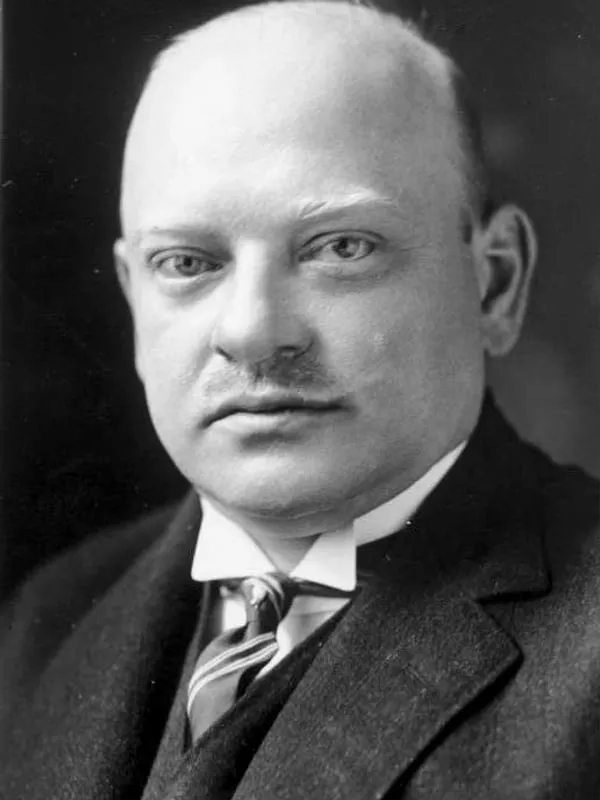
- Born:
- 10 May 1878, Berlin
- Died:
- 3 October 1929, Berlin
- Author:
- Łukasz
- Photo:
- autor nieznany, CC BY-SA 3.0 DE, Wikimedia Commons

Gustav Stresemann was the most outstanding statesman of the Weimar Republic. During the First World War he was one of the loudest advocates of German conquest, and after the defeat he turned from a monarchist into a “republican of reason”. In the autumn of 1923, as Chancellor, he ended passive resistance in the Ruhr and prepared the end of hyperinflation. For the next six years, as Foreign Minister, he pursued a policy of understanding with the West: the Dawes Plan, the Locarno treaties, Germany’s entry into the League of Nations, the Young Plan. For the reconciliation with France he received the Nobel Peace Prize together with Aristide Briand. Yet he wanted the same as the nationalists, only by different means: to throw off the burdens of Versailles and to revise the border with Poland. He died in October 1929, three weeks before the Wall Street Crash. His death and the Great Depression closed a brief period in which it seemed that Germany would come to terms with the post-war order.
The son of a Berlin brewer
Gustav Ernst Stresemann was born on 10 May 1878 in Berlin, in a working-class district on Köpenicker Straße. He was the youngest of several children. His father bottled and delivered beer and ran a small tavern in the family home. The family was not rich, but it could afford a grammar school for its gifted son, who was passionate about history, Napoleon and Goethe. He studied political economy, history and law in Berlin and at Leipzig, where in 1901 he gained his doctorate with a thesis on the Berlin bottled-beer industry. Even as a student he wrote for newspapers and combined liberalism with fervent nationalism, a combination that was to mark him for the rest of his life.
He began his career as an official of business associations in Saxony. In 1902 he founded the Association of Saxon Industrialists, which represented medium-sized and small firms against the great cartels. In 1903 he married Käte Kleefeld, the daughter of a wealthy Berlin businessman of Jewish descent. They had two sons. Nationalists and Nazis later exploited his wife’s origins in antisemitic attacks on Stresemann.
National Liberal
In 1907 Stresemann entered the Reichstag for the National Liberal Party as one of its youngest members and became a close associate of its chairman, Ernst Bassermann. He supported the expansion of the navy and colonial policy, but also social reform. He lost his seat in 1912 and returned to the Reichstag at a by-election in 1914.
During the war, exempted from service on grounds of poor health, he was one of the loudest annexationists in parliament. He demanded Belgium for Germany, part of northern France, vast territories in the east and colonies; he supported unrestricted submarine warfare and close cooperation with the Supreme Army Command of Erich Ludendorff. In 1916, on a journey to Constantinople, he learned of the scale of the Armenian genocide and noted it in his diary, but did not protest. At the same time he favoured internal reform: abolition of the Prussian three-class franchise and the responsibility of the chancellor to the Reichstag. In July 1917, together with Matthias Erzberger and with the approval of the high command, he helped bring down Chancellor Theobald von Bethmann Hollweg. After Bassermann’s death he became leader of the National Liberal parliamentary group in the autumn of 1917. The defeat and the revolution of November 1918 came as a shock to him, for which he paid with a breakdown in his health.
From monarchist to republican of reason
The left-wing liberals who founded the German Democratic Party in November 1918 did not want a wartime annexationist in their ranks. So Stresemann, with the right wing of the old National Liberals, founded the German People’s Party (DVP) and on 15 December 1918 became its chairman. The party, financed largely by heavy industry, was at first monarchist and distrustful of the republic. It voted against the Weimar constitution and against the Treaty of Versailles, which Stresemann regarded as a disgrace. During the Kapp Putsch in March 1920 he behaved ambiguously and tried to mediate between the putschists and the government, for which the left long accused him of opportunism.
In time, however, he came to understand that Germany could regain its position only on the basis of the new order, not in defiance of it. He regarded the economy as the only strength Germany had left: industry, exports and credit, which provided leverage with America and Britain. The political murders, above all the assassination of Walther Rathenau in June 1922, persuaded him to defend the republic against the extreme right. At heart he remained a monarchist, but he accepted the republic as the lesser evil. The Germans called such people Vernunftrepublikaner, republicans of reason.
A hundred days as chancellor
1923 was the hardest year of the republic. Since January the occupation of the Ruhr and passive resistance, financed by printing money, had been under way, and the mark was disintegrating in hyperinflation. When Wilhelm Cuno’s government fell in August, President Friedrich Ebert appointed Stresemann Chancellor on 13 August 1923. He headed a grand coalition stretching from the Social Democrats to his own DVP and also took the Foreign Ministry himself.
He concluded that resistance in the Ruhr had no chance and that printing more money would destroy the state. The French Prime Minister, Raymond Poincaré, refused to discuss any terms. On 26 September 1923 the government announced the end of passive resistance. The right denounced Stresemann as a traitor. That same day Bavaria declared a state of emergency and handed power to Gustav von Kahr, while Ebert declared a state of emergency throughout the Reich and transferred executive power to the Reichswehr Minister. The Bavarian authorities refused to obey Berlin, and Hans von Seeckt made it clear that the army would not march against Bavaria. At the same time the communists entered the state governments of Saxony and Thuringia, and the Comintern was planning a “German October”. Stresemann backed a Reich execution against Saxony: at the end of October the army removed the Saxon government, and in Hamburg the communists staged a short-lived uprising. On 8–9 November Adolf Hitler and Ludendorff tried to seize power in Munich and march on Berlin. The Munich Putsch collapsed under the fire of the Bavarian police.
In those same weeks the government prepared a currency reform. On 15 November 1923 the Rentenmark was introduced and inflation stopped. The Social Democrats, outraged that the government had acted firmly against left-wing Saxony while treating right-wing Bavaria leniently, left the coalition. On 23 November Stresemann lost a vote of confidence in the Reichstag and resigned. He had been chancellor for just over a hundred days, but it was in that time that the republic survived its most dangerous crisis.
Foreign Minister
From 30 November 1923 until his death, in the successive governments of Wilhelm Marx, Hans Luther and Hermann Müller, Stresemann was Foreign Minister. His strategy was called the policy of fulfilment, but he himself understood it as a road to revision: Germany was to carry out the treaty loyally, regain trust and credit, and then throw off its burdens step by step. In 1924 Germany accepted the Dawes Plan, which spread reparations out in instalments and opened the way to American loans. Thanks to it France and Belgium withdrew their troops from the Ruhr.
In February 1925 Stresemann proposed to France a pact guaranteeing the Rhine frontier. In the autumn, at Locarno in Switzerland, the Locarno treaties were agreed; they were signed in London on 1 December 1925. Germany voluntarily recognised its borders with France and Belgium and the demilitarisation of the Rhineland, with Britain and Italy as guarantors. Stresemann did not recognise the borders with Poland and Czechoslovakia. With those countries he signed only arbitration agreements, which ruled out the use of force but not a change of the border. The Poles said that Locarno had divided Germany’s borders into better and worse ones. Since June 1925, moreover, a German–Polish customs war had been under way, and Stresemann hoped that an economic crisis would force Poland to give up the “Corridor” and Gdańsk (Danzig).
At the same time he cultivated good relations with Moscow, to which Germany was bound by the Treaty of Rapallo. In April 1926 he signed the Treaty of Berlin with the Soviet Union, in which both sides undertook to remain neutral if the other were attacked by a third state. In September 1926 Germany joined the League of Nations with a permanent seat on the Council. On 10 September Stresemann spoke in Geneva, and Aristide Briand proclaimed the end of wars between France and Germany. A few days later the two ministers met over lunch at Thoiry and discussed an early evacuation of the Rhineland and the return of the Saar, but nothing came of these plans. For Locarno, Stresemann and Briand received the Nobel Peace Prize for 1926. In the same year the prize for 1925, held over for a year, was awarded to Austen Chamberlain and Charles Dawes.
In a letter of 7 September 1925 to the former Crown Prince Wilhelm, Stresemann set out his aims: a solution of the reparations question, protection of the twelve million Germans living under foreign rule, a correction of the eastern borders – that is, the recovery of Danzig and the “Corridor” and a change of the border in Upper Silesia – and, in the more distant future, union with Austria. Historians argue over how sincere the letter was and how far it was written for a right-wing recipient. What is certain is that Stresemann was a German nationalist, but one who believed in peaceful revision and in Germany’s economic strength, not in war.
Last years
In August 1928 Stresemann signed the Kellogg–Briand Pact renouncing war in Paris. On the right he was hated more and more: to the nationalists he was a “fulfilment politician”, a Freemason and the husband of a Jewish woman. In 1929 he negotiated the Young Plan, which reduced the annual reparations instalments and abolished foreign control over the German economy. At the Hague conference in August 1929 he obtained the powers’ consent for the last Allied soldiers to leave the Rhineland by 30 June 1930, five years ahead of schedule. The nationalist Alfred Hugenberg and Hitler responded with a joint campaign against the Young Plan and a demand that ministers who signed it should be punished with penal servitude for high treason.
Stresemann had been seriously ill for years, suffering from kidney and heart disease, and in 1928 he had his first stroke. Even so, he did not rest. On the night of 2–3 October 1929, after an exhausting day in which, according to accounts, he had been persuading his party’s deputies to accept a compromise that would save the coalition, he suffered two strokes and died in the early morning of 3 October in Berlin. He was 51. His funeral on 6 October drew hundreds of thousands of people.
Legacy
Three weeks after his death the Wall Street Crash set off the Great Depression, which cut Germany off from the American credit on which Stresemann had built his policy. A year later, in the elections of September 1930, the NSDAP became the second-largest party in the Reichstag, and his own party began to dwindle. The last French soldiers left the Rhineland, as he had planned, on 30 June 1930, but in a country gripped by crisis few remembered whom they had to thank for it. Hitler achieved some of the aims Stresemann had described in his letter to the Crown Prince, but by methods Stresemann rejected: breaking treaties, terror and war.
Stresemann remains a contested figure. To some he was a European and a forerunner of Franco-German reconciliation; to others a skilful nationalist who wanted to restore Germany’s great-power status and take Poland’s western lands from it, only without guns. Most historians see him as a realist who understood that Germany could not win a new war and who gave Europe a few years of genuine détente. Gordon Craig wrote that no German politician since Bismarck had shown such great diplomatic talent. Whether the republic would have survived the Great Depression had he lived longer remains an open question.
Sources
Often appears with
People who appear in the same events.