- Category:
- Crimes and repression
- Front:
- Poland
- Date:
- 5 August 1944
- Author:
- Łukasz
- Battle:
- Warsaw Uprising
- Tags:
- Poland, Third Reich, civilians, Heinrich Himmler
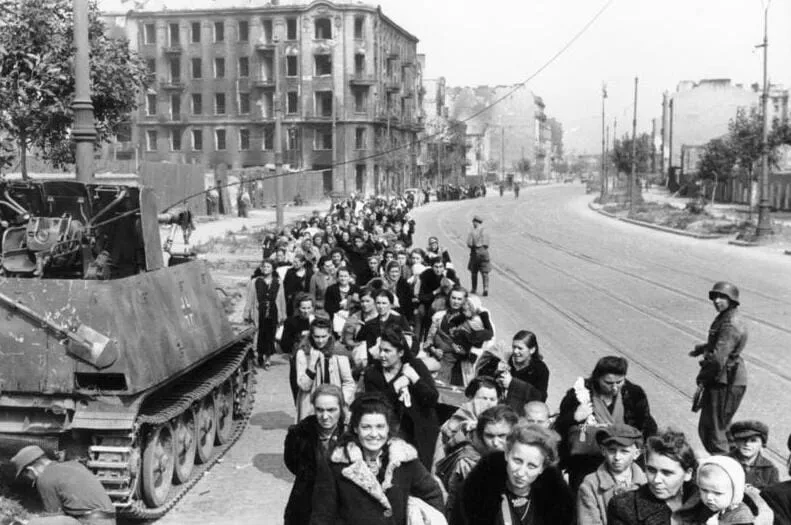
On Saturday 5 August 1944, the fifth day of the Warsaw Uprising, German police and SS units attacked Wola from the west – a working-class district of Warsaw through which ran the most important road to the Kierbedź Bridge. Alongside the assault on the insurgents’ barricades began the systematic murder of the inhabitants: men, women and children, patients in hospitals, monks and priests. People were killed in flats and cellars, in the courtyards of tenement blocks, on factory premises, in parks and in cemeteries. Most of the victims died in the space of three days, 5, 6 and 7 August, but individual and mass executions continued in Wola for weeks afterwards. In Polish memory 5 August is called “Black Saturday”, and the whole event the Wola massacre.
Some chronologies record under this date that “German and collaborationist Russian forces” murdered 40,000–50,000 civilians in Wola. Both elements need qualifying. The main perpetrators were Germans – policemen from the Warthegau, SS men of the Dirlewanger regiment and gendarmes – supported by Azerbaijani units (companies of the Bergmann battalion and Battalion I/111); the Russian collaborationist RONA brigade was murdering at the same time in neighbouring Ochota. The number of victims is not known: estimates by Polish and German historians range from about 10,000–15,000 to more than 60,000, and 40,000–50,000 is one of many approximations.
The order to destroy Warsaw
The leaders of the Third Reich treated the outbreak of the uprising on 1 August as an opportunity to settle accounts once and for all with a city that the occupiers had from the start regarded as the centre of Polish resistance. As early as December 1943 Governor-General Hans Frank had noted in his diary that, were it not for Warsaw, the Germans would not have four-fifths of their troubles in the General Government. Adolf Hitler, still distrustful of his generals after the attempt on his life of 20 July, entrusted the suppression of the uprising not to the Wehrmacht but to the Reichsführer-SS, Heinrich Himmler.
The content of the order is known only from post-war accounts. According to the testimony of SS-Obergruppenführer Erich von dem Bach-Zelewski, it ran: every inhabitant was to be killed, no prisoners were to be taken, and Warsaw was to be razed to the ground as a deterrent example to the whole of Europe. The SS and Police Leader in the Warsaw District, Paul Otto Geibel, testified that on the evening of 1 August Himmler had already ordered him by telephone to “destroy tens of thousands”. The authorship of the order remains disputed. Some historians accept Bach’s version, according to which Hitler ordered the city destroyed and Himmler on his own initiative added the order to murder its inhabitants; others, among them Antoni Przygoński (PL) and Piotr Madajczyk, believed that the extermination order was given verbally by Hitler himself and that Himmler’s instructions were merely executive.
Reinefarth’s forces
The first crimes in Wola were committed in the very first days of the uprising. Soldiers of the Hermann Göring Parachute Panzer Division, who from 2 August were trying to clear the Wola thoroughfare, murdered captured insurgents – about 400, according to historians’ findings – and shot groups of men from the surrounding houses. They also drove civilians in front of their tanks as “human shields”: on 2 August on Okopowa Street they tied 50 Poles to a ladder, and on 3 August they herded some 300 men and women ahead of an armoured column on Wolska Street. These, however, were still ad hoc acts of reprisal rather than planned extermination.
That came with the “relief forces” that Himmler began assembling in Poznań on 2 August together with Gauleiter Arthur Greiser. He entrusted command of the group to the Higher SS and Police Leader in the Warthegau, SS-Gruppenführer Heinz Reinefarth. The so-called Kampfgruppe Reinefarth comprised companies of motorised Order Police and gendarmerie from the Warthegau – mostly older reservists, Reich Germans and ethnic Germans – a battalion of cadets from the Poznań officer school and a company from the SS-Junkerschule in Braunschweig. By 5 August the group had grown to about 2,750 men. It was supported by the 1st Battalion of the Dirlewanger SS special regiment (365 men under SS-Hauptsturmführer Herbert Meyer), made up largely of disciplined SS men and soldiers and criminals from concentration camps, which had earlier carried out “pacifications” of villages in Belarus. Oskar Dirlewanger himself arrived in Warsaw only on 8 August. Also assigned to the attack were two Azerbaijani companies from the Bergmann special unit and a battalion of the 111th Infantry Regiment, formed from prisoners and volunteers from the Caucasus (the Azerbaijani Legion), as well as the Wehrmacht’s 608th Security Regiment.
The second axis of attack – through Ochota towards the Poniatowski Bridge – was given to a composite regiment of 1,500–1,700 men from Bronislav Kaminski’s collaborationist SS assault brigade RONA (PL), made up mainly of Russians. All the forces sent against the uprising were to be commanded by Erich von dem Bach-Zelewski, until then head of the German anti-partisan formations; until his arrival Reinefarth was in command, although both Dirlewanger and Kaminski, citing authority from Himmler, obeyed him reluctantly.
On the morning of 5 August the plan of attack was discussed at a briefing at Reinefarth’s command post on Wolska Street. The course of the meeting is known only from the testimony of its participants, given in the 1960s in a West German investigation and not free of self-justification: according to them, no explicit order to kill civilians was given, but Reinefarth is said to have stressed that the whole population was taking part in the uprising and was to be treated without mercy. The rank and file received unequivocal instructions. A non-commissioned officer of the Dirlewanger regiment testified in Soviet captivity that in the morning Himmler’s order to kill the insurgents and the population and to destroy the city was read out in his unit; in a police battalion from the Warthegau an announcement was read that “the Führer has ordered Warsaw to be completely destroyed”.
“Black Saturday”
The attack began between 7 and 9.30 a.m. – sources differ as to the time – on a front about a kilometre wide, along Wolska and Górczewska Streets and the streets adjoining them. It was supported by armoured guns, an armoured train and Ju 87 aircraft. Resistance was offered by poorly armed units of the AK’s Wola district and the People’s Army (AL), since the strongest grouping in the district, the Radosław Group, was tied down in fighting by the Wola cemeteries. For many hours soldiers of the Parasol battalion defended the Michler Palace at 40 Wolska Street. By evening the Germans had reached the area of Kercelego Square, but they had not cleared the Wola thoroughfare.
The murder of the population began in the morning and followed step by step behind the attack, reaching its greatest scale in the blocks that had remained in German hands since the start of the uprising. At first the killing was chaotic: in flats, in cellars into which grenades were thrown, in courtyards and streets; houses were set on fire and those fleeing were shot. Some 2,000 people are said to have died in the Hankiewicz houses at 105/109 Wolska Street, and between 2,000 and 3,000 in the Wawelberg houses at 15 Górczewska Street. At least twenty children were murdered in the Orthodox orphanage at 149 Wolska Street. The massacres were accompanied by rape and looting.
In the afternoon the massacre took on an organised character. The population was herded into a few selected places – factory halls, parks, cemeteries, courtyards – and shot in groups, usually with a shot to the back of the head or with machine guns, with each new batch of victims being made to climb onto the piles of bodies of those before them. According to estimates by Polish historians, the largest executions on “Black Saturday” itself took place:
- around Górczewska Street and the railway workshops at Moczydło, where thousands of people were herded and then led out in groups to the execution sites – between 4,500 and 10,000 victims;
- on the premises of the Ursus factory at 55 Wolska Street – between 6,000 and 7,500; among those killed there were the three children of Wanda Lurie, who herself survived the execution while heavily pregnant;
- in the Franaszek factory at 41/45 Wolska Street – between 4,000 and 6,000;
- in the tram depot on Młynarska Street – about 1,000;
- in Sowiński Park – about 1,500;
- by the smithy at 122/124 Wolska Street, in the Bramenco factory at 60 Wolska Street, in the courtyard of the house at 15 Staszica Street and by the Orthodox cemetery, where the parish priest, Archimandrite Teofan, and his parishioners were shot in the courtyard of the Church of St John Climacus – several hundred people at each.
Among the killers were policemen from the Warthegau, Dirlewanger’s SS men and Azerbaijanis. A German artillery lieutenant, Hans Thieme, after the war rector of the University of Freiburg, testified that some soldiers looked for opportunities to take part in the executions and had themselves photographed at them; other witnesses described nervous breakdowns among Germans watching the massacre.
The hospitals
Patients and staff of hospitals, protected by the laws of war, also fell victim to the massacre. In the early afternoon of 5 August the Germans entered the Wola Hospital (PL) at 26 Płocka Street. The director, Dr Józef Piasecki, the paediatrician Professor Janusz Zeyland (PL) and the chaplain, Father Kazimierz Ciecierski, were shot in the director’s office. Several hundred patients and most of the staff were marched to the halls at Moczydło; almost all the men were shot that same day by the railway viaduct. More than 360 people died, including 60 hospital staff and about 300 patients. Between 4 p.m. and 7 p.m. the Germans took St Lazarus Hospital on Leszno and Karolkowa Streets, where residents of the surrounding houses had taken refuge alongside the patients. The hospital was set on fire, and those inside were killed with bullets and grenades; the number of victims is estimated at about 1,200, among them eleven AK nurses, most of them teenage Girl Guides, Benedictine nuns and some 40 wounded insurgents.
The only hospital spared that day was St Stanislaus Infectious Diseases Hospital at 37 Wolska Street: when Dirlewanger’s SS men began shooting the patients who had been driven out into the courtyard, the director, Dr Paweł Kubica, managed to persuade the officer in command to stop the executions, and a delegation including Dr Joanna Kryńska obtained consent at Reinefarth’s headquarters for the hospital to be spared. The next day, 6 August, Germans and soldiers of one of the Azerbaijani battalions burst into the Karol and Maria Hospital at 136 Leszno Street; the hospital was burned, and between 100 and 200 seriously wounded and sick people, among them at least twenty children, were murdered. On the way to the Wola Hospital, to which the staff and the less seriously ill were taken, the chief surgeon, Dr Włodzimierz Kmicikiewicz, was shot.
Bach-Zelewski and the following days
On the afternoon of 5 August Erich von dem Bach-Zelewski arrived at Reinefarth’s command post and took command. That same evening – probably with his superiors’ knowledge – he moderated the extermination order: he forbade the killing of women and children, but maintained the order to shoot Polish men and captured insurgents. From then on women and children were to be sent to the transit camp set up on 6 August in the railway workshops at Pruszków (Dulag 121). Bach wrote in his diary that he had “saved the lives of thousands of women and children, even though they were Poles”. Historians point rather to calculation: the mass murders were stiffening resistance, and soldiers busy killing, raping and looting were not advancing.
The new guidelines did not reach all units at once, and the massacre went on. Przygoński estimated that about 10,000 people were killed in Wola on 6 August. That day the Dirlewanger regiment fought its way along Chłodna and Krochmalna Streets to the Saxon Garden, murdering the inhabitants of the houses it captured. The main execution site became the agricultural machinery depot of the Kirchmajer and Marczewski factory at 79/81 Wolska Street, where nearly 2,000 people died, among them some 50 Jews from Greece, Hungary and Romania who had been freed the day before by AK soldiers from the camp on Gęsia Street, and more than 20 monks from the Redemptorist monastery on Karolkowa Street (in all, 30 Redemptorists died in the massacre). The Church of St Adalbert (St Stanislaus the Bishop (PL)) at 76 Wolska Street was turned into an assembly point for those being expelled; according to German figures, about 90,000 people passed through it between 6 and 10 August alone, and at least 400 men pulled out of the crowd were shot in its vicinity.
To cover up the traces and prevent an epidemic, on 6 August the Germans formed the Verbrennungskommando – about a hundred Polish men selected from among the population being murdered, forced to collect and burn the corpses. As witnesses they were to be liquidated; only a few survived. On 7 August the Germans captured the area of Chłodna and Elektoralna Streets, the Mirów Halls and Żelazna Brama Square, cutting off the Old Town from Śródmieście. About 700 people were shot by the Mirów Halls on 7 and 8 August; Przygoński put the number killed in Wola on 7 August at about 3,800.
From 8 August the pace of killing clearly slowed. On 12 August Bach-Zelewski also forbade the murder of male civilians – according to Geibel’s testimony, he invoked Hitler’s words that half a million workers for the Reich amounted to a battle won. The order to liquidate captured insurgents, however, remained in force, and from 8 August a Security Police Sonderkommando under SS-Hauptsturmführer Alfred Spilker operated with the Reinefarth group, picking out “undesirables” from the crowds of expellees – those suspected of taking part in the uprising, Jews, the wounded and the sick – and shooting them mainly on Okopowa Street, next to the Pfeiffer tannery. The fighting in Wola ended on 11 August, when the Radosław Group withdrew through the ruins of the ghetto to the Old Town.
Ochota
During the same days similar crimes were committed in Ochota. The RONA composite regiment, which entered the district on 4 or 5 August, murdered, raped, looted and set fire to houses on Grójecka Street, in the Staszic Colony and in the Radium Institute on Wawelska Street. The symbol of the “pacification” became the Zieleniak market, turned into an assembly point for the expelled population, where nearly a thousand people died. Historians estimate the number of victims in Ochota at about 10,000. Kaminski himself soon disappeared from Warsaw; according to the most commonly given version, the Germans shot him at the end of August 1944, although the date and circumstances of his death are disputed.
How many victims
The exact number of those murdered in Wola cannot be established: the Germans burned most of the bodies, and entire families perished without witnesses. In 1980 Przygoński calculated, on the basis of population records among other sources (Wola had more than 84,000 inhabitants in 1938 and fewer than 20,000 in May 1945), that more than 65,000 people died, 59,400 of them on 5–7 August. Other estimates are about 50,000; 38,000 (Adam Borkiewicz, Władysław Bartoszewski); 30,000–40,000 (Joanna Hanson, Alexandra Richie); 30,000 (given by General Tadeusz Bór-Komorowski); and at least 20,000. The West German historian Hanns von Krannhals put the number of victims at 10,000–15,000, and in recent years the researcher Marek Strok has reached a similar result – no more than 15,000 victims of the Reinefarth group on 5 and 6 August. Whatever these discrepancies, many historians regard the Wola massacre as one of the largest single massacres of civilians in occupied Europe, greater than the crimes at Lidice, the Ardeatine Caves and Oradour-sur-Glane put together. Lawyers and historians disagree on whether it was genocide within the meaning of the 1948 convention, or a war crime and crime against humanity forming part of the occupier’s genocidal policy.
After the war Heinz Guderian and Reinefarth himself shifted the blame onto “dubious elements” – Dirlewanger’s criminals and the eastern collaborators. Research by Polish historians and the findings of the West German prosecutors, who attributed sole responsibility for 16 of the 41 identified mass executions to the Dirlewanger regiment, show that German policemen from the Warthegau played the key role.
Significance
News of the massacre spread through the city like lightning. Refugees from Wola flooded the Old Town and Śródmieście; the insurgent authorities, fearing panic, tried to limit the influx of people and the spread of the news, and help was given to them mainly by the Polish Red Cross, the Scouts and the parishes. In a report to Colonel Antoni Chruściel (“Monter”) in the early hours of 6 August, Lieutenant Colonel Jan Mazurkiewicz (“Radosław”) compared the tragedy of Wola to the massacre of Praga in 1794; hence the name, which Zygmunt Wojciechowski and Edward Serwański established in 1946. According to Krannhals, the massacre was also a military mistake by the Germans: it bound the population to the insurgents and for a long time deprived the AK command and the inhabitants of any trust in German promises. Many of the survivors from Wola died a few weeks later during the siege of the Old Town.
The perpetrators went unpunished. The American prosecutor Telford Taylor’s plan to devote a separate trial before the tribunal at Nuremberg to the destruction of Warsaw came to nothing, and from 1947 the Western powers halted extraditions to Poland. Bach-Zelewski, a prosecution witness at Nuremberg, was convicted in West Germany of killings committed in the 1930s, but never for Warsaw; he died in prison in 1972. Dirlewanger died in June 1945 in custody at Altshausen, beaten – according to the accepted version – by Polish guards in French service. Reinefarth was denazified, was mayor of Westerland on the island of Sylt from 1951 to 1964 and a member of the Schleswig-Holstein Landtag from 1958 to 1962; the investigation against him was discontinued by the Flensburg prosecutor’s office in 1967 for lack of evidence that his subordinates had done the killing. He died in 1979. Of the nearly one thousand participants in the fighting in Wola who were questioned, none was brought to trial. Only in 2014 was a plaque commemorating the victims of the uprising put up on the town hall in Westerland.
The ashes of those murdered, collected after the war from the execution sites, rest in the Warsaw Insurgents Cemetery in Wola – by some estimates as much as 12 tonnes, corresponding to several tens of thousands of people. Since 2010, 5 August has been observed in Warsaw as the Day of Remembrance of the Inhabitants of Wola. The massacres in Wola and Ochota opened a two-month struggle in which – as the following weeks showed – the Germans had no intention of sparing either the people or the city: after the capitulation of the uprising on 2 October the population was expelled, and left-bank Warsaw was systematically demolished until January 1945.
Places·Warsaw
Sources
Meanwhile
(04)Elsewhere, within a week.
- 4 August 1944 · MediterraneanThe liberation of FlorenceOn 4 August 1944 New Zealanders and South Africans entered southern Florence. Overnight the Germans blew the Arno bridges; only the Ponte Vecchio survived.
- 3 August 1944 · PacificThe capture of MyitkyinaOn 3 August 1944, after a 78-day siege, Stilwell's Chinese divisions and Americans took Myitkyina, the most important Japanese-held town in northern Burma.
- 7 August 1944 · Crimes and repressionThe trial of the 20 July plottersOn 7 August 1944 the first 20 July conspirators stood before Roland Freisler's People's Court. All eight were hanged at Plötzensee on 8 August.
- 1 August 1944 · PacificThe end of the fighting on TinianOn 1 August 1944 the Americans declared Tinian taken. Almost the entire garrison was killed, and the island became one of the largest B-29 bases.
Related events
(04)The same battle, people or subject.
- 2 October 1944 · PolandThe surrender of the Warsaw UprisingOn 2 October 1944 an agreement ending the Warsaw Uprising was signed at Ożarów. The Home Army received combatant rights; the city's people were expelled.
- 1 August 1944 · PolandThe Warsaw Uprising beginsAt 5 p.m. on 1 August 1944 Home Army units attacked the Germans in Warsaw to liberate the capital before the Red Army entered it.
- 5 September 1944 · PolandThe Uprising after the fall of the Old TownIn early September 1944 Warsaw fought on after losing the Old Town. Powiśle fell on 5–6 September, and in starving Śródmieście talk of surrender began.
- 18 October 1944 · MilitaryThe VolkssturmOn 18 October 1944 at Bartenstein in East Prussia Himmler announced the creation of the Volkssturm – a levy en masse of men aged 16 to 60.