Germany
Arthur Greiser
President of the Senate of the Free City of Danzig (1934–1939), Gauleiter and Reich Governor of the Reichsgau Wartheland (1939–1945)
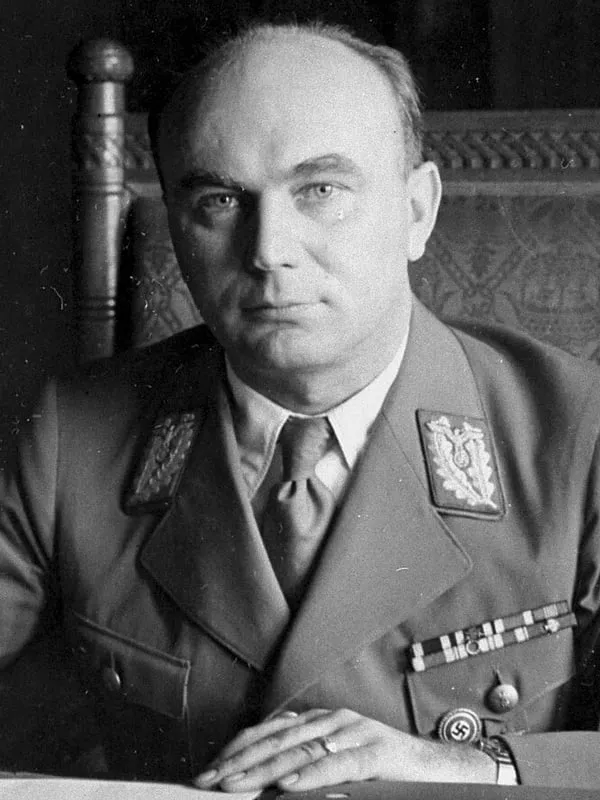
- Born:
- 22 January 1897, Środa (Province of Posen, German Empire)
- Died:
- 21 July 1946, Poznań
- Author:
- Natalia
- Photo:
- autor nieznany, domena publiczna, Wikimedia Commons

Arthur Greiser was a German from Greater Poland who built his career on hatred of the reborn Polish state and then ruled his native region as an occupier. In the 1930s, as President of the Senate of the Free City of Danzig, he and his party rival and superior Albert Forster brought the city under Nazi control. In the autumn of 1939 Adolf Hitler entrusted him with the administration of western Poland, annexed to the Reich as the Reichsgau Posen and later renamed the Reichsgau Wartheland (the Warthegau). Greiser wanted to make it a “model Gau” of the Reich: he had Poles and Jews expelled, brought in German settlers in their place, destroyed the Church and Polish culture, and from 1941 was one of the initiators of the murder of Jews in the first German extermination camp. After the war he stood trial before a Polish court as the first defendant of the Supreme National Tribunal and was publicly hanged in Poznań.
Childhood in Greater Poland and war in the air
Arthur Karl Greiser was born on 22 January 1897 in Środa, a small town in the Prussian Province of Posen, the youngest child of the court bailiff Gustav Greiser and Ida, née Siegmund. The family soon moved to Inowrocław (then Hohensalza), where he attended the royal humanist grammar school. He grew up among a Polish majority and spoke Polish fluently, which did not stop him becoming a bitter enemy of the Poles.
In August 1914, without taking his school-leaving examination, he volunteered for the Imperial German Navy. He served in the coastal artillery and from 1917 in naval aviation, in the last weeks of the war as a fighter pilot over the Belgian coast. In September 1918 he was shot down and badly wounded. Propaganda later presented him as a “flying ace”, although he flew as a fighter pilot for only a few weeks.
Germany’s defeat and the Treaty of Versailles, which gave his home region to Poland, came as a shock to him. After the outbreak of the Greater Poland Uprising he joined the volunteer units of the Grenzschutz Ost, which tried to keep the eastern provinces in Germany.
Danzig: from merchant to President of the Senate
Greiser settled in Gdańsk (Danzig), where in 1919 he married Ruth Tripler. He ran a wholesale business in fats and oils, which went bankrupt in 1928, and then operated his own excursion boat on the Bay of Gdańsk. He was active in nationalist organisations, including the Danzig Stahlhelm. In 1925, at a rally against the Polish postboxes in the city, he demanded that all Poles be thrown out of Gdańsk.
On 1 December 1929 he joined the NSDAP and the SA, and in 1931 he transferred to the SS. The Danzig party was weak and divided at the time. In October 1930 Hermann Göring briefly put Greiser in charge of it, but in the same month Hitler sent a new Gauleiter from Franconia, Albert Forster. Greiser became his deputy and the party district’s business manager, and in November 1930 chairman of the Nazi group in the Danzig Volkstag. From then on the two men were locked in a bitter rivalry that ended only in 1939.
After the Nazi victory in the Volkstag election of 28 May 1933, Greiser became Vice-President of the Senate and Senator for the Interior in the government of Hermann Rauschning. He was responsible for the repression of the opposition press and parties. When Rauschning, who sought an accommodation with Poland, lost his struggle with Forster, Greiser replaced him on 28 November 1934 as President of the Senate, that is, head of the Free City’s government. In April 1935, after a divorce, he married the pianist Maria Koerfer; the witnesses were Heinrich Himmler and Forster.
As President of the Senate Greiser was Danzig’s public face to the outside world. While Hitler was courting Poland after the non-aggression declaration, he visited Warsaw, met Józef Beck and went hunting with Polish dignitaries. Inside the city, meanwhile, the Nazis were eliminating the opposition in breach of the constitution guaranteed by the League of Nations. When the League’s Irish High Commissioner, Seán Lester, defended Danzig’s opposition politicians, Greiser travelled to Geneva on 4 July 1936 to demand his recall before the League Council. His appearance turned into a scandal: Greiser insulted the League and stuck his tongue out at journalists. Yet the aim was achieved: Lester left, and his successor, the Swiss historian Carl Jakob Burckhardt, was far more accommodating towards the Nazis. He and Greiser soon became almost friends. In 1938 Greiser tried for economic reasons to delay the introduction of anti-Jewish laws in Danzig, but the Jews were pushed out of the city regardless, and after Kristallnacht synagogues burned there.
The Danzig crisis and defeat by Forster
In 1939, when Danzig became the pretext for war, Greiser carried out Berlin’s instructions together with Forster, even though the two men hated each other. As head of the Free City’s government he signed the notes with which the Senate stoked the dispute with Poland. At the end of July he demanded the withdrawal of the Polish border guards accompanying the customs inspectors, and in August, when the Danzig customs officers refused to cooperate with the Polish inspectors and Poland threatened a firm response, he backed down, claiming that no such decision had been taken.
Greiser lost his rivalry with Forster just before the war. On 23 August 1939 the Senate made Forster “head of state”, the formal ruler of the city, above the President of the Senate. According to Burckhardt, in the last days of August Greiser was “completely broken”. On the morning of 1 September he watched the attack on Westerplatte, and after the incorporation of Danzig into the Reich Forster barred him from the Senate building and made him hand over his keys.
Governor of the Warthegau
Greiser soon received a new assignment. On 8 September 1939 Hitler appointed him head of the civil administration attached to the military command in Poznań. On 21 September, at a rally of local Germans, he announced that a Pole would never be the equal of a German and could only serve him. He wanted to turn Greater Poland into a “model Gau” of the Reich and, as he put it, a laboratory of the struggle between nationalities.
October 1939 gave him full power. By Hitler’s decree of 8 October the western part of occupied Poland was annexed to the Reich, and its central part became the Reichsgau Posen, renamed Wartheland on 29 January 1940. It comprised the former Poznań Voivodeship and parts of the Łódź and Pomeranian Voivodeships, and from November 1939 also Łódź itself. More than four million people lived on over 43,000 square kilometres, of whom Germans made up less than a tenth. On 14 October Greiser, as the only representative of the civil administration, attended a conference in Berlin of the heads of the Security Police and the commanders of the Einsatzgruppen, at which Reinhard Heydrich ordered that the liquidation of the Polish leadership class be completed by 1 November. On 21 October he became Gauleiter of the NSDAP, and on 26 October, when the annexation decree came into force, Reich Governor (Reichsstatthalter) – on the same day that Hans Frank’s General Government was created from the rest of the German occupation zone. His seat became the Imperial Castle in Poznań, and all party and state power in the Gau was concentrated in his hands.
The autumn of 1939 was a time of mass terror in Greater Poland. The killings of Operation Tannenberg and the Intelligenzaktion, begun during the campaign, continued: Einsatzgruppe VI, formally subordinate both to Greiser and to the SS leadership, murdered teachers, priests, landowners, officials, veterans of the Greater Poland Uprising and Jews. Public executions of hostages took place in many towns. In October 1939, in Fort VII in Poznań, which had been turned into a concentration camp, Herbert Lange’s SS unit murdered patients from the psychiatric hospital at Owińska and from Poznań with carbon monoxide in a makeshift gas chamber – this is regarded as the first mass killing of people by gas in Europe. The same unit then murdered thousands of patients from across the Gau.
Germanisation by expulsion
Greiser’s methods differed from Forster’s. Forster enrolled the inhabitants of Pomerania en masse on the German People’s List (Volksliste), simply to be able to report quickly to Hitler that his Gau was German. Greiser, in agreement with Himmler, relied on racial selection: Poles were to remain in the Warthegau only as cheap labour, or else disappear. From December 1939 transports left the Gau for the General Government: nearly 88,000 people were deported by the end of 1939, and by the end of 1940 the expulsions (PL) had affected more than 250,000 Poles and Jews, who were stripped of their homes, farms and workshops without compensation. In their place came Germans resettled under the Heim ins Reich programme – first from Estonia and Latvia, then from Volhynia, Galicia, Bessarabia and Bukovina. Frank’s opposition and the preparations for the attack on the USSR led to the deportations being halted in 1941. From 1940 Greiser was also Himmler’s commissioner for the strengthening of Germandom in the Gau, which gave him the decisive voice in population policy.
Poles were deprived of their schools, universities, press, associations and property, and even of the right to marry below a certain age. Greiser, himself hostile to Christianity, fought with particular ferocity against the Catholic Church, which for centuries had sustained Polish identity. The churches in the Gau were stripped of their legal status and reduced to private associations, most places of worship were closed, and hundreds of priests were sent to concentration camps, above all to Dachau, where many of them died.
The destruction of the Jews in the Warthegau
Before the war nearly 400,000 Jews lived in the territory of the Warthegau. Greiser wanted his Gau to become “free of Jews” as quickly as possible. In December 1939 he ordered them to wear a yellow star, and at the beginning of 1940 a closed ghetto was established in Łódź, renamed Litzmannstadt. When deportations to the General Government and plans to ship the Jews to Madagascar proved unworkable, in the summer of 1941 Greiser’s circle began to speak of a “solution” by killing those unable to work. Greiser obtained Himmler’s and Heydrich’s consent; in a letter to Himmler of May 1942 he invoked their authorisation for the “special treatment” of 100,000 Jews.
In the autumn of 1941 Lange’s unit began murdering Jews in the Konin area, and on 8 December 1941 the extermination camp at Chełmno nad Nerem (Kulmhof) began operating – the first camp in which Jews were killed by gas on a mass scale, in gas vans. By the spring of 1943, and again in 1944 during the liquidation of the Łódź Ghetto, between at least 150,000 and more than 180,000 people were murdered there according to various estimates, the overwhelming majority of them Jews, as well as several thousand Roma. The Reich Governor’s administration, in particular Hans Biebow’s Łódź Ghetto administration, helped organise the killings and the plunder of the victims’ property, from which Greiser himself also profited. In March 1943 he personally visited Chełmno and thanked the staff. Of nearly 400,000 Jews in the Warthegau, according to Polish estimates only a few thousand survived the war. Historians cite him, alongside Odilo Globocnik, as an example of a regional dignitary whose own initiative accelerated the decisions that led to the Holocaust.
Flight, trial and execution
In 1942 he became an SS-Obergruppenführer, and in September 1944 commander of the Volkssturm in the Gau. He forbade Germans to prepare for evacuation, and when the Soviet offensive came in January 1945 he left Poznań on 20 January, citing a telegram from Martin Bormann. He left the city, which had been declared a fortress, to the fighting that lasted until 23 February. Joseph Goebbels regarded his departure as cowardice and a disgrace to the party.
In mid-May 1945 the Americans arrested him in the Alps, where he was recognised by a former woman prisoner from Greater Poland. In March 1946 he was handed over to Poland. His trial before the Supreme National Tribunal – the first in the court’s history – opened on 21 June 1946 in the great hall of Poznań University. He was charged with the murder of civilians and prisoners of war, expulsions, Germanisation, plunder, the abduction of children and the extermination of the Jews. Greiser pleaded not guilty: he claimed that he had been carrying out orders, had known nothing of the crimes and had been forced by Himmler to carry out the expulsions. On 9 July 1946 the tribunal sentenced him to death. The judgment was one of the first in the world in which a court used the concept of genocide, and it also found the defendant guilty of taking part in the preparation of a war of aggression.
The Vatican interceded on the condemned man’s behalf, which caused indignation in Poland; the chairman of the State National Council, Bolesław Bierut, did not exercise his right of pardon. On the morning of 21 July 1946 Greiser was hanged on the slope of the Poznań Citadel before a crowd estimated at tens of thousands – according to some accounts as many as a hundred thousand people. The scandalous scenes during the execution meant that it was the last public execution in Poland.
Significance
Greiser was the embodiment of the revisionism that led to war: a German from the lands given to Poland who never accepted Versailles and found in Nazism a path to revenge. In Danzig he helped turn a city under the protection of the League of Nations into a Nazi bridgehead, and in 1939 he took part in the crisis that Hitler used as a pretext for the invasion of Poland. The Gau he ruled from October 1939 became a testing ground for Nazi racial policy: mass expulsions, plunder, the persecution of the Church, the first killings by gas and one of the first extermination camps. His trial in Poznań, held while the Nuremberg trial was still in progress, opened a series of Polish trials of Nazi governors, in which two years later his old rival Forster also stood before the court.
Sources
Mentioned in battles
(02)Often appears with
People who appear in the same events.