- Category:
- Military operations
- Front:
- Mediterranean
- Date:
- 2 December 1943
- Author:
- Natalia
- Tags:
- Italy, Luftwaffe, United States, United Kingdom
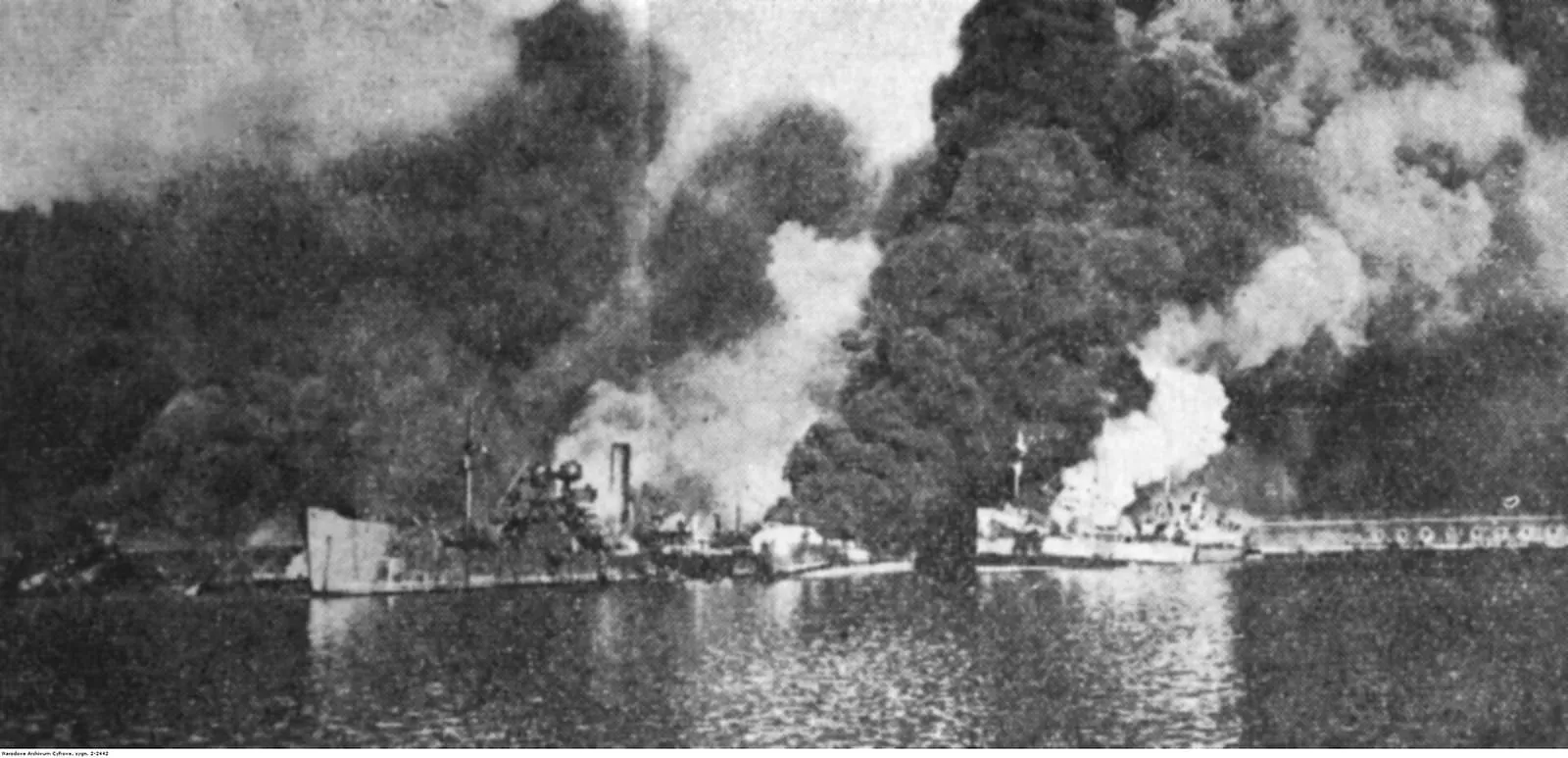
On the evening of 2 December 1943 more than a hundred German bombers appeared over the port of Bari. In less than an hour they turned the Allies’ most important supply base on the east coast of Italy into a sea of burning oil. More than a dozen ships went to the bottom – between 17 and 28, depending on the tally – and the explosions shattered windows more than ten kilometres from the quays. Among the vessels destroyed was the American freighter SS John Harvey, which was secretly carrying some 2,000 aerial bombs filled with mustard gas in her holds. The poison spread across the water and rose with the smoke over the port and the town. Hundreds of survivors, dockers and inhabitants were poisoned without knowing by what, and for several days doctors treated them blindly, because the command would not admit that the Allies had brought chemical weapons to Italy.
The American press called the raid the most damaging surprise attack since Pearl Harbor, and the term “little Pearl Harbor” has become established in the literature. It was one of the most successful raids by the Luftwaffe of the entire war and at the same time – as the American author Glenn B. Infield wrote – the most serious chemical-weapons accident of that war: people died of gas, even though no one had used it.
A port that nobody defended
Bari, the largest port on Italy’s Adriatic coast, had a population of about 250,000. The British entered it on 11 September 1943 without a fight, a few days after the Italian surrender was announced. From then on supplies for General Bernard Montgomery’s Eighth Army passed across Bari’s quays, as did supplies for the airfields around Foggia, where American heavy bombers were being based. The Allies’ other great base in Italy, Naples, taken on 1 October, was only just coming back to life after the German demolitions.
At the turn of November and December the port was working flat out. The autumn rains had admittedly halted the Allies in front of the German positions in central Italy, but the Eighth Army, which in the second half of November had seized a bridgehead across the Sangro, was preparing an attack on the eastern end of the Bernhardt Line and needed ammunition, fuel and equipment. On the evening of 2 December some 30 merchant ships – American, British, Polish, Norwegian and Dutch – lay in the harbour basin, along with Italian civilian vessels. To speed up unloading, the quays were lit as in peacetime and the ships were moored side by side.
Bari’s air defences were weak. No fighter squadron assigned to cover the port was stationed nearby – the fighters within range had other tasks – and the anti-aircraft guns and radars were not prepared for a massed attack. The Allied command believed that the Luftwaffe in Italy was too weak to threaten ports behind the front, even though German bombers had attacked Naples four times in November. That very afternoon Air Marshal Sir Arthur Coningham, commander of the Allied tactical air forces in the Mediterranean, assured a press conference that the Germans had lost the war in the air. According to journalists’ accounts, he added that he would regard the appearance of even a single German aircraft over the city as a personal affront.
Richthofen’s decision
On the afternoon of 2 December the German pilot Werner Hahn flew over Bari in a Messerschmitt Me 210 reconnaissance aircraft and reported that the port was full of ships. The report reached Field Marshal Wolfram von Richthofen, commander of Luftflotte 2, which was responsible for air operations in Italy. Richthofen – in 1937 chief of staff of the Condor Legion at the time of the bombing of Guernica – had long been looking for a target he could strike with his modest forces. The German Commander-in-Chief in Italy, Field Marshal Albert Kesselring, had earlier considered an attack on the airfields around Foggia, but the Luftwaffe did not have enough aircraft to paralyse so many well-defended bases at once. Richthofen suggested Bari instead: destroying the port could slow down the Eighth Army, and the crowded harbour basin was a target that would be hard to miss.
Kesselring agreed. Richthofen had at his disposal virtually nothing but Junkers Ju 88 A-4 bombers. He had hoped for 150 aircraft and assembled 105 – some of them from bomber wing KG 54 – mostly from airfields in Italy, with a few from Yugoslavia to mislead the Allies about the direction from which the blow had come. According to some studies, 96 of them reached the target. The bombers first flew east over the Adriatic and then turned south and west, so as to come in from the sea, from where the defenders did not expect an attack.
The evening of 2 December
The raid began at about 7.25 p.m. The first aircraft circled over the port at about 3,000 metres, dropping strips of aluminium foil (which the Germans called Düppel) to blind the Allied radars, and flares – which were entirely superfluous, since the quays were brightly lit anyway. Then the main force arrived. The Ju 88s bombed from low altitude and with great accuracy. Hits on two ammunition ships set off enormous explosions. A bomb severed a fuel pipeline on the quay and the gushing petrol caught fire; the burning layer spread across the basin and engulfed ships the bombs had not reached. Ships moored side by side set each other alight.
The bombing was brief – between twenty minutes and half an hour according to most accounts, although some studies speak of a little over an hour – but the fires and the exploding ammunition continued all night. The all-clear was sounded only at about 11 p.m. The Germans lost at most one or two aircraft. The American sailor Warren Brandenstein recalled that the whole harbour was ablaze, the surface of the water was burning, and ships consumed by the flames were blowing up.
Losses in the port
The extent of the destruction depends on how it is counted. The most frequently cited tally speaks of 28 ships sunk or completely destroyed – ten Italian, seven British, five American, three Norwegian, two Polish and one French – and twelve damaged; three of the vessels sunk were later raised together with part of their cargo. Other studies, including the work of the American historian Rick Atkinson, count 17 ships sunk and 8 badly damaged, not including small craft. Between some 31,000 and 38,000 tons of cargo were lost: ammunition, fuel, food, medical equipment and more than 10,000 tons of steel matting for building field airstrips. The submarines based at Bari came through the raid unscathed.
Among the ships sunk were two Polish vessels: the cargo ship SS Lwów and SS Puck (PL). On Puck her third officer and several British gunners from the crew of her deck guns were killed. Two British escort destroyers, HMS Bicester and HMS Zetland, damaged by the force of the explosions, towed the tanker La Drome out of the fire and took survivors aboard, after which they were ordered to Taranto.
The port of Bari was closed for three weeks and returned to full working order only in February 1944. The human losses were never counted precisely. According to Atkinson, more than a thousand Allied servicemen and seamen were killed or missing – for the most part merchant seamen, gunners from the ships’ gun crews and men working in the port. The number of Bari’s inhabitants killed is estimated, again approximately, at about a thousand. They died under the rubble of houses in the old town by the harbour, from shell splinters and in the panic in which people trampled one another on the way to the shelters. To these must be added the victims of poisoning.
The secret of the John Harvey
The American Liberty ship John Harvey had arrived at Bari at the end of November and was waiting to be unloaded. Besides ordinary ammunition she carried in her holds some 2,000 M47A1 aerial bombs, each containing 27–32 kilograms of sulphur mustard – mustard gas, familiar from the fronts of the First World War. The cargo was top secret. In June 1943 President Franklin Delano Roosevelt had warned publicly that if the Axis powers used chemical weapons, the United States would respond in kind. According to the British naval historian Stephen Roskill, the bombs had been sent to Italy precisely in case such retaliation became necessary, should the Germans – as intelligence reported – decide to use gas. Neither the United States nor Britain intended to be the first to resort to weapons banned by the Geneva Protocol of 1925; but they did not want to be left without the means to reply.
The John Harvey blew up during the raid, probably from the fire and the explosion of a neighbouring ammunition ship. Almost all her crew were killed – according to Italian studies, the master and 77 men – including the officers who knew what was in the holds. Some of the bombs burst, and liquid mustard poured into water already covered by a thick layer of oil from other ships. The oil proved an excellent solvent for the poison. Some of the mustard evaporated and mixed with the smoke of the fires; the wind carried this cloud over the town.
Poisoned without knowing by what
The survivors pulled from the water were coated in a slime of oil and mustard. Bari’s military hospitals, overflowing with wounded, dealt first with the victims of blast and burns. Men who appeared merely soaked and smeared with oil were wrapped in blankets and left in their wet uniforms for many hours – and it was precisely this prolonged contact with the poison that proved deadly. Rescuers noticed a smell like garlic, but no one who knew about the John Harvey’s cargo had survived to explain it.
Within a day hundreds of patients developed symptoms that the doctors could not attribute to any known injury: streaming eyes and blindness, huge blisters, skin darkening as if sunburnt, difficulty in breathing. On the destroyer Bicester, by morning nearly all the officers had lost so much of their sight that the ship had to call for help from shore to enter the harbour at Taranto. Hundreds of Bari’s inhabitants, poisoned by the fumes that had passed over the town, also came to the hospitals.
The deputy chief of the medical service at Allied headquarters in Algiers sent to Bari Lieutenant Colonel Stewart F. Alexander, a medical officer specialising in chemical warfare who had trained at the American Edgewood Arsenal. Although nobody had told him about the cargo, Alexander quickly recognised the effects of mustard gas. By plotting on a plan of the port where the casualties had been, he identified the John Harvey as the source, and in the water he found a fragment of the casing of an American M47A1 bomb. He persuaded the doctors to treat the sick as gas casualties, which saved many of them. According to his tally, symptoms of poisoning were found in 628 servicemen and seamen (Italian sources give 617 confirmed cases), of whom 83 had died by the end of December; the subsequent inquiry noted that there were also many others of whom no record remained. How many victims the mustard gas claimed among the civilian population is unknown – many of the poisoned inhabitants left the town to seek shelter with relatives.
The cover-up
The Allied command decided to keep the presence of the gas secret. It was feared that the Germans would take it as proof of preparations for chemical warfare and would strike first themselves. General Dwight Eisenhower, Allied Commander-in-Chief in the Mediterranean, accepted Alexander’s report, but its contents were classified. Prime Minister Winston Churchill – according to Alexander’s account and later authors – refused to acknowledge that there had been mustard gas at Bari, and in British documents the deaths of the poisoned were described as the result of “burns due to enemy action”. For many years the families of the dead did not know what had really killed their relatives.
The secret could not, however, be kept from so many witnesses. In February 1944 the US Joint Chiefs of Staff admitted in a statement that an accident had occurred and gave an assurance that the United States would use chemical weapons only in retaliation. The American records of the raid were declassified in 1959, and the wider public learned of the affair only from Glenn B. Infield’s book Disaster at Bari, published in 1967. The British government acknowledged to the survivors in 1986 that they had been exposed to gas, and only then adjusted their pensions. Alexander received official recognition from the US Army Medical Department in 1988.
From mustard gas to chemotherapy
Alexander kept tissue samples taken at the post-mortem examinations of the victims and drew attention to a phenomenon that seemed to him particularly important: in those poisoned, the white blood cell count fell sharply, and tissues with rapidly dividing cells, such as bone marrow and lymph nodes, were destroyed. His observations reached American researchers, among them Cornelius Rhoads, who after the war headed the Sloan-Kettering Institute in New York. They were not the only source of the discovery – scientists at Yale University had been secretly studying the effect of the related nitrogen mustards on blood cancers since 1942 – but the Bari tragedy demonstrated the mechanism in hundreds of cases. In 1949 mechlorethamine became the first anti-cancer drug approved for use in the United States, and modern cancer chemotherapy (PL) descends from it.
The bombs from the John Harvey did not vanish with the end of the war. Some of them came to rest on the bottom of the harbour basin; clearance work was carried out after the war, but – according to a study by the University of Bari in 2001 – local fishermen went on hauling up corroded shells in their nets for decades, and the mustard in them caused poisonings, several of them fatal.
Place in the war
For the Luftwaffe, which had been forced onto the defensive in Italy for months, the Bari raid was a rare and spectacular success: some hundred bombers sank more than a dozen ships in a single night, with almost no losses of their own. It did not, however, change the course of the fighting in Italy. Supplies were routed through other ports, Bari was back at work within a few weeks, and in December the Eighth Army continued its advance along the Adriatic. The Allied inquiry cleared Coningham of negligence, while finding that the absence of earlier raids had lulled the defences into complacency.
Bari remained one of the main Allied ports in Italy. From the turn of 1943 and 1944 units of General Władysław Anders’s Polish II Corps, which fought at Monte Cassino in the spring of 1944, arrived through the ports of Apulia, and from the airfields of Apulia, especially near Brindisi, aircraft took off with supplies for the partisans in the Balkans and – in August 1944 – for the insurgents in Warsaw.
Yet the most enduring legacy of 2 December 1943 proved to be the secret of the mustard gas. Bari was a reminder that both sides kept chemical weapons at the ready throughout the war and were restrained from using them above all by fear of retaliation. The story of the cover-up – of deaths described as “burns”, of families who for decades did not know the truth – became one of the examples of how wartime military secrecy could be turned against a country’s own soldiers and civilians.
Sources
Meanwhile
(04)Elsewhere, within a week.
- 3 December 1943 · Western FrontMurrow's "orchestrated hell"On 3 December 1943 Edward R. Murrow told CBS listeners about an RAF raid on Berlin he had flown in a Lancaster. It became a classic of war reporting.
- 4 December 1943 · BalkansTito proclaims a provisional governmentIn early December 1943 the world learned of Tito's government set up at Jajce. The royal government protested, while the British turned away from Mihailović.
- 29 November 1943 · BalkansThe second session of AVNOJ at JajceOn 29 November 1943 at Jajce in Bosnia the partisan council AVNOJ declared itself Yugoslavia's supreme authority, set up Tito's government and barred the king.
- 28 November 1943 · DiplomacyThe Tehran ConferenceOn 28 November 1943 Stalin, Roosevelt and Churchill met in Tehran. They decided to invade France in May 1944 and discussed Poland without its government.
Related events
(04)The same battle, people or subject.
- 17 January 1944 · MediterraneanThe Battle of Monte Cassino beginsOn 17 January 1944 British X Corps crossed the lower Garigliano at the western end of the Gustav Line. The first Battle of Monte Cassino had begun.
- 9 September 1943 · MediterraneanThe landing at SalernoOn 9 September 1943 Mark Clark's American-British Fifth Army landed in the Gulf of Salerno. Despite Italy's surrender, the Germans were waiting on the beaches.
- 15 November 1943 · Western FrontThe Allied Expeditionary Air ForceOn 15 November 1943 the tactical air command for the invasion of France was set up under Leigh-Mallory. SHAEF followed in February 1944.
- 24 December 1943 · Western FrontEisenhower to command the invasionOn 24 December 1943 Roosevelt announced on the radio that General Dwight Eisenhower would command the invasion of France. Marshall stayed in Washington.