- Category:
- Military operations
- Front:
- Mediterranean
- Date:
- 9 September 1943
- Author:
- Natalia
- Battle:
- Battle of Salerno
- Tags:
- Italy, United States, United Kingdom, Wehrmacht
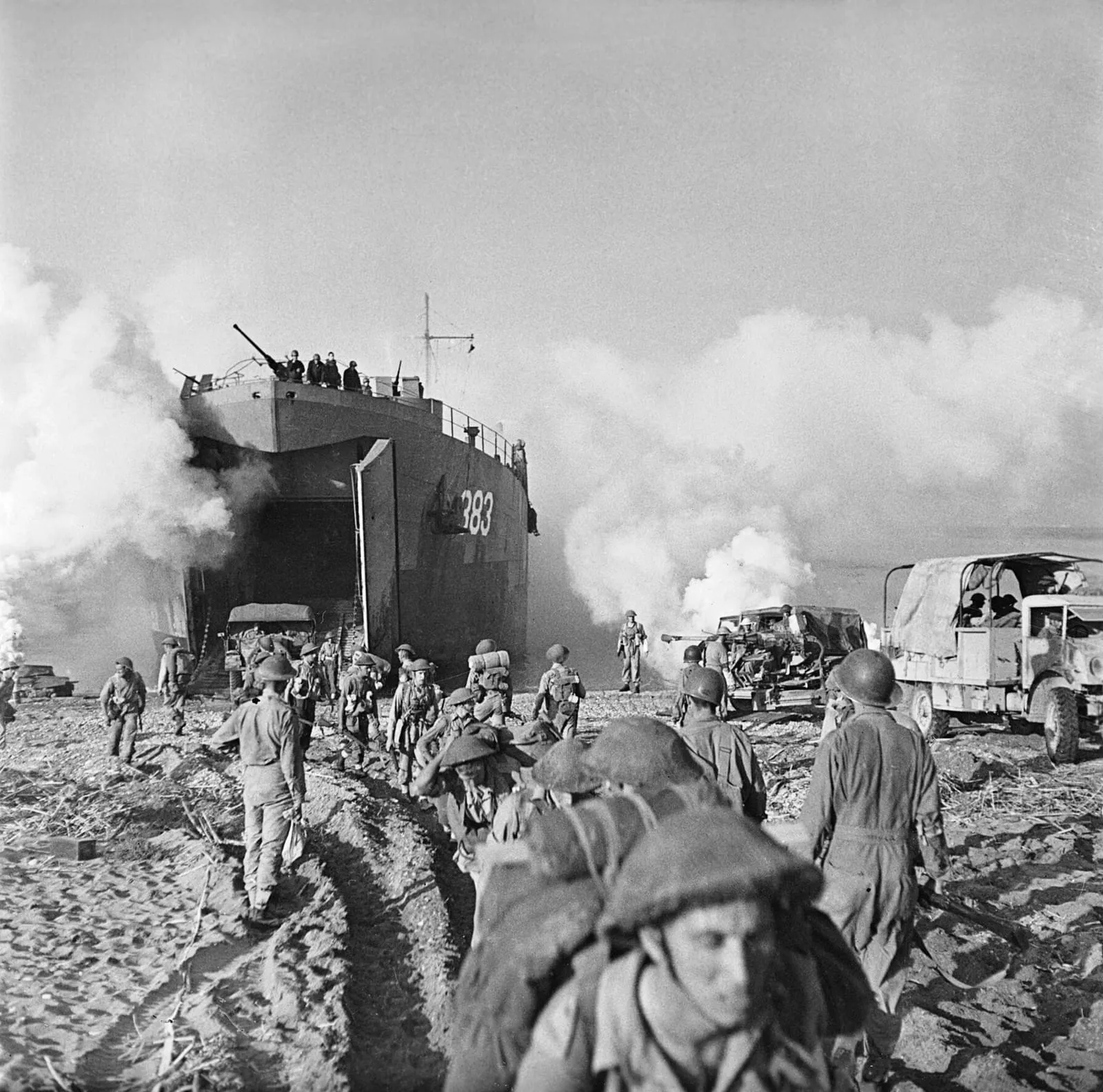
On the night of 8–9 September 1943 hundreds of Allied warships and merchant vessels lay in the Gulf of Salerno, some fifty kilometres south-east of Naples. At 3.30 a.m. the first landing craft grounded on the sandy beaches between Salerno and the ruins of the Greek city of Paestum. Operation Avalanche had begun – the main Allied landing on the European mainland in 1943 and the first major operation of the American-British Fifth Army under General Mark Clark. The men heading for the shore had known for several hours that Italy had surrendered, and many of them expected to walk ashore unopposed. Waiting for them on the beaches and in the hills, however, was the German 16th Panzer Division.
Why Salerno
After the capture of Sicily the Allies argued at length about what to do next. The British, led by Winston Churchill, wanted to exploit Mussolini’s fall and knock Italy out of the war; the Americans feared that every new operation in the Mediterranean would delay the cross-Channel invasion. The compromise was a landing on the Italian mainland with limited forces, without encroaching on the preparations for the invasion of France. On 3 September General Bernard Montgomery’s Eighth Army crossed the Strait of Messina into Calabria (Operation Baytown). The main blow, however, was to be a landing further north, which would allow the swift capture of Naples – the port indispensable for supplying an army in Italy – and cut off the German forces in the south of the peninsula.
The choice of site was dictated by the range of fighters. Spitfires flying from airfields in Sicily could cover a beachhead no further away than the Salerno area, and even there, according to most accounts, they could stay over the beaches for no more than fifteen to twenty minutes. The Gulf of Salerno had wide beaches suited to landing craft and an airfield close by at Montecorvino. It also had serious drawbacks, which the Germans could see as well: the plain was enclosed by an arc of hills and mountains from which the defenders could watch every movement on the beaches, and it was separated from Naples by the mountainous Sorrento Peninsula, crossed by only a few narrow passes. Albert Kesselring, commanding the German forces in southern Italy, regarded Salerno as one of the most likely landing sites, and the commander of the Tenth Army deployed an entire panzer division in the hills above the gulf.
The Avalanche plan was drawn up in less than six weeks. The attack was to be made by the Fifth Army, comprising two corps: the British X Corps of General Richard McCreery, with the 46th and 56th Infantry Divisions, and the American VI Corps of General Ernest Dawley, with the 36th Infantry Division and the 45th Division in reserve. On the left flank, near Maiori and Vietri sul Mare, three battalions of American Rangers under Lieutenant Colonel William Darby and two British Commandos under Brigadier Robert Laycock were to land and seize the passes leading to Naples. The naval forces – some 600 warships, transports and landing craft in all – were commanded by Vice Admiral Henry Kent Hewitt. Distant cover was provided by the British Force H, with four battleships and two aircraft carriers, under Admiral Andrew Cunningham, while Seafires from the escort carriers of Rear Admiral Philip Vian’s Force V were to fly over the beaches.
The evening of 8 September
The convoys sailed from ports in North Africa and Sicily – Oran, Algiers, Bizerte, Tripoli and Palermo – several days before the landing date. On the evening of 8 September, while they were already at sea, the ships’ radios broadcast the address by General Dwight Eisenhower announcing Italy’s surrender. There was jubilation aboard the transports. The soldiers, especially those of the American 36th Division, which had never yet been in action, concluded that the war in Italy was as good as over and that the landing would turn into a friendly entry into a country that had just laid down its arms. Officers reminded them in vain that there were Germans in Italy. Many commanders later believed that this mood cost them men in the first hours of the fighting.
The Germans drew the opposite conclusions from the announcement of the armistice. That same evening they launched Operation Achse, planned weeks in advance – the disarming of the Italian army. Above the Gulf of Salerno, units of the 16th Panzer Division took over the positions of an Italian coastal defence division. Its commander, General Ferrante Vincenzo Gonzaga, was, according to Italian sources, shot by the Germans on 8 September when he refused to hand over his weapons. From then on there was nobody left on the shore to welcome the Allies. The convoys had in any case already been spotted by German reconnaissance aircraft, and from the early hours of 9 September Luftwaffe aircraft were bombing and strafing the beaches and the ships.
The landing
The commander of the American 36th Division, General Fred L. Walker, counting on surprise, dispensed with a naval preparatory bombardment in his sector, even though Admiral Hewitt warned that there would be no surprise. The British in the northern sector shelled the shore from the sea before landing. In both sectors the first waves headed for the beaches at 3.30 a.m. One of the most often repeated stories of Salerno has it that a voice then rang out over the water from a German loudspeaker, calling on the approaching troops in English to give themselves up, since they were covered anyway. The story appears in many memoirs and histories, but its details – and even whether the loudspeaker really existed – remain uncertain. What is certain is that the defenders were not caught by surprise.
General Rudolf Sieckenius’s 16th Panzer Division was the only German division on the gulf, but it was well prepared. Sieckenius had divided it into four battle groups, positioned a few kilometres from the shore, with observers in the hills. In the American sector, at Paestum, artillery fire directed from Monte Soprano fell on the landing craft and the beaches. One tank landing ship took more than a dozen hits, and some landing craft turned back under the shelling. The 141st Infantry Regiment was pinned down at the water’s edge and could not break inland all day, and without it neither artillery nor anti-tank guns could be landed. The 142nd Regiment fared better, supported by the 143rd Regiment from reserve, which came ashore before eight in the morning. Once minesweepers had cleared a lane, destroyers closed to within about a hundred metres of the shore and began shelling the German positions, while the cruisers USS Philadelphia and USS Savannah engaged the German tanks. Several tank counter-attacks were broken up by fire from the ships and from bazookas and the guns that had been hauled ashore.
In the north the British of the 46th and 56th Divisions also had to fight for every kilometre. They met strong resistance, and the depth of the German defences forced the commanders to concentrate their forces rather than push them south to link up with the Americans. By evening X Corps had taken the airfield at Montecorvino, but because the hills above it remained in German hands, it lay within range of their artillery and could not be used. The Rangers at Maiori met no opposition and quickly seized the Chiunzi Pass, from which they could see the plain of Naples, while the Commandos took the heights above the Salerno–Naples road and, after a fight, entered the town of Salerno itself.
The first day’s balance
By the evening of 9 September the Fifth Army had not achieved all its objectives, but it held firmly to the shore. The two British divisions had penetrated eight to eleven kilometres inland, the Rangers and Commandos held the passes of the Sorrento Peninsula, and the American 36th Division had taken part of the plain south of the River Sele and the hills to a depth of some eight kilometres, though one of its regiments was still stuck by the beach. General Clark directed the operation all day from the command ship USS Ancon. The most serious weakness of the beachhead was the gap between the two corps: the British and Americans were separated by more than ten kilometres, and the boundary between them ran along the Sele valley, which at first nobody covered.
The Germans had no reason to panic either, but nor had they grounds for satisfaction. The battle groups of the 16th Panzer Division had done their job and delayed the Allies, but they had not driven them into the sea. That same day General Hermann Balck, commanding XIV Panzer Corps, sent the Hermann Göring Division and the 15th Panzergrenadier Division to the gulf, and from Calabria, where the Eighth Army was advancing slowly, the 29th Panzergrenadier Division set off. The commander of the newly formed Tenth Army, General Heinrich von Vietinghoff, began preparing a counter-stroke. Kesselring, though busy disarming the Italians and taking control of Rome, regarded Salerno as the most important point in the south. His request for two panzer divisions from northern Italy, which were under Field Marshal Erwin Rommel, was, however, turned down.
On the same day, far to the east, the British 1st Airborne Division landed from warships in the port of Taranto (Operation Slapstick), while King Victor Emmanuel III and Marshal Pietro Badoglio, who had left Rome before dawn, were fleeing south via Pescara to Brindisi. The Italian army, left without orders, was disintegrating. For the soldiers on the beaches at Salerno, however, this mattered little: their enemy was the Germans, and it was the Germans who would decide whether the beachhead survived.
Place in the war
The landing at Salerno opened the Italian campaign in the strict sense – the struggle for the peninsula that was to last until May 1945. For the Americans it was the first major landing on the European mainland; for the Allies as a whole it was the first attempt at an amphibious landing in a place where the enemy expected an attack and had had time to prepare. The following days were to show how close it came to disaster. Between 12 and 14 September the Germans mounted a powerful counter-attack in the valleys of the Sele and the Calore, Clark ordered plans to be drawn up for evacuating part of the beachhead, and the situation was saved by reinforcements rushed in by sea and air, massed naval gunfire and air bombardment. On 16 September the first patrols of the Eighth Army reached the beachhead, and the Germans began an orderly withdrawal northwards. On 1 October the Allies entered Naples.
Salerno left lasting lessons. Naval gunfire proved one of the most effective means of defending a beachhead, something that was put to use later in Normandy. Forgoing a preparatory bombardment in the hope of achieving surprise was widely acknowledged to have been a mistake. The broad landing front, the separated corps and the slow unloading of reinforcements became material for study in planning later landings, including Anzio. Finally, Salerno showed that Italy’s surrender had not opened the road north to the Allies. Rather than withdraw behind the Apennines, as some of their commanders had expected, the Germans decided to make a stand as far south as possible – and that decision turned Italy into one of the hardest fronts of the war for a year and a half.
Sources
Meanwhile
(04)Elsewhere, within a week.
- 4 September 1943 · PacificThe landing at Lae and the drop on NadzabOn 4 September 1943 the Australian 9th Division landed east of Lae, and on 5 September American paratroopers seized Nadzab. Lae fell on 16 September.
- 4 September 1943 · PoliticsBulgaria after the death of Tsar Boris IIIIn September 1943 Bulgaria buried Tsar Boris III, and a regency council took power for six-year-old Simeon II. There was not yet any war with the USSR.
- 14 September 1943 · BalkansThe Viannos massacresOn 14 September 1943 the Germans began a punitive operation around Viannos in Crete. In three days they killed over 460 civilians and burned about 20 villages.
- 3 September 1943 · SocietyThe evacuation of BerlinAfter Hamburg, Goebbels urged Berliners without work in the city to leave. After raids around the turn of August and September the evacuation was accelerated.
Related events
(04)The same battle, people or subject.
- 16 September 1943 · MediterraneanThe crisis at SalernoOn 13 and 14 September 1943 a German counter-attack nearly split the Salerno beachhead. On 16 September Eighth Army patrols met the Fifth Army.
- 11 September 1943 · MediterraneanThe British at Taranto and BariOn 9 September 1943 the British 1st Airborne Division landed from warships at Taranto; on 11 September the British entered Brindisi and Bari on the Adriatic.
- 10 July 1943 · MediterraneanThe landing in SicilyOn 10 July 1943 the Allies landed in Sicily: Montgomery’s Eighth Army in the south-east, Patton’s Seventh Army in the Gulf of Gela. Operation Husky had begun.
- 6 August 1943 · MediterraneanThe Germans move into ItalyFrom late July 1943 one Wehrmacht division after another crossed the Alps into Italy. At Tarvisio on 6 August both allies pledged loyalty – and both lied.