- Category:
- Military operations
- Front:
- Eastern Front
- Date:
- 12 January 1945
- Author:
- Łukasz
- Battle:
- Vistula–Oder offensive
- Tags:
- Red Army, Wehrmacht, Poland, Ivan Konev
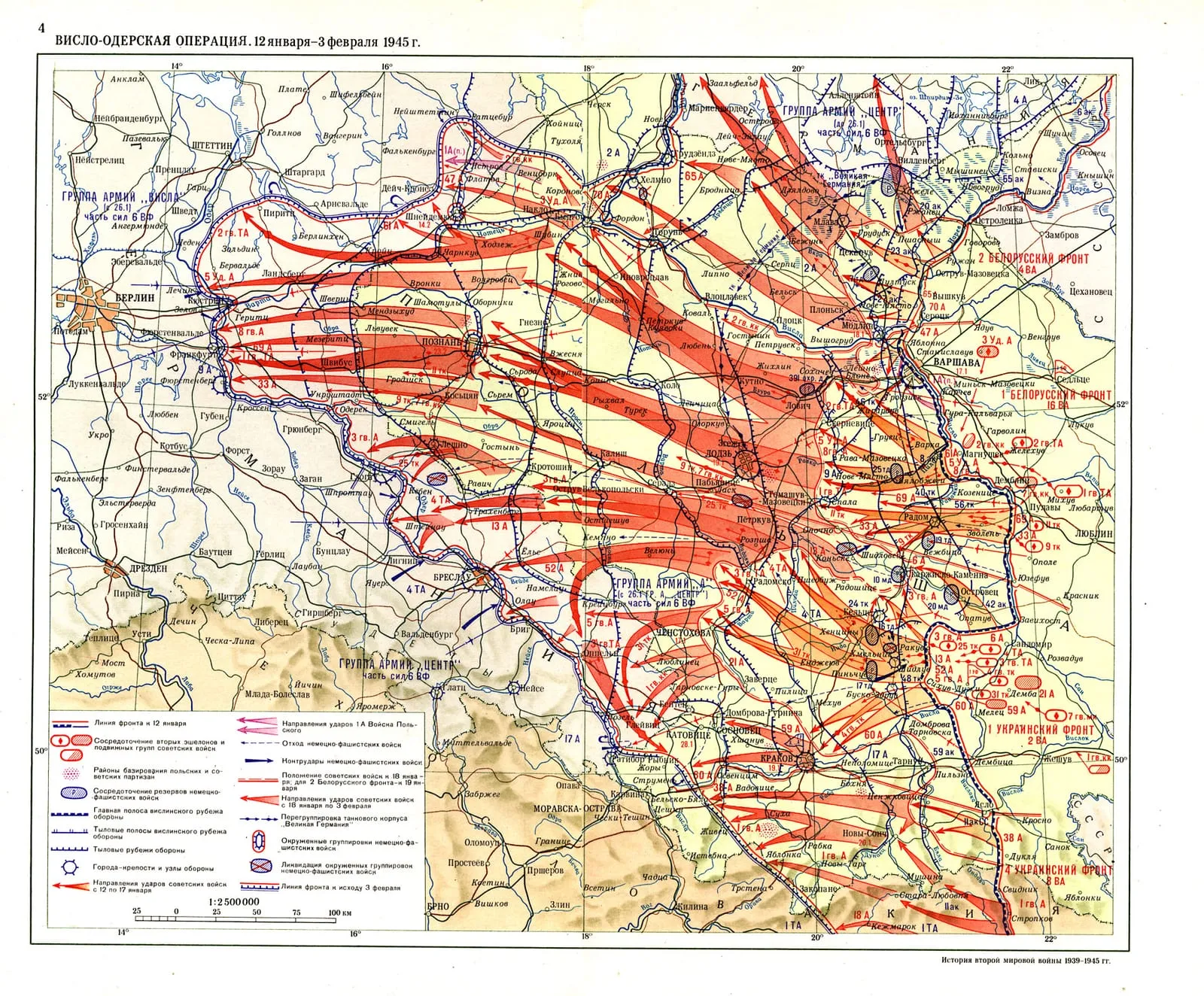
Before dawn on 12 January 1945 the artillery of Marshal Ivan Konev’s 1st Ukrainian Front opened fire in the Baranów–Sandomierz bridgehead beyond the Vistula. So began the Vistula–Oder offensive, known in Poland also as the January offensive – one of the largest and fastest offensive operations of the entire war. Two days later, on 14 January, Marshal Georgy Zhukov’s 1st Belorussian Front attacked from the bridgeheads at Magnuszew and Puławy. The aim of the offensive was to smash the German forces on the central sector of the front, take the Polish lands between the Vistula and the Oder, and open the way into eastern Germany and to Berlin. Within three weeks the Soviet armies had advanced from the Vistula to the Oder.
The front on the Vistula in the winter of 1944–1945
In the summer of 1944 the Belorussian offensive and the Lwów–Sandomierz offensive had brought the Red Army to the line of the Vistula and the Narew. In the course of Operation Bagration, the troops of the 1st Belorussian Front, then commanded by Marshal Konstantin Rokossovsky, had seized bridgeheads on the left bank of the Vistula at Magnuszew and Puławy; the Warka–Magnuszew bridgehead (PL) was established at the beginning of August by General Vasily Chuikov’s 8th Guards Army. In the south, at Baranów and Sandomierz, Konev’s troops had taken the largest and deepest bridgehead of all. All through the autumn the Germans tried, without success, to eliminate them.
Between the bridgeheads lay Warsaw. The Uprising that broke out on 1 August had collapsed after 63 days of fighting (the surrender was signed on 2 October), and the Germans then methodically destroyed the city on the left bank, house by house. The attempt by units of the Polish 1st Army to cross to Czerniaków and Żoliborz in September, when Berling reached the Vistula, ended in a bloody withdrawal. From October the front in Poland stood still. The Red Army shifted its main effort to the Baltic states, Hungary and the Balkans, while on the Vistula it massed forces for the decisive blow.
In November 1944 Stalin made a change whose significance became clear only in January: Zhukov took command of the 1st Belorussian Front, which was advancing on the Berlin axis, and Rokossovsky was moved to the 2nd Belorussian Front, which was to operate in the north, towards East Prussia and Pomerania. At the same time Joseph Stalin reserved to himself the personal coordination of the fronts’ operations from Moscow, through the Headquarters of the Supreme High Command (the Stavka).
The plan and the opposing forces
The plan for the 1945 campaign, drawn up by the General Staff in the autumn of 1944, envisaged an advance without an operational pause: in the first stage the fronts were to reach the line Bydgoszcz–Poznań–Wrocław, in the second to force the Oder and drive on Berlin. The 1st Ukrainian Front was to strike from the Sandomierz bridgehead in the general direction of Radomsko and Wrocław, detaching part of its forces against Kraków and Upper Silesia. The 1st Belorussian Front was to break through the defences from the Magnuszew and Puławy bridgeheads, close off Warsaw from the west and advance through Łódź on Poznań.
Soviet superiority was overwhelming. According to figures cited by the American historian David Glantz and in Russian studies, the two fronts had about 2.2 million men, more than 4,500 tanks and about 2,500 self-propelled guns – some 7,000 armoured fighting vehicles in all – more than 30,000 guns and mortars and about 5,000 aircraft. On the narrow breakthrough sectors artillery was concentrated at a density the Red Army had never used before: according to Soviet data, as many as about 200–250 barrels per kilometre of front.
Facing them stood the German Army Group A under Colonel General Josef Harpe: the Ninth Army at Warsaw and opposite Magnuszew and Puławy, General Fritz-Hubert Gräser’s Fourth Panzer Army around the Sandomierz bridgehead, and General Friedrich Schulz’s Seventeenth Army in the south, covering Kraków and Upper Silesia. According to the same figures, the army group had about 400,000–450,000 men, about 1,100–1,150 tanks and assault guns and more than 4,000 guns. The armoured reserves – General Walther Nehring’s XXIV Panzer Corps in the Kielce area and XL Panzer Corps – stood too close to the front line to escape the first artillery blow. The German defence rested on several belts of fortifications between the Vistula and the Oder, but there were not enough men to man them.
Guderian’s warnings
The Chief of the Army General Staff, Colonel General Heinz Guderian, knew what was coming. In December the Foreign Armies East intelligence department (Abteilung Fremde Heere (PL)) under General Reinhard Gehlen assessed Soviet superiority on the bridgeheads as manifold: about eleven to one in infantry, seven to one in tanks, and about twenty to one in artillery and aircraft. Several times – on Christmas Eve 1944 and on 1 and 9 January 1945 – Guderian travelled to Hitler’s headquarters at Ziegenberg, from which Adolf Hitler was directing the Ardennes offensive, and asked for divisions to be transferred from the west to the Vistula.
According to Guderian’s memoirs, Hitler dismissed Gehlen’s figures as “completely idiotic” and is said to have demanded that their author be shut up in a lunatic asylum. Guderian himself recorded that he warned him that the Eastern Front was like a house of cards: if it were broken through at one point, the whole of it would collapse. Not only did Hitler fail to reinforce the Vistula, but at the end of December he sent IV SS Panzer Corps from the Warsaw area to Hungary to relieve encircled Budapest, where the siege had begun. He also refused to evacuate Courland, where several dozen divisions were bottled up. In weighing these accounts it should be borne in mind that Guderian’s memoirs were written after the war and shifted the blame for defeat onto Hitler; other sources, however, consistently confirm them.
The timing and Churchill’s request
On 6 January 1945, when heavy fighting was going on in the Ardennes and the Germans had for several days been attacking in northern Alsace in Operation Nordwind, Prime Minister Winston Churchill wrote to Stalin asking whether the Western Allies could count on a major Soviet offensive on the Vistula front or elsewhere during January. Stalin replied on 7 January that an offensive was being prepared and would begin, regardless of the weather, no later than the second half of January.
Soviet historiography – followed by the memoirs of Konev and of General Sergei Shtemenko – later presented the matter as if the date of the attack had been brought forward from 20 to 12 January at the request of the Allies, even though preparations were not complete. This version is disputed. Some historians point out that the forecasts predicted a thaw at the end of the month, while the tanks needed frozen ground; others stress that the fronts would in any case have been ready in the first half of January. Besides, by the time the offensive began the crisis in the Ardennes had already largely been mastered. What is beyond doubt is that Stalin was happy to make political use of the story, especially at the Yalta Conference in February.
12 January: the blow from the Sandomierz bridgehead
The offensive began in the south. In the Sandomierz bridgehead the artillery opened fire early in the morning (sources give 4.35 or 5 a.m., depending on the time zone used). After a short, violent bombardment, reconnaissance battalions went forward and took the first line of trenches; at around 10 a.m. came the main artillery preparation, lasting nearly two hours. The fire fell above all on the Fourth Panzer Army’s XLVIII Panzer Corps. Fog and snowstorms grounded the aircraft, but the artillery was enough: the German defence on the axis of the main attack virtually ceased to exist, and communications broke down. According to German accounts cited by historians, the front-line divisions lost a large part of their artillery and men within a few hours.
In the afternoon Konev committed his tank armies to the breach: General Pavel Rybalko’s 3rd Guards Tank Army and General Dmitry Lelyushenko’s 4th Tank Army. On the first day the front’s troops penetrated to a depth of over ten and in places more than 20 kilometres on a sector several dozen kilometres wide. The German reserves, thrown into a counter-attack in the Kielce area, went into battle already shattered by the bombardment and were outflanked. On 14 January Konev’s spearheads forced the Nida and pressed on westwards towards the Pilica and the Warta.
14 January: Magnuszew and Puławy
On the morning of 14 January the 1st Belorussian Front went over to the attack. From the Magnuszew bridgehead struck General Nikolai Berzarin’s 5th Shock Army and Chuikov’s 8th Guards Army (PL), with the 61st Army on the right flank advancing on Warka and Grójec. Behind them, ready to be committed, stood the 1st and 2nd Guards Tank Armies of Generals Mikhail Katukov and Semyon Bogdanov. From the Puławy bridgehead General Vladimir Kolpakchi’s 69th Army and the 33rd Army moved off towards Radom. Outside Warsaw waited the Polish 1st Army under Major General Stanisław Popławski, who had commanded it since December 1944, and north of the city the Soviet 47th Army.
The defences of the German Ninth Army cracked as quickly as those of the Fourth Panzer Army. From the Puławy bridgehead Soviet troops advanced several dozen kilometres on the very first day, and LVI Panzer Corps, which was defending there, was cut off from its lines of retreat and fell apart. On 15 January the 47th Army crossed the Vistula near Modlin, and the 61st Army and Polish units began to encircle Warsaw from the south. That day Hitler, against Guderian’s advice, ordered General Dietrich von Saucken’s Panzer Corps Großdeutschland to be transferred from East Prussia; its trains were unloaded in the Łódź area, in the middle of a retreating front, and instead of closing the breach the corps had to cover the withdrawal.
The breakthrough
Within a few days the two fronts had torn open the defences of Army Group A across a width of several hundred kilometres. Kielce was taken on 15 January, Radom on 16 January and Częstochowa on 17 January. On 17 January units of the Polish 1st Army and the Soviet 47th Army entered the ruins of left-bank Warsaw, abandoned by the Germans. On 19 January troops of the 59th and 60th Armies and the 4th Guards Tank Corps took Kraków, and the 8th Guards Army took Łódź. Kraków survived largely intact because the Germans, threatened with encirclement, withdrew in haste; the later Soviet and communist Polish story of a city “saved” by Konev’s personal decision is treated by historians with great caution.
Hitler blamed his commanders. On 20 January Colonel General Ferdinand Schörner replaced Harpe in command of Army Group A, and General Theodor Busse took over the Ninth Army. The orders issued from headquarters to defend every position could no longer stop troops that were advancing westwards at 25–30 kilometres a day, and armoured units at several dozen kilometres a day. The remnants of Nehring’s XXIV Panzer Corps fought their way westwards in a “wandering pocket” until, in the area of the Warta, they joined up with Saucken’s corps.
By the end of January Konev’s troops had taken the Upper Silesian Industrial Region, leaving the German Seventeenth Army a line of retreat so as to capture the plants and mines as intact as possible; on 27 January soldiers of the 60th Army entered the Auschwitz camp. In the north the 1st Belorussian Front encircled Poznań, declared a fortress by Hitler, on 25 January. As early as 22 and 23 January Konev’s spearheads had forced the Oder at Ścinawa and Oława, and on 31 January a detachment of the 5th Shock Army crossed the river on the ice and took the village of Kienitz (PL) on the west bank, some 70 kilometres from Berlin. The Stavka declared the operation complete on 3 February. According to the study by Grigori Krivosheev, Soviet losses amounted to about 43,000 killed and missing and about 150,000 wounded and sick. German losses are hard to establish; the Soviet side claimed to have destroyed several dozen divisions and taken nearly 150,000 prisoners.
Poland between occupations
For the Poles, the January offensive meant the end of the German occupation – of executions, round-ups, deportations and camps – in lands that had been under it since 1939. The retreating Germans blew up bridges and factories and evacuated the prisoners of camps and jails on death marches in which thousands of people died. The arriving Soviet troops were greeted with relief, and often with genuine joy.
Behind the front, however, came a new power. On 31 December 1944 the communist Polish Committee of National Liberation had transformed itself into the Provisional Government of the Republic of Poland under Prime Minister Edward Osóbka-Morawski; on 5 January it was recognised by the USSR, but not by Britain and the United States, which still maintained relations with the Polish government in London. On 11 January, the day before the offensive, Lavrentiy Beria issued NKVD Order No. 0016 on “cleansing the rear” of the fronts of “hostile elements”; NKVD plenipotentiaries were appointed to the fronts, the post with the 1st Belorussian Front being held by General Ivan Serov. In practice, as earlier after Operation Ostra Brama in the Wilno region and in the Lublin region, this meant the arrest of soldiers of the Home Army and other underground organisations, filtration camps and deportations deep into the USSR, and in Upper Silesia also the deportation of thousands of people for forced labour. On 19 January Brigadier General Leopold Okulicki dissolved the Home Army. That is why January 1945 is remembered in Poland both as liberation from German occupation and as the beginning of a new order imposed by Moscow; both views are well founded, and both must be taken into account.
Significance
The Vistula–Oder offensive was one of the Red Army’s most crushing victories. In three weeks Zhukov’s and Konev’s troops covered – by Soviet reckoning – some 500 kilometres, destroyed the main German forces between the Vistula and the Oder, and established themselves on bridgeheads over the Oder, a few dozen kilometres from the capital of the Reich. The loss of Upper Silesia deprived Germany of its last great intact centre of heavy industry and coal; at the end of January the armaments minister, Albert Speer, wrote in a memorandum to Hitler that the war was lost economically. The Vistula line, which Guderian had for months regarded as the weakest point of the Eastern Front, collapsed exactly as he had predicted.
The road to Berlin, however, was not yet open. The 1st Belorussian Front had pushed far to the west, and its right flank remained exposed in Pomerania; in February and March Zhukov and Rokossovsky first had to clear Pomerania, and Konev Lower Silesia, where encircled Wrocław held out for another three months. The siege of Poznań lasted until 23 February. The final assault on Berlin began from the Oder and the Neisse only on 16 April.
Politically, the offensive decided Poland’s fate long before Yalta: when the leaders of the Big Three met in the Crimea in February, the whole country was already under the control of the Red Army and the Provisional Government it backed. For the inhabitants of the Polish lands, January 1945 closed the bloodiest period of the German occupation, but it did not bring the freedom for which the soldiers of the Home Army and the government in London had been waiting.
Places·Warsaw
Sources
Meanwhile
(04)Elsewhere, within a week.
- 14 January 1945 · Western FrontOperation BlackcockIn mid-January 1945 the British XII Corps attacked the Roer Triangle between the Meuse and the Roer. By 26 January it had cleared almost all of it.
- 9 January 1945 · PacificAmericans in Lingayen GulfOn 9 January 1945 Krueger’s Sixth Army landed almost unopposed in Lingayen Gulf on Luzon. Kamikazes kept attacking the ships of the invasion fleet.
- 15 January 1945 · BalkansThe Athens truceOn 15 January 1945 a truce between ELAS and the British came into force, ending the Dekemvriana – the battle for Athens that the Greek left had lost.
- 8 January 1945 · Western FrontThe dispute over StrasbourgIn early January 1945 Eisenhower wanted to pull back from around Strasbourg. De Gaulle refused and forced a change on 3 January. The French defended the city.
Related events
(04)The same battle, people or subject.
- 17 January 1945 · PolandThe entry into WarsawOn 17 January 1945 units of the Polish 1st Army and the Red Army took the ruins of left-bank Warsaw. A new, communist authority arrived with the troops.
- 31 January 1945 · Eastern FrontThe bridgehead on the OderOn 31 January 1945 a forward detachment of the 5th Shock Army crossed the frozen Oder at Kienitz and seized a bridgehead some 70 km from Berlin.
- 16 April 1945 · Eastern FrontThe Berlin offensive beginsOn 16 April 1945 Soviet and Polish troops struck at Berlin from the Oder and the Neisse. At the Seelow Heights Zhukov's attack stalled for three days.
- 10 February 1945 · Eastern FrontThe East Pomeranian offensive beginsOn 10 February 1945 Rokossovsky’s 2nd Belorussian Front struck into East Pomerania to remove the threat to Zhukov’s flank on the Oder.