Poland
Tadeusz Kutrzeba
Commandant of the Higher Military School (1928–1939), commander of the Poznań Army (1939), deputy commander of the Warsaw Army (1939), Major General
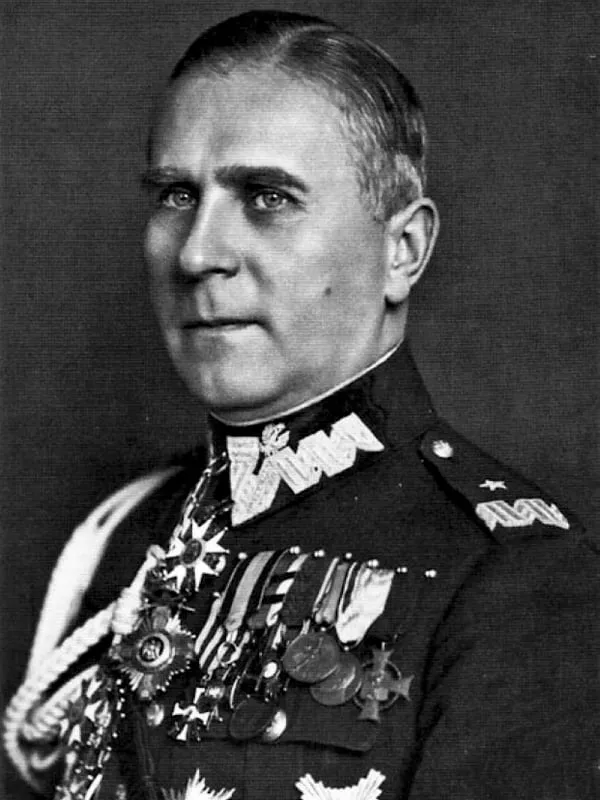
- Born:
- 15 April 1886, Kraków (Austria-Hungary)
- Died:
- 8 January 1947, London
- Author:
- Łukasz
- Photo:
- autor nieznany, domena publiczna, Wikimedia Commons

Tadeusz Kutrzeba was one of the best-educated and most highly regarded staff officers of the Second Polish Republic. A military engineer from the Austro-Hungarian army, in the Polish–Soviet War he was chief of staff of successive formations commanded by Edward Rydz-Śmigły, and for more than ten years he headed the Higher Military School, the forge of Poland’s staff-trained officers. In September 1939 he commanded the Poznań Army and was the architect of the only great Polish offensive operation of the campaign, the Battle of the Bzura. A few days after losing it he signed the capitulation of Warsaw. He spent the war in German captivity, and after it ended he began writing the history of the Polish September.
An officer of the imperial army
He was born on 15 April 1886 in Kraków (some sources give 1885), the son of Tomasz Kutrzeba, a captain in the Austro-Hungarian army, and Ludwika, née Szula. He chose his father’s path. He attended the military secondary schools at Fischau near Wiener Neustadt and at Hranice in Moravia, and took his school-leaving examination in Vienna in 1903. He then studied at the Technical Military Academy in Mödling, graduating top of his year in 1906. As a second lieutenant he chose to serve in a pioneer battalion in his native Kraków. From 1910 to 1913 he attended the higher engineering course in Vienna, and was then posted to the engineering directorate in Sarajevo, where he designed fortifications on the border with Montenegro. He was in the city in June 1914 when the assassination of Archduke Franz Ferdinand set off the chain of events leading to the Great War.
During the First World War he served on staffs, first on the Serbian front, then as a liaison officer with German commands in the Carpathians, on the Italian front in the Tyrol, in Transylvania and on the Romanian front, in Volhynia, and in 1918 at the base at Brăila on the Danube. In this way he came to know at first hand how command worked in the German and Austro-Hungarian armies, knowledge on which he drew for the rest of his life.
In the Polish–Soviet War
In November 1918 he reported to the Polish Liquidation Commission in Kraków, and on 29 November he was accepted into the Polish Army as a captain and posted to the General Staff, where he headed the plans section. In the autumn of 1919 he became chief of staff of the 1st Legions Infantry Division under Colonel Edward Rydz-Śmigły. He drew up the plan for the Daugavpils operation, in which in January 1920 the Poles, together with the Latvians, took Dyneburg (Daugavpils), and for this he received the Virtuti Militari. In the spring of 1920, as chief of staff of Rydz-Śmigły’s group and then of the 3rd Army (PL), he took part in the Kiev offensive, and during the retreat he was chief of staff of the South-Eastern Front.
In August 1920, during the Battle of Warsaw, he headed the staff of the Central Front (PL), and then of the 2nd Army, which in September and October fought in the Battle of the Niemen and pursued the Soviet forces towards Grodno and Lida. The Polish–Soviet War bound him to Rydz-Śmigły for many years. He later described its campaigns in books on the Battle of the Niemen (1926) and the Kiev offensive (1927).
Staff officer and teacher of officers
After the war he lectured on tactics at the General Staff School and worked on regulations, and from the end of 1921 he headed the operations department of the bureau of the Supreme War Council, which in Józef Piłsudski’s conception was to be the peacetime nucleus of the Commander-in-Chief’s staff. In 1922 he became a colonel. During the May Coup of 1926 he declared for the government but did not fight Piłsudski’s troops, and after the coup he kept his posts. In December 1926 he became deputy chief of the General Staff, and in 1927 a brigadier general.
On 9 October 1928, after the departure of the French lecturers, he took command of the Higher Military School in Warsaw, which he headed until 1939. He built up a Polish teaching staff there and trained most of the staff-qualified officers who held staff posts in September 1939. He wrote a great deal, especially in the monthly Bellona (PL). He believed that the next war would be a war of manoeuvre dominated by aircraft and armour, and he advocated mobile defence combined with counter-strokes. He proposed, without success, the creation of motorised anti-tank units as mobile reserves.
When after Piłsudski’s death Rydz-Śmigły became Inspector General of the Armed Forces, Kutrzeba’s standing rose. From November 1935 he was a general assigned to the Inspector General, responsible for operational studies concerning Greater Poland, and he analysed the Reich’s war potential. In 1936 he prepared a study of the war capabilities of Germany and Poland. At the turn of 1937 and 1938, under his direction, Lieutenant Colonel Stefan Mossor drew up the “Study of a Strategic Plan for Poland against Germany”, for years attributed to Kutrzeba himself as his memorandum. The study anticipated that in a war with Germany Poland would be unable to defend its whole territory and would have to hold out until its allies entered the fight.
The Poznań Army
In the spring of 1939, after the occupation of Bohemia and the German demands on Poland, Kutrzeba was made a major general with seniority from 19 March and an army inspector, and on 23 March commander of the Poznań Army, which was to defend Greater Poland. Its position in a westward-jutting “balcony” was dangerous, but the German plan directed the main thrusts against the neighbouring armies. In the first days of the September Campaign the Poznań Army saw almost no fighting. Kutrzeba proposed to the Commander-in-Chief a strike at the flank of the German 8th Army, which was attacking the Łódź Army, but Rydz-Śmigły refused and ordered a retreat towards Warsaw.
On 8 September, as the Germans reached the outskirts of the capital, Kutrzeba obtained permission to attack from the Commander-in-Chief’s chief of staff, General Wacław Stachiewicz. On 9 September the Poznań Army and the Pomorze Army, commanded by Major General Władysław Bortnowski, struck across the Bzura at the flank of General Johannes Blaskowitz’s 8th Army. So began the Battle of the Bzura, the largest battle of the campaign. For three days the Poles advanced southwards and smashed the German 30th Infantry Division, but the command of General Gerd von Rundstedt’s Army Group South brought panzer divisions from around Warsaw to the Bzura and closed the Polish armies in an encirclement. On 12 September Kutrzeba halted the attack and tried to break out eastwards. After the Pomorze Army’s failed attack near Łowicz on 14 September and a concentric German assault supported by massed air raids, both groupings were destroyed. Kutrzeba and his staff fought their way through the Kampinos Forest and reached Warsaw on 22 September.
The capitulation of Warsaw
In the besieged capital he became deputy to Major General Juliusz Rómmel, commander of the Warsaw Army, who directed the defence of the city. When the city ran out of water, electricity and ammunition, and air raids and shelling were killing thousands of civilians, Rómmel decided to open talks with the Germans and entrusted them to Kutrzeba. On the morning of 27 September Kutrzeba began negotiations with Blaskowitz, his opponent on the Bzura, and on 28 September at Rakowiec on the outskirts of Warsaw he signed the act of capitulation of the capital. The agreement granted the defenders honourable terms: officers went into captivity with the right to keep their sabres, while NCOs and men were to be released after a time.
Captivity and exile
After the capitulation he went into captivity. He was held in turn in the Oflags at Hohnstein and Königstein, from the autumn of 1940 in the generals’ camp at Johannisbrunn, and from April 1942 in Oflag VII A Murnau. At Murnau he organised secret courses preparing younger officers for study at the Higher Military School. After the Americans liberated the camp in 1945 he commanded the gathering of former Polish prisoners of war there.
In 1945 he came to London. He declined the post of Minister of National Defence in the Polish government-in-exile and became head of the Historical Commission for the September Campaign and the Polish Armed Forces in the West, set up in October 1945. He took part in founding the General Władysław Sikorski Institute in London. He considered returning to Poland, but cancer made it impossible. He died in London on 8 January 1947 and was buried with military honours in Brookwood Cemetery. In 1957, in accordance with his wishes, his ashes were brought to Poland and laid in the Avenue of the Meritorious at the Powązki Military Cemetery. He was posthumously awarded the Commander’s Cross of the Virtuti Militari.
Significance
Kutrzeba was a typical representative of the generation of officers who acquired their training in the armies of the partitioning powers and on that basis built the army of independent Poland. As a staff officer and teacher he was among the most outstanding in the Second Polish Republic. He understood the changes that tanks and aircraft had brought to warfare, although as commandant of a school he had no influence on rearmament. In September 1939 he proved to be one of the few Polish army commanders who kept the initiative and control over their troops. The Battle of the Bzura could not change the course of the campaign, but it held up the German attack on Warsaw for several days and gave the capital’s defenders time.
To the end of his life he was convinced that had the Commander-in-Chief agreed to his attack a few days earlier, the outcome might have been different. His critics, for their part, faulted him for pressing the attack southwards for too long instead of breaking through to Warsaw at once. He set out his own version in works written in captivity and in exile, among them Wojna bez walnej bitwy (War Without a Decisive Battle) and the study Bitwa nad Bzurą (9–22 września 1939 r.) (The Battle of the Bzura, 9–22 September 1939), published in Warsaw in 1958. In communist Poland his memory was restored relatively early: his ashes were brought home in 1957, and in 1961 a street in Warsaw was named after him. Since 2020 his statue has stood in front of the War Studies University, the successor to the school he headed.
Sources
Commanded in battles
(02)Mentioned in battles
(01)Often appears with
People who appear in the same events.