Germany
Fedor von Bock
Commander of Army Group North (1939), B (1939–1941 and 1942), Centre (1941) and South (1942), field marshal (1940)
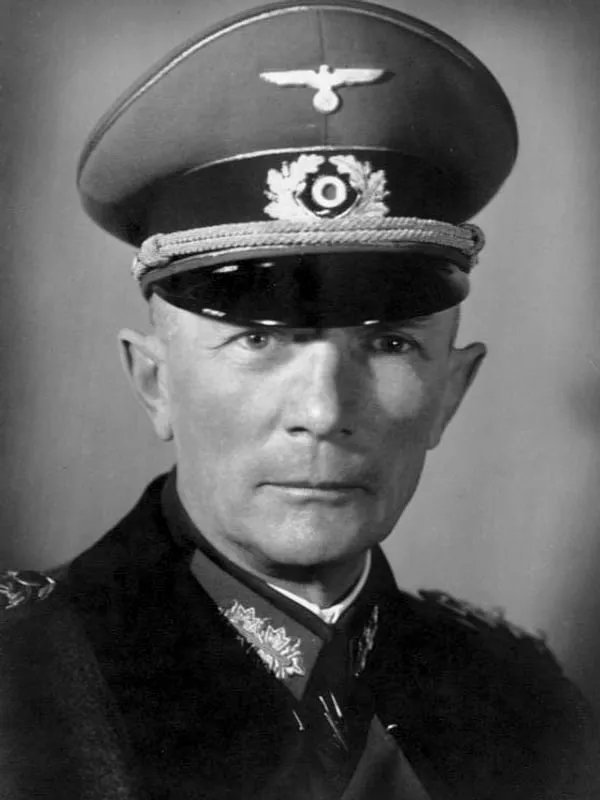
- Born:
- 3 December 1880, Küstrin, now Kostrzyn nad Odrą (Brandenburg, German Empire)
- Died:
- 4 May 1945, Oldenburg in Holstein
- Author:
- Natalia
- Photo:
- autor nieznany, CC BY-SA 3.0 DE, Wikimedia Commons

Fedor von Bock was one of the three great army group commanders with whom Hitler fought his first campaigns. In September 1939 his Army Group North cut across the Polish Corridor, joined the Reich to East Prussia and struck at Warsaw from the north. In May 1940 his troops overran the Netherlands and Belgium, and in the summer of 1941 Army Group Centre under his command inflicted defeats on the Red Army at Białystok, Minsk, Smolensk and Vyazma and reached the approaches to Moscow. There his career collapsed. An old-school Prussian officer and a monarchist who disliked the Nazis but never stood up to Hitler, he was a textbook example of the general for whom obedience and professional competence counted for more than the question of what they served. He was killed in the last days of the war, the only German field marshal to die as a result of enemy action.
Origins and early life
He was born on 3 December 1880 in the fortress of Küstrin on the Oder, now Kostrzyn nad Odrą, into a family with strong military traditions. His father, Moritz von Bock, was a Prussian general ennobled for his services in the Franco-Prussian War. His mother, Olga, née von Falkenhayn, was the sister of Erich von Falkenhayn, later Chief of the General Staff in the first years of the First World War. Bock followed the typical path of a son of a Prussian officer family: the cadet schools at Potsdam and Groß-Lichterfelde near Berlin, then, in 1898, a posting to the 5th Foot Guards Regiment in Spandau. He had a reputation as a stern, ambitious officer utterly devoted to the service. To the cadets at his old school he would repeat that the greatest glory for a soldier was to die for the fatherland. In 1905 he married Mally von Reichenbach, who died in 1910, leaving him a daughter. In 1910 he was sent for staff training, and in 1912, as a captain, he joined the Great General Staff.
The First World War
He began the war as a staff officer with the Guards Corps on the Western Front. In May 1915 he was transferred to the staff of the 11th Army on the Eastern Front, with which he took part in the breakthrough at Gorlice, and in 1916 to the 200th Infantry Division, which fought in the Carpathians and helped repel the Brusilov Offensive. From 1917 he served on the staff of the Army Group of the Crown Prince in France. On 1 April 1918, for his staff work on the German Spring Offensive, he was awarded the Pour le Mérite, Prussia’s highest decoration for bravery. For a monarchist like him, Germany’s defeat and the Kaiser’s abdication were a personal blow.
In the Reichswehr
After the war Bock remained in the Reichswehr, the 100,000-man army to which the Treaty of Versailles had reduced the German forces. As chief of staff of the 3rd Division in Berlin, in the early 1920s he ran, on the orders of General Hans von Seeckt, the so-called Black Reichswehr – illegal volunteer units concealed as “labour commandos” attached to army units, intended to circumvent the Versailles limits. Major Bruno Buchrucker organised them on his behalf. Within these units, supposed “traitors” were secretly murdered, and at trials in the 1920s it was alleged that the orders had come from officers in Bock’s circle. Bock himself denied in court that the ministry had known anything. When on 1 October 1923 Buchrucker, against Bock’s express opposition, attempted a putsch in Küstrin, the Reichswehr crushed it within a few hours and Seeckt disbanded the Black Reichswehr. Earlier, in March 1920, Bock had not supported the Kapp Putsch.
In the years that followed he was promoted steadily: in 1924 he took over a battalion, in 1926 an infantry regiment in Kolberg (Kołobrzeg), in 1929, as a Generalmajor, a cavalry division in Frankfurt an der Oder, and in 1931, as a Generalleutnant, the 2nd Division and the military district in Stettin (Szczecin).
Hitler’s general
Bock greeted Adolf Hitler’s rise to power with reserve but without opposition. He was not a party member and was regarded as a monarchist indifferent to Nazi ideology, but the expansion of the army opened his way to the top. On 1 March 1935, in the very days when Germany was openly breaking with the disarmament provisions of Versailles, he became a General of Infantry and commander of Army Group 3 in Dresden. In 1936 he married for the second time, Wilhelmine von der Osten, née von Boddien. In the spring of 1938, during the Anschluss of Austria, he commanded the 8th Army, formed from his staff, which entered Austria on 12 March. He then ordered that martial law be applied ruthlessly against any resistance by the population, even passive resistance. He was promoted to Colonel General, and in November 1938 he took over Army Group 1 in Berlin, the most important command in the east of the Reich.
The September Campaign
In the spring and summer of 1939 Bock’s staff prepared the northern part of Case White. On 26 August his command was converted into Army Group North. It had two armies: the 4th Army of General Günther von Kluge in Western Pomerania and the 3rd Army of General Georg von Küchler in East Prussia, some 630,000 men in all. On 1 September, when Germany invaded Poland, the 4th Army struck at the Polish Corridor, while the 3rd Army advanced from East Prussia towards Mława and on to Warsaw. After a few days of fighting in the Tuchola Forest the link between the Reich and East Prussia was an accomplished fact, and the Pomorze Army had to fall back to the south. Bock then moved Heinz Guderian’s panzer corps to East Prussia, from where it drove through Wizna towards Brest, deep into the rear of the Polish defence. The troops of Army Group North took part in the siege of Warsaw, and on 29 September the Modlin fortress capitulated to them. On 30 September Bock was awarded the Knight’s Cross of the Iron Cross for the September Campaign.
The campaign also had a dark side, for which Bock as commander bore responsibility. On 10 September he ordered that villages from which shots had been fired at German soldiers should be burned if the house from which the shooting came could not be identified. German historians, among them Jochen Böhler, have shown that such orders, combined with an obsessive fear of “partisans”, led to mass executions of civilians and the burning of entire villages by the Wehrmacht. In his diary Bock made no secret of his unease at what was happening behind the front. In November 1939 he noted that if the “colonisation” of occupied Poland continued by such methods, those methods would one day turn against the Germans. It went no further than a diary entry.
The Netherlands, Belgium and France
Even before the fighting in Poland was over, Bock moved his headquarters to the west, where in October 1939 he formed Army Group B. Like other senior commanders, he believed that an autumn offensive against France would end in disaster and said so openly, which had no effect on Hitler’s decisions. On 10 May 1940 his 18th and 6th Armies attacked the Netherlands and Belgium. The attack was meant to persuade the Allies that this was where the main blow was falling and to draw their best armies north while Gerd von Rundstedt broke through the Ardennes. The plan worked. The Netherlands capitulated on 15 May and Belgium on 28 May, and on 14 June Bock’s troops entered Paris. Bock took the salute at a parade by the Arc de Triomphe and was present at the signing of the armistice at Compiègne on 22 June, in the same railway carriage in which Germany had signed the armistice ending the First World War in 1918. On 19 July 1940 Hitler made him a field marshal, together with eleven other generals. On his sixtieth birthday in December 1940 he received a large cash gift from Hitler, and like the other field marshals he also drew monthly tax-free supplements from a secret fund – part of the system by which the dictator bound the generals to himself.
The drive on Moscow
For Operation Barbarossa Bock commanded the largest of the three army groups, Army Group Centre, with the two panzer groups of Hermann Hoth and Guderian. As early as February 1941 he asked Hitler whether defeating the Red Army would be enough to force the USSR to make peace. When the Commissar Order was issued in May, requiring the shooting of captured Red Army political commissars, Bock, urged on by his staff officers Henning von Tresckow and Rudolf-Christoph von Gersdorff, lodged a verbal objection with the Army High Command. When this achieved nothing, he is said to have told his officers: “Gentlemen, I put it on record: Field Marshal von Bock has protested.” The order was carried out in his army group as well.
On 22 June 1941 Bock’s troops crossed the Bug. In the first weeks they trapped hundreds of thousands of Soviet soldiers in pockets at Białystok and Minsk, and then at Smolensk. Bock wanted to drive straight for Moscow, but in August Hitler diverted part of his forces towards Kiev. The offensive against Moscow, codenamed Typhoon, began only on 30 September–2 October. The double encirclement at Vyazma and Bryansk brought the Germans several hundred thousand prisoners, but then came the autumn mud, frost and stiffening resistance. By early December the leading units stood a few dozen kilometres from the Kremlin, exhausted and without winter equipment. On 5–6 December the Red Army went over to the counter-offensive and drove them back from the city. Meanwhile, in the rear of Army Group Centre, Einsatzgruppe B was murdering tens of thousands of Jews, and millions of Soviet prisoners of war were dying of hunger and disease in Wehrmacht camps. According to some historians Bock was one of the few commanders who spoke up about the fate of the prisoners, but he did little to improve it in his own area. On 19 December, at the same time as the Commander-in-Chief of the Army, Walther von Brauchitsch, Hitler relieved him of his command, officially on grounds of ill health.
Last command and dismissal
As early as January 1942, after the sudden death of Field Marshal Walter von Reichenau, Bock took over Army Group South. In May he repulsed a Soviet offensive at Kharkiv and turned it into the encirclement of several hundred thousand Red Army soldiers. In June he led the first phase of the summer offensive towards the Don and Voronezh. When Hitler split his forces into two army groups, and Bock wanted first to destroy the Soviet forces at Voronezh rather than immediately chase them eastwards, the dictator lost patience. In mid-July 1942 Bock was dismissed and transferred to the reserve. The troops he had commanded went on, to Stalingrad and the Caucasus.
He received no further command for the rest of the war and lived in seclusion on his estate. Tresckow, who was married to his cousin, repeatedly tried to win him over to the conspirators, without success. Bock condemned the 20 July plot of 1944 as a crime. After Hitler’s suicide he offered his services to the government of Admiral Karl Dönitz. On 3 May 1945 his car, heading towards Hamburg, was strafed by a British aircraft near Lensahn in Holstein. His wife, stepdaughter and driver were killed. Bock, gravely wounded, died the next day, 4 May 1945, in the naval hospital at Oldenburg in Holstein.
Significance
Fedor von Bock was one of the Wehrmacht’s most operationally gifted commanders and one of the architects of the victories of 1939–1941. In Poland his army group cut off Pomerania and closed the ring around Warsaw from the north; in France it acted as the bait that made the breakthrough in the Ardennes possible; and in the USSR it advanced further east than any other. At Moscow, however, the era of easy victories came to an end, and his dismissal was part of the purge in which Hitler took personal command of the army. Bock represented an officer corps that accepted Hitler because he gave the army money, equipment and war. His diary shows a man who saw the crimes being committed in Poland and the USSR, sometimes criticised them, but never went further than diary entries and verbal protests. He did not live to face a trial in which he would have had to answer for them.
Sources
Commanded in battles
(10)- 1 September – 6 October 1939Invasion of PolandPoland
- 10–28 May 1940Belgian CampaignWestern Front
- 10 May – 25 June 1940Battle of FranceWestern Front
- 26 May – 4 June 1940Battle of DunkirkWestern Front
- 22 June – 9 July 1941Battle of Białystok–MinskEastern Front
- 22 June – 5 December 1941Operation BarbarossaEastern Front
- 10 July – 10 September 1941Battle of Smolensk (1941)Eastern Front
- 30 September 1941 – 7 January 1942Battle of MoscowEastern Front
- 12–28 May 1942Second Battle of KharkovEastern Front
- 28 June – 18 November 1942Case BlueEastern Front
Mentioned in battles
(07)Often appears with
People who appear in the same events.
On the timeline
(39)1938
1939
1940
January
February
May
- 10
- Key eventGermany attacks in the WestOn 10 May 1940 the Wehrmacht struck the Netherlands, Belgium and Luxembourg. The Allies advanced into Belgium as Kleist's tanks entered the Ardennes.
- The Battle for The HagueOn 10 May 1940 German airborne troops landed near The Hague to seize the Dutch Queen and government. By nightfall the Dutch had retaken three airfields.